
What a 4/12 Roof Pitch Means for Design, Performance, and Material Choice

A 4/12 roof pitch is one of those building terms that sounds technical until you translate it into plain language. Once you do, it becomes much easier to judge whether the roof suits the house, the climate, and the materials you want to use.
In simple terms, a 4/12 pitch means the roof rises 4 inches for every 12 inches of horizontal run. That ratio is the key to understanding how steep the roof is, how it sheds water, how it looks from the street, and how much usable space it creates under the framing.
For homeowners and design professionals alike, 4/12 is a practical, moderate pitch. It is steeper than a low-slope roof, but not so steep that it becomes visually dominant or difficult to maintain. That makes it a common fit for projects that need a straightforward compromise between appearance and performance.
What a 4/12 Roof Pitch Means
Roof pitch is usually written as rise over run. In a 4/12 roof, the roof rises 4 inches vertically for every 12 inches horizontally. You may also see it written as 4:12 or “4 in 12.”
That notation matters because it tells you far more than a vague label like “medium slope.” It gives a measurable geometry that can be compared across roof types, materials, and design options.
A quick way to visualize it: if you drew a 12-inch horizontal line and then lifted one end by 4 inches, that is the slope you are dealing with. It is noticeable, but it is not dramatic. On a house, it usually reads as a restrained, familiar residential roof rather than a sharp, high-pitched one.
What a sawtooth roof is and where it fits can help if you are comparing roof geometry for style, but 4/12 is much more conventional and broadly usable.
How Steep Is a 4/12 Roof in Degrees and Percent Slope?
A 4/12 pitch converts to about 18.4 degrees. That is an approximate conversion, which is useful to remember when comparing drawings or specifications that may round the angle slightly differently.
As a percentage, 4/12 is about 33.3% grade. This percentage is based on rise divided by run, so it is another way of expressing the same geometry in a format often used on technical drawings, site plans, and drainage references.
What it looks like in real life
From the ground, a 4/12 roof can appear moderate and familiar, though the exact impression depends on the building height, roof shape, and viewing distance. It has enough slope to avoid the “nearly flat” appearance of very low-slope roofs, but it does not create the pronounced triangular profile of 8/12 or steeper roofs.
That makes it a good fit when the design needs a roofline that supports the architecture without taking over the composition. It works especially well on simple gable and hip roofs where the roof shape is meant to complement the house rather than dominate it.
Where 4/12 Sits on the Roof Pitch Spectrum
The easiest way to judge 4/12 is to compare it with nearby common pitches.
| Pitch | Approx. degrees | General feel | Drainage | Walkability | Attic space | Material flexibility |
|---|---|---|---|---|---|---|
| 3/12 | 14.0° | Low to moderate | Slower than 4/12 | Slightly easier than steeper roofs | Limited | More material-specific caution |
| 4/12 | 18.4° | Moderate | Good for typical runoff | Still requires caution | Moderate | Broadly compatible with many common systems |
| 6/12 | 26.6° | Clearly pitched | Better shedding | Harder to work on | More volume | Very common residential choice |
| 8/12 | 33.7° | Steep residential | Fast shedding | Much less walkable | More volume | Often strong visually, but more demanding |
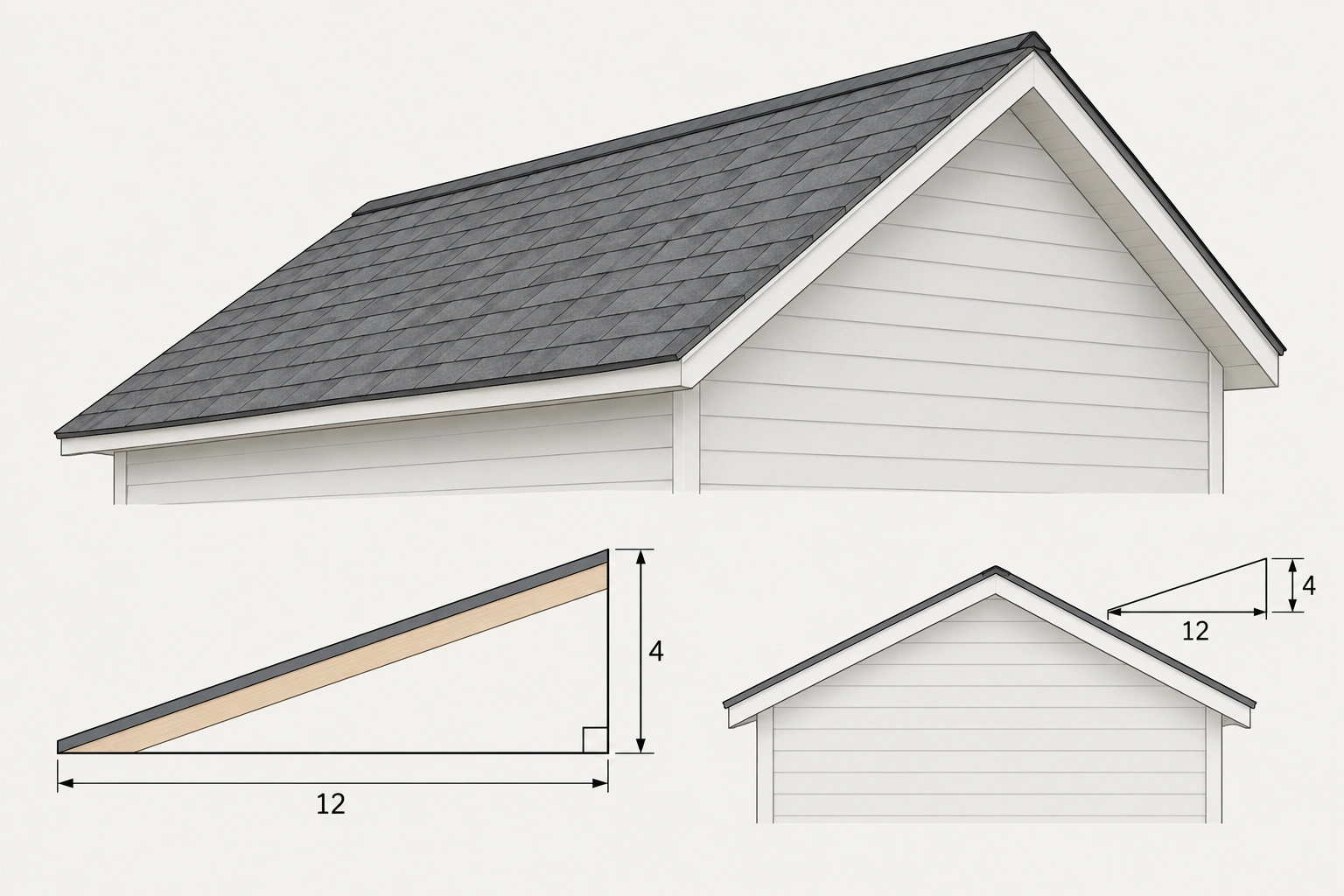
The important takeaway is not just that 4/12 is “in the middle.” It is that the roof is steep enough to perform better than flatter forms in everyday drainage, while still being easier to frame, cover, and access than steeper traditional roofs.
That position can be useful, but it is not automatically the right answer. In heavy-snow regions, for example, a steeper roof may shed snow more aggressively. In very low-profile modern designs, 4/12 may still look too pitched unless the whole composition is adjusted around it.
Practical Performance: Drainage, Rain, Snow, and Wind
Rain and water shedding
A 4/12 roof generally sheds rain well because gravity does most of the work once water reaches the surface. It is not a flat roof, so it avoids the standing-water concerns that come with very low slopes.
That said, drainage performance is not just about pitch. Valleys, flashing, gutters, roof penetrations, and underlayment details all matter. A well-detailed 4/12 roof can perform better than a poorly detailed steeper roof.
Snow and ice
In colder climates, pitch affects how readily snow slides off and how long it lingers. A 4/12 roof will shed snow more readily than a 3/12 roof, but it is still moderate enough that snow can remain on the surface after storms, especially if the roof is shaded or the attic is warm.
That means ice dam risk is still a design issue. If the building is in a snow-prone region, the roof assembly, insulation, ventilation, and eave detailing matter as much as the pitch itself.
Wind exposure
Pitch can influence wind behavior, but roof shape, fastening, and site exposure usually matter more than pitch alone. A 4/12 roof is not so steep that it creates the same profile as a high-pitched roof, which can be helpful from a design and maintenance standpoint. Still, no one should assume it is automatically “wind-safe.” The actual performance depends on the roof system, not the pitch alone.
Roofing Materials That Work Well on a 4/12 Pitch
A 4/12 roof is generally compatible with many common residential roofing materials, but the phrase “compatible” should always be checked against the manufacturer’s installation instructions. If a product lists a minimum slope, that minimum overrides any general assumption that the material works on 4/12.
Asphalt shingles
Asphalt shingles are commonly used on 4/12 roofs. That is one reason this pitch is so familiar in residential work. The slope is comfortably above the threshold where water shedding becomes a bigger concern for many standard shingle applications, but installation details still matter.
For lower-slope applications, manufacturers often require special underlayment or specific installation methods. Even at 4/12, it is worth checking the product instructions rather than assuming every shingle line performs the same way.
Metal roofing
Metal roofing also works well on 4/12 in many cases, especially when the system is designed for the pitch and installed according to the manufacturer’s specs. Metal can be a smart choice when the design calls for clean lines, durable water shedding, and a lighter visual profile.
Tile and other specialty materials
Some tile systems can work at 4/12, but tile is less forgiving when slope, underlayment, and flashing details are not coordinated. At this pitch, the system choice matters more than the material label. The same is true for other specialty products: the pitch alone does not guarantee suitability, and the manufacturer’s minimum slope requirements still control.
For technical slope guidance, the National Roofing Contractors Association is a useful place to look for industry context, while product-specific installation manuals should always have the final say.
Framing, Code, and Manufacturer Considerations
A 4/12 roof does not usually create unusual framing problems in standard residential work. In that sense, it is a familiar and manageable pitch for builders.
But “manageable” is not the same as “automatic.” The framing system still has to match the design intent, and the structure still has to be checked against local code requirements and the chosen roofing product’s installation limits.
Why manufacturer instructions matter
Roofing systems are not interchangeable. A product that performs well on 4/12 in one assembly may not be approved in another if the underlayment, fastening pattern, or flashing details differ. This is especially true where warranties are concerned.
If a product lists a minimum slope, that minimum is not a suggestion. It is part of the system the manufacturer expects you to build.
Code and design coordination
Building code requirements vary by location, snow load, fire conditions, and roof assembly. For that reason, it is better to treat 4/12 as a starting point for coordination, not a final approval.
If you are working from a code-based design package, the International Code Council is the right place to verify the governing framework, then confirm the local adoption and the product-specific requirements.
Walkability, Safety, and Maintenance Access
A 4/12 roof is often described as accessible, but that should not be confused with safe to walk on casually.
From a maintenance standpoint, it is easier to move on than a steeper roof, which helps with inspections, minor repairs, and gutter work. That said, the roof can still be hazardous when wet, icy, dusty, or covered in debris.
The practical rule is simple: if the work is routine and the surface is dry, 4/12 may be manageable with proper precautions. If the roof is wet, frosty, or high above grade, treat it as a fall-risk surface and use the access and protection methods the job calls for.
This is one reason 4/12 is often favored on homes where owners want a roof that is not excessively difficult to inspect over time. It is more forgiving than a steep roof, but it is not a no-risk surface.
How a 4/12 Pitch Affects Attic Space and Interior Design
Pitch influences the volume under the roof, which affects storage, mechanical placement, and ceiling shape.
A 4/12 roof provides some attic volume, but not as much as a 6/12 or 8/12 roof. That means you can usually gain more space than you would under a very low-slope roof, yet you still may not get enough headroom for a fully usable upper level unless the design is intentionally planned that way.
What this means for interiors
If the goal is a vaulted ceiling or a more open upper floor, a 4/12 roof can support that look without becoming visually overpowering from the exterior. If the goal is maximum attic storage, a steeper pitch may be more efficient.
For renovations, this is often a trade-off between exterior restraint and interior volume. A moderate pitch can improve the inside experience, but not enough to replace a full attic conversion strategy on its own.
Interactive roof design tools can be useful when you want to test how pitch changes the interior profile before committing to a build.
Design Aesthetics and Common Building Types
A 4/12 roof tends to look balanced and familiar. It suits many conventional suburban homes, ranch-style variations, and modestly scaled custom houses where the roof should support the architecture rather than become the main event.
It is also a practical choice for designs that need a restrained profile. A roof that is too steep can make a home feel taller and more traditional than intended. A roof that is too flat can feel too commercial, too minimal, or too vulnerable to drainage issues depending on the context.
Where it works best
4/12 often fits:
– simple gable forms
– hip roofs with a clean, low-key profile
– homes that need a moderate attic volume
– projects balancing curb appeal and straightforward construction
It is less compelling when the design language calls for a very low modern roofline or a strongly pitched vernacular form. In those cases, the pitch should reinforce the style, not just satisfy a technical minimum.
Pros and Cons of a 4/12 Roof Pitch
Advantages
- Moderate slope that handles ordinary drainage well
- Broad compatibility with many common residential materials
- Easier to maintain than steeper roofs
- Often visually balanced on typical homes
- Can provide some attic volume without a tall exterior profile
Trade-offs
- Not as fast at snow shedding as steeper roofs
- Still requires fall protection and caution during maintenance
- May not create enough interior volume for some attic conversions
- Material compatibility still depends on manufacturer instructions
- Can be too pitched for some low-profile architectural styles
The main value of 4/12 is practicality. The downside of a practical roof pitch is that it may not be ideal if your project has a strong single priority, such as maximum snow shedding or a very flat modern appearance.
When a 4/12 Roof Pitch Is a Good Choice
A 4/12 roof pitch makes sense when you want a roof that is practical, familiar, and visually moderate. It is especially useful when the project needs good everyday drainage, compatibility with common residential materials, and a roofline that does not overwhelm the house.
It is often a strong candidate when:
– the home is in a moderate climate
– the design calls for a traditional residential look
– the budget favors standard framing and common roofing systems
– you want some attic volume without committing to a steep roof
– the roof must remain reasonably accessible for inspection and maintenance
It is less compelling when the site has severe snow conditions, the architecture demands an ultra-low profile, or the selected roofing system has stricter slope requirements than the design can comfortably meet.
If you are deciding whether 4/12 is right for a new build or renovation, the best question is not “Is it a good roof pitch?” It is “Does this pitch support the climate, the material, and the building form I actually want?” When those three line up, 4/12 is often a very efficient answer.
FAQ
Is 4/12 considered low-slope?
No. It is generally treated as a moderate or medium-slope roof, not a low-slope roof.
Can you walk on a 4/12 roof?
Sometimes, but it still requires caution. Wet, icy, dusty, or high roofs can be hazardous even at this pitch.
Is 4/12 good for asphalt shingles?
Often yes, but you still need to follow the shingle manufacturer’s installation requirements and any local code provisions.
Does 4/12 create much attic space?
It creates some, but not as much as steeper roofs like 6/12 or 8/12.
Is 4/12 a common residential roof pitch?
Yes, it is a familiar and widely used residential pitch because it balances appearance, drainage, and construction practicality.