
How to Spot Roof Structural Problems From Inside the Attic

A roof rarely fails all at once. More often, the attic gives away the story first: a little daylight at a joint, a soft stain around a penetration, a rafter that doesn’t quite line up the way it used to. For homeowners, architects, and builders, the attic is one of the best places to separate a minor maintenance issue from a roof structure that may be losing capacity.
The key is to read the attic like a system, not a single defect. A stain by itself may point to a leak or old condensation. A bowed member by itself may be old framing. But when sagging, cracking, moisture, and separation appear together, the probability of structural trouble rises quickly.
This guide explains what to look for, what can be normal, what should trigger concern, and when to stop the DIY inspection and bring in a roofer, building inspector, or structural engineer.
How to inspect the attic safely before looking for damage
Before diagnosing roof problems, make sure the attic is safe enough to enter.
Use a flashlight, gloves, eye protection, and a dust mask if the space is dirty or moldy. Enter only if there is a stable access point and enough headroom to move carefully. In many attics, the safest path is along framing members designed to carry limited foot traffic, not on drywall or loose insulation. If you cannot clearly identify where to step, do not guess.
A practical rule: if the attic feels unstable, visibly sags, has active dripping, or shows major damage at the framing, stop and leave. That is not the moment to “check one more thing.” It is the moment to call a professional.
Inspect in daylight if possible. That makes it easier to spot openings, stains, and uneven framing. GAF notes that a roof inspection can begin inside the attic by looking for leaks, dark spots, holes, or sagging sheathing, and that ceilings should also be checked for stains, mold, or mildew. GAF roof damage guide
The order that works best
- Look for obvious signs of distress from the access opening.
- Scan the underside of the roof deck for stains, daylight, or sagging.
- Check framing members for cracks, bowing, splits, or displacement.
- Look at connections, fasteners, and metal hardware.
- Note moisture, odors, rust, or mold.
- Only then try to interpret whether the issue is structural, moisture-related, or both.
That order matters because moisture can hide structural movement, and insulation can hide the framing you need to evaluate.
What counts as normal attic conditions versus a roof problem
Not every irregularity means the roof structure is failing.
Older homes often have framing that is not perfectly straight. Small variations in rafter alignment, slight waviness in sheathing, or a modest ridge irregularity can exist without active damage. A little unevenness can be part of the age and construction of the roof, especially in homes built before modern truss systems became common.
The more important question is whether the condition appears stable or progressive.
A stable, long-standing irregularity tends to look consistent across seasons. A structural problem often looks worse in one area, affects multiple members, or shows signs of movement such as fresh splits, growing gaps, or new staining. If you can see that the roof line sags more in one bay than the next, or that a member is no longer aligned with its neighbors, that deserves a closer look.
Here is the practical distinction:
- Normal settling: slight irregularity, no fresh cracking, no obvious displacement, no associated moisture damage.
- Concerning condition: visible sagging, bowed members, cracked connections, or signs the condition is changing.
- High-risk condition: sagging plus cracking, separation, rot, or active water intrusion.
A useful rule of thumb: if the bowing is slight, long-standing, and looks consistent across similar framing members, it is more likely to be normal aging or settling. If the sag is obvious from the attic floor, localized to one area, or seems to be getting worse, treat it as urgent and get a professional to review it.
The most important attic warning signs of roof structural trouble
Some attic clues matter more than others because they point to load-bearing movement, not just surface damage.
Sagging sheathing or roof deck
The roof deck should generally read as a continuous plane from inside the attic. If the underside of the sheathing dips, waves, or forms a noticeable low spot, that can indicate deflection in the structure above or deterioration of the deck itself.
A small amount of unevenness is not automatically an emergency. But if the low spot is localized, worsening, or paired with moisture damage, the concern increases. Sagging near the ridge, around a valley, or at a long unsupported span is especially worth noting.
Bowed, split, cracked, or displaced rafters and trusses
Framing members should carry load in a predictable line. A rafter that bows more than its neighbors, a truss chord that looks cracked, or a web member that has shifted out of plane may indicate overload, moisture damage, or connection failure.
Trusses deserve special attention because they rely on the geometry of the whole assembly. A damaged truss member or a separated connector plate can affect the load path in a way that is more serious than a simple cosmetic crack. Home inspectors and roofing contractors commonly look for cracked or sagging rafters and trusses during attic walkthroughs. Home Genius Exteriors attic inspection overview
Daylight at joints or through roof boards
If you can see light through a joint, gap, or opening in the roof deck, treat it as a defect worth documenting. In many cases, daylight means there is a path for water as well, especially during wind-driven rain. That does not prove structural failure by itself, but it does show that the roof assembly is no longer tightly closed at that point. Signs of roof damage during visual inspections
Uneven roof lines that match attic movement
An attic clue becomes more meaningful when it lines up with what the structure above is doing. If one side of the roof deck sags, one rafter bay looks distorted, and the exterior roof line also appears depressed, the attic evidence is no longer isolated. It is part of a pattern.
How to interpret sagging, bowing, and deflection in the framing
Sagging is not just “the roof looks old.” In structural terms, it means the framing or deck is carrying load in a way that changes its shape.
A little deflection can be expected in any spanning member under load. The question is whether the movement is modest and predictable or excessive and localized. In a rafter roof, gradual deflection may develop over time from age, moisture, or long-term load. In a truss roof, visible distortion can be more alarming because the truss is engineered as a system; one compromised member can affect the whole unit.
That difference matters when you decide whom to call:
- Rafter roofs sometimes show gradual, long-term bending or settlement.
- Truss roofs can fail more abruptly when a chord, web, or connector is compromised.
If the sag is new, uneven, or visibly increasing, assume it is active until a professional says otherwise. If the bowing is slight but consistent across the whole roof and has clearly been there for years, it may be a stable condition — but it still deserves documentation.
A useful decision rule: if you can look at one member and say, “that one is clearly different from the rest,” treat it as a warning sign. If the dip is subtle and the framing still looks aligned with neighboring members, it is more likely to be normal settling than urgent structural sagging.
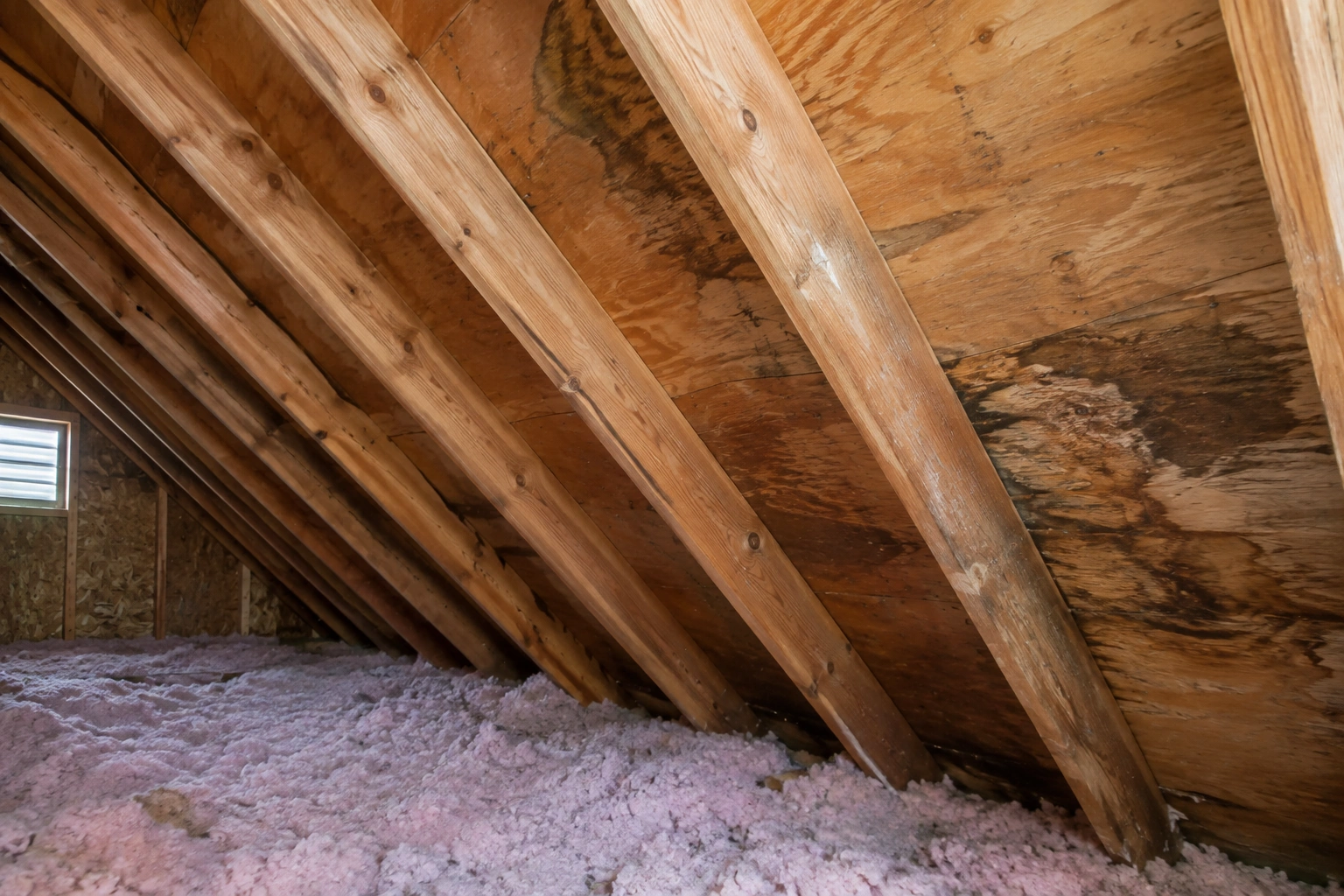
What water staining, rot, and mold can tell you about structural risk
Moisture does not automatically mean structural failure, but it often starts the process.
Inside the attic, look for:
- dark spots on the roof deck,
- damp or compressed insulation,
- discoloration around penetrations,
- soft or punky wood,
- visible rot,
- mold or mildew,
- a musty odor,
- rust on metal fasteners or connectors.
These signs often point to a leak or condensation problem. The National Roofing Contractors Association’s inspection guidance notes that attic inspections may include looking for water stains on the underside of the roof deck, damp insulation, or signs of mold and rot. NRCIA roof inspection guide
A stain alone does not prove the roof is actively failing. It may reflect a past leak that has already dried out, or moisture from condensation that is no longer ongoing. The structural concern rises when the staining is paired with soft wood, sagging, cracking, or separation. That combination suggests the moisture has moved beyond a cosmetic mark and may be affecting the framing or sheathing.
How to read the pattern
- Single, localized stain near a vent or flashing: often a leak path, not immediate structural failure.
- Widespread staining with soft wood: higher risk of material breakdown.
- Staining plus sagging or cracking: treat as structural until proven otherwise.
Condensation can complicate this. Poor attic ventilation may create moisture that looks like a leak, and trapped condensation can slowly rot structural wood. Either way, the source of the moisture still needs to be corrected. How attic moisture affects roof repairs
Fastener failure, joint separation, and nail pops: when small gaps matter
Not every gap is dangerous, but some gaps reveal that the structure is moving.
Look closely at:
- ridge connections,
- truss plates,
- rafter-to-ridge joints,
- collar tie connections,
- ceiling joist intersections,
- nail pops or fasteners backing out,
- split wood around a connection.
A single popped nail in old framing may be minor. A cluster of popped fasteners near a joint, especially with visible separation, suggests the assembly may be shifting under load or moisture stress.
Joint separation is especially important when the gap is new or uneven. A narrow, stable gap in old framing is less concerning than a joint that looks forced apart. If a connector plate has shifted, or if a truss joint no longer sits flush, that is no longer a cosmetic issue.
The practical test is simple: does the connection still look like it is carrying load cleanly? If not, it needs professional review.
Signs the attic is overloaded by snow, storage, or equipment
Sometimes the problem is not a leak first. It is too much load.
Stored boxes, heavy items, or equipment placed where the attic was never intended to carry them can push ceiling joists or framing beyond what they were designed to handle. Snow load can do the same from above, especially if there is already weakness in the structure.
Watch for:
- ceiling joists that look bowed or compressed,
- sagging between supports,
- truss members that appear strained,
- cracking at joints after a load event,
- fresh deflection following heavy snow or new storage.
If the attic contains stored items and the framing looks stressed, remove the load immediately. That is one of the few actions a homeowner can take right away that may reduce further movement while waiting for a professional.
Do not assume the roof will “bounce back” once the load is removed. If the framing has already been damaged, the deformation may remain.
How insulation and ventilation problems can mimic structural damage
This is where many attic inspections go wrong.
Insulation can hide framing members, making the attic look more irregular than it is. Loose-fill insulation can obscure the bottom of the roof deck, and compressed insulation can make a localized issue look larger than it is.
Ventilation problems create another layer of confusion. Condensation can leave darkening, rust, or mold in areas that are not directly under a roof leak. That means not every stain is proof of roof covering failure. But it also means moisture should not be dismissed just because the shingles look fine from outside.
A useful comparison:
- Leak-related damage often tracks with a specific entry point, such as a vent, chimney, valley, or penetration.
- Condensation-related damage often appears more diffuse and may be worse in poorly ventilated areas.
In both cases, moisture can eventually weaken wood. So the diagnostic question is not whether moisture matters. It is where it is coming from and whether it has already affected the framing.
When attic findings mean you should call a roofer, structural engineer, or inspector
This is the decision point that saves time and reduces risk.
Call a roofer when:
- you see staining, daylight, or damp insulation that suggests a roof leak,
- the damage appears tied to flashing, penetrations, or roof covering defects,
- the framing looks intact but the roof envelope is letting moisture in.
Call a structural engineer when:
- there is noticeable sagging,
- a rafter, truss, or truss connector appears cracked or displaced,
- joints are separating in a load-bearing area,
- you are unsure whether the framing is compromised,
- the roof has a visible change in shape after snow, impact, or prolonged leakage.
Call a building inspector when:
- you want a broader condition assessment,
- you need a neutral evaluation before deciding on repairs,
- the issue may involve both roofing and structural concerns.
If the attic shows active dripping, major sagging, or signs of imminent collapse, do not keep inspecting. Leave the area and call for help.
For homeowners who want a broader sense of roof risk, the U.S. Department of Energy’s guidance on attics and ventilation is a useful reference point for how attic conditions affect performance and moisture behavior. DOE attic and ventilation basics
A practical attic inspection checklist and next steps
Use this as a quick field checklist:
- Confirm the attic is safe to enter.
- Look for daylight, stains, damp insulation, rust, mold, or musty odor.
- Check rafters, trusses, ridge areas, and ceiling joists for bowing or cracking.
- Note any separation at joints or connector plates.
- Look for localized sagging in the roof deck.
- Identify whether moisture looks like a leak or condensation pattern.
- Remove stored loads if the framing appears stressed.
- Photograph what you find from the same angle for comparison later.
- If the issue is new, worsening, or paired with sagging, call a professional.
A good attic inspection is not about proving the roof is failing. It is about recognizing when the attic is telling you the roof system needs attention before the damage spreads into finishes, insulation, or structure.
FAQ
Can a roof look fine from outside and still have structural problems in the attic?
Yes. The attic can reveal leaks, sagging sheathing, cracked framing, and moisture damage before those problems are obvious from the exterior or the ceiling below.
Is a little daylight in the attic always a serious problem?
Not always, but it is never something to ignore. Daylight usually means there is an opening or gap in the roof assembly, and that opening can also admit water during rain.
How do I tell the difference between condensation and a roof leak?
Look at the pattern. Condensation often appears in more diffuse, poorly ventilated areas, while leaks usually track to a specific entry point such as a vent, flashing, or penetration. Either way, moisture should be investigated.
What if I see a cracked truss member?
Treat that as a professional-level concern. Trusses work as a system, so a cracked member or separated connector can affect how the whole roof carries load.
How often should I check the attic?
A practical rhythm is after major storms, after heavy snow, and whenever you notice ceiling stains, odors, or changes in the roof line. Routine seasonal checks are also sensible in climates with severe weather.
Can I walk on the attic floor anywhere?
Only if you know the attic is designed for that and you can clearly identify safe stepping points. Never step on drywall or between joists.
The attic is one of the few places where roof problems announce themselves early. Read the clues carefully, compare them against the structure type, and treat any combination of sagging, cracking, separation, and moisture as a reason to escalate.