
What Is a Jerkinhead Roof? Design, Structure, and Common Uses

A jerkinhead roof is one of those roof forms that looks simple at first glance, then reveals a useful design compromise the longer you study it. It takes the familiar triangular profile of a gable roof and clips the top of the gable ends with small hip sections. The result is a roof that sits somewhere between a gable and a hip roof: visually softer than a plain gable, but less closed-in than a full hip.
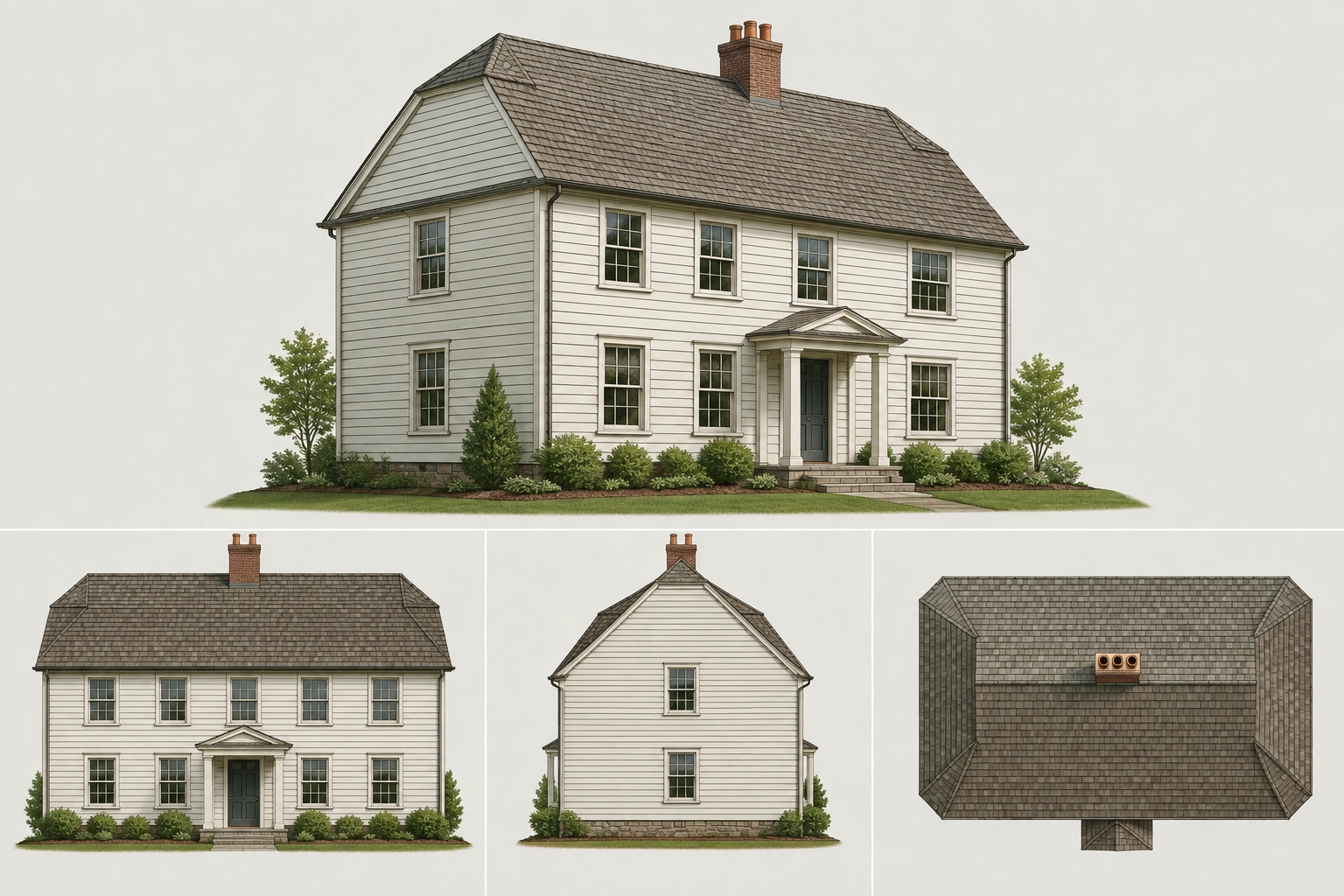
That middle-ground quality is exactly why the style matters. For homeowners, it can add character without feeling ornamental for ornament’s sake. For architects and builders, it offers a roof profile that can improve the look of a building mass and, in some cases, reduce wind pressure at the gable ends compared with a basic gable roof. IKO notes that jerkinhead roofs are slightly more complex to build than standard gables and that the clipped form can experience less wind pressure than a full gable end, which is part of the appeal for practical design as well as aesthetics. IKO’s roof type guide explains this clearly.
What Is a Jerkinhead Roof?
A jerkinhead roof is a gable roof with the upper portion of each gable end clipped off and replaced by a short hip. In plain English, imagine a regular gable roof, then trim the pointed peak at the ends so the roof slopes down a little at the top corner. That clipped section is what gives the roof its name and its distinctive profile.
You may also see the style called a clipped gable roof, docked gable, bullnose, snub gable, or half-hipped roof. These terms are related and are often used for the same general form, but regional usage and the exact geometry can vary, so they are not always perfect synonyms. IKO uses several of those alternate names and describes the roof as a gable roof with a small section of hipped roof at the top of each gable. See the roof-style reference.
The easiest way to think about it is this: a jerkinhead roof keeps the main logic of a gable roof—two principal slopes meeting at a ridge—but softens the ends with a short hipped cap. That makes it a recognizable hybrid rather than a separate structural family.
How the Jerkinhead Design Works
The geometry is straightforward, even if the framing is not quite as simple as a standard gable.
A basic gable roof has two long roof planes meeting at a ridge, with triangular gable walls at the ends. A jerkinhead roof modifies that triangle by cutting off the top point and replacing it with a small sloping plane. Structurally, that means the end of the ridge is shortened and the gable wall no longer rises all the way to a sharp peak.
That clipped end changes both the silhouette and the way wind interacts with the roof. A full gable end presents a large vertical or near-vertical face to the wind. A clipped gable reduces that exposed area. That can be a modest advantage in some windy settings, but it does not by itself guarantee better storm performance.
From a framing perspective, the roof usually requires more coordination than a simple gable because the clipped end introduces additional roof geometry. The ridge, rafters, and end framing must work together to form the hip-like transition. That is one reason jerkinhead roofs are often chosen deliberately rather than accidentally: they are a design decision, not just a default roof shape.
How to Identify a Jerkinhead Roof Visually
If you are trying to identify one from the street, look for three cues:
-
The gable end does not come to a sharp point.
Instead, the top of the triangle is cut off. -
There is a short sloping section at the end of the ridge.
That small hip is the giveaway. -
The roof still reads as mostly gable.
Unlike a full hip roof, the building does not lose its strong end-facing roof identity.
This matters because jerkinhead roofs are often mistaken for hip roofs from a distance. The difference is proportion. In a hip roof, the sloping planes dominate and there is no true gable end. In a jerkinhead roof, the gable still exists, but it is partially clipped.
A useful field test: if the roof appears to have a gable shape with the peak “shaved off,” you are probably looking at a jerkinhead. If all sides slope to the walls without any triangular end wall expression, that is more likely a hip roof.
Jerkinhead Roof vs. Gable Roof, Hip Roof, and Dutch Gable Roof
Here is the quick comparison that helps most readers separate the styles.
| Roof type | Core shape | Visual character | Framing complexity | Space under roof | Typical use |
|---|---|---|---|---|---|
| Gable roof | Two slopes meeting at a ridge | Simple, crisp triangle | Lowest | Often generous attic volume | Common residential forms |
| Jerkinhead roof | Gable with clipped ends | Balanced, slightly softer than gable | Moderate | Usually more than a hip roof, less than a full gable in some layouts | Traditional homes, wind-conscious designs |
| Hip roof | All sides slope down | Compact, stable, contained | Moderate to higher | Often less attic volume | Homes needing a more enclosed profile |
| Dutch gable roof | Hip roof with a gable section above | More expressive and complex | Higher | Can improve upper volume | Decorative or larger residential forms |
The most important distinction is this: a jerkinhead roof is not simply a decorative gable. It is a true hybrid form that sits between a gable and a hip roof in both appearance and behavior.
Jerkinhead Roof vs. Gable Roof
Compared with a gable roof, the jerkinhead version is less stark and less pointed. It can feel more settled visually, especially on homes where a tall triangular end would look too abrupt. Functionally, the clipped end may reduce the wind load on the gable face, but it also adds framing complexity.
If you want the simplest and most economical roof shape, the gable usually wins. If you want a bit more visual refinement and a slightly more moderated end profile, the jerkinhead is the more nuanced choice.
Jerkinhead Roof vs. Hip Roof
A hip roof is more fully sloped and generally reads as more compact. A jerkinhead roof keeps more of the gable identity, which can preserve a more traditional or architectural look. In many homes, that makes the jerkinhead feel less heavy than a full hip roof.
The trade-off is that the hip roof is often the more uniform form, while the jerkinhead is a hybrid with more transitions to frame and detail.
Jerkinhead Roof vs. Dutch Gable Roof
A Dutch gable roof is usually a hip roof with a gable section added near the top, making it more elaborate and often taller in appearance. A jerkinhead does the opposite in a sense: it begins as a gable and trims the peak back. Dutch gables tend to be more decorative and visually prominent; jerkinheads tend to be simpler and more restrained.
If you are deciding between them, ask whether the building needs a roof that feels lighter and more traditional, or one that makes a stronger architectural statement. That question often matters more than the name.
Where Jerkinhead Roofs Are Commonly Used
Jerkinhead roofs show up most often where design character matters and where a fully pointed gable would feel too exposed or too plain.
Traditional residential architecture
You will often see them on homes that borrow from historic or vernacular styles—especially bungalows, Craftsman-inspired houses, cottage-like homes, and some Tudor-influenced designs. The clipped end suits these styles because it softens the roofline without making the building look overly formal.
Smaller civic or institutional buildings
The form also appears on schools, small public buildings, churches, and community structures where the roof is meant to look balanced and well-proportioned rather than aggressively modern.
Renovation and replacement projects
A jerkinhead roof can be a smart choice when a homeowner wants to move away from a plain gable during a major renovation. It is particularly effective when the building mass is simple but the design needs a little more depth at the roofline.
A practical example: if a one-and-a-half-story house has a very tall gable end that feels visually top-heavy, clipping the peak can make the roof read as more grounded and less boxy.
Advantages and Disadvantages of a Jerkinhead Roof
No roof form is universally better. The jerkinhead’s value comes from the balance it strikes.
Advantages
Better visual balance than a plain gable.
The clipped end makes the roofline feel less abrupt. On homes with strong vertical proportions, that can improve curb appeal immediately.
Potentially improved wind behavior at the gable end.
Because the gable peak is clipped, the roof presents less of a full triangular face to the wind. That is one reason the style is often discussed in relation to wind exposure.
More distinctive than a standard gable, less heavy than a full hip.
For designers, that middle ground is useful. It keeps the roof recognizable while adding more character.
Good fit for traditional architecture.
The form tends to look at home on older or historically influenced buildings.
Disadvantages
More complex than a basic gable.
The added geometry means more framing coordination and more opportunities for detailing mistakes if the design is not well resolved.
Not as simple or economical as a plain gable roof.
If budget and speed are the main priorities, the extra complexity may not be justified.
Less attic volume than a pure gable in some designs.
Because the end is clipped, the usable upper space can be reduced at the ends. It will not usually behave like a full gable with uninterrupted triangular ends, which can also make access and storage at the edges less convenient.
Can be harder to detail for drainage and maintenance.
The clipped transition adds roof intersections that need careful flashing and regular inspection, especially where leaves, debris, or ice can collect.
Can be less common in very modern minimalist architecture.
The style leans traditional. That is an advantage in the right context and a drawback in a building that wants an extremely clean, minimal roofline.
Cost, Framing Complexity, and Build Considerations
A jerkinhead roof usually costs more to frame than a straightforward gable because it requires additional layout, more intersections, and more careful detailing at the clipped end. IKO specifically notes that jerkinheads are slightly more complex to build than basic gable roofs. In practical terms, it is usually more expensive than a basic gable because of the added framing complexity, though the actual cost depends on project size, region, and labor rates.
That does not automatically mean the roof is expensive in absolute terms; it means the design is less efficient to build than the simplest option. In a custom home or a renovation where roof form is part of the architectural identity, that extra effort may be worthwhile. In a production build where repeatability and speed matter, it may be harder to justify.
A sensible decision rule is this: if the roof form is doing real architectural work—improving the house’s proportions, fitting a historic style, or supporting a wind-conscious design—then the added complexity can be earned. If the clipped end is only there because it “looks different,” the cost-benefit case is weaker.
For builders, the key issue is coordination. The framing crew, designer, and any truss supplier need to be aligned early so the clipped geometry is resolved cleanly. For homeowners, the practical takeaway is that a jerkinhead roof should be treated as a design choice with build implications, not as a cosmetic afterthought.
Is a Jerkinhead Roof a Good Choice for Your Climate and Project?
This is where the style becomes a decision, not just a description.
When it makes sense
A jerkinhead roof is worth serious consideration when:
- the building sits in a windy area and the gable end would otherwise be highly exposed,
- the architecture benefits from a softer, more finished roof silhouette,
- you want a roof that feels traditional without going all the way to a hip roof,
- the project can absorb a bit more framing complexity.
When a different roof may be better
A plain gable may be smarter if the project is tightly budgeted, the roof plan is very simple, and attic volume is a priority. A full hip roof may be better if the design calls for a more compact, all-sided roof form. And if the building is modern and minimal, the jerkinhead can feel stylistically out of step unless it is used very deliberately.
For storm-prone or high-wind locations, do not assume the jerkinhead is automatically the best answer. It can reduce exposure at the gable end, but local wind conditions, roof geometry, fastening strategy, and code requirements still govern the actual performance. The International Code Council is a useful reference point for understanding how local code and structural design standards shape roof decisions, even though the final answer always depends on the specific project and jurisdiction.
Common Design Variations and Related Roof Forms
The jerkinhead sits in a family of roof forms that all blend or modify a gable profile.
A clipped gable is the most common alternate name and is often used interchangeably. A half-hipped roof usually describes the same general idea, though some regions or professionals may use the term with slight nuance. A Dutch gable roof goes in the opposite direction by adding a gable element to a hip roof, making it more expressive and often more complex.
That family resemblance is useful when you are comparing roof options. If your goal is to keep the familiar look of a gable but reduce its sharpness, jerkinhead is the likely candidate. If your goal is to create a more layered or decorative silhouette, Dutch gable may be closer to the mark.
For broader roof-design context, ArchDaily’s architecture coverage is a good place to see how roof forms influence massing, proportion, and style in real projects.
When to Consult an Architect or Roofing Pro
Bring in an architect or experienced roofing professional when the roof is part of a renovation, when the house has unusual proportions, or when you are weighing a jerkinhead against another roof form for performance reasons. That is especially true if the building is in a high-wind location or if the roof framing will need to be reworked rather than simply re-covered.
A design consultation is also worth it when the roof is doing more than keeping water out. On a jerkinhead roof, the clipped end is a visible architectural decision, so the framing, eave depth, and wall proportions should all work together. A roof that looks good in isolation can still feel wrong if it does not suit the building mass beneath it.
Conclusion
A jerkinhead roof is best understood as a clipped gable: a roof that keeps the familiar gable form but trims the peak at the ends with a short hip. That small change has a meaningful effect on appearance, roof geometry, and sometimes wind behavior. It is not the simplest roof to build, but it often earns its place by improving the balance of the building and giving the roofline a more resolved, architectural finish.
If you are choosing a roof style for a new build or renovation, the key question is not whether jerkinhead roofs are “better” in the abstract. It is whether the clipped profile supports the building’s look, budget, and climate. When those three line up, the style can be an elegant and practical choice.
