
Roof Fall Safety: How to Stay Safe on a Metal Roof

A metal roof can last for decades, but inspecting or working on one can put a homeowner at serious risk. Smooth metal panels, steep slopes, morning dew, loose debris, and unexpected wind can turn a simple roof check into a dangerous situation.
Good roof fall safety starts with recognizing that getting onto the roof is not always necessary. Many leaks, storm-damage signs, drainage problems, and loose components can be investigated from the ground, attic, or a safe ladder position.
This guide explains why metal roofs present unique fall hazards, what precautions matter most, how fall-protection systems work, which roof tasks are reasonable for homeowners, and when a licensed roofing contractor is the safer choice.
Quick Answer
Roof fall safety on a metal roof means avoiding unnecessary roof access, staying off wet or steep panels, using ladders correctly, and relying on proper fall protection for elevated work. Because metal roofs can become extremely slippery, homeowners should handle most inspections from the ground and hire trained roofing professionals for repairs or close-up assessments.
Why Fall Safety Matters on a Metal Roof
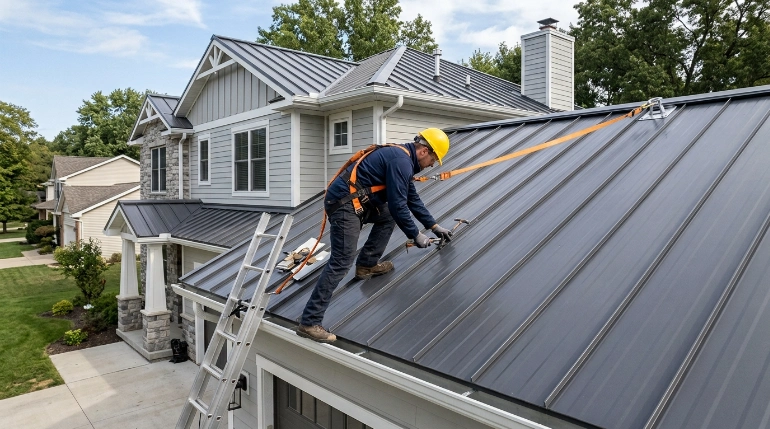
Falling is one of the most serious hazards associated with roofing work. OSHA identifies falls as a major construction hazard and requires employers to provide fall protection in many situations where employees work at elevation. Homeowners are not automatically governed by the same workplace rules, but the safety principles offer an important warning about the risks involved.
The OSHA fall protection guidance explains that construction workers generally need fall protection when exposed to falls of 6 feet or more. That standard should not be interpreted as meaning a fall below 6 feet is safe. Even a fall from a one-story roof can cause severe injury.
Metal roofs deserve extra caution because the walking surface behaves differently from asphalt shingles.
Common hazards include:
- Smooth painted or coated panels
- Morning dew or condensation
- Rain, frost, snow, or ice
- Dust, pollen, leaves, or algae
- Steep roof pitch
- Raised seams and ribs
- Fragile or damaged panels
- Skylights and roof openings
- Unprotected roof edges
- Loose tools or materials
Never assume that a metal roof is safe to walk on simply because it looks dry or has a low slope.
Why Metal Roofs Can Be Especially Slippery
Metal roofing materials commonly include steel, aluminum, copper, and zinc. Their surfaces can be smoother than traditional shingles, particularly when panels have factory-applied coatings.
A surface that feels secure while standing on the ground can become surprisingly slick when your weight is placed on a sloping panel.
Moisture creates one of the biggest problems. A metal roof may be unsafe even when it has not rained. Dew can form overnight, and shaded portions of the roof may remain damp long after sunny sections appear dry.
Pollen and fine dust can also reduce traction.
Wind adds another concern. A sudden gust can affect balance, especially when someone is carrying a tool, moving around an obstruction, or standing near an edge.
If there is any doubt about surface conditions, do not climb onto the roof.
Understand Roof Pitch Before Considering Roof Access
Roof pitch describes how steeply a roof rises.
A low-slope metal roof may appear easy to walk on, but appearance can be misleading. As pitch increases, maintaining traction becomes more difficult and the consequences of slipping become more severe.
A homeowner should not use appearance alone to decide whether walking is safe.
Risk also depends on:
- Roof height
- Panel profile
- Surface coating
- Roof condition
- Weather
- Available fall protection
- Nearby power lines
- Skylights or openings
- Safe ladder access
- Experience working at height
A steep metal roof should generally be treated as professional-only territory.
Roof Fall Protection Systems Explained
Professional roofing crews may use several types of fall-prevention or fall-arrest equipment depending on roof design and job conditions.
These systems are more complicated than simply putting on a harness.
Personal Fall Arrest System
A personal fall arrest system generally combines components such as:
- Full-body harness
- Connecting device or lifeline
- Approved anchorage
- Appropriate connectors
- Equipment designed to limit the forces created during a fall
The anchor point is critical. Attaching a rope or harness to a vent pipe, gutter, plumbing stack, chimney component, or another convenient-looking roof feature can create a false sense of security.
The anchor and entire system must be appropriate for the application.
Fall Restraint System
Fall restraint is intended to prevent a person from reaching an exposed edge in the first place.
Instead of catching someone after a fall begins, properly configured restraint equipment limits movement so the user cannot enter the fall-hazard area.
Guardrails and Other Systems
Some professional roofing projects use:
- Guardrail systems
- Safety nets
- Warning-line systems where permitted
- Temporary engineered anchors
- Permanent roof anchors
OSHA’s guidance on reducing falls while installing standing-seam metal roofs specifically discusses fall hazards associated with metal-roof installation and the importance of suitable protection around edges, openings, and skylights.
Buying a harness by itself does not create a complete fall-protection system. Incorrect anchorage, poor equipment fit, excessive slack, or improper setup can still result in serious injury.
A Safer Homeowner Roof Inspection
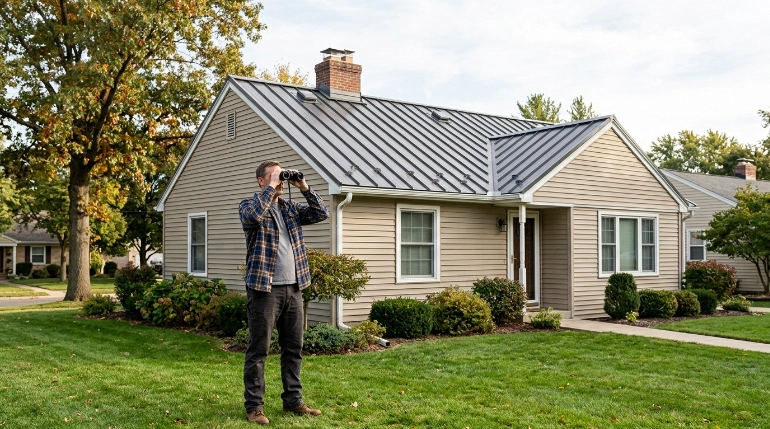
Most homeowners can learn a surprising amount about their roof without stepping onto it.
Start from the ground.
Use binoculars or a camera with optical zoom to examine:
- Ridge caps
- Panel edges
- Flashing
- Gutters
- Downspouts
- Chimney intersections
- Roof-mounted vents
- Missing fasteners or trim
- Visible dents
- Displaced panels
- Tree impact areas
Next, inspect the attic when it is safe and accessible.
Look for:
- Water stains
- Damp insulation
- Darkened roof decking
- Active dripping
- Musty odors
- Daylight through openings
- Rust around penetrations
- Condensation problems
Decking is the structural surface underneath the roofing material. On many homes it consists of plywood or oriented strand board attached to the roof framing.
Finding moisture in the attic can help narrow down a problem without exposing yourself to a fall.
Be Extra Careful After Storm Damage
Storms can make an already hazardous roof far more dangerous.
Wind may loosen panels or trim. Hail can damage coatings. Falling branches can weaken decking or create hidden structural damage.
The National Roofing Contractors Association’s storm repair guidance recommends that homeowners initially assess storm-damaged roofs from ground level and leave closer inspection and repair to professional roofing contractors.
After severe weather, look from the ground for:
- Lifted metal panels
- Bent flashing
- Missing ridge components
- Detached gutters
- Fallen branches
- Visible punctures
- Debris on the roof
- Damage around vents or chimneys
Do not climb onto a storm-damaged roof simply to take photographs for an insurance claim.
Photos taken safely from the ground, windows, or other protected locations are preferable until a qualified professional can inspect the roof.
Extension Ladder Safety Is Part of Roof Fall Safety
Many roof accidents begin before someone reaches the roof itself.
An extension ladder must rest on firm, level ground and should never be placed on loose soil, unstable blocks, boxes, outdoor furniture, or other makeshift supports.
OSHA’s safe-use guidance for extension ladders recommends approximately a 4-to-1 setup angle and says a ladder used to access an elevated surface should extend about 3 feet above that surface or otherwise be properly secured.
Other practical precautions include:
- Inspect the ladder before use.
- Keep the base away from doors and vehicle traffic.
- Never use a damaged ladder.
- Keep your body between the side rails.
- Maintain secure hand contact while climbing.
- Do not climb while carrying bulky tools.
- Never reach excessively to one side.
- Do not use a metal ladder near energized electrical lines.
Transitioning from a ladder to a roof is often one of the most unstable moments of the entire task.
Tasks Homeowners Should and Should Not Attempt
| Roof Task | Typical Homeowner Risk | Safer Choice |
|---|---|---|
| Viewing roof from ground | Low | Reasonable DIY inspection |
| Checking attic for leaks | Low to moderate | DIY if attic access is safe |
| Photographing roof with zoom lens | Low | Good DIY option |
| Cleaning reachable ground-level gutters | Moderate | DIY only with safe access |
| Walking on metal panels | High | Professional recommended |
| Repairing roof flashing | High | Roofing contractor |
| Replacing metal panels | Very high | Roofing contractor |
| Storm-damage inspection on roof | Very high | Roofing contractor |
| Working near skylights | Very high | Trained professional |
| Repairing structural decking | Very high | Roofing/structural professional |
The condition of your individual home always matters. A task that appears simple on a single-story low-slope roof can be extremely dangerous on another property.
How Safety Decisions Affect Roof Cost and Lifespan
Avoiding risky DIY work is not only about injury prevention. Incorrect foot placement, tools, fasteners, sealants, and repair techniques can also damage a metal roof.
Depending on the system, careless roof traffic may:
- Dent unsupported panels
- Scratch protective coatings
- Damage seams
- Distort flashing
- Loosen fasteners
- Damage sealants
- Create new leak paths
Metal roofing is often chosen because of its long service life, but longevity depends heavily on installation quality, drainage, coating condition, flashing details, ventilation, and maintenance.
A small repair performed correctly may preserve years of useful service. A poorly executed repair can turn a localized problem into repeated leakage.
Labor also represents a significant portion of professional roofing costs because contractors must account for access, training, fall protection, insurance, specialized tools, and safe working procedures.
Paying for professional labor can therefore include far more than the few minutes spent tightening or replacing a visible component.
Consider the Roof Warranty Before DIY Repairs
Before drilling, sealing, coating, fastening, or replacing a metal roofing component, check the manufacturer’s warranty and your contractor’s workmanship warranty.
Some warranties include specific requirements regarding:
- Approved repair materials
- Fastener types
- Sealants
- Coatings
- Penetrations
- Flashing modifications
- Contractor qualifications
- Maintenance documentation
An improvised repair may interfere with future warranty coverage.
If your roof is relatively new, contact the installer or manufacturer before making a permanent modification.
What About Roof Leaks?
Discovering a leak creates urgency, but urgency should not override safety.
Place containers under active interior drips when practical and protect furniture, flooring, and valuables. If water is near electrical fixtures, outlets, or wiring, avoid contact and obtain appropriate professional help.
Then document the leak location from inside the home.
Remember that water does not always enter directly above the visible ceiling stain. It can travel along:
- Rafters
- Roof decking
- Underlayment
- Fasteners
- Pipes
- Flashing
- Structural framing
That is one reason walking to the spot directly above an indoor stain and applying sealant often fails.
A roofing contractor can evaluate the complete water path rather than treating only the visible symptom.
Expert Tip: Photograph the leak inside the attic and mark its location relative to fixed features such as chimneys, vents, walls, or roof valleys. This gives the roofer useful diagnostic information without requiring you to climb onto the roof.
Do Not Rely on Improvised Fall Protection
One of the most dangerous mistakes homeowners make is creating a homemade safety system.
Do not assume you can safely tie yourself to:
- A chimney
- Gutter
- Plumbing vent
- Satellite mount
- Roof vent
- Railing
- Tree branch
- Vehicle
- Temporary screw
- Random framing member
Fall-arrest forces can be substantial, and a connection that seems strong during normal movement may fail suddenly during an actual fall.
Professional fall-protection equipment also requires correct positioning, compatibility, inspection, and planning.
There is another issue that homeowners sometimes overlook: rescue.
A harness may stop a fall without returning the person safely to the roof. A worker left suspended after a fall can still face a medical emergency.
For that reason, fall protection should be treated as a complete system rather than a single piece of equipment.
Common Mistakes Homeowners Should Avoid
Walking on a Wet Metal Roof
Even a small amount of moisture can dramatically reduce traction.
Assuming a Low Roof Is Harmless
A one-story fall can still cause severe injuries.
Wearing the Wrong Footwear
Hard, dirty, worn, or unsuitable soles can reduce grip and may damage roof coatings.
Setting a Ladder on Uneven Ground
A secure roof surface does not matter if the ladder shifts during access.
Carrying Tools While Climbing
Tools can affect balance and reduce your ability to maintain secure hand contact.
Working Alone
If an accident occurs, no one may be available to call for help.
Using an Improvised Harness Anchor
A convenient attachment point is not automatically an approved fall-protection anchor.
Inspecting During or Immediately After a Storm
Rain, wind, lightning, debris, and hidden damage make roof access especially hazardous.
Assuming the Roof Can Support Your Weight Everywhere
Damaged decking, skylights, openings, and deteriorated structural components may not safely support a person.
Prioritizing a Small Repair Over Personal Safety
Stopping a minor leak is never worth risking a serious fall.
When to Consult a Licensed Roofing Contractor
A qualified roofing contractor should generally be your first call when a problem requires walking on the roof, removing panels, opening flashing, or working near an exposed edge.
Professional evaluation is especially important when you notice:
- Active leaks
- Major storm damage
- Loose or displaced panels
- Structural sagging
- Damaged decking
- Rust-through or corrosion
- Open seams
- Significant hail damage
- Bent ridge or edge flashing
- Water entering around penetrations
- Recurring leaks after previous repairs
- Damage that may involve an insurance claim
The NRCA’s roofing resources for property owners also caution that most roofing work should not be treated as a homeowner DIY project because incorrect techniques can damage the roof and expose people to serious fall hazards.
For structural sagging, widespread decking deterioration, or damage involving rafters or trusses, the roofer may recommend further assessment by a structural professional.
Roof Fall Safety FAQs
Can I safely walk on my metal roof?
Sometimes a metal roof is physically capable of supporting foot traffic, but that does not automatically make walking on it safe. Panel type, roof slope, moisture, structural condition, footwear, access, and fall protection all matter. For most homeowners, a ground-level inspection or professional roof inspection is safer.
Are metal roofs more slippery than shingle roofs?
Metal panels can be particularly slippery because their surfaces are comparatively smooth. Water, dew, frost, pollen, dust, and leaves can reduce traction further. Never rely on appearance alone when deciding whether the roof surface is safe.
Do I need a harness to go onto my roof?
A harness alone is not enough. Effective fall protection depends on the complete system, including proper anchorage, connecting equipment, fit, setup, inspection, and rescue planning. Homeowners unfamiliar with these systems should generally avoid elevated roof work and hire an experienced professional.
Is it safe to inspect a roof immediately after a storm?
Usually not from the roof itself. Wind, moisture, loose panels, branches, electrical hazards, and hidden structural damage can make storm-damaged roofs unpredictable. Inspect from the ground and document visible damage while waiting for professional evaluation.
Can I use a ladder to inspect a metal roof without stepping onto it?
A ladder may provide limited visibility in some circumstances, but ladder use still carries fall risk. The ladder needs stable footing, correct positioning, adequate length, and safe surroundings. Do not lean sideways or climb higher than the ladder is designed to allow simply to improve your view.
What should I do if my metal roof is leaking during heavy rain?
Protect the interior when you can do so safely, move valuables away from the leak, and document where water appears. Avoid climbing onto a wet roof to apply an emergency patch. Have a roofing contractor locate and repair the actual entry point when conditions permit safe work.
Should I inspect my metal roof myself every year?
You can perform routine visual checks from the ground and inspect accessible attic areas for moisture. Close-up roof inspections are better handled by a qualified professional when they require climbing, walking on panels, evaluating structural damage, or working near roof edges.
Conclusion
The most important principle of roof fall safety is simple: you do not need to stand on a roof to be a responsible homeowner.
Metal roofs can become dangerously slippery because of moisture, dust, coatings, slope, and weather conditions. Add roof edges, ladders, skylights, storm damage, or deteriorated decking, and a routine inspection can become a serious fall hazard.
Use ground-level observation and attic inspections whenever possible. Keep ladders limited to situations where they can be used safely, and never treat a harness or improvised tie-off as a substitute for a properly designed fall-protection system.
If the job requires walking across metal panels, repairing flashing, replacing damaged roofing, inspecting storm damage up close, or working near an exposed edge, contact a qualified roofing contractor. Protecting the roof matters, but protecting yourself matters more.