
Roof Anchor for Safety Harness on a Metal Roof: Homeowner Safety Guide

Working on a metal roof can look simple from the ground. Once someone steps onto the surface, the risk changes quickly. Metal panels may be steep, smooth, wet, hot, or unexpectedly slippery. Wind, loose tools, and damaged roofing can make the situation even more dangerous.
A properly selected roof anchor for safety harness use gives a worker a secure connection point for a personal fall arrest or restraint system. But the anchor is only one part of the system. The roof structure, harness, lifeline or lanyard, connectors, installation method, and anchor location all have to work together.
For homeowners, the goal is not to learn how to install fall-protection hardware themselves. It is to understand what a safe roofing contractor should be using and what questions to ask before anyone works on a metal roof.
Quick Answer
A roof anchor for safety harness use must be compatible with the metal roof and connected to a structure capable of handling fall-protection loads. Standing seam roofs may use specialized non-penetrating clamps, while other anchors attach to structural framing. Anchor selection and installation should follow manufacturer instructions and applicable OSHA requirements.
What Is a Roof Anchor for a Safety Harness?
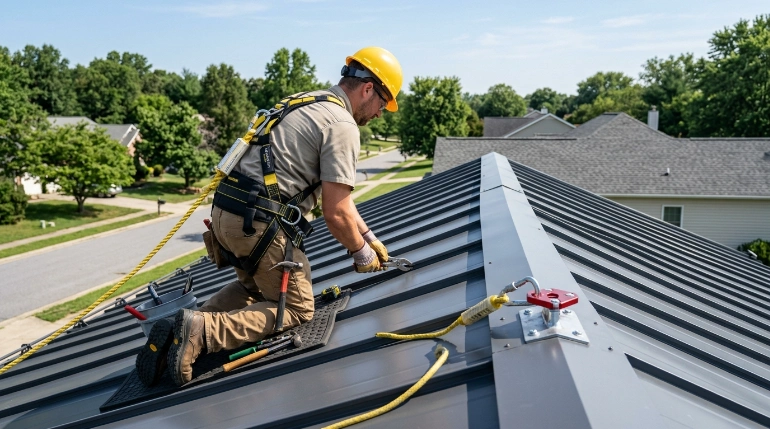
A roof anchor is the connection point between a worker’s fall-protection equipment and the building.
A typical personal fall arrest system may include:
- A full-body harness
- A lanyard or self-retracting lifeline
- Compatible connectors
- A properly rated anchor
- A structurally adequate anchorage
The terms anchor and anchorage are sometimes used interchangeably, but they are not always the same thing.
The anchor is usually the manufactured hardware that a worker clips into. The anchorage includes the structural part of the building supporting that hardware.
This distinction matters because a strong metal anchor installed into a weak part of the roof does not create a safe system.
According to OSHA’s fall-protection system criteria, anchorages for personal fall arrest equipment generally must support at least 5,000 pounds per attached employee, or be designed, installed, and used as part of a complete system with a safety factor of at least two under the supervision of a qualified person.
A safety harness is only as dependable as the entire system supporting it.
Why Metal Roofs Require Special Fall Protection
Metal roofing presents several fall hazards that homeowners may not immediately notice.
The surface can become extremely slippery when wet. Dust, pollen, frost, condensation, or light rain can reduce traction. Loose panels and construction materials can also create trip hazards.
OSHA specifically warns that workers installing standing seam metal roofs face fall hazards from slippery surfaces, sudden wind gusts, and loose roofing materials.
Roof design also matters.
A standing seam metal roof is very different from an exposed-fastener metal roof. The seams, panel profile, structural framing, underlayment, decking, and attachment system may all affect which type of fall-protection anchor can safely be used.
An anchor designed for one seam profile should never be assumed to fit another.
When Is Fall Protection Required?
For residential construction covered by OSHA, employees working 6 feet or more above a lower level generally must be protected by an approved fall-protection method. Depending on the type of roofing work, acceptable methods may include guardrails, safety nets, personal fall arrest systems, or other systems permitted by the standard.
OSHA specifically requires protection on steep roofs with unprotected edges 6 feet or more above lower levels. Different options are available for qualifying low-slope roofing work. OSHA’s construction fall-protection requirements explain these requirements in detail.
For homeowners, OSHA regulations are most directly relevant to the contractors and employers performing the work. They also provide an important benchmark when evaluating whether a roofing crew is taking fall hazards seriously.
Never assume a short repair is safe simply because the worker expects to be on the roof for only a few minutes.
Types of Roof Anchors Used on Metal Roofs
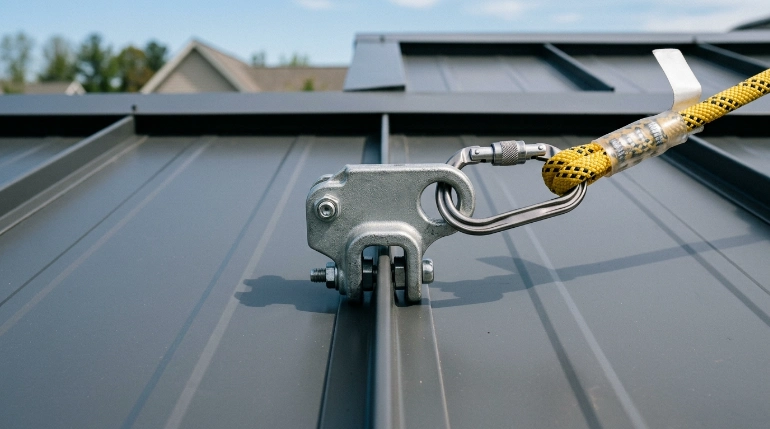
There is no single anchor that works on every metal roof.
The correct option depends on the panel type, roof structure, work being performed, and fall-protection system.
| Anchor Type | Typical Metal Roof Use | Roof Penetration | Main Consideration |
|---|---|---|---|
| Standing seam clamp | Compatible standing seam panels | Usually no | Must match the seam and manufacturer requirements |
| Peak or ridge anchor | Near roof ridge or structural framing | Often yes | Must be securely attached to adequate structure |
| Permanent D-ring anchor | Long-term maintenance access | Usually yes | Structural attachment and weatherproofing are critical |
| Temporary structural anchor | Short-duration roofing work | Usually yes | Installation and fasteners must match instructions |
| Engineered anchor system | Complex or commercial roofs | Varies | Requires system-specific design and evaluation |
Standing Seam Roof Clamps
Standing seam clamps are especially useful because certain designs connect directly to compatible seams without drilling through the finished panel.
This can help preserve the weather-resistant roof surface.
OSHA’s guidance for installing standing seam metal roofs specifically identifies standing seam roof clamps as an anchorage option. OSHA also emphasizes selecting a clamp intended for the particular roofing application and following the manufacturer’s instructions.
Compatibility is critical.
Seam shape, panel material, thickness, clamp orientation, fastener torque, and allowable loading may vary by system. A clamp that physically fits over a seam is not automatically approved for fall protection.
Peak and Ridge Anchors
Peak anchors are normally positioned high on the roof, often around the ridge.
Keeping an anchor high can help reduce some movement and fall-distance problems, depending on the system design.
OSHA notes that peak anchors are typically secured to structural framing beneath the roof.
This is important because attaching only to thin metal panels or another nonstructural surface may not provide the required support.
Permanent D-Ring Anchors
A permanent anchor can remain on the building for future roof maintenance.
This may be useful on a metal roof that will require periodic inspection, gutter work, solar-panel service, chimney maintenance, HVAC access, or future repairs.
A properly planned permanent anchor can reduce the temptation for future workers to create an improvised tie-off point.
However, permanent penetrations must be correctly flashed and sealed. Poor installation can create exactly the problem the roof is supposed to prevent: water intrusion.
Fall Arrest vs. Fall Restraint
These terms describe two different safety strategies.
Fall Restraint
A restraint system is configured so the worker cannot reach the roof edge or another fall hazard.
The worker remains on the roof rather than falling and being caught.
OSHA recognizes properly configured fall restraint as an option in residential construction. Its guidance explains that a worker may be connected to an anchor with a line short enough to prevent reaching the edge.
Fall Arrest
A fall arrest system allows some movement into a fall but is designed to stop the worker before the worker strikes a lower level.
That requires careful control of:
- Free-fall distance
- Deceleration distance
- Available clearance
- Anchor position
- Swing-fall exposure
- Harness fit
- Rescue planning
OSHA requires personal fall arrest systems to be rigged so an employee does not free-fall more than 6 feet or contact a lower level, among other system requirements.
For many homeowners, this illustrates why simply purchasing a harness and clipping it to something on the roof is not adequate fall protection.
How Contractors Should Choose an Anchor for a Metal Roof
Anchor selection should begin with the roof, not with the hardware catalog.
A contractor should evaluate several factors.
1. Identify the Metal Roof System
Determine whether the roof is:
- Standing seam
- Exposed-fastener metal
- Metal shingles
- Corrugated metal
- Structural metal panel
- Another proprietary panel system
The manufacturer’s documentation may identify approved attachment methods.
2. Identify Adequate Structural Support
The visible metal panel is not necessarily the structure that must resist a fall.
Depending on the roof assembly, structural support may include rafters, trusses, purlins, decking, or another engineered component.
OSHA advises following anchor-manufacturer instructions or consulting a qualified person and specifically notes the importance of properly securing applicable anchors into structural roof framing.
3. Match the Anchor to the Intended System
A fall-arrest anchor should be used as part of a complete, compatible fall-protection system.
Mixing random components can introduce problems with connector compatibility, allowable loads, fall distance, and system performance.
4. Consider Anchor Location
Location can affect both working freedom and fall consequences.
An anchor placed poorly may create a swing fall, where the worker falls and swings sideways like a pendulum.
The contractor should plan tie-off locations before work starts rather than improvising once workers are already exposed.
5. Follow Manufacturer Requirements
Installation requirements may specify:
- Approved roof profiles
- Required structural substrate
- Fastener size and quantity
- Clamp position
- Installation torque
- Maximum number of users
- Inspection intervals
- Permitted lifeline orientation
These requirements are part of the safety system, not optional suggestions.
Expert Tip: Ask your roofing contractor where workers will tie off before the job begins. A clear answer involving a roof-specific anchor system is much more reassuring than hearing, “We’ll figure something out once we’re up there.”
Can a Roof Anchor Damage a Metal Roof?
It can if the wrong anchor or installation method is used.
Penetrating anchors intentionally pass fasteners through roofing components to reach structural material. Those penetrations must be properly located and weatherproofed.
Poor installation can contribute to:
- Water leaks
- Damaged coatings
- Corrosion around penetrations
- Distorted metal panels
- Loose fasteners
- Warranty problems
Non-penetrating standing seam clamps can avoid making holes through compatible panels, but they still need to be approved for the specific seam and fall-protection application.
A non-penetrating anchor is not automatically safer simply because it does not create holes.
Roof Warranty Considerations
Metal roofing can remain in service for decades, making future roof access an important planning issue.
Before installing a permanent anchor, the contractor should consider the roofing manufacturer’s requirements.
An improperly drilled hole, incompatible fastener, damaged protective coating, or incorrectly flashed penetration may affect warranty coverage.
Ask the roofer to confirm:
- Whether the anchor method is approved for the roof system.
- Whether penetrations are required.
- How penetrations will be flashed and sealed.
- Whether the work could affect the material or workmanship warranty.
- Whether documentation will be provided after installation.
Keep that information with your roofing warranty documents.
What Does a Roof Anchor System Cost?
The anchor itself is only one cost factor.
Overall cost may depend on:
- Anchor type
- Number of anchors required
- Roof pitch
- Roof height
- Metal panel profile
- Structural access
- Permanent versus temporary installation
- Required flashing or waterproofing
- Lifelines and harness equipment
- Labor and inspection requirements
A simple compatible anchor on accessible framing may involve relatively little additional labor. An engineered permanent system on a large or complicated roof can involve substantially more planning.
Do not choose fall-protection equipment based primarily on the lowest price. Compatibility, structural capacity, proper installation, and worker training matter much more.
Roof Conditions That Make Safety Even More Important
Fall protection deserves additional attention when a contractor is inspecting or repairing a roof after:
- Hail or wind damage
- A fallen tree or branch
- Loose metal panels
- Active roof leaks
- Damaged flashing
- Rust or corrosion
- Storm-related fastener failure
- Long-term deterioration
Storm damage may leave sections of a roof less stable than they appear from the ground.
Wet metal also creates a serious slip hazard. OSHA advises workers to avoid working on wet, slippery metal roofing when possible and highlights slip-resistant footwear when such conditions cannot be avoided.
Homeowners should avoid climbing up to investigate these conditions themselves.
Inspecting Fall-Protection Equipment
A roof anchor is not something that should be installed and forgotten forever.
OSHA requires personal fall arrest systems to be inspected before use for wear, damage, and deterioration. Equipment subjected to impact loading from a fall must be removed from service until appropriately evaluated. OSHA also requires employers to provide for prompt rescue following a fall.
Depending on the anchor system, inspections may look for:
- Loose hardware
- Corrosion
- Cracks or deformation
- Damaged seams
- Missing fasteners
- Water intrusion around penetrations
- Damaged lifelines
- Worn harness webbing
- Improper connectors
- Previous fall loading
The manufacturer’s inspection requirements should always be followed.
When to Consult a Licensed Roofing Contractor
A homeowner should contact a qualified roofing professional when roof access involves fall exposure, uncertain structural conditions, or potential damage to a metal roof system.
Professional evaluation is particularly important when:
- You do not know which metal panel system is installed.
- Structural framing cannot be confirmed.
- A permanent anchor will penetrate the roof.
- The roof is steep.
- Panels are wet, icy, loose, or storm damaged.
- The building has multiple roof levels.
- Solar panels, skylights, or other obstacles affect tie-off locations.
- Existing anchors show rust or damage.
- A worker has already fallen while connected to the system.
- Roof warranty coverage could be affected.
For complex fall-protection systems, a qualified person may need to evaluate or design the anchorage. OSHA’s standards specifically provide for qualified-person supervision when the system relies on engineered safety-factor criteria instead of the basic 5,000-pound anchorage requirement.
A homeowner should never be pressured into personally testing, installing, or improvising a fall-protection anchor.
Common Mistakes Homeowners Should Avoid
- Assuming the metal panel itself is a safe tie-off point. The anchor and supporting structure must work together.
- Using a standing seam clamp on an unapproved seam. Similar-looking seams can have different profiles and structural characteristics.
- Clipping a harness to plumbing vents, gutters, chimneys, or other convenient objects. Convenience does not establish anchorage capacity.
- Ignoring manufacturer instructions. Fastener placement, torque, allowable users, and compatible panels can be safety-critical.
- Allowing unnecessary roof work in rain or on wet metal. Metal surfaces can become extremely slippery.
- Ignoring swing-fall hazards. Anchor location matters as much as anchor strength.
- Forgetting rescue planning. Stopping a fall is not the end of the emergency.
- Installing permanent penetrations without considering waterproofing or warranty requirements.
- Reusing equipment after a fall without proper evaluation. OSHA requires impacted personal fall arrest equipment to be removed from service until it is determined suitable for reuse.
Questions to Ask Your Roofing Contractor
Before metal roof work begins, consider asking:
- What fall-protection system will your crew use?
- What type of roof anchor will be used?
- Is the anchor approved for my specific metal roof?
- Where will the anchor connect structurally?
- Will the installation penetrate the roof?
- How will any penetration be waterproofed?
- Will the anchor remain permanently installed?
- Could installation affect my roof warranty?
- How are workers protected while reaching the anchor?
- What is the rescue plan if a worker falls?
A professional contractor should be able to discuss fall protection without treating it as an inconvenience.
FAQs
Can you attach a safety harness directly to a metal roof?
Not simply to any metal panel. A harness must connect through compatible fall-protection equipment to an appropriate anchorage. The required system depends on the roof and anchor design.
How much weight should a roof anchor support?
For construction personal fall arrest systems, OSHA generally requires anchorage capable of supporting at least 5,000 pounds per employee attached, or an engineered complete system maintaining a safety factor of at least two under qualified-person supervision.
Can you use a roof anchor on a standing seam metal roof?
Yes, compatible standing seam anchors are available. OSHA identifies standing seam clamps as one option and stresses that the anchor must be suitable for the roof and installed according to manufacturer instructions.
Do standing seam roof anchors require drilling?
Some specially designed standing seam clamps attach without penetrating the finished roof panel. Compatibility must still be confirmed for the particular seam and fall-protection application.
Can a roof anchor cause a leak?
A penetrating anchor can create a leak if it is incorrectly located, fastened, flashed, or sealed. Permanent installations should account for both structural safety and long-term weather protection.
Should a roof anchor be installed permanently?
It depends on the building. Permanent anchors can make future inspections and maintenance safer, especially when repeated roof access is expected. The roof structure, waterproofing, anchor inspection requirements, and warranty should all be considered first.
Can a homeowner install a safety harness roof anchor?
Because an anchor is life-safety equipment and its performance depends on the underlying structure, installation should not be treated as a routine DIY roofing project. A qualified professional should evaluate uncertain structures, metal roof compatibility, and fall-protection requirements.
Conclusion
A roof anchor for safety harness use is one of the most important components of a fall-protection system on a metal roof, but strength alone does not make an installation safe.
The anchor must be compatible with the roof, supported by adequate structure, positioned correctly, installed according to the manufacturer’s requirements, and used with a complete fall-protection system. Standing seam roofs may offer non-penetrating clamp options, while other systems may require anchors attached directly to structural framing.
Homeowners do not need to become fall-protection experts. They do need to recognize when roof work is being approached responsibly.
Before allowing repair, inspection, solar work, or replacement work on your metal roof, ask the contractor what workers will tie off to, whether the anchor is compatible with the roof, and how the system protects them from a fall.
When there is any doubt about the roof structure, anchor compatibility, or safe installation, hire a qualified roofing professional rather than improvising a solution.