
What Is a Standing Seam Metal Roof? A Homeowner’s Complete Guide

Choosing a new roof can feel overwhelming, especially when contractors use terms that are unfamiliar. One option you may hear about is a standing seam metal roof. It looks modern, lasts longer than many traditional roofing materials, and hides most of its fasteners from the weather.
But what is a standing seam metal roof, and is it suitable for your home?
A standing seam roof uses long metal panels connected by raised vertical seams. The fastening system is usually concealed beneath the panels, helping protect the roof from leaks, corrosion, and weather-related damage. This guide explains how the system works, how much it may cost, its benefits and limitations, and what to check before hiring a contractor.
Quick Answer
A standing seam metal roof is a roofing system made from long metal panels joined by raised seams. Clips or concealed fasteners secure the panels to the roof deck without leaving exposed screws on the surface. This design creates a clean appearance, supports thermal movement, and provides strong long-term weather protection.
How Does a Standing Seam Metal Roof Work?
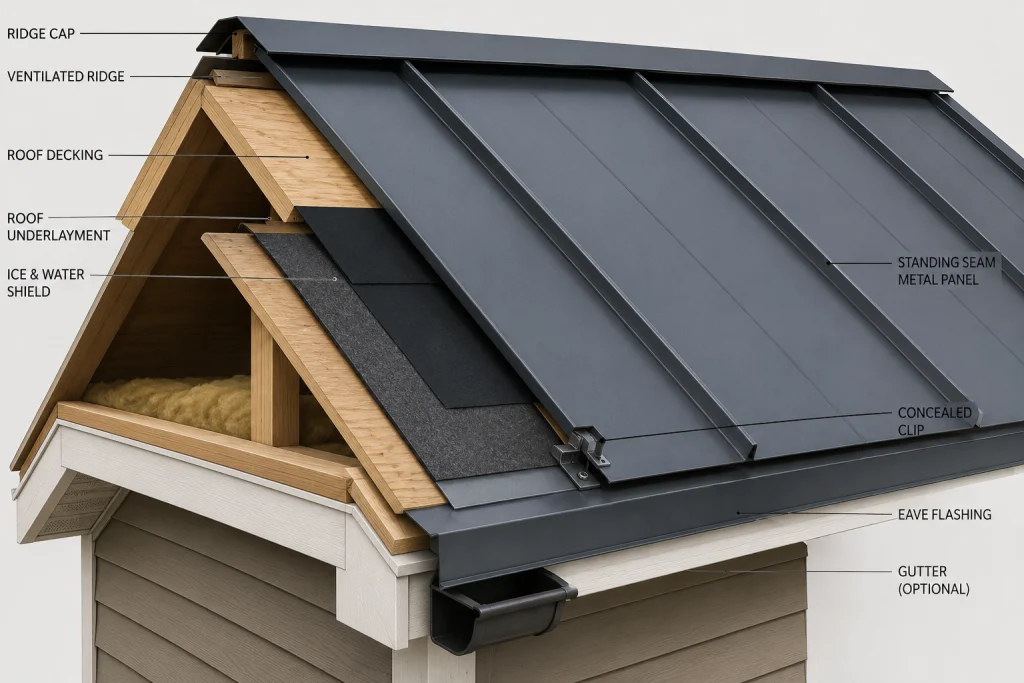
Standing seam roofing consists of metal panels running vertically from the roof ridge down to the eaves. The edges of neighboring panels connect and form raised seams, usually about 1 to 2 inches above the flat surface.
These raised seams give the roof its name. Instead of lying flat where water can collect, the panel connections “stand” above the drainage surface.
Most standing seam systems use:
- Long steel, aluminum, zinc, or copper panels
- Raised vertical seams between panels
- Concealed clips or fasteners
- Protective coatings or painted finishes
- Flashing around valleys, chimneys, vents, and roof edges
- An underlayment beneath the metal panels
The Metal Construction Association’s overview of steep-slope metal roofing explains that vertical standing seam systems are commonly attached to the underlying structure with hidden clips or fastening systems. (Metal Construction Association)
The concealed attachment is one of the most important differences between standing seam roofing and lower-cost exposed-fastener metal panels.
What Are Concealed Fasteners?
Concealed fasteners are screws or clips covered by the finished roofing panels. They do not remain exposed to rain, sunlight, snow, and changing temperatures.
In many systems, a contractor attaches clips to the roof deck. The panels lock or snap onto those clips. The clips hold the panels securely while allowing a controlled amount of movement as the metal expands and contracts.
This design reduces the number of exposed penetrations through the finished roof surface.
Why Metal Panels Need to Move
Metal expands when it becomes hot and contracts when it cools. A long roof panel can move slightly throughout the day and across different seasons.
A properly designed standing seam system allows this movement without placing excessive stress on the panels or fasteners. Poor installation, however, can restrict movement and lead to:
- Buckled or wavy panels
- Loose seams
- Damaged clips
- Fastener failure
- Oil canning
- Leaks around flashing
Oil canning is a visible waviness in the flat areas of metal panels. It is usually an appearance issue rather than a sign that the roof is failing, although severe distortion should be inspected.
Types of Standing Seam Metal Roof Systems
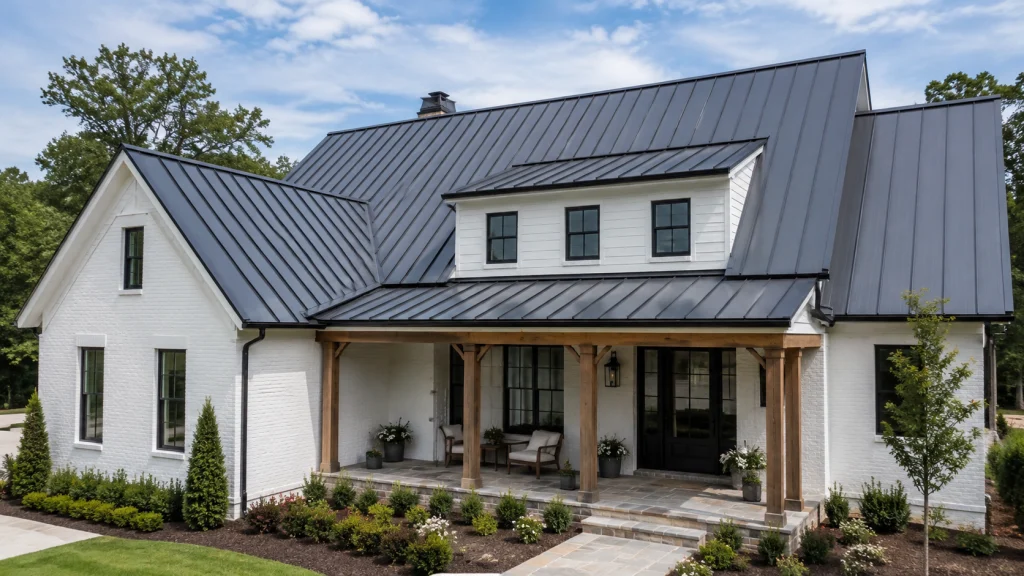
Not every standing seam roof uses the same panel connection. The appropriate system depends on the roof slope, local weather, building design, and manufacturer specifications.
Snap-Lock Panels
Snap-lock panels have formed edges that snap together during installation. They are commonly used on residential roofs with adequate slope.
Advantages include:
- Faster installation than mechanically seamed systems
- Clean, narrow seams
- Concealed attachment
- Good performance on many standard residential roofs
Snap-lock panels must still be installed according to the manufacturer’s minimum slope and underlayment requirements.
Mechanically Seamed Panels
Mechanically seamed panels are joined with a special seaming tool after being placed on the roof. The tool folds or locks the panel edges together.
These systems may use a single-lock or double-lock seam. A double-lock seam creates a tighter connection and is often selected for lower-slope roofs or demanding weather conditions.
Mechanically seamed roofs generally require more labor and specialized installation equipment.
Nail-Flange or Fastener-Flange Panels
Some residential standing seam products have a fastening flange along one side of the panel. The next panel covers the fasteners.
These systems may be more affordable, but they do not always allow the same amount of thermal movement as clip-based systems. Homeowners should ask how the selected product handles expansion and contraction.
Structural and Architectural Systems
An architectural standing seam roof is normally installed over a solid roof deck. This is common on houses.
A structural standing seam system can span between supporting members such as purlins. Structural systems are more common on commercial, agricultural, and industrial buildings.
Standing Seam vs. Exposed-Fastener Metal Roofing
Both systems use metal panels, but their attachment methods and expected performance differ.
| Feature | Standing seam metal roof | Exposed-fastener metal roof |
|---|---|---|
| Fasteners | Hidden beneath panels or seams | Visible on the roof surface |
| Typical cost | Higher | Lower |
| Appearance | Smooth and modern | Ribbed or agricultural |
| Thermal movement | Usually better accommodated | More limited |
| Maintenance | Generally lower | Washers and screws need closer monitoring |
| Leak risk | Fewer exposed penetrations | More exposed screw penetrations |
| Installation | Specialized | Simpler |
| Common use | Homes and commercial buildings | Barns, sheds, workshops, and budget projects |
Exposed-fastener panels are not automatically poor-quality products. They can perform well when properly installed and maintained. However, their screws and sealing washers remain exposed to ultraviolet light, moisture, and temperature changes.
A standing seam system usually offers a more refined appearance and fewer exposed points where water may eventually enter.
What Materials Are Used?
Galvanized or Galvalume-Coated Steel
Steel is the most common residential choice because it combines strength, availability, and reasonable cost.
The steel normally has a metallic protective coating and a painted finish. The coating helps resist rust, while the paint provides color and additional weather protection.
Ask the contractor to identify:
- The steel thickness or gauge
- The metallic coating
- The paint system
- The panel manufacturer
- The finish warranty
A lower gauge number generally indicates thicker steel. However, gauge terminology can vary, so compare actual thickness and manufacturer specifications instead of relying only on the gauge label.
Aluminum
Aluminum naturally resists corrosion and can be useful in coastal environments. It is lighter than steel but may be more vulnerable to denting.
Because coastal conditions vary, the complete roofing assembly—including clips, screws, flashing, and sealants—must be compatible with the environment.
Copper
Copper develops a natural patina over time and can last for many decades. It is usually selected for premium homes, historic buildings, porches, accents, or specialty roofing details.
Its main limitation is cost.
Zinc
Zinc also forms a protective patina and can provide a distinctive appearance. It is durable but expensive and requires contractors who understand its installation and compatibility requirements.
Benefits of a Standing Seam Metal Roof
Long Service Life
A well-designed and correctly installed standing seam roof can provide decades of service. Actual lifespan depends on the metal, coating, climate, roof design, installation quality, and maintenance.
The installation details often matter as much as the metal itself. A premium panel cannot compensate for poor flashing or incorrect seam construction.
Reduced Exposure of Fasteners
Because most fasteners are covered, they receive less direct exposure to rain and sunlight. This can reduce maintenance problems associated with deteriorating screw washers.
Strong Water-Shedding Design
Long panels carry water from the ridge toward the eaves with relatively few horizontal joints. The raised seams keep panel connections above the main drainage surface.
This does not make every standing seam roof waterproof under every condition. Underlayment, flashing, slope, penetrations, and seam type remain critical.
Clean Appearance
Standing seam panels create straight lines and a simple architectural look. They work well with modern, farmhouse, cabin, commercial-inspired, and traditional home designs.
Colors commonly include:
- Charcoal gray
- Matte black
- Bronze
- Forest green
- Deep red
- Medium gray
- Natural metallic finishes
Fire and Weather Resistance
Metal roofing is noncombustible, although the fire performance of the complete roof depends on the deck, underlayment, insulation, and tested assembly.
Wind resistance also depends on the panel profile, clip spacing, roof edges, substrate, fasteners, and installation details. A metal roof should never be described as “hurricane-proof” without product-specific engineering and tested ratings.
Potential Energy Benefits
Metal roofs can be produced with finishes that reflect more solar energy than darker, less-reflective surfaces. This may help reduce roof surface temperatures and cooling demand in warm climates.
The U.S. Department of Energy notes that cool roofs generally provide their greatest cooling benefits in hot climates, while climate should be considered because highly reflective roofs may reduce helpful winter heat gain in colder regions. (The Department of Energy’s Energy.gov)
Roof color alone does not determine home comfort. Attic insulation, air sealing, ventilation, roof design, and local climate also matter.
Easier Solar Panel Attachment
Some solar mounting systems clamp directly to standing seams without drilling through the flat panel surface. The clamp and roof must be approved for the specific system and expected wind and snow loads.
Solar equipment should not be attached based only on appearance. The roof manufacturer, mounting manufacturer, structural designer, and installer should confirm compatibility.
Limitations to Consider
Higher Initial Cost
Standing seam roofing usually costs more than asphalt shingles and exposed-fastener metal panels. The price reflects the metal, factory finishing, specialized trim, clips, fabrication, and skilled labor.
The investment may make more sense when:
- You expect to own the home for many years
- The existing roof needs full replacement
- Long-term maintenance is important
- The home’s design suits metal roofing
- Local contractors have relevant experience
Installation Requires Specialized Skills
Errors around valleys, dormers, skylights, chimneys, transitions, and wall connections can cause serious leaks.
A general roofer who occasionally installs metal may not have the same experience as a contractor who regularly installs the specific standing seam system you are considering.
Appearance Can Show Imperfections
Long, smooth panels may show oil canning, dents, uneven decking, or installation irregularities. Wider panels and highly reflective finishes can make waviness more visible.
Rain May Sound Louder in Some Assemblies
A standing seam roof installed over a solid deck, underlayment, attic, and insulated ceiling is normally much quieter than metal installed directly over open framing.
Noise levels depend on the entire assembly rather than the exterior panel alone.
Repairs Can Be More Complex
Replacing a damaged panel may require opening connected seams or removing nearby trim. Repairs should be performed by someone familiar with that panel profile.
How Much Does a Standing Seam Metal Roof Cost?
Installed prices vary substantially across the United States. Roof complexity, labor costs, metal type, panel profile, location, and removal requirements can change the final estimate.
Important cost factors include:
- Total roof area
- Roof pitch
- Number of valleys and dormers
- Chimneys and skylights
- Tear-off and disposal
- Roof deck repairs
- Steel, aluminum, copper, or zinc selection
- Panel thickness
- Factory-made versus site-formed panels
- Paint and coating system
- Clip and seam design
- Snow guards or specialized drainage details
- Local permit and code requirements
Do not compare proposals using price alone. One estimate may include tear-off, new underlayment, deck repairs, ventilation, and detailed flashing, while another may exclude them.
Expert Tip:
Ask every contractor to identify the panel manufacturer, panel profile, metal thickness, coating, paint system, clip type, seam type, underlayment, warranty, and flashing method in writing. “Standing seam metal roof” alone is not a complete product specification.
What Should Be Under a Standing Seam Roof?
Most residential standing seam roofs are installed over a solid deck made from plywood or oriented strand board. The panels are not normally the only protective layer.
A complete assembly may include:
- Structural roof framing
- Plywood or oriented strand board decking
- Air-sealing and insulation components
- Underlayment
- High-temperature membrane at vulnerable areas
- Clips or concealed fastening flanges
- Metal panels
- Flashing, closures, sealants, and trim
Underlayment provides secondary protection, but it should not be used to excuse poorly installed metalwork.
In colder climates, ice-dam protection, attic ventilation, insulation, and air sealing deserve special attention. In hot-humid climates, moisture control and condensation planning are important.
Can Standing Seam Roofing Go Over Shingles?
In some situations, a standing seam roof can be installed over an existing asphalt shingle roof. However, this is not automatically the best approach.
Before approving a roof-over installation, the contractor should evaluate:
- Local building-code limits
- Number of existing roof layers
- Condition of the roof deck
- Existing leaks or trapped moisture
- Uneven shingle surfaces
- Added roof weight
- Ventilation and condensation control
- Manufacturer requirements
- Flashing heights around walls and penetrations
Removing the old roofing allows the contractor to inspect and repair the deck. It also creates a cleaner surface for the new assembly.
Covering shingles may reduce tear-off waste and labor, but hidden damage can remain undiscovered. Request a written explanation of why a roof-over installation is appropriate for your home.
What Maintenance Does It Need?
Standing seam roofing is often described as low-maintenance, but it is not maintenance-free.
A professional inspection should check:
- Loose or damaged panels
- Open seams
- Scratched coatings
- Rust or corrosion
- Failing sealant
- Damaged flashing
- Debris in valleys
- Clogged gutters
- Loose ridge or edge trim
- Snow-retention components
- Areas affected by branches or foot traffic
Homeowners can safely inspect much of the roof from the ground with binoculars or from an upper-floor window.
Do not walk on a metal roof without proper training and fall protection. Metal panels can be slippery, especially when wet, dusty, frosted, or covered with pollen. OSHA’s residential fall-protection guidance emphasizes protecting roofing workers from fall hazards. (OSHA)
Warning Signs That Need Attention
Contact a qualified roofer when you notice:
- Water stains on ceilings or walls
- Damp insulation
- Visible panel movement
- Loose trim after a storm
- Rust along cut edges
- Gaps at seams
- Missing closure materials
- Dented panels near seams
- Leaks around chimneys or skylights
- Repeated sealant repairs
- Unusual popping or movement noises
- Fasteners backing out from trim or flashing
A small stain does not necessarily identify the point where water entered. Water can travel along decking, underlayment, framing, or panel seams before becoming visible indoors.
When to Call a Roofing Professional
Standing seam roof installation is not a typical beginner do-it-yourself project. Long panels are difficult to handle, and mistakes can affect wind resistance, drainage, warranties, and safety.
Call an experienced metal roofing professional when:
- Installing a complete roof
- Replacing damaged panels
- Repairing seams or concealed clips
- Adding a skylight, vent, or chimney
- Installing solar panels
- Investigating an active leak
- Repairing storm damage
- Evaluating rust or coating failure
- Modifying gutters or roof edges
- Working on a steep or high roof
Ask whether the contractor has installed the exact panel system being proposed. Request photographs of completed projects and references from homeowners with similar roofs.
Also verify licensing, insurance, permits, written warranties, and who will perform the actual installation.
Questions to Ask a Standing Seam Contractor
Use these questions when comparing estimates:
- Who manufactures the panels?
- What is the exact panel profile?
- Is the system snap-lock or mechanically seamed?
- Are clips used, or does the panel have a fastening flange?
- What metal and thickness are included?
- What coating and paint system will be used?
- What is the minimum approved roof slope?
- How will valleys and wall intersections be flashed?
- Will the old roof be removed?
- How will damaged decking be priced?
- What underlayment will be installed?
- How will attic ventilation and condensation be addressed?
- What wind rating applies to this specific assembly?
- Who provides the workmanship warranty?
- What maintenance could affect the warranty?
A reliable contractor should be able to explain these details without relying on vague promises such as “lifetime metal” or “maintenance-free roofing.”
Common Mistakes Homeowners Should Avoid
- Choosing the lowest estimate without comparing scope. A low proposal may exclude tear-off, deck repairs, flashing, permits, or ventilation work.
- Assuming every metal roof is standing seam. Corrugated and exposed-fastener panels are different systems.
- Accepting exposed screws in the main panel field. Some trim requires visible fasteners, but the primary roof panels in a true concealed-fastener system should follow the approved design.
- Ignoring the roof deck. Uneven, weak, or damaged decking can affect appearance and performance.
- Using an inexperienced installer. Standing seam details require specialized tools, measurements, and seaming knowledge.
- Relying too heavily on sealant. Sealant is useful in specific locations, but it should not replace properly folded and integrated flashing.
- Assuming metal automatically solves ventilation problems. Roofing material, attic ventilation, insulation, and air sealing perform different jobs.
- Walking on the roof unnecessarily. Incorrect foot placement can dent panels, damage seams, and create a serious fall hazard.
- Failing to document the product. Keep panel specifications, finish information, warranties, invoices, photos, and maintenance records.
FAQs
Is a standing seam metal roof better than shingles?
It may be better for homeowners who prioritize durability, concealed fasteners, low maintenance, and a modern appearance. Asphalt shingles usually have a lower upfront cost and a larger installer network. The better choice depends on your budget, climate, roof design, and ownership plans.
How long does a standing seam metal roof last?
A properly designed and installed system can last for several decades. Its actual service life depends on the metal, coating, installation, weather exposure, maintenance, and roof details.
Does standing seam metal roofing leak?
Any roof can leak if it is damaged or installed incorrectly. Standing seam roofing reduces exposed penetrations, but seams, flashing, valleys, penetrations, and roof edges must still be installed correctly.
Is a standing seam metal roof noisy when it rains?
It may be noisy when installed over open framing, such as on some barns. On a house with solid decking, underlayment, attic space, insulation, and a finished ceiling, rain noise is usually much less noticeable.
Can you walk on a standing seam metal roof?
Trained professionals can walk on many standing seam roofs using approved access methods and proper fall protection. Homeowners should avoid walking on them because the surface can be slippery and incorrect foot placement may damage the panels.
Does a standing seam roof attract lightning?
Metal roofing does not increase the likelihood that a particular home will be struck simply because the roof is metal. Lightning protection requirements depend on the building, location, risk level, and applicable standards—not only the roofing material.
Can solar panels be installed on standing seam roofing?
Yes. Some systems use clamps that attach to the raised seams without penetrating the flat panel surface. The roof manufacturer, mounting-system manufacturer, and solar installer should confirm structural and warranty compatibility.
Conclusion
So, what is a standing seam metal roof? It is a metal roofing system with long panels, raised vertical seams, and mostly concealed fasteners. Its design helps manage water, limits exposed penetrations, allows thermal movement, and creates a clean architectural appearance.
Its strongest advantages are durability, low routine maintenance, weather resistance, and long-term value. Its main limitations are a higher initial price and the need for skilled installation.
Before making a decision, obtain detailed written proposals from contractors who regularly install standing seam systems. Compare the complete assembly—not simply the price per square foot—and verify the panel, coating, flashing, underlayment, fastening method, and warranty.
A carefully specified roof installed by an experienced metal roofing contractor is far more likely to protect your home and provide the long service life you expect.