
Roof Measuring Tools: How to Choose the Right Option for Accurate Estimates

If you measure roofs for a living, or even just for one project at home, the tool you choose changes the whole job. A roof measurement that is off by a little can turn into a material shortage, an overage, or a bid that looks weak when the numbers get checked.
I’ve seen contractors lose time because they trusted a quick footprint estimate on a roof with multiple valleys. I’ve also seen homeowners buy too much shingle because they forgot that pitch changes the actual surface area. The point of roof measuring tools is simple: get the roof area, pitch, and layout right enough to order material, price labor, and avoid expensive surprises.
What Roof Measuring Tools Do and Why Accuracy Matters
Roof measuring tools help you figure out three things that drive the rest of the job:
- the roof’s dimensions
- the roof’s pitch or slope
- the total area you need to cover
That matters because roofing is not just square footage on the ground. A 2,000-square-foot house does not automatically mean 2,000 square feet of roof. Pitch increases surface area, and complex shapes add waste. If you miss that, you can underorder shingles, underlayment, flashing, or drip edge.
For contractors, this affects the estimate. For DIY homeowners, it affects whether the project stops halfway through a tear-off while you wait on another material run.
There’s also a safety angle. Measuring from the ground or with remote tools can reduce the need to climb just to gather basic dimensions. OSHA’s fall protection guidance is worth reviewing before anyone starts treating roof access like a casual task.
How to Choose the Right Roof Measuring Tool
Before comparing tool types, decide what job the tool needs to do.
Use these four filters
1. Roof complexity
A simple gable roof is a different animal than a roof with dormers, hips, valleys, and multiple slopes. The more breaks in the roofline, the more you need a method that can capture segments cleanly.
2. Access and safety
If the roof is steep, tall, wet, damaged, or just awkward to reach, don’t force an on-roof measurement when a ground-based or remote method will do the first pass.
3. Accuracy requirement
A quick lead qualification can tolerate a rougher number than final material ordering. A bid on a full replacement needs more confidence than a rough estimate for a homeowner call-back.
4. Frequency of use
If you measure roofs every week, a digital workflow may pay for itself in time saved. If you only measure one roof a year, a tape measure and pitch gauge may be enough.
That’s the real decision: are you buying a tool for occasional measuring, or a process for repeated estimating?
Roof Measuring Tool Types Compared
Here’s the practical view of the main roof measuring tools.
| Tool | Best Use | Strengths | Limits | Typical Fit |
|---|---|---|---|---|
| Tape measure | Short spans, verification, DIY work | Cheap, simple, familiar | Slow on large roofs, requires access | Homeowners, spot checks |
| Laser distance measurer | Ground-to-point distances, quick field checks | Fast, cleaner than tape for long runs | Needs line of sight, can struggle with obstructions | Contractors, estimators |
| Roofing square / framing square | Layout, pitch checks, small measurement tasks | Useful for geometry and pitch-related work | Not a full roof measurement solution | Roofers, remodelers |
| Measuring wheel | Ground perimeter and long straight runs | Quick on flat or open ground | Weak on irregular or sloped surfaces | Basic field estimating |
| Pitch gauge | Roof slope and pitch reading | Helps turn slope into area adjustment | Measures pitch, not full roof area | Roofers, inspectors |
| Drone | Hard-to-reach or complex roofs | Can capture roof surfaces without walking them | Requires equipment, skill, and weather cooperation | Pros on difficult jobs |
| Roof measurement software / service | Estimating, ordering, remote quoting | Saves time, can provide area and pitch data | Usually subscription or per-report cost | Contractors, sales teams |
A few notes from the field:
- Tape measures are still common traditional tools.
- Survey wheels are useful on flat surfaces, but they are not the answer for every roof.
- Digital roof measuring tools are now part of many contractor workflows, especially when speed matters.
- Remote roof measurement tools can help qualify leads quickly, which is why some teams use them before they ever schedule a ladder visit.
Jobber’s free roof measurement tool is presented as a remote option for contractors who want to qualify leads quickly. RoofScope also describes ground-based ways to measure roofs, including manual methods, satellite imagery, and professional reports. EagleView says its reports can include measurements such as area, pitch, and waste factor without the user needing to climb the roof.
Manual Tools vs Digital Tools: Trade-Offs That Affect Real-World Accuracy
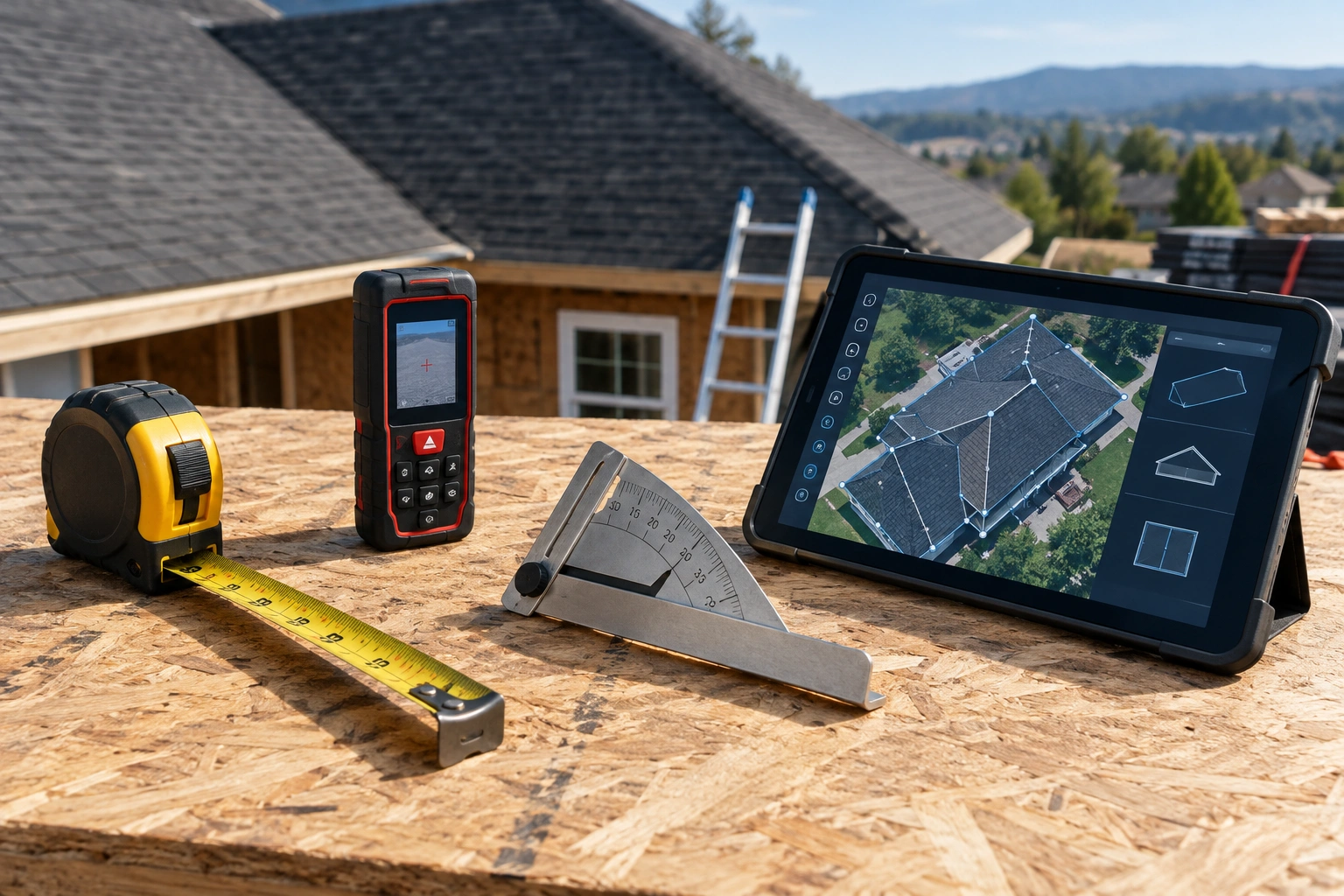
Manual tools win on cost and simplicity. Digital tools win on speed and convenience.
Manual tools are strongest when:
- the roof is simple
- you need a quick verification
- you already have roof access
- you only measure occasionally
A tape measure, pitch gauge, and framing square can get the job done on straightforward roofs. The trade-off is user error. If you misread a line, skip a segment, or forget to adjust for pitch, the estimate suffers.
Digital tools are strongest when:
- you need to measure many roofs
- you want to quote faster
- the roof is hard to access
- you need repeatable reports for sales or estimating
Software and aerial tools can reduce the amount of climbing and manual tracing. That doesn’t make them magic. They still depend on image quality, roof visibility, and correct interpretation of the report.
The practical rule I use is this:
If the roof is simple and accessible, manual tools can be enough. If the roof is complex, steep, or part of a high-volume estimating workflow, digital tools usually make more sense.
On-Roof vs Ground-Based Roof Measurement
There are two ways to gather roof dimensions: on the roof or from the ground.
On-roof measurement
This gives you direct access to edges, ridges, valleys, and penetrations. It can be useful when you need to verify a tricky detail.
The downside is obvious: it requires climbing. That means more time, more exposure, and more risk. If the roof is steep or fragile, the cost of a “simple measurement” can become a safety problem.
Ground-based measurement
This includes laser tools, satellite imagery, aerial reports, and pitch-based calculations. It’s often the better first move when the goal is estimating rather than hands-on verification.
RoofScope describes ground-based approaches that can include manual measuring, satellite imagery, and professional measurement reports. EagleView says its reports can provide area, pitch, and waste factor without the user needing to leave the ground.
That said, ground-based data should be reviewed with common sense. If a roof has hidden additions, unusual dormers, or heavily shaded sections, the report may need a human check before ordering materials.
How to Measure Roof Pitch, Slope, and Area
Pitch changes the math. Ignore it, and you’ll understate the roof surface.
Roof pitch
Pitch is the rise over run, usually expressed as something like 4/12 or 8/12. A pitch gauge helps you read that slope directly. A level and tape can also be used if you know the method.
Roof area
Roof area is the actual surface you cover, not just the footprint of the house. On a pitched roof, the surface area is larger than the flat outline below it.
A simple way to estimate it is:
Roof area = footprint area × pitch multiplier
The pitch multiplier depends on the slope. For example, a steeper roof needs a larger adjustment than a low-slope roof.
Simple roof area example
Say a roof footprint is 2,000 square feet.
- Footprint: 2,000 sq ft
- Pitch adjustment: if the roof pitch requires a multiplier of 1.12, then
2,000 × 1.12 = 2,240 sq ft - Waste factor: if you add 10% waste for cuts, valleys, and layout, then
2,240 × 1.10 = 2,464 sq ft
That means you would plan for about 24.64 roofing squares before rounding up for ordering. Since roofing is ordered in squares, that would typically become 25 squares of material, plus any accessory items the roof design needs.
Roofing squares
Roofing is often ordered in squares, where one square equals 100 square feet of roof area. So if your final roof area is 2,400 square feet, you’re working with 24 squares before waste and accessory calculations.
Waste and layout
Waste depends on roof shape, cut patterns, and material type. A simple roof wastes less than a roof with many valleys and hips. That’s why measurement reports that include waste factor are useful: they translate dimensions into a more realistic order quantity.
A practical example:
A simple rectangular roof may be easy to estimate from length and width. But once you add pitch and multiple intersections, you need a method that captures the real surface, not just the footprint.
Which Tool Is Best for Simple, Steep, Large, or Hard-to-Reach Roofs
Simple residential roof
A tape measure plus pitch gauge is often enough for a small, straightforward roof. If you’re a homeowner planning a shingle purchase, this is the most economical route.
Steep roof
A ground-based measurement service, drone, or satellite report is usually the smarter choice. The roof may be measurable by hand, but that doesn’t mean it’s worth the access risk.
Large roof
A digital measurement workflow saves time on large jobs. The bigger the roof, the more a manual method turns into repeated climbing, repeated checks, and more room for error.
Hard-to-reach roof
Use remote tools first. If the roof is tall, blocked, or unsafe to access, don’t make the measurement problem worse by forcing an on-roof approach.
Complex roof
This is where detailed reports matter. Multiple slopes, valleys, and transitions are exactly where a basic footprint estimate tends to miss material needs.
Best Roof Measuring Tool by Situation
Best budget option for DIY homeowners
Tape measure + pitch gauge
Best when the roof is simple, accessible, and you only need one accurate estimate.
Best mid-range digital option
Laser distance measurer
A strong step up for contractors or hands-on homeowners who want faster field checks without paying for a full measurement service every time.
Best professional service option
Roof measurement software or a paid measurement report
Best when you estimate often, need faster turnaround, or want a more repeatable workflow for sales and ordering.
Best option for steep roofs
Ground-based report or drone measurement
These reduce access risk and are usually a better fit than climbing just to measure.
Best option for large roofs
Remote measurement software or aerial report
The time savings become more valuable as the roof size and job volume increase.
Cost and Value: What You Get at Different Price Levels
Low-cost tools are fine when the roof is simple and the work is occasional. A tape measure, pitch gauge, and roofing square can cover a lot of homeowner projects and small repair estimates.
Mid-range digital tools make sense when speed matters. A laser distance measurer is a good step up for field work, especially when you want faster distance checks without dragging a tape across awkward spans.
Professional measurement services and software are the higher-value play for contractors who estimate often. They cost more, but they can save time on quoting and reduce the need to climb for every bid. Roofr, for example, markets measurement reports as a faster alternative to manual measuring, with reviewed reports delivered quickly. That kind of workflow can matter when the next estimate is waiting.
The value question is not “What’s cheapest?” It’s “What reduces mistakes and delays for the way you actually work?”
When Roof Measurement Software, Satellite Data, or Drone Measurements Make Sense
Remote measurement methods are strongest when speed, access, or safety are the priority.
Use them when:
– you need a fast estimate from an address
– the roof is hard to access
– you want to qualify leads before a site visit
– you’re handling multiple bids in a short window
Jobber’s free roof measurement tool is presented as a remote option for contractors who want to qualify leads quickly. That can be useful when you’re trying to respond fast and keep the lead warm.
Satellite data
Satellite or aerial reports are often the fastest option for a first-pass estimate. They usually do not require a site visit, which makes them efficient for quoting and lead qualification. The trade-off is that they depend on image clarity and roof visibility.
Drone capture
Drone-based measurement can help when the roof is difficult to walk or when a visual record matters. It gives you more control than satellite-only methods, but it also requires equipment, pilot skill, and suitable weather.
Paid measurement services
A paid measurement report can be a good middle ground when you want more detail than a rough aerial estimate but do not want to measure everything manually. The downside is cost, and the report still needs to be checked against the actual roof layout.
Is an app enough, or do you need a full service?
A roof measurement app alone can be enough for simple roofs, quick lead qualification, or rough planning. A full measurement service is usually better when the roof is complex, the order is large, or the estimate needs to support a final bid with less room for error.
The limitation is simple: remote tools are only as good as the imagery and the roof geometry they can see. If the roof is highly irregular or partially hidden, a physical cross-check is still smart before ordering material.
How Roof Measurements Affect Shingle, Underlayment, and Waste Estimates
Roof measurements are not just numbers on a page. They drive what you order.
Shingles
Shingles are usually ordered by the square, so the roof area has to be converted properly. If the pitch is steep, the actual area will be larger than the footprint.
Underlayment
Underlayment coverage follows the same logic, but overlaps and installation pattern matter. A simple area calculation is not the whole story.
Waste
Waste comes from cuts, starter courses, valleys, hips, and ridge details. A roof with lots of transitions will consume more material than a plain roof of the same size.
Here’s a concrete way to think about it:
- Start with the measured footprint
- Apply the pitch adjustment to get actual roof area
- Add a waste factor for cuts, overlaps, and roof complexity
- Round up to the next whole square when ordering shingles
So if a roof measures 2,000 square feet on the footprint, adjusts to 2,240 square feet after pitch, and then gets 10% waste added, the order number becomes about 2,464 square feet, or 25 squares. That is the number you use as the base for shingles, while underlayment and accessories still need their own coverage checks.
The safest habit is to treat the measurement as the base number, then add the real-world extras the roof design requires: waste, overlaps, starter strips, ridge material, and any roof-specific details that affect coverage. That is how you avoid the classic mistake of ordering for the footprint and hoping the roof is simpler than it looks.
Common Mistakes to Avoid When Measuring a Roof
The most expensive mistakes are usually basic:
- measuring only the house footprint
- forgetting to adjust for pitch
- trusting a single estimate on a complex roof
- using an on-roof method when a safer ground-based option exists
- ignoring waste, overlaps, and cut lines
- assuming a remote report needs no review
The biggest one is this: don’t confuse a measurement method with a final answer. Even a good report should be checked against the roof’s shape, visible features, and material plan.
Who Each Option Is For
DIY homeowners
Use a tape measure, pitch gauge, or a basic remote measurement tool if the roof is straightforward. If the roof is steep or complicated, pay for a measurement report before you buy material.
Roofing contractors
Use digital tools, aerial reports, or software if you measure often. Manual tools still matter for verification and field checks, but they should not slow down every estimate.
Quick estimators and sales teams
Remote measurement software is the best fit when response time matters. It helps you qualify jobs before you burn time on a full site visit.
Steep or complex roofs
Use a remote method first, then verify critical details before ordering. That’s the combination that usually gives the best balance of safety and accuracy.
When to Call a Roofing Pro
Call a roofing pro when the roof is steep, damaged, hard to access, or too complex to measure confidently from the ground. If you’re a homeowner and the measurement will affect a full replacement order, paying for a professional roof report is often cheaper than fixing a material shortage later.
If you need a refresher on how measurements connect to actual roof work, our guides on tools used for roof leak detection and tools needed to repair a roof leak can help you think through the job before you start.
FAQ
What is the most accurate way to measure a roof?
For many roofs, a professional measurement report or a careful on-roof measurement is the most accurate. For steep or hard-to-reach roofs, remote reports can be a practical alternative, but they should still be checked against the roof’s actual layout.
Can I measure a roof from the ground?
Yes, in many cases. Satellite reports, drone capture, laser tools, and pitch-based calculations can all support ground-based measurement. The method you choose depends on roof complexity and how precise the estimate needs to be.
Do roof measurement apps replace manual measuring?
Not always. A roof measurement app can be enough for simple roofs or early estimates, but manual verification is still useful for complex layouts, hidden sections, or final material ordering.
How much waste should I add to a roof estimate?
It depends on the roof design and material type. Simple roofs usually need less waste than roofs with hips, valleys, and multiple cuts. Use the roof’s complexity and the manufacturer’s guidance to decide the final allowance.
Final Take
The best roof measuring tool is the one that matches the roof, the risk, and the accuracy you need. For simple jobs, manual tools are still useful and inexpensive. For repeat estimating, steep roofs, and fast bids, digital and remote tools usually pay off. The smart move is not choosing the fanciest option — it’s choosing the one that gets you the right number without creating a safety problem or a material mistake.
