
What Is Included in a Roof Replacement Estimate? A Homeowner’s Guide

Replacing a roof is a major home expense, so a one-line quote with a total price is not enough. Before you sign a contract or pay a deposit, you should understand exactly what the contractor plans to remove, install, repair, and charge for.
Knowing what is included in a roof replacement estimate also makes it much easier to compare contractors fairly. Two estimates may differ by thousands of dollars because one includes decking repairs, upgraded underlayment, permits, cleanup, or a better warranty while another leaves those items out.
This guide explains the major items a detailed roofing estimate should cover, what can cause the final cost to change, and which questions homeowners should ask before approving the project.
Quick Answer
A roof replacement estimate should include the roof size and scope of work, tear-off and disposal, roofing materials, underlayment, flashing, ventilation, labor, permits, cleanup, warranty information, payment terms, and an estimated project schedule. It should also explain how unexpected repairs, such as damaged roof decking, will be priced.
Why a Detailed Roof Replacement Estimate Matters
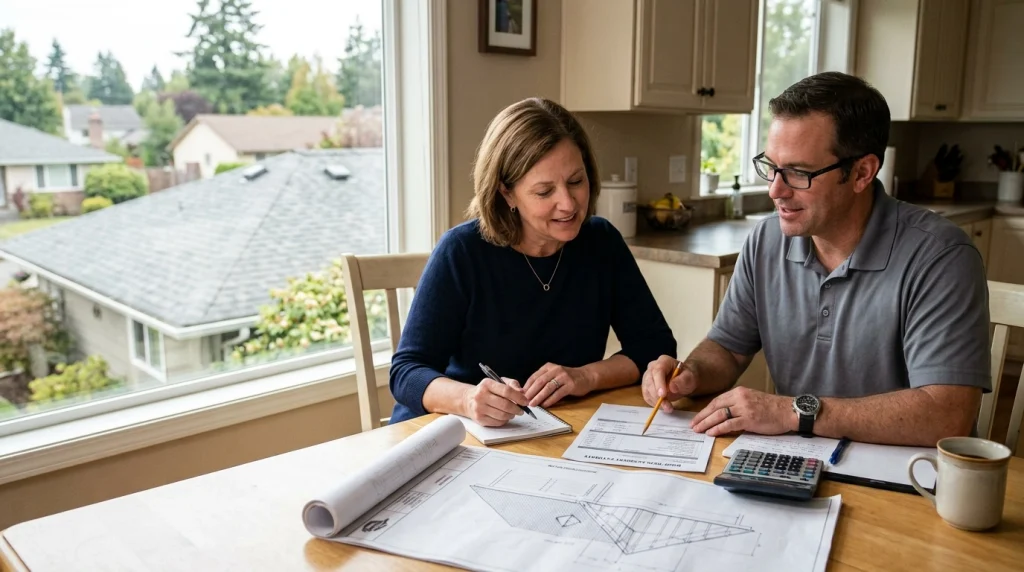
A good estimate does more than tell you the price of a new roof. It establishes what the contractor intends to do and helps prevent disagreements once work starts.
The National Roofing Contractors Association’s contractor-selection guidance recommends getting a written proposal with complete descriptions of the work and specifications, along with project dates and payment procedures.
Detailed estimates also make comparison shopping more meaningful.
For example, Contractor A may quote $14,000 while Contractor B quotes $16,000. At first glance, Contractor A appears cheaper. But Contractor B’s proposal might include replacing deteriorated flashing, installing upgraded synthetic underlayment, improving attic ventilation, obtaining permits, and providing a stronger workmanship warranty.
Compare the scope of work, not just the total at the bottom of the page.
What Is Included in a Roof Replacement Estimate?
Although estimates vary by contractor and roofing system, a professional proposal should address the following major areas.
1. Contractor and Property Information
The estimate should clearly identify both the property and the business performing the work.
Look for:
- Contractor’s legal business name
- Business address and phone number
- Contractor or roofing license number, where required
- Property address
- Homeowner’s name
- Estimate date
- Estimate or proposal number
- Contractor insurance information when applicable
Before hiring anyone, verify licensing requirements with your state or local government.
The Federal Trade Commission’s home-improvement guidance recommends considering licensed and insured contractors, getting multiple estimates, and carefully reviewing written agreements before signing.
2. Roof Measurements and Size
The contractor should explain how much roofing area is being replaced.
Roofers commonly measure roofing in squares. One roofing square equals 100 square feet of roof surface.
A 2,000-square-foot house does not necessarily have a 2,000-square-foot roof. Roof pitch, overhangs, attached garages, porches, dormers, valleys, and other features affect the actual roofing area.
A detailed estimate may show:
- Total roof area
- Number of roofing squares
- Roof pitch or slope
- Number of roof sections
- Valleys and ridges
- Waste allowance
Waste allowance accounts for material that must be trimmed around edges, valleys, hips, and other roof features.
Complex roofs generally require more material and labor than simple two-sided roofs of the same basic size.
3. Removal of the Existing Roof
The estimate should state whether the old roofing will be removed.
Look for wording covering:
- Number of existing roofing layers being removed
- Removal of old shingles, metal, tile, or membrane
- Removal of old underlayment
- Removal of nails and fasteners
- Dumpster or disposal fees
- Hauling debris away from the property
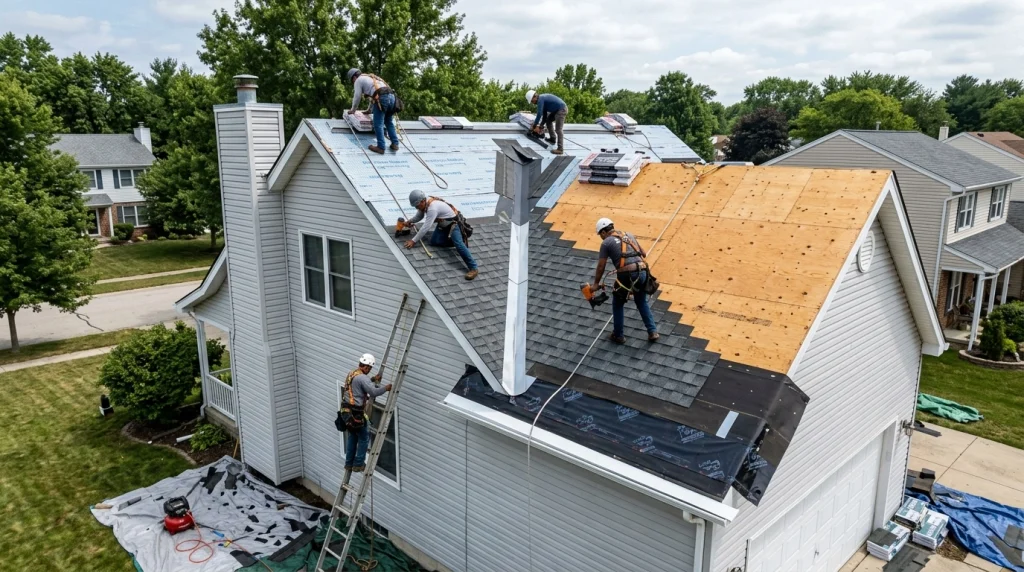
Tear-off costs can increase when several layers of roofing exist or when heavy materials such as tile must be removed.
The estimate should also state what happens if the crew discovers additional roofing layers that were not visible during the initial inspection.
4. Roof Decking Inspection and Repairs
The roof deck, sometimes called sheathing, is the structural surface beneath the roofing materials. It is commonly made from plywood or oriented strand board (OSB).
Contractors often cannot determine the condition of every section of decking until the old roof is removed.
Water leaks, long-term moisture, storm damage, or poor ventilation can cause decking to rot or weaken.
A good estimate should explain:
- Whether decking inspection is included
- What type of replacement decking will be used
- Cost per sheet of plywood or OSB
- Labor charges for replacement
- Whether a certain amount of decking repair is already included
This is one of the most important potential extra costs to clarify.
Ask for the unit price for decking replacement before work starts.
That way, discovering six damaged sheets does not lead to an unexpected pricing dispute halfway through the job.
Typical Items to Look for in a Roofing Estimate
| Estimate Item | What It Should Explain | Why It Matters |
|---|---|---|
| Tear-off | Existing roof removal and disposal | Prevents surprise removal fees |
| Decking | Inspection and replacement price | Hidden rot may increase cost |
| Underlayment | Product type and coverage | Adds protection beneath roofing |
| Roofing material | Brand, product line, style, color | Determines quality and warranty |
| Flashing | Replacement or reuse details | Helps prevent leaks at vulnerable areas |
| Ventilation | Intake and exhaust components | Helps manage attic heat and moisture |
| Labor | Installation work included | Major part of total project cost |
| Permits | Who obtains and pays for them | Requirements vary by location |
| Cleanup | Debris and nail removal | Protects landscaping and property |
| Warranty | Material and workmanship coverage | Defines protection after installation |
5. Underlayment and Water Protection
Underlayment is a protective layer installed between the roof decking and the finished roofing material.
The estimate should specify what will be installed rather than simply saying “underlayment included.”
Common options include:
- Asphalt-saturated felt
- Synthetic underlayment
- Ice-and-water protection membrane
Ice-and-water membrane is commonly installed in particularly vulnerable areas depending on the roof design, climate, manufacturer requirements, and local building codes.
Possible locations include:
- Valleys
- Eaves
- Around roof penetrations
- Around chimneys
- Leak-prone transitions
Different products have different costs, so identifying the product helps you compare competing estimates accurately.
6. Roofing Material Details
The estimate should clearly identify the new roofing product.
For asphalt shingles, look for:
- Manufacturer
- Product line
- Shingle style
- Color
- Quantity
- Starter shingles
- Ridge-cap shingles
- Fastener requirements
For metal, tile, wood shake, EPDM, TPO, or another roofing system, the proposal should provide similar product-specific information.
Avoid estimates that simply say something vague such as “install architectural shingles.”
There can be substantial differences between product lines, warranties, installation systems, and material grades.
Flashing, Drip Edge, and Roof Penetrations
Flashing directs water away from joints and openings where leaks commonly develop.
A replacement estimate should explain how the contractor will handle flashing around:
- Chimneys
- Skylights
- Plumbing vents
- Sidewalls
- Dormers
- Roof-to-wall intersections
- Valleys
The proposal should also address drip edge, which is metal installed along roof edges to help direct water away from the decking and fascia.
Do not assume existing flashing will automatically be replaced. Some estimates include new flashing, while others propose reusing components that remain serviceable.
Ask the contractor to identify which approach is included.
Roof Ventilation
Ventilation is easy to overlook when comparing roofing estimates, but it can be important to the overall roof system.
A balanced attic ventilation system typically uses intake ventilation near the lower portion of the roof and exhaust ventilation higher up.
Depending on the house, an estimate might include:
- Ridge vents
- Soffit vents
- Box vents
- Other approved intake or exhaust vents
The proposal should explain whether existing ventilation will remain, be replaced, or be modified.
Poor ventilation can contribute to excess attic heat and moisture. However, adding more vents without evaluating the existing system is not automatically an improvement.
A qualified contractor should consider the roof design and existing ventilation before recommending changes.
Labor and Installation Charges
Labor often represents a significant portion of a roof replacement budget.
The estimate should explain what installation work is included rather than leaving everything under an unexplained lump sum.
Labor can include:
- Removing old roofing
- Preparing the roof deck
- Installing underlayment
- Installing roofing material
- Installing flashing
- Installing ventilation components
- Installing ridge caps and accessories
- Cleanup
Roof difficulty affects labor costs.
A steep roof, multiple stories, numerous valleys, dormers, limited property access, or complicated architectural features can require more time and additional safety measures.
Permits and Inspections
Roof replacement permitting requirements vary by location.
Your estimate should state:
- Whether a permit is required
- Who obtains it
- Whether the permit cost is included
- Whether required inspections are included
Do not assume permit costs are part of a bid simply because the contractor handles the paperwork.
Ask for clarification before signing.
Cleanup and Property Protection
Roof replacement creates a considerable amount of debris.
The estimate should explain how the contractor intends to protect and clean the property.
Look for details involving:
- Dumpster placement
- Debris removal
- Magnetic nail cleanup
- Protection for siding
- Protection for windows
- Protection for landscaping
- Driveway protection where needed
- Final cleanup
You may also want to ask who is responsible if roofing debris damages landscaping, vehicles, siding, or other property.
Project Schedule
A roofing estimate should normally provide an approximate project schedule.
This may include:
- Estimated start date
- Approximate duration
- Weather-delay procedures
- Material-delivery timing
A contractor generally cannot guarantee perfect weather, so reasonable schedule flexibility is normal.
However, vague promises such as “we’ll get to it sometime next month” are less helpful than a documented approximate window.
Payment Terms
Never look only at the project total. Review how and when payment is expected.
The estimate or related contract should explain:
- Deposit amount
- Progress payments, if any
- Final payment
- Accepted payment methods
- Financing terms, if applicable
- Charges for approved change orders
The FTC advises homeowners not to automatically choose the lowest bid and warns against paying the full project amount upfront.
Do not sign an agreement containing blank spaces or unclear payment obligations.
Material and Workmanship Warranties
Roof warranties usually involve two separate types of protection.
Manufacturer Warranty
This applies to the roofing product and is provided by the manufacturer.
Coverage depends on the specific product and warranty terms.
Contractor Workmanship Warranty
This covers problems related to installation for the period specified by the contractor.
The estimate should identify:
- Warranty length
- Who provides each warranty
- What is covered
- Major exclusions
- Whether registration is required
Do not assume a “30-year shingle” means every roof problem is covered for 30 years.
Read the actual warranty terms.
What Can Make the Final Roof Cost Higher Than the Estimate?
A roof replacement estimate is based partly on conditions that can be observed before tear-off. Some problems remain hidden until the existing roofing is removed.
Common additional costs include:
- Rotten decking
- Structural damage
- Multiple unexpected roof layers
- Damaged flashing
- Deteriorated fascia
- Code-required upgrades
- Additional ventilation work
- Unforeseen water damage
Your contract should explain how these changes will be documented and approved.
Ideally, the contractor uses a written change order showing the additional work and cost before proceeding, except where immediate action is necessary to keep the structure weather-tight or safe.
Expert Tip
Expert Tip: Ask every contractor to price common unknowns—especially decking replacement—by unit before signing. Comparing a “$75 per sheet” decking charge with an undefined “additional wood repairs billed as needed” can save you from major surprises later.
How to Compare Two Roof Replacement Estimates
Do not simply place the totals side by side.
Use this process instead:
- Confirm both contractors measured the same roofing scope.
- Compare the exact roofing products.
- Check whether tear-off and disposal are included.
- Compare underlayment and water-protection materials.
- Review flashing and ventilation work.
- Check decking replacement pricing.
- Compare permit and cleanup charges.
- Review both warranties.
- Compare payment terms.
- Ask about any major price differences.
NRCA’s homeowner roofing resources similarly note that new-roof pricing varies with factors such as material choice, contractor, home size, location, labor rates, and timing—and that price should be considered together with material and workmanship quality.
Common Mistakes Homeowners Should Avoid
- Choosing only by price. The lowest proposal may have a smaller scope of work or less comprehensive materials.
- Accepting vague material descriptions. Get specific manufacturer and product information.
- Ignoring decking charges. Hidden wood damage is one of the most common variables during tear-off.
- Assuming all flashing is new. Make sure the estimate states whether flashing will be replaced or reused.
- Overlooking ventilation. A new roof does not automatically correct an existing ventilation problem.
- Failing to compare warranties. Material and workmanship warranties are not the same thing.
- Paying the entire project price upfront. Review your state’s rules and agree to clear payment terms.
- Accepting verbal promises. Important promises and scope changes should be documented in writing.
- Inspecting a steep or damaged roof yourself. A pricing question is not worth risking a serious fall.
When to Consult a Licensed Roofing Contractor
A professional roofing evaluation is particularly important when your home has:
- Active roof leaks
- Missing or badly damaged shingles
- Hail or wind damage
- Sagging roof areas
- Soft or deteriorated decking
- Persistent attic moisture
- Major flashing failure
- A roof near the end of its expected service life
- Possible structural damage
- An insurance claim involving storm damage
You should also use professional help if determining the roof’s condition would require climbing onto it.
Roof work carries serious fall hazards. OSHA’s residential roofing fall-protection guidance emphasizes fall protection during residential construction and roofing work.
For homeowners, the practical takeaway is simple: you do not need to climb onto a steep, wet, storm-damaged, or structurally questionable roof just to verify an estimate.
Ask the contractor for photographs or video documentation instead.
If visible sagging, widespread decking deterioration, damaged rafters or trusses, or other structural concerns are discovered, additional evaluation by an appropriately qualified professional may be necessary before replacement continues.
FAQs
What should a roof replacement quote include?
A detailed quote should describe roof size, tear-off, disposal, decking procedures, underlayment, roofing materials, flashing, ventilation, labor, permits, cleanup, warranties, payment terms, and the approximate project schedule.
Does a roof estimate include plywood replacement?
Sometimes, but not always. Because damaged decking may remain hidden until tear-off, many contractors list a per-sheet replacement price instead of including an unlimited amount of plywood in the original bid.
Should gutters be included in a roof replacement estimate?
Not necessarily. Gutters are a separate component, although roof work may involve removing or protecting them. If gutter replacement or repair is needed, make sure it is specifically listed in the proposal.
Are permits normally included in a roofing quote?
This depends on the contractor and local requirements. The estimate should state whether permit fees are included and who is responsible for obtaining required permits.
Why are my roofing estimates so different?
Differences may come from roof measurements, roofing products, labor rates, tear-off assumptions, decking allowances, ventilation work, flashing, warranties, overhead, and other scope details. Ask each contractor to explain significant differences.
Can the final roof price be higher than the estimate?
Yes, particularly when hidden damage is discovered after tear-off. Your agreement should explain how additional work is priced, documented, and approved.
How many roof estimates should I get?
Getting multiple written estimates gives you a better basis for comparing scope, materials, warranties, and pricing. The FTC specifically recommends obtaining multiple estimates and asking for explanations when prices differ significantly.
Conclusion
Understanding what is included in a roof replacement estimate helps you make a much better decision than simply looking for the lowest number.
A strong estimate should clearly explain the roofing materials, tear-off, decking procedures, underlayment, flashing, ventilation, labor, permits, cleanup, warranties, payment terms, and potential extra charges.
Pay particular attention to anything that is undefined. Hidden decking repairs, flashing decisions, permit fees, disposal charges, and change-order procedures can all affect the final price.
Before signing, compare several detailed proposals, verify the contractor’s credentials where required, and ask questions about every unclear line item.
The best next step is to request an itemized written estimate and make sure you understand exactly what is—and is not—included before approving your roof replacement.