What Are the Different Types of Metal Roofing? A Homeowner’s Guide

Choosing a metal roof can feel confusing because “metal roofing” is not one single product. Panels may look similar from the ground, yet they can differ greatly in fastening method, appearance, durability, maintenance needs, and price.
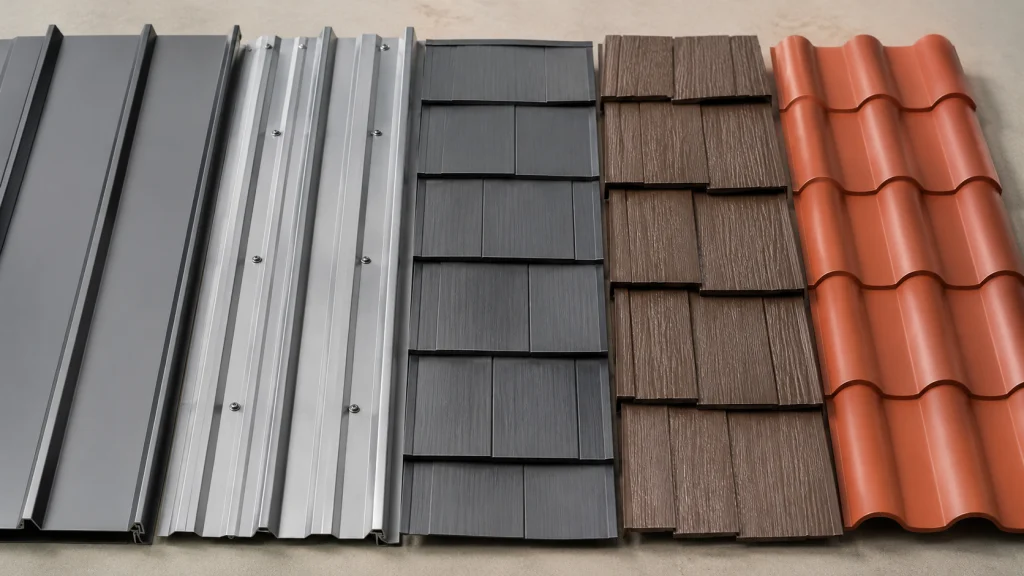
Understanding what are the different types of metal roofing helps you compare estimates and avoid paying for a system that does not fit your home. This guide explains the main metal roof styles, common materials, advantages, limitations, costs, and questions to ask before hiring a contractor.
Quick Answer
The main types of metal roofing are standing seam panels, exposed-fastener panels, metal shingles, corrugated panels, and metal tiles or shakes. They are commonly made from steel, aluminum, copper, or zinc. The best option depends on your budget, roof design, climate, desired appearance, and maintenance expectations.
Metal Roofing Can Be Classified in Two Ways
When comparing metal roofs, homeowners should look at both the roofing system and the metal material.
The roofing system describes how the pieces are shaped, connected, and fastened. Examples include standing seam panels and metal shingles.
The material describes what the roof is made from. Common options include:
- Galvanized steel
- Galvalume steel
- Aluminum
- Copper
- Zinc
- Stainless steel
Two roofs can use the same type of panel but different metals. For example, a standing seam roof may be made from painted steel, aluminum, copper, or zinc.
Main Types of Metal Roofing Systems
1. Standing Seam Metal Roofing
Standing seam is one of the most recognizable premium metal roofing systems. It uses long vertical panels with raised seams running from the eave toward the ridge.
The fasteners are usually hidden beneath the seams. Clips secure the panels while allowing the metal to expand and contract as temperatures change.
Benefits of standing seam roofing
- Clean, modern appearance
- Concealed fasteners are protected from weather
- Lower risk of fastener-related leaks
- Suitable for many steep- and low-slope roofs
- Works well with snow-retention and solar-panel systems
- Usually requires less fastener maintenance than exposed-fastener roofing
Limitations
- Higher initial installation cost
- Requires trained installers and specialized equipment
- Poorly formed seams can allow water intrusion
- Flat areas may show waviness known as oil canning
Standing seam is often a strong choice for homeowners who want long service life, low maintenance, and a simple architectural appearance. However, the quality of the installer matters as much as the panel itself.
2. Exposed-Fastener Metal Panels
Exposed-fastener roofing uses screws that pass through the face of the panel and into the roof deck or framing. Each screw normally has a rubber sealing washer beneath its head.
Common profiles include:
- R-panel
- PBR panel
- AG panel
- 5V-crimp
- Ribbed utility panels
This system is widely used on barns, workshops, garages, sheds, and some homes.
Benefits of exposed-fastener panels
- More affordable than standing seam
- Faster to install
- Readily available in many regions
- Suitable for simple roof shapes
- Available in many colors and rib profiles
Limitations
- Thousands of fasteners may be exposed to rain and sunlight
- Washers can deteriorate over time
- Screws may loosen as panels expand and contract
- Improper screw placement can cause leaks
- More frequent inspections may be needed
Exposed-fastener roofing is not automatically a poor-quality roof. It can perform well when correctly designed, installed, and maintained. It simply has more exposed points that may eventually require attention.
3. Corrugated Metal Roofing
Corrugated roofing has a repeated wavy pattern. The curves strengthen thin sheets of metal and help direct water down the roof.
Traditional corrugated panels are commonly fastened through the face, although some newer architectural systems use concealed attachment methods.
Corrugated metal works well for:
- Farmhouses
- Cabins
- Rustic homes
- Porches
- Agricultural buildings
- Contemporary industrial-style designs
It is usually economical, lightweight, and easy to source. However, homeowners should confirm whether the selected profile is rated for residential roofing and suitable for the roof’s slope.
4. Metal Shingles
Metal shingles are smaller interlocking panels designed to resemble traditional asphalt shingles. From the street, many products do not immediately look like metal.
They may be smooth, stamped, stone-coated, or formed with dimensional patterns.
Benefits of metal shingles
- Familiar residential appearance
- Lighter than many tile or slate products
- Concealed or partially concealed fastening
- Suitable for complex roofs with hips, valleys, and dormers
- Available in a wide range of colors and textures
Limitations
- Usually more expensive than exposed-fastener panels
- Installation requires product-specific training
- Individual repairs can be difficult if matching pieces are unavailable
- Foot traffic may dent some profiles
Metal shingles can be a practical compromise for homeowners who want metal-roof performance without the long vertical lines of standing seam.
5. Metal Roofing That Looks Like Tile
Metal tile roofing is pressed or stamped to resemble clay, concrete, or Spanish-style roof tiles. It creates a traditional appearance without the heavy structural load of real masonry tile.
This type may be attractive in Mediterranean, Southwestern, coastal, and Spanish Colonial architecture.
Its main advantages include:
- Much lower weight than concrete or clay
- Resistance to cracking from freeze-thaw cycles
- Interlocking panels that shed water efficiently
- Availability in painted and stone-coated finishes
The installation details around valleys, ridges, walls, and penetrations can be complex. A contractor should have experience with the exact tile-profile system being proposed.
6. Metal Shake Roofing
Metal shakes are designed to imitate split cedar or wood shakes. Stamped patterns, varied colors, and textured coatings create a more natural appearance.
Metal shakes do not rot, split, absorb water, or attract insects like real wood. They may also provide better fire performance, depending on the tested roof assembly.
Possible drawbacks include a higher purchase price and the risk of denting from severe hail or careless foot traffic.
7. Stone-Coated Steel Roofing
Stone-coated steel uses formed steel panels covered with small mineral granules. The granules create texture and allow the panels to resemble shingles, shakes, or tile.
Why homeowners choose it
- Traditional appearance
- Durable steel base
- Wide range of profiles
- Granulated surface reduces the shiny metal look
- Lighter than concrete or clay tile
The granules may wear or loosen over time, particularly in valleys or areas with frequent foot traffic. Repairs should use compatible materials so the color, texture, and corrosion protection remain consistent.
Comparison of Metal Roofing Types
| Roofing type | Fastener style | Typical appearance | Relative cost | Maintenance level | Best suited for |
|---|---|---|---|---|---|
| Standing seam | Concealed | Modern vertical seams | High | Low | Homes, additions, premium projects |
| Exposed-fastener panel | Exposed | Ribbed or agricultural | Low to moderate | Moderate | Garages, barns, simple homes |
| Corrugated panel | Usually exposed | Wavy, rustic, industrial | Low to moderate | Moderate | Cabins, porches, farm-style homes |
| Metal shingles | Usually concealed | Traditional shingles | Moderate to high | Low to moderate | Residential roofs with complex shapes |
| Metal tile | Usually concealed | Clay or Spanish tile | High | Low to moderate | Mediterranean and Southwestern homes |
| Metal shakes | Usually concealed | Wood-shake appearance | High | Low to moderate | Rustic and traditional homes |
| Stone-coated steel | Concealed or interlocking | Shingle, shake, or tile | Moderate to high | Moderate | Homeowners seeking textured finishes |
Prices and maintenance needs vary by metal thickness, coating, roof complexity, local labor rates, and installation quality.
Types of Metal Used for Roofing
Galvanized Steel
Galvanized steel is coated with zinc to protect the steel core from corrosion. It is strong, widely available, and relatively economical.
The coating must remain intact because exposed steel can eventually rust. Cut edges, scratches, and incompatible fasteners require careful treatment.
Galvanized steel is commonly used for exposed-fastener panels, corrugated sheets, and some standing seam systems.
Galvalume Steel
Galvalume steel has an aluminum-zinc alloy coating. It is widely used for residential and commercial metal roofing because it offers strong corrosion resistance in many environments.
It may be sold with a bare metallic finish or a factory-applied paint system.
Bare Galvalume may not be suitable for every coastal, agricultural, or chemically aggressive environment. Local exposure conditions and manufacturer requirements should guide the decision.
Aluminum
Aluminum naturally resists rust and is particularly useful in coastal areas where salt air can accelerate corrosion.
Its advantages include:
- Low weight
- Strong corrosion resistance
- Easy forming for architectural details
- Suitability for coastal environments
Aluminum is softer than steel, so it may dent more easily. It also tends to cost more than common steel roofing.
Copper
Copper is a premium roofing material known for its distinctive appearance. New copper begins with a bright metallic color and gradually develops a brown and then greenish patina.
Copper is often used for:
- High-end standing seam roofs
- Bay windows
- Porches
- Towers
- Cupolas
- Flashing and decorative details
It can remain serviceable for many decades, but the initial cost is high. Copper must also be separated from incompatible metals to prevent galvanic corrosion.
Zinc
Zinc is another premium metal that develops a protective surface layer as it ages. Small scratches may become less visible as this patina forms.
Zinc is durable and highly formable, making it useful for complex architectural roofs. However, it is expensive and requires installers who understand zinc-specific ventilation, fastening, and detailing requirements.
Stainless Steel
Stainless steel offers high strength and excellent corrosion resistance. It is more common in specialized, industrial, coastal, or high-performance applications than in ordinary residential roofing.
Its cost usually limits its use to selected roof sections, fasteners, flashings, or demanding environments.
Which Metal Roof Is Best for Your Home?
There is no single best metal roof for every property. Use the following factors to narrow your choices.
Your budget
Exposed-fastener steel panels generally have the lowest initial cost. Standing seam, metal shingles, aluminum, zinc, and copper usually cost more.
Do not compare only the price per square foot of the panel. A complete estimate should include:
- Removal of the old roof
- Deck repairs
- Underlayment
- Flashing
- Ventilation work
- Trim and accessories
- Labor
- Permits
- Disposal
- Warranty coverage
Your local climate
Coastal homes may benefit from aluminum or specially approved coated-steel systems. Snowy areas may need snow guards and carefully designed eaves. High-wind regions require tested panels, proper attachment, and correctly spaced fasteners or clips.
Metal roofing products and their installation must comply with applicable building requirements. FEMA’s wind-resistant provisions for residential roof coverings show why wind design, fastening, and a continuous load path are important in vulnerable locations. (FEMA)
Roof shape and slope
Long standing seam panels work efficiently on simple roof planes. Smaller metal shingles may be easier to fit around multiple dormers, valleys, hips, and changes in slope.
Some metal systems can be installed on relatively low slopes, while others require a steeper pitch. Never assume that every metal panel is suitable for your roof slope. Follow the product’s tested installation instructions.
Energy performance
Metal roofs can use reflective coatings that reduce solar heat absorption. However, performance depends on the coating, color, insulation, ventilation, climate, and complete roof assembly.
The U.S. Department of Energy explains that cool-roof benefits are generally greatest in hot climates, while winter heating effects should also be considered in colder locations. (The Department of Energy’s Energy.gov)
Appearance
Ask to see full-size samples outdoors. A small color chip may look very different when installed across an entire roof.
Consider how the profile and color will work with:
- Siding
- Brick or stone
- Gutters
- Fascia
- Windows
- Neighborhood architecture
- Homeowners association requirements
Understanding Metal Thickness and Coatings
Roofing steel is often described by gauge. A lower gauge number generally indicates thicker steel, but homeowners should not choose a roof based on gauge alone.
Compare the full product specification, including:
- Actual metal thickness
- Base metal
- Galvanized or Galvalume coating designation
- Paint system
- Panel width and rib depth
- Testing approvals
- Wind-uplift rating
- Impact rating
- Finish warranty
- Substrate warranty
Painted metal commonly uses either polyester-based coatings or higher-performance resin systems. Better coatings generally retain color and resist chalking longer, although exposure, roof angle, color, and location also affect weathering.
Expert Tip:
Ask every contractor to identify the exact panel manufacturer, product name, metal thickness, coating, paint system, and warranty in writing. “Premium metal roof” is a marketing description, not a complete specification.
How Long Do Different Metal Roofs Last?

A metal roof’s actual service life depends on the material, coating, environment, design, installation, and maintenance.
In general:
- Exposed-fastener steel roofs may require periodic screw and washer maintenance.
- Painted standing seam steel can provide decades of service when properly detailed.
- Aluminum performs especially well where rust is a concern.
- Copper and zinc are commonly chosen for very long-term architectural applications.
- Damaged coatings, trapped moisture, poor flashing, and incompatible metals can shorten any roof’s life.
The Metal Construction Association describes metal roofing as a group of systems for low-slope, steep-slope, and insulated-panel applications rather than one universal product. Its metal roofing technical overview also notes the role of reflective pigments and recycled content in modern products. (Metal Construction Association)
Can Metal Roofing Be Installed Over Existing Shingles?
Some metal roofs can be installed over one existing layer of shingles, but the decision should be made only after inspecting the deck, framing, flashing, and local code requirements.
Covering an old roof may hide:
- Rotten sheathing
- Previous leaks
- Soft decking
- Damaged flashing
- Uneven surfaces
- Inadequate ventilation
The existing roof also affects how the new panels lie. Uneven shingles can telegraph through flat metal panels or contribute to visible waviness.
A contractor should explain whether the old roof will remain, how the deck will be evaluated, and what separation layer or underlayment will be used.
Metal Roofing Safety and DIY Limitations
Metal panels are long, sharp, slippery, and difficult to control in wind. Improper handling can cause severe cuts, falls, panel damage, or electrical contact.
Metal roof installation also requires precise work around:
- Valleys
- Chimneys
- Skylights
- Plumbing vents
- Sidewalls
- Ridges
- Eaves
- Roof-to-wall transitions
A minor flashing error can allow water to travel beneath several panels before appearing inside the house.
OSHA’s residential roofing fall-protection guidance emphasizes the serious fall risks involved in roofing work. (OSHA) Homeowners should avoid climbing onto a metal roof without suitable training, access equipment, footwear, anchor points, and fall protection.
Do not attempt installation or leak repair during rain, frost, high winds, or when the panels are wet.
When to Call a Roofing Professional
Call a qualified metal roofing contractor when:
- You are choosing between concealed- and exposed-fastener systems.
- The roof has valleys, dormers, skylights, chimneys, or multiple slopes.
- Panels are lifting, buckling, rusting, or separating at seams.
- Screws are loose or washers are cracked.
- Water stains appear after wind-driven rain.
- The roof deck feels soft or uneven.
- You need an assessment after hail or severe wind.
- You are considering installing metal over existing shingles.
- Your home is in a coastal, wildfire, hurricane, or heavy-snow area.
A professional should inspect the complete assembly rather than judging the roof only from the ground.
Ask contractors for proof of licensing where required, liability insurance, workers’ compensation coverage, manufacturer training, recent references, and a detailed written scope.
Common Mistakes Homeowners Should Avoid
- Choosing by color alone: The fastening system, metal thickness, coating, flashing, and installer quality are more important than appearance alone.
- Comparing incomplete estimates: One quote may include tear-off, underlayment, and flashing while another does not.
- Assuming all steel panels are equal: Coating type, thickness, paint system, and testing can vary significantly.
- Using incompatible metals: Contact between certain metals can accelerate corrosion.
- Installing unsuitable screws: Fasteners should match the panel, substrate, environment, and manufacturer’s instructions.
- Overdriving exposed screws: Crushing the washer can damage the seal.
- Ignoring ventilation: A new roof covering does not correct existing attic moisture or airflow problems.
- Hiring an asphalt-only contractor: Metal roofing requires different layout, cutting, fastening, and flashing skills.
- Walking on panels carelessly: Incorrect foot placement can dent panels or damage seams.
- Assuming every metal roof is maintenance-free: Even premium systems need periodic inspection of sealants, flashings, penetrations, coatings, and drainage paths.
Questions to Ask a Metal Roofing Contractor
Before signing a contract, ask:
- What exact roofing system and panel profile are you proposing?
- Are the fasteners exposed or concealed?
- What metal, thickness, coating, and paint system will be used?
- Is the system approved for my roof slope and local wind conditions?
- How will valleys, walls, chimneys, and penetrations be flashed?
- Will the old roof be removed?
- How will damaged decking be identified and priced?
- What underlayment and ventilation work are included?
- Who provides the workmanship and material warranties?
- Have you installed this exact product before?
The contractor’s answers should appear in the written proposal. Avoid relying on verbal assurances for major installation details.
FAQs
What are the most common types of metal roofing for homes?
The most common residential choices are standing seam panels, exposed-fastener panels, metal shingles, stone-coated steel, metal shakes, and metal tiles. Standing seam and metal shingles are especially popular when homeowners want concealed fasteners.
Is standing seam better than corrugated metal roofing?
Standing seam generally offers better fastener protection and lower maintenance because its attachment system is concealed. Corrugated roofing is usually less expensive but often uses exposed screws that require periodic inspection.
What is the least expensive type of metal roof?
Exposed-fastener steel panels are usually the most affordable. Final cost depends on roof shape, panel thickness, coating, tear-off requirements, flashing complexity, and local labor rates.
Which metal roofing material does not rust?
Aluminum, copper, and zinc do not develop red rust like ordinary steel. However, they can still weather, corrode under certain conditions, or react with incompatible materials. Coated steel resists rust as long as its protective system remains effective.
What type of metal roof is best for a coastal home?
Aluminum is often considered for coastal environments because it resists rust. Some coated-steel and stainless-steel systems may also be suitable when specifically approved for the site’s salt exposure. Product warranties and fastener compatibility should be checked carefully.
Are metal shingles as durable as standing seam roofing?
Quality metal shingles can be highly durable, but performance depends on the product, installation, roof design, and environment. Standing seam has fewer horizontal joints and is often preferred for simple roof planes, while shingles may fit complex roofs more easily.
Does a metal roof make a house hotter?
Not necessarily. Roof temperature depends on color, solar reflectance, coating, insulation, ventilation, and climate. Reflective metal finishes can reduce heat absorption, but the complete attic and roof assembly determines indoor comfort and energy use.
Conclusion
Understanding what are the different types of metal roofing makes it easier to compare products without being distracted by broad marketing terms. Standing seam offers concealed fasteners and a clean appearance, while exposed-fastener and corrugated panels provide a more economical option. Metal shingles, shakes, and tiles offer traditional styles, and steel, aluminum, copper, and zinc each perform differently.
The best roof is not simply the most expensive material. It is the system that fits your climate, roof slope, architecture, maintenance expectations, and budget—and is installed with correct fastening, flashing, ventilation, and corrosion control.
Request detailed written estimates from experienced metal roofing contractors, compare complete product specifications, and have the existing roof structure inspected before making your final decision.