
Free Online Roof Measuring Tool: How to Choose the Right One for Fast, Usable Estimates

If you need a roof size estimate fast, a free online roof measuring tool can save a lot of time. But “free” can mean very different things. Some tools give you a rough roof area from an address and aerial imagery. Others add pitch, material takeoffs, or even a branded quote workflow. The key is knowing what the tool actually measures, what it only estimates, and when you still need eyes on the roof.
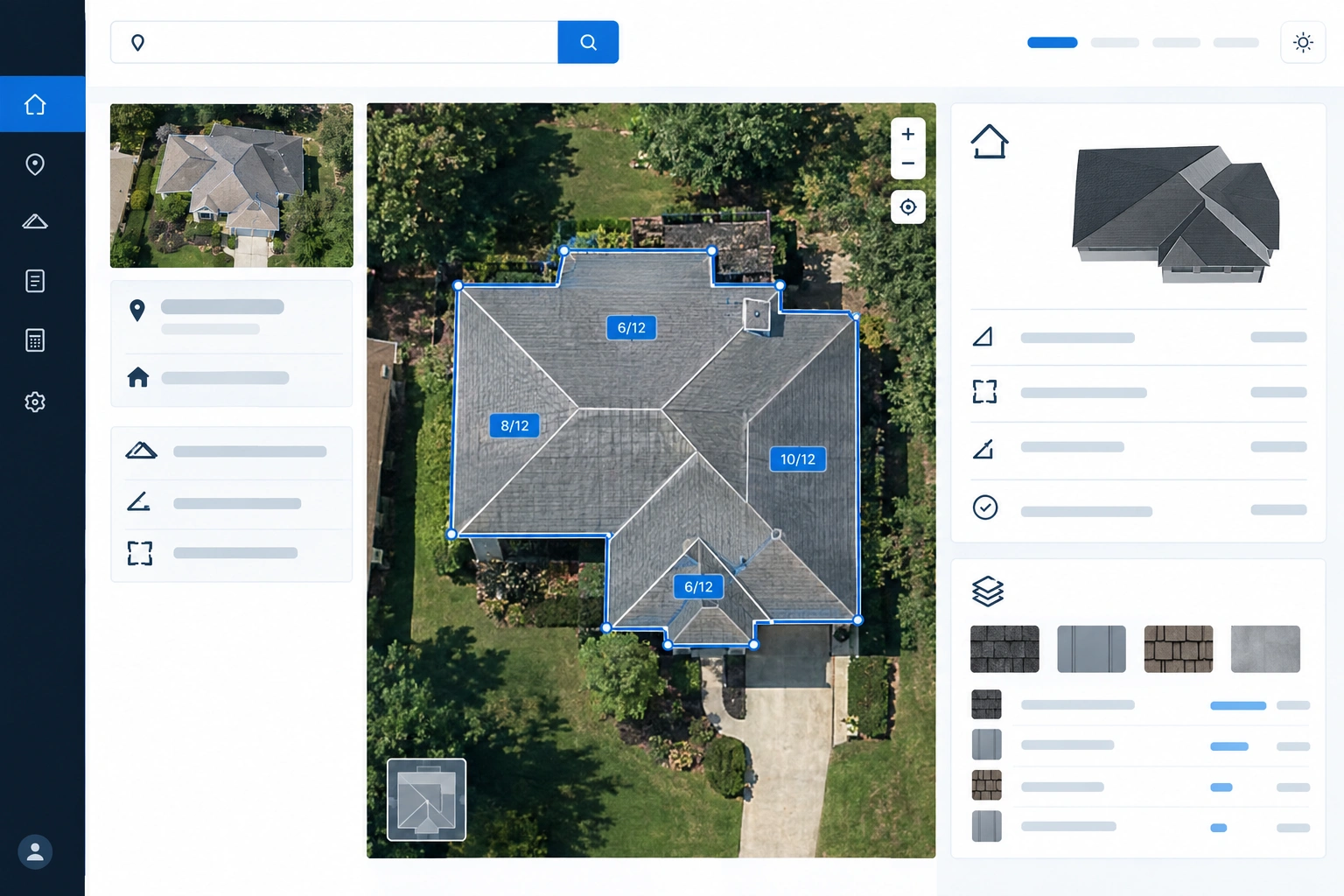
I’ve spent enough time around estimates and jobsite numbers to know this: a quick online measurement is useful only if you understand its limits. If you treat a free tool like a final takeoff, you can end up short on materials, off on labor, or underpricing a job. If you use it the right way, though, it’s a strong early-stage tool for contractors and a practical budgeting aid for homeowners.
What a Free Online Roof Measuring Tool Actually Does
A free online roof measuring tool is usually built to estimate roof dimensions without climbing a ladder or pulling out a tape. The tool may ask for an address, let you mark a roof on imagery, or pull in aerial data automatically. From there, it can estimate roof area, pitch, and sometimes materials.
That sounds straightforward, but there’s an important difference between a measurement and an estimate. A true measurement is based on defined roof geometry and visible data. An estimate may be based on imagery quality, building footprint, roof pitch assumptions, and default waste factors. That’s fine for early planning. It is not the same as a final field takeoff.
In practice, free tools usually fall into one of three buckets: address-based tools that return a roof estimate from property data and aerial imagery, aerial or satellite tools that let you trace the roof from overhead images, and photo-based tools that rely on drone photos, uploaded images, or blueprints. Each can be useful, but none can fully replace an on-site inspection when the roof is complex, damaged, or hidden conditions matter.
Jobber’s free roof measurement tool is an example of a measurement-to-quote workflow, but the main point is broader: free tools can help you move quickly, yet they should not be your last checkpoint for a complex or high-dollar roof. See Jobber’s free roof measurement tool.
How Roof Measurement Tools Work
Most free roof tools use one of three approaches.
Satellite or aerial imagery
These tools use overhead imagery to trace the roof outline. That can be enough for a simple gable or hip roof with clean edges. The upside is speed. The downside is that imagery may be dated, shadows can hide edges, and roof features like dormers or step-down sections may not be obvious.
Address-based measurement
Some tools start with an address, then pull in roof data tied to that property. Eroofquote says its Roof Quote Tool uses your address and aerial roof measurements to estimate roof size, pitch, and replacement cost. That makes it easier for a homeowner or contractor to get a quick ballpark without drawing the roof from scratch. See Eroofquote’s address-based roof estimate tool.
DIY image or blueprint measurement
A few tools let you upload drone photos or work from new-build blueprints. Roofr says you can pull up imagery and measure roofs yourself, including for drone photos or new-build blueprints. That’s useful when you already have better source material than a public aerial image. It gives you more control, but it also puts more responsibility on you to trace correctly. See Roofr’s measurement workflow.
RoofSnap takes a slightly different angle. Its free trial includes measuring service, DIY measuring, instant estimates, contracts, and more, and the first report is free. That matters if you want to test a more contractor-oriented workflow before paying for ongoing access. See RoofSnap’s free trial.
What to Look for in a Free Roof Measuring Tool
If you’re comparing tools, use the same checklist every time. That keeps you from getting distracted by flashy marketing or a “free” label that only covers a tiny part of the workflow.
1) Required inputs
A good free tool should be simple enough to use without much setup. Address-only tools are easiest for homeowners and fast-moving sales teams. Image-based tools are better when you already have drone shots or a blueprint. If a tool needs too many manual inputs just to get a basic roof size, the time savings disappear.
2) Pitch handling
Roof pitch changes material needs and labor assumptions. If the tool ignores pitch, it may understate the actual roof surface. That’s a problem on steeper roofs, where the roof area is larger than the footprint suggests. If pitch is included, check whether the tool asks you to confirm it or estimates it from imagery.
3) Material takeoff support
A roof area number alone is not enough for ordering. Roofr says materials are calculated based on pitch, roofing squares, and your preferred waste factor. That is the kind of detail contractors need when they are turning measurements into a real takeoff. If a free tool stops at square footage, you will still need to do the material math yourself.
4) Report and export options
A free tool is much more useful if it gives you something you can actually use later: a PDF, a shareable report, a quote draft, or line-item output. If the result only appears on-screen and disappears once you leave, it is harder to use for bidding or homeowner discussions.
5) Imagery recency
This is one of the most overlooked issues. A roof can change after a storm, repair, addition, or remodel. Old imagery can miss new dormers, a replaced addition, or a reconfigured roofline. If the tool shows imagery date or source date, check it before trusting the result.
6) Hidden free-plan limits
“Free” may still mean limited exports, limited reports, limited quotes, or a trial that ends after one measurement. Read the fine print before you build a workflow around it. A tool can be free enough for one homeowner estimate but too restricted for a contractor trying to quote multiple jobs a day.
Free vs Paid Roof Measuring Tools: The Real Trade-Offs
Here is the practical difference in plain language: free tools are usually enough for early-stage estimating, while paid tools are built for repeatable production work.
| Feature | Free tool | Paid tool |
|---|---|---|
| Speed | Often fast for a single estimate | Fast, with more workflow features |
| Roof area estimate | Usually included | Included, often with more detail |
| Pitch and slope | Sometimes included | More likely to be detailed |
| Material takeoff | Sometimes basic | Usually stronger and more configurable |
| Exports and reports | Often limited | Usually broader and more professional |
| Quoting workflow | Basic or absent | Often includes branded quotes and line items |
| Best use | Budgeting, rough quotes, screening jobs | Final quoting, production estimating, repeat use |
The biggest trade-off is control. A free tool may be quick, but you may not control how the measurement is generated or how much detail you can export. A paid tool often gives you more accuracy support, better reporting, and more consistent estimating output.
RoofingCalculator says its online roof measuring tool lets users and roofers see measurements instantly so they can quote instantly. That kind of speed is valuable, but instant quoting only works well when the underlying measurement is trustworthy enough for the roof type. See RoofingCalculator’s roof quote tool.
Which Free Roof Measuring Tool Is Best?
The best free option depends on the job.
- For homeowners: an address-based or simple aerial tool is usually best, because it gives a quick budget number with minimal setup.
- For contractors: a tool that combines aerial measurement with a usable report or quote workflow is usually the best fit, because it saves time beyond the first measurement.
- For complex roofs: no free tool is usually “best” on its own. A photo-based or drone-based workflow can help, but complex roofs still need manual review and often an on-site inspection.
A simple rule of thumb: choose the easiest free tool that matches the roof complexity. If the roof is straightforward, address-based or satellite measurement is often enough for a rough estimate. If the roof has multiple planes, dormers, valleys, or additions, use the free tool only as a starting point and verify the result before quoting.
Accuracy Limits and Common Measurement Mistakes
Free tools fail most often for the same reasons manual estimates fail: bad assumptions and missed roof details.
Complex roof geometry
Dormers, valleys, multiple planes, and offsets can all change the takeoff. A simple outline may not reflect the real roof surface. If the roof has a lot of breaks, a quick remote estimate should be treated as a starting point, not a final number.
Overhangs and edge conditions
Some tools measure the visible roof plane, but not every tool handles overhangs the same way. That matters when you are estimating sheathing, drip edge, or trim-related material. If the scope is replacement, not just shingles, you need to know what the tool includes and what it leaves out.
Pitch and waste-factor errors
A footprint-based estimate without pitch adjustment can be too low. So can a takeoff that assumes a waste factor that doesn’t match the roof layout. Roofr’s note about pitch, roofing squares, and preferred waste factor is a good reminder that waste is not a one-size-fits-all number.
Outdated imagery
If the imagery predates a remodel, addition, or storm damage, the tool may be measuring a roof that no longer exists. That’s a real problem when you’re using the result to order materials or set expectations with a customer.
Confusing square footage with roofing squares
This one still bites people. Roofing squares are not the same as square feet. A roofing square equals 100 square feet of roof area. If you hand a supplier a square footage number and forget to convert it correctly, your order can be off before the work starts.
When a Free Tool Is Good Enough
A free roof measuring tool is usually enough when the goal is rough planning, not final ordering.
Use it when you need:
– a quick budget range for a homeowner
– a preliminary quote before a site visit
– a simple estimate on a straightforward gable or hip roof
– a way to screen leads before investing more time
A homeowner with a basic ranch house can often get a useful planning number from a free tool. So can a contractor who wants to decide whether a lead is worth a full field measure. The simpler the roof, the more likely the free estimate will be close enough to guide the next step.
If you are comparing tools for early-stage estimating, our roof measuring tools buying guide is a good companion read. It breaks down manual, laser, aerial, drone, and app-based options by use case.
When You Still Need an On-Site Inspection
Remote measurement can tell you roof size, but it cannot verify hidden conditions under the roof surface, decking damage, ventilation problems, flashing failures, or other issues that affect the real scope of work. It also cannot reliably confirm everything about steep access, storm damage, or mixed roof sections.
Call a roofing pro or schedule an on-site visit when:
– the roof has multiple levels, dormers, or heavy valley work
– there is visible storm damage or suspected structural damage
– the roof pitch is steep enough that access is a safety concern
– the home has additions or mixed roof sections that may not show clearly in imagery
– you need final numbers for ordering materials, not just budgeting
Safety matters here too. If a roof requires climbing to verify details, that work should be handled with proper fall protection and safe jobsite practices. For basic safety guidance, the OSHA fall protection resources are worth reviewing before anyone treats roof access casually.
How to Turn Roof Measurements Into Material Estimates
Once you have roof area, you still need to convert it into a usable takeoff.
Shingles
Start with total roof area, then convert to roofing squares. From there, check the shingle bundle coverage listed by the manufacturer. Different products cover differently, so don’t assume every bundle count works the same way. Your waste factor should also reflect the roof layout. A simple roof may need less waste than a roof with lots of cuts and penetrations.
For example, if a roof measures 2,400 square feet, that equals 24 roofing squares because one square equals 100 square feet. If you add a 10% waste factor, the takeoff becomes 2,640 square feet, or 26.4 squares. Rounded up, that is 27 squares for ordering. If the shingles cover 3 bundles per square, you would need about 81 bundles before any product-specific rounding or starter-strip adjustments.
Underlayment
Underlayment is usually estimated from roof coverage area, but overlaps and starter details can change the total. If you are only budgeting, a quick area-based estimate may be enough. If you are ordering, verify the product coverage and roll count. Using the example above, you would base underlayment on the waste-adjusted roof area, not just the original footprint.
Labor
Labor can be estimated from roof size, pitch, and complexity. A steep or broken roof takes more time than a simple one of the same size. That is why a roof area number alone is not enough to price the job correctly. Pitch and layout change the labor burden even when the footprint looks similar.
A practical rule
Use the free measurement for the first pass, then adjust for pitch, waste, and complexity before you quote. That gives you a more honest number and reduces the chance of underbidding.
Best Fit by User Type: Contractors vs DIY Homeowners
For contractors
Contractors need speed plus repeatability. A free tool is useful when you are qualifying leads, giving ballpark numbers, or deciding whether to schedule a site visit. If the tool can generate a professional report or feed into a quote workflow, that is even better. Jobber’s ability to move from estimate to branded quote is a good example of how a free measurement can fit into a sales process.
For DIY homeowners
Homeowners usually want one thing: a realistic budget. A free tool can help you understand whether you are looking at a modest project or a major one. It can also help you compare contractor quotes by giving you a rough idea of roof size and material needs.
The DIY mistake to avoid is treating the first number as the final answer. Use it to plan, not to buy everything blindly.
How to Compare Your Top Options Before Choosing
When you narrow down your choices, compare them in this order:
-
Can it measure from your actual data source?
Address, aerial image, drone photo, or blueprint? -
Does it handle pitch and roof complexity?
If it only gives a footprint, expect more manual work. -
Can it estimate materials, not just area?
That’s the difference between a rough number and a usable takeoff. -
What do you get for free?
One report, limited exports, or a usable workflow? -
Is the imagery recent enough?
If not, the tool may be measuring the wrong roof. -
Who is it built for?
Homeowner budgeting and contractor quoting are not the same job.
If you want a simple decision rule, use this:
– Free tool only if the roof is simple and you need a budget number or early quote.
– Free plus on-site verification if the roof is complex or the job is expensive.
– Paid measurement workflow if you quote roofs regularly and need consistency.
Final Take
A free online roof measuring tool is best viewed as a fast estimating aid, not a replacement for a proper takeoff. Used well, it helps you size the job, set expectations, and decide whether a site visit is worth the time. Used carelessly, it can leave you short on materials or too far off on price.
For contractors, the smartest move is to use free measurement tools for screening and early quoting, then verify anything that affects final pricing. For homeowners, the tool is most useful as a planning aid that helps you understand the scale of the project before you commit.
FAQ
Can a free roof measuring tool measure from photos alone?
Sometimes, but only if the tool is designed for photo-based input such as drone images, uploaded roof photos, or blueprints. Most free tools rely on address-based or aerial imagery because those inputs are easier to standardize. A regular homeowner photo is usually not enough for a reliable roof takeoff.
How accurate are free roof measuring tools?
They can be accurate enough for rough budgeting and early quotes on simple roofs, but accuracy drops as roof complexity increases. They are best used as a starting point, then checked against pitch, waste, and on-site conditions before final pricing.
What can a free tool measure remotely?
A free tool can usually estimate roof area and sometimes pitch, slope, and basic material quantities. It cannot reliably confirm hidden damage, decking condition, flashing failures, ventilation issues, or other problems that require an inspection.
Do I still need an on-site inspection?
Yes, if the roof is complex, damaged, steep, or being quoted for final ordering. Remote tools are useful for speed, but they do not replace a physical inspection when hidden conditions could change the scope.
What is the difference between satellite, aerial, address-based, and photo-based roof measurement?
Satellite and aerial tools use overhead imagery to trace the roof. Address-based tools start with the property location and pull in roof data tied to that address. Photo-based tools rely on drone photos, uploaded images, or blueprints. Each can help, but they vary in how much manual input they need and how well they handle complex roofs.
How do I convert roof area into roofing squares?
Divide the roof area in square feet by 100. For example, 2,400 square feet equals 24 roofing squares. Then add waste and convert that adjusted total into bundles or rolls based on the product coverage.
