What Is Galvalume Metal Roofing? A Practical Homeowner’s Guide

Choosing a metal roof can become confusing quickly. Contractors may mention galvanized steel, Galvalume, aluminum, standing seam panels, exposed-fastener panels, and several coating types. These terms can sound similar, but they do not describe the same roofing product.
So, what is Galvalume metal roofing, and is it a good choice for your home?
Galvalume roofing is made from steel sheets protected by a coating that combines aluminum, zinc, and a small amount of silicon. This coating helps slow rust and corrosion while maintaining the strength and affordability of steel.
This guide explains how Galvalume works, how it compares with galvanized steel, its advantages and limitations, expected costs, maintenance needs, and when you should consult a roofing professional.
Quick Answer
Galvalume metal roofing is steel roofing coated with an aluminum-zinc-silicon alloy. The coating helps protect the steel from moisture, rust, and weather-related corrosion. Galvalume is commonly used for standing seam and exposed-fastener roofs because it is durable, relatively affordable, lightweight, and available in painted or natural metallic finishes.
What Is Galvalume Metal Roofing Made Of?
Galvalume roofing begins with a structural steel sheet. During manufacturing, the steel is coated with an alloy made of approximately:
- 55% aluminum
- 43.5% zinc
- 1.5% silicon
The exact formulation may vary slightly by product specification. According to U.S. Steel’s construction product information, Galvalume combines the corrosion protection of aluminum with the galvanic protection of zinc.
Each ingredient serves a different purpose.
Aluminum Provides a Protective Barrier
Aluminum forms a durable barrier over the steel. This barrier helps prevent water and oxygen from reaching the underlying metal.
Because rust develops when steel is repeatedly exposed to moisture and oxygen, limiting that contact can significantly slow corrosion.
Zinc Protects Exposed Steel
Zinc provides what is known as galvanic protection. In simple terms, the zinc can help protect small exposed areas of steel, including certain scratches or cut edges.
However, zinc cannot repair major coating damage. Large scratches, improperly cut panels, and exposed steel may still rust.
Silicon Helps the Coating Bond
The small amount of silicon helps the aluminum-zinc coating adhere properly to the steel during manufacturing.
Silicon is not the main source of corrosion resistance, but it supports coating stability and production quality.
How Galvalume Roofing Is Manufactured
Galvalume roofing is commonly produced using a continuous coating process.
The basic steps are:
- Steel sheets or coils are cleaned and prepared.
- The steel passes through a heated bath containing aluminum, zinc, and silicon.
- Excess coating is controlled to create a consistent thickness.
- The coated steel cools and hardens.
- The material is formed into roofing panels.
- A paint system or protective acrylic coating may be added.
The finished material can be shaped into several roofing profiles, including:
- Standing seam panels
- Corrugated panels
- Ribbed agricultural panels
- Exposed-fastener roofing
- Concealed-fastener roofing
- Metal shingles and specialty profiles
Galvalume describes the coated steel underneath the finish. It does not describe one specific panel style.
For example, a standing seam roof may use Galvalume-coated steel, galvanized steel, aluminum, zinc, or another metal substrate.
Galvalume vs. Galvanized Metal Roofing
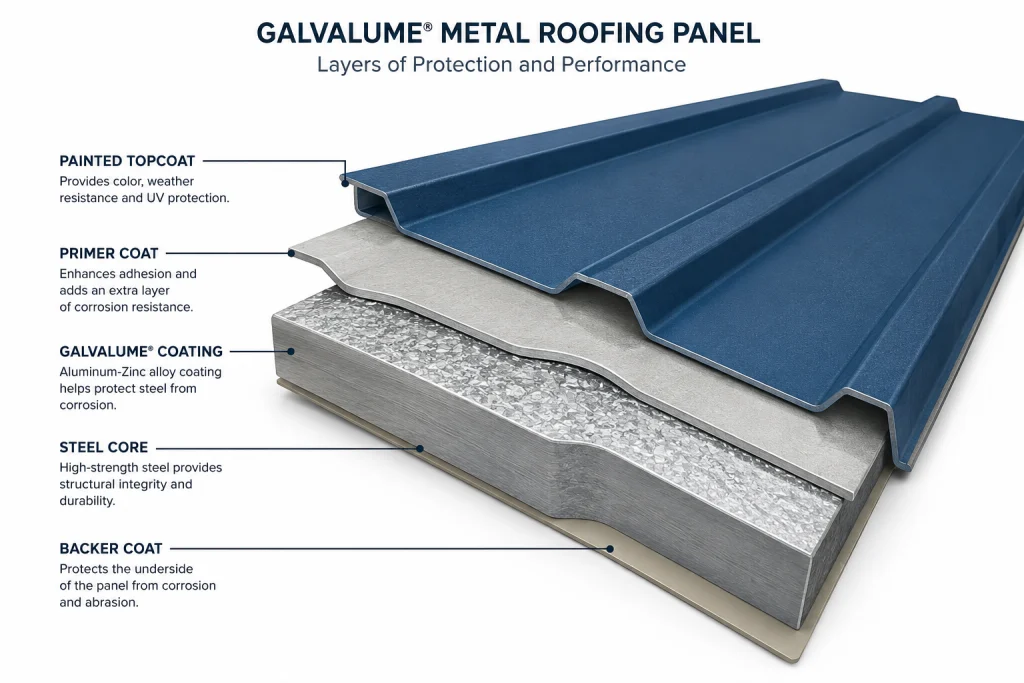
Galvalume and galvanized roofing both use steel as the base material. The main difference is the protective coating.
Galvanized steel is coated primarily with zinc. Galvalume steel uses aluminum, zinc, and silicon.
| Feature | Galvalume Steel | Galvanized Steel |
|---|---|---|
| Base material | Steel | Steel |
| Main coating | Aluminum-zinc-silicon alloy | Zinc |
| General corrosion resistance | Usually stronger in many atmospheric conditions | Good, but may corrode faster in some environments |
| Cut-edge protection | Moderate | Often stronger at exposed cut edges |
| Surface appearance | Speckled, matte metallic finish | Brighter or more uniformly silver |
| Common roofing uses | Standing seam and exposed-fastener roofs | Roofing, flashing, gutters, and structural components |
| Animal-contact environments | May be unsuitable in some cases | Often preferred for certain agricultural uses |
| Coastal suitability | Product-specific; standard Galvalume may not suit severe salt exposure | Also requires careful product selection |
Galvalume often provides better long-term corrosion resistance across broad panel surfaces. Galvanized steel may perform better in applications where the material is frequently scratched, cut, or exposed to highly alkaline conditions.
Neither material is automatically best for every property. Climate, roof design, coating weight, paint system, installation quality, and manufacturer warranty all matter.
Benefits of Galvalume Metal Roofing
Strong Corrosion Resistance
The aluminum-zinc coating helps protect the steel from rain, humidity, snow, and normal atmospheric exposure.
This corrosion resistance is one reason Galvalume is widely used for residential, commercial, and agricultural roofing.
Long Potential Service Life
A properly designed and installed Galvalume roof can provide decades of service. However, its lifespan depends on several factors:
- Panel thickness
- Coating weight
- Paint quality
- Roof slope
- Local climate
- Salt exposure
- Installation quality
- Fastener condition
- Maintenance
- Ventilation and condensation control
Homeowners should be cautious about any contractor promising an exact lifespan without inspecting the home and reviewing the product warranty.
Lightweight Construction
Galvalume roofing is much lighter than materials such as concrete tile, clay tile, or natural slate.
Its lower weight may reduce structural demands on the roof framing. However, an older home should still be inspected before installation, especially if the roof deck has water damage, sagging, or multiple existing roof layers.
Good Strength-to-Weight Ratio
The steel core gives Galvalume panels good strength without excessive weight.
Correctly specified panels can withstand wind, rain, hail, and snow loads. Performance still depends on panel gauge, fastening pattern, roof geometry, deck condition, and compliance with local building codes.
Available in Many Colors and Styles
Galvalume panels may be left with a natural metallic appearance or coated with a painted finish.
Painted systems allow homeowners to select colors that complement siding, brick, stone, trim, and neighborhood architecture.
Premium paint finishes may resist fading and chalking better than lower-cost coatings. Ask the contractor to identify both the steel coating and the paint system.
Potential Energy Benefits
A metal roof does not automatically make a home cooler. Roof color, surface reflectance, insulation, ventilation, and attic conditions all influence heat transfer.
Light-colored or specially coated metal roofs may reflect more solar energy than dark roofing. The U.S. Department of Energy’s cool-roof guidance explains that reflective roofing can reduce roof surface temperatures and cooling demand in suitable climates.
Energy savings vary by home. A reflective roof may provide limited improvement if the attic is already well insulated and air-sealed.
Limitations of Galvalume Roofing
It Can Still Rust
Galvalume is corrosion-resistant, not corrosion-proof.
Rust may develop when:
- The coating is deeply scratched
- Cut edges remain exposed
- Metal shavings are left on the roof
- Water becomes trapped against the panels
- Dissimilar metals cause galvanic corrosion
- Fasteners fail
- Salt deposits accumulate
- Wet leaves or debris remain in roof valleys
- Condensation repeatedly forms beneath the panels
Early surface staining should be inspected before corrosion reaches the steel core.
Standard Products May Not Suit Harsh Coastal Areas
Salt air can accelerate metal corrosion. A home directly exposed to ocean spray may require a specially approved coastal product, heavier coating, premium paint finish, aluminum roofing, or another corrosion-resistant system.
Do not assume that every Galvalume warranty covers coastal exposure. Warranty exclusions may be based on distance from saltwater, breaking surf, industrial emissions, or other environmental conditions.
It May React Poorly in Certain Environments
Galvalume may not be recommended where it will contact:
- Copper runoff
- Lead
- Wet pressure-treated lumber
- Concrete or mortar residue
- Highly alkaline materials
- Certain animal waste environments
Water flowing from copper flashing or copper gutters onto Galvalume panels may contribute to galvanic corrosion.
Exposed-Fastener Systems Need More Maintenance
Galvalume is available in both standing seam and exposed-fastener systems.
Exposed-fastener roofs use screws with washers that penetrate the panels. Over time, fasteners may loosen, washers may crack, and panel movement may enlarge screw holes.
Standing seam systems usually hide the fasteners beneath the seams. This reduces direct weather exposure and generally lowers the risk of fastener-related leaks.
Installation Can Be Noisy Without Proper Roof Assembly
Rainfall may sound louder on metal panels installed over open framing or poorly insulated spaces.
On most homes, solid roof decking, underlayment, attic insulation, and interior ceilings reduce the noise considerably.
Bare Galvalume vs. Painted Galvalume
Homeowners may choose between natural, unpainted Galvalume and painted Galvalume panels.
Bare Galvalume
Bare Galvalume has a silver-gray metallic appearance. It is commonly used on barns, workshops, sheds, modern homes, and commercial buildings.
Advantages include:
- Lower material cost in some markets
- No colored paint layer to fade
- Distinctive metallic appearance
- Good general corrosion resistance
Possible disadvantages include:
- Uneven weathering
- Visible fingerprints or handling marks
- Water spotting
- Limited aesthetic compatibility with some homes
- Restrictions in certain neighborhoods
Painted Galvalume
Painted Galvalume includes primer and a colored topcoat over the coated steel.
Advantages include:
- Wider color selection
- Better architectural appearance
- Additional protection from the finish system
- Availability of reflective “cool roof” colors
- Better compatibility with residential designs
Paint performance depends on the coating chemistry. Ask whether the panels use a premium fluoropolymer finish, commonly associated with strong color retention, or a more economical polyester-based system.
How Much Does Galvalume Metal Roofing Cost?
Galvalume roofing costs vary significantly by roof design and installation method. Homeowners should avoid comparing bids using panel price alone.
Important cost factors include:
- Standing seam versus exposed-fastener construction
- Steel thickness or gauge
- Coating specification
- Paint system
- Roof size
- Roof pitch
- Number of valleys, dormers, and penetrations
- Tear-off and disposal
- Deck repairs
- Underlayment
- Ventilation upgrades
- Flashing details
- Labor rates
- Permit requirements
- Wind or impact-rated components
An exposed-fastener Galvalume roof is generally less expensive than a concealed-fastener standing seam system. However, standing seam roofing may provide better weather resistance and lower long-term fastener maintenance.
When comparing estimates, request an itemized scope that identifies:
- Panel manufacturer
- Panel profile
- Steel gauge
- Galvalume coating designation
- Paint finish
- Fastener type
- Underlayment
- Flashing material
- Ventilation work
- Workmanship warranty
- Manufacturer warranty
The lowest bid may exclude important flashing, deck repair, or ventilation work.
How Long Does Galvalume Metal Roofing Last?
There is no single lifespan that applies to every Galvalume roof.
A high-quality roof installed correctly in a suitable environment may last several decades. A poorly installed system can develop leaks or corrosion much earlier.
The following factors have the greatest effect on service life:
Panel and Coating Quality
Thicker steel and appropriate coating specifications generally offer better resistance to physical damage and corrosion.
Do not judge quality by appearance alone. Two panels may look similar while having different steel thicknesses, coatings, or warranties.
Installation Details
Incorrect screws, poor flashing, overdriven fasteners, exposed cut edges, and incompatible metals can shorten the life of the roof.
Most early metal-roof problems are connected to detailing and installation rather than the broad field of the panel.
Roof Drainage
Standing water, clogged valleys, blocked gutters, and low-slope areas can increase corrosion risk.
Galvalume panels must be approved for the roof’s slope and installed according to the manufacturer’s requirements.
Local Environment
Saltwater, industrial pollution, animal waste, heavy tree debris, and persistent humidity may reduce service life.
A contractor should evaluate site exposure before recommending a specific metal and coating.
Galvalume Roofing Maintenance Checklist
Inspecting the roof regularly can help identify small problems before they become expensive repairs.
| Maintenance Item | What to Look For | Suggested Timing |
|---|---|---|
| Roof surface | Rust spots, scratches, dents, or loose debris | Once or twice per year |
| Fasteners | Loose screws, backed-out screws, or cracked washers | Annually on exposed-fastener roofs |
| Flashing | Separation around chimneys, walls, skylights, and vents | Annually and after severe storms |
| Sealants | Cracking, shrinking, or loss of adhesion | During professional inspections |
| Gutters and valleys | Leaves, branches, standing water, and sediment | At least twice per year |
| Panel edges | Corrosion at cuts, laps, and drainage points | Annually |
| Attic | Moisture, staining, mold, or condensation | During seasonal inspections |
Avoid using harsh chemicals, abrasive tools, or pressure-washing methods that could damage the coating.
Can You Install Galvalume Roofing Yourself?

Small sheds or simple accessory buildings may appear manageable for experienced DIYers. Residential roofing is considerably more difficult.
Metal panels can be sharp, slippery, heavy, and difficult to control in windy conditions. Incorrect panel spacing, fastening, cutting, flashing, or underlayment can cause leaks and void warranties.
Roof falls can cause severe or fatal injuries. OSHA’s residential fall-protection guidance outlines the importance of proper systems, equipment, and training for roofing work.
Homeowners should not climb onto a wet, icy, steep, or damaged metal roof. Use binoculars, ground-level photographs, attic observations, or a qualified roof inspector instead.
Expert Tip:
Before accepting a proposal, ask the contractor to show the exact panel specification, paint warranty, substrate warranty, and installation details. The word “Galvalume” alone does not confirm panel thickness, coating quality, finish quality, or workmanship.
When to Call a Roofing Professional
Contact a qualified metal-roofing professional when you notice:
- Active leaks or ceiling stains
- Rust spreading around fasteners or seams
- Loose, lifted, or displaced panels
- Storm damage
- Dented or punctured panels
- Missing flashing
- Repeated condensation in the attic
- Loose exposed fasteners
- Failed pipe-boot or chimney seals
- Signs of deck rot
- Unexplained metallic staining
- Noise or movement during strong winds
You should also request professional help before replacing asphalt shingles with metal roofing. The contractor should evaluate the roof deck, ventilation, flashing, structure, existing roof layers, and local code requirements.
Choose a contractor with specific metal-roofing experience. Installing asphalt shingles does not require the same tools, fabrication skills, or flashing methods as installing standing seam metal panels.
Common Mistakes Homeowners Should Avoid
- Assuming all metal roofs are the same. Galvalume identifies a coated steel substrate, not a complete roofing system.
- Choosing solely by price. A low estimate may use thinner steel, lower-cost paint, basic underlayment, or incomplete flashing.
- Ignoring the local environment. Coastal salt, industrial pollutants, tree debris, and animal waste can affect material selection.
- Mixing incompatible metals. Copper runoff and certain metal combinations may accelerate corrosion.
- Using the wrong cutting tools. High-speed abrasive cutting can damage protective coatings and leave hot metal particles that rust on the roof.
- Leaving metal shavings behind. Drilling and cutting debris can create rust spots even when the main panels are undamaged.
- Walking on the roof unnecessarily. Improper foot placement may dent panels, damage seams, or cause a fall.
- Assuming the manufacturer warranty covers labor. Material warranties and contractor workmanship warranties are usually separate.
- Ignoring attic moisture. Condensation beneath metal roofing can damage decking and insulation even when rain is not entering the roof.
- Hiring a contractor without metal-roof experience. Poorly fabricated flashing can cause leaks around walls, valleys, chimneys, skylights, and roof penetrations.
Is Galvalume Roofing Right for Your Home?
Galvalume may be a good choice when you want:
- A durable steel roofing system
- Strong general corrosion resistance
- A standing seam or ribbed metal appearance
- Lower weight than tile or slate
- Painted or natural metallic finishes
- Long-term performance with proper maintenance
It may not be the best choice when:
- Your home is extremely close to saltwater
- Copper runoff will contact the roof
- The roof will face continuous exposure to animal waste
- Your neighborhood restricts metallic finishes
- The roof design is below the panel’s approved minimum slope
- The installer lacks metal-roofing experience
- The product warranty excludes your environment
The best decision should consider the complete roofing assembly, not just the visible panels.
FAQs
Is Galvalume the same as aluminum roofing?
No. Galvalume roofing has a steel core coated with aluminum, zinc, and silicon. Aluminum roofing is made primarily from aluminum and does not contain a steel core. Aluminum is often selected for severe coastal exposure because it does not rust like steel.
Does Galvalume metal roofing rust?
Galvalume can rust if its protective coating is damaged or if it is exposed to unsuitable conditions. Scratches, trapped moisture, salt, metal debris, incompatible materials, and failed fasteners can increase corrosion risk.
Is Galvalume better than galvanized steel?
Galvalume generally provides stronger broad-surface corrosion resistance in many roofing environments. Galvanized steel may provide better protection at certain cut edges and in some specialized applications. The better choice depends on location, roof design, exposure, and manufacturer recommendations.
Can Galvalume roofing be painted?
Yes. Galvalume is commonly sold with factory-applied paint systems. Existing bare Galvalume may also be painted, but proper cleaning, surface preparation, primer selection, and coating compatibility are essential.
Is Galvalume roofing good for coastal homes?
Standard Galvalume may not be appropriate for homes exposed to heavy salt spray. Coastal-rated Galvalume products may be available, but warranty terms vary. Aluminum, zinc, or specially coated systems may be better in severe marine environments.
Does Galvalume roofing make a house hotter?
Not necessarily. Heat performance depends on roof color, solar reflectance, insulation, attic ventilation, roof assembly, and climate. Light-colored or reflective finishes may reduce solar heat absorption compared with dark roofing.
Can Galvalume roofing be installed over shingles?
Some building codes and manufacturers allow metal roofing over one existing shingle layer under specific conditions. The roof deck, moisture risks, ventilation, flashing, weight, and local regulations must be evaluated first. Removing old shingles often provides a better opportunity to inspect and repair the deck.
Conclusion
Galvalume metal roofing is steel protected by an aluminum-zinc-silicon coating. It offers a useful balance of strength, corrosion resistance, low weight, and design flexibility, making it a popular substrate for standing seam and exposed-fastener roofing systems.
However, the material name alone does not guarantee a high-quality roof. Panel thickness, coating specification, paint finish, flashing, ventilation, environmental exposure, and installer experience all affect performance.
Before choosing Galvalume, obtain detailed estimates from experienced metal-roofing contractors. Compare complete specifications and warranties—not just price per square foot. A careful inspection and a properly designed roofing system will help you decide whether Galvalume metal roofing is the right long-term investment for your home.