Are Black Metal Roofs Hotter? What Homeowners Should Know
If you love the clean, bold look of a black metal roof, one question probably comes up before you commit: are black metal roofs hotter than lighter roof colors? The honest answer is yes, black metal roofing can get hotter on the surface because dark colors absorb more sunlight. But that does not automatically mean your home will become uncomfortable or your cooling bills will skyrocket.
The real answer depends on your roof coating, insulation, attic ventilation, roof design, climate, and installation quality. This guide explains how black metal roofs handle heat, when they make sense, when they may not, and what homeowners should check before choosing one.
Quick Answer
Yes, black metal roofs are hotter on the surface than light-colored metal roofs because black absorbs more solar heat. However, a properly installed black metal roof with reflective coatings, good attic ventilation, and adequate insulation may still perform well. The biggest concern is usually roof surface temperature, not automatically indoor comfort.
Why Black Metal Roofs Get Hotter
Black roofing absorbs more sunlight than white, beige, light gray, or other lighter colors. This is true for metal roofing, asphalt shingles, tile, and most exterior materials.
Think about wearing a black shirt on a sunny summer day. It feels warmer than a white shirt because it absorbs more solar energy. A roof works in a similar way.
According to the U.S. Department of Energy’s cool roof guidance, cool roofs are designed to reflect more sunlight and absorb less solar energy than conventional roofs. That is why color and coating matter.
A black metal roof can become hotter because of:
- Dark color absorption
- Direct sun exposure
- Low roof reflectivity
- Poor attic ventilation
- Weak insulation
- Heat-trapping attic spaces
- Dark underlayment or decking systems
But metal roofing also has an advantage: it can release heat faster than many other roofing materials once the sun goes down. That means a black metal roof may heat up quickly during the day but cool down more quickly in the evening than some heavier materials.
Surface Heat vs Indoor Heat
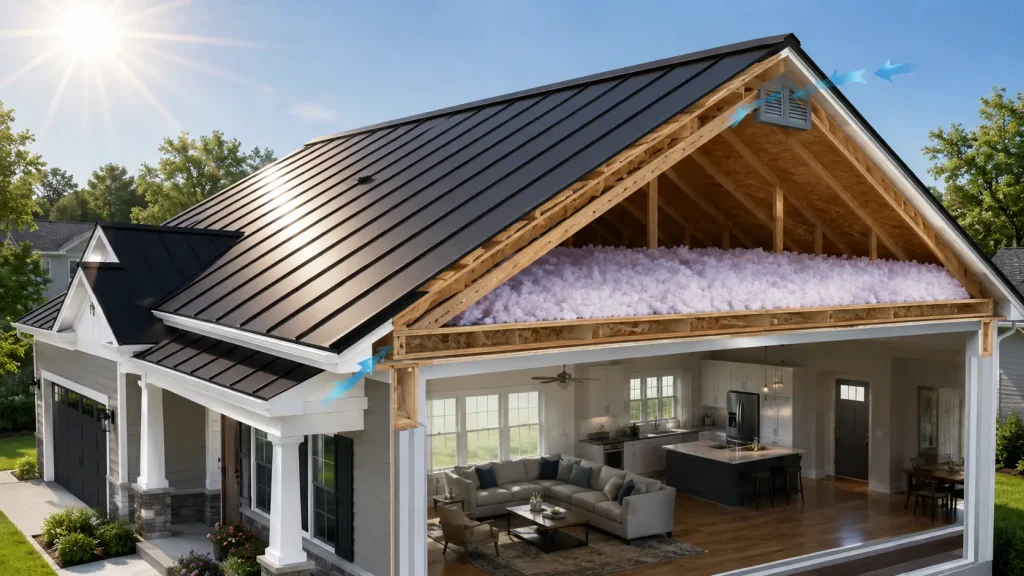
One of the biggest homeowner misunderstandings is assuming that a hotter roof surface always means a hotter house.
That is not always true.
A black metal roof can feel extremely hot to the touch on a sunny day. However, the heat must still travel through the roofing panel, underlayment, roof deck, attic air space, insulation, and ceiling before it affects your living space.
Your indoor comfort depends heavily on what is under the roof.
What Controls Indoor Temperature?
A black metal roof is only one part of the heat equation. Your home’s comfort depends on:
- Attic insulation: Slows heat transfer into your rooms.
- Attic ventilation: Lets hot air escape before it builds up.
- Roof deck condition: A damaged or poorly sealed deck can affect performance.
- Radiant barriers: Can reduce radiant heat transfer in some attics.
- HVAC condition: An undersized or aging air conditioner may struggle in hot climates.
- Roof slope and sun exposure: A west-facing roof plane may absorb more afternoon heat.
- Panel coating: Reflective paint technology can improve performance.
Key point: A black roof can be hotter outside, but a well-built roof system can reduce how much of that heat reaches the inside of your home.
Are Black Metal Roofs Bad for Energy Efficiency?
Not necessarily. Black metal roofs are usually less reflective than lighter colors, but they are not automatically a poor energy choice.
Modern metal roofing often uses factory-applied paint systems designed to improve reflectivity and durability. Some dark colors can perform better than homeowners expect because the coating reflects some infrared heat even when the visible color appears dark.
The Whole Building Design Guide explains cool metal roofing as a system that can improve energy performance depending on surface finish, solar reflectance, and infrared emittance. In simple terms, the finish matters almost as much as the color.
What Is Solar Reflectance?
Solar reflectance means how much sunlight a roof reflects away.
A high-reflectance roof sends more sunlight back into the air. A low-reflectance roof absorbs more sunlight and turns it into heat.
Light roof colors usually have higher solar reflectance. Black roof colors usually have lower solar reflectance.
What Is Thermal Emittance?
Thermal emittance means how well a material releases absorbed heat.
Metal roofing can often release heat efficiently, depending on the coating and finish. This is why two black metal roofs may not perform exactly the same. One may have a better coating and better heat release than another.
You can compare rated roofing products through resources such as the Cool Roof Rating Council product directory, which lists roof products by tested solar reflectance and thermal emittance values.
Black Metal Roofs vs Light Metal Roofs
A light-colored metal roof usually performs better in hot, sunny climates if cooling efficiency is the top priority. A black metal roof usually performs better for homeowners who prioritize appearance, contrast, and modern curb appeal.
Here is a simple comparison:
| Factor | Black Metal Roof | Light Metal Roof |
|---|---|---|
| Surface temperature | Usually hotter | Usually cooler |
| Cooling efficiency | Can be lower without good ventilation and insulation | Usually better in hot climates |
| Appearance | Bold, modern, high contrast | Softer, cooler, more traditional |
| Dirt visibility | May hide some stains but show dust or pollen | May show algae, streaks, or dark debris |
| Fading visibility | Fading may be more noticeable over time | Fading is often less obvious |
| Snow melting | May help snow melt slightly faster in sunny winter conditions | May retain snow slightly longer |
| Best use | Modern homes, cooler climates, shaded roofs, strong insulation systems | Hot climates, high-sun homes, energy-focused projects |
Best practical answer: choose black for design only after checking climate, coating quality, attic ventilation, and insulation.
Do Black Metal Roofs Make Cooling Bills Higher?
They can, especially in hot climates, but the increase is not guaranteed.
A black metal roof may increase heat gain compared with a white or light-colored metal roof. This can matter more if:
- You live in a hot southern or desert climate
- Your attic insulation is weak
- Your attic has poor airflow
- Your roof gets full sun all day
- Your home already has high summer cooling bills
- Your HVAC system is old or undersized
However, if the roof is installed with proper ventilation, high-quality insulation, and a good reflective coating, the effect may be manageable.
For many homeowners, the bigger issue is not simply choosing black. It is choosing black without checking the whole roof system.
When a Black Metal Roof Makes Sense
A black metal roof can be a smart choice in the right situation. Many homeowners choose black because it looks sharp, works with many siding colors, and gives the home a modern appearance.
Black metal roofing may make sense if:
- You live in a cooler or mixed climate
- Your home has strong attic insulation
- Your attic ventilation is already well designed
- Your roof has partial shade during the hottest part of the day
- You choose a high-quality coated metal panel
- You value curb appeal and architectural style
- You understand that the surface will be hotter in summer
Black can look especially good on homes with white siding, natural wood accents, stone veneer, brick, or modern farmhouse designs.
When You Should Think Twice About a Black Metal Roof
A black metal roof may not be the best choice for every home.
You may want to consider a lighter color if:
- Your area has long, hot summers
- Your house gets intense direct sun
- Your attic already feels extremely hot
- Your upper rooms are uncomfortable in summer
- Your cooling bills are already high
- Your insulation is thin or old
- You plan to stay in the home long term and want maximum energy savings
Important warning: Do not choose a black metal roof based on appearance alone if your home already has heat problems. Fixing attic ventilation and insulation after installation can cost more than planning correctly before the project starts.
The Role of Roof Coatings
Not all black metal roofs are equal.
A basic black finish may absorb more heat than a premium coated panel designed to reflect some infrared energy. Many modern metal roof finishes are engineered for better color retention, chalk resistance, and weather performance.
When comparing black metal roof products, ask the contractor or supplier for:
- Solar reflectance rating
- Thermal emittance rating
- SRI, or Solar Reflectance Index
- Paint system type
- Finish warranty
- Fade and chalk warranty
- Product approval for your climate
A high-quality coating can help reduce some heat-related concerns, but it will not make black perform exactly like white. Black is still a dark color. The goal is to choose the best-performing black finish available if that is the look you want.
Ventilation Matters More Than Many Homeowners Realize
Attic ventilation is one of the most important parts of roof heat control.
When your attic cannot release hot air, heat builds up under the roof deck. That trapped heat can push into your living space, stress your HVAC system, and shorten the life of some roofing components.
A good ventilation system usually needs both:
- Intake ventilation: Usually at the soffits or eaves, where cooler air enters.
- Exhaust ventilation: Usually at the ridge, vents, or roof vents, where hot air exits.
A black metal roof on a poorly ventilated attic can make heat issues more noticeable. A black metal roof on a well-ventilated attic may perform much better.
Common Signs of Poor Attic Ventilation
Watch for these warning signs:
- Upstairs rooms feel much hotter than downstairs rooms
- Attic feels extremely hot and stuffy
- High summer cooling bills
- Musty attic smell
- Condensation under the roof deck
- Mold or mildew near roof sheathing
- Ice dams in cold climates
- Premature roof wear
If you notice these signs, address ventilation before focusing only on roof color.
Insulation Is the Second Big Factor
Insulation slows down heat transfer. Without enough insulation, any hot roof surface can make indoor comfort harder to control.
Before installing a black metal roof, ask your contractor or energy auditor whether your attic insulation meets current recommendations for your region. The ENERGY STAR insulation guidance explains how recommended insulation levels vary by climate zone.
If your insulation is weak, upgrading it may do more for comfort than changing roof color alone.
Will a Black Metal Roof Fade Faster?
Black metal roofs can show fading, chalking, dust, pollen, and surface changes more clearly than some lighter colors. This does not mean every black roof fades quickly. It depends on paint quality, sun exposure, coating type, and maintenance.
Higher-quality painted metal panels usually hold color better than cheaper products. If you are choosing black, pay close attention to the finish warranty.
Ask about:
- Fade resistance
- Chalking resistance
- UV performance
- Coastal exposure limitations
- Warranty exclusions
- Cleaning requirements
A cheaper black metal roof may look attractive on installation day but age faster than expected. For dark colors, finish quality matters a lot.
Does a Black Metal Roof Help in Winter?
A black metal roof may absorb more sunlight during winter, which can slightly help with snow melting on sunny days. However, homeowners should not choose black only for snow performance.
Snow behavior depends on roof pitch, metal panel smoothness, insulation, attic heat loss, sun exposure, and local weather. A metal roof can shed snow quickly, sometimes in large sheets, so snow guards may be needed above walkways, driveways, decks, and entrances.
Safety warning: Falling snow and ice from a metal roof can injure people and damage property. Ask your roofing contractor whether snow guards are appropriate for your home.
Cost Considerations for Black Metal Roofs
Black metal roofing does not always cost more simply because it is black. The cost usually depends on the panel type, metal thickness, paint system, roof complexity, labor, trim, flashing, and ventilation work.
However, black can become more expensive if you choose premium coatings or custom colors.
Cost factors include:
- Standing seam vs exposed fastener panels
- Steel vs aluminum
- Galvalume or galvanized substrate
- Paint finish quality
- Roof size and slope
- Number of valleys, dormers, chimneys, and skylights
- Tear-off and disposal
- Deck repairs
- Ventilation upgrades
- Insulation improvements
Cost vs Value Guidance
Choose the cheapest black metal roof only if you fully understand the tradeoffs. A lower-cost panel may have weaker paint, thinner metal, shorter warranty coverage, or poorer long-term appearance.
A better approach is to compare total value:
- Panel quality
- Coating performance
- Installer experience
- Ventilation plan
- Warranty terms
- Long-term maintenance needs
A black roof is a design investment. Make sure the product quality matches the look you want.
Expert Tip
Expert Tip:
Before choosing a black metal roof, ask your contractor for the product’s solar reflectance, thermal emittance, paint warranty, and attic ventilation plan in writing. If they only talk about color and price, you do not have enough information to make a smart decision.
DIY Considerations and Safety Limits
Homeowners can compare colors, review warranties, inspect attic comfort, and ask good questions. But installing or modifying a metal roof is not a simple DIY project.
Metal roofing involves sharp panels, ladders, roof edges, fasteners, flashing, underlayment, ventilation details, and fall hazards. OSHA notes in its residential fall protection guidance that roofing work presents serious fall risks.
Avoid DIY roof work if it involves:
- Walking on a steep roof
- Removing old roofing
- Installing metal panels
- Cutting panels
- Working near power lines
- Modifying flashing
- Adding roof vents
- Repairing structural decking
- Installing snow guards on steep slopes
A mistake on a metal roof can cause leaks, injury, warranty problems, or expensive repairs.
When to Call a Roofing Professional
Call a roofing professional before choosing a black metal roof if you are unsure about heat, ventilation, insulation, roof condition, or installation quality.
You should especially call a contractor if:
- Your attic gets extremely hot
- Your upstairs rooms are uncomfortable
- Your current roof has leaks
- Your roof deck may be damaged
- You have skylights, chimneys, or many roof penetrations
- You live in a hot climate
- Your home has poor soffit or ridge ventilation
- You want standing seam metal roofing
- You need snow guards
- You are comparing warranty options
A good roofing contractor should inspect more than the outside of the roof. They should also look at attic ventilation, insulation, decking, flashing, and moisture signs.
Questions to Ask the Contractor
Use these questions before signing:
- Is this black metal roof product rated for energy performance?
- What is the solar reflectance rating?
- What is the thermal emittance rating?
- What paint system does the panel use?
- How long is the finish warranty?
- Will you inspect attic ventilation?
- Do I need more intake or exhaust ventilation?
- Will this roof meet local code?
- How will you handle flashing around chimneys and skylights?
- Are snow guards recommended for my roof?
Common Mistakes Homeowners Should Avoid
- Choosing black only because it looks good: Appearance matters, but heat performance, coating quality, and ventilation matter too.
- Ignoring attic ventilation: Poor ventilation can make any roof color perform worse.
- Assuming all metal roofs are energy efficient: Metal roofing can perform well, but color and coating still matter.
- Buying the cheapest dark panel: Low-quality finishes may fade, chalk, or age poorly.
- Not checking insulation: Weak insulation can make roof heat more noticeable indoors.
- Forgetting about snow guards: Smooth metal roofs can shed snow quickly in cold climates.
- Hiring an inexperienced installer: Metal roofing requires careful flashing, fastening, and panel handling.
- Skipping written product details: Always ask for warranty and performance information before choosing a roof color.
Best Black Metal Roof Options for Homeowners
If you want a black metal roof, focus on quality. The best option is usually not just “black metal.” It is a complete roof system.
Look for:
- Factory-painted metal panels
- Strong fade and chalk resistance
- Good solar reflectance for a dark color
- Proper underlayment
- Balanced attic ventilation
- Correct flashing details
- Experienced metal roof installation
- Clear workmanship warranty
Standing seam metal roofing is often the premium choice because hidden fasteners reduce exposed screw issues and create a clean look. Exposed fastener panels can cost less, but they require more maintenance because the screws and washers are exposed to weather.
Black Metal Roof Pros and Cons
| Pros | Cons |
|---|---|
| Bold, modern appearance | Hotter surface temperature |
| Works with many home styles | May increase cooling demand in hot climates |
| Can improve curb appeal | Fading may be more noticeable |
| May shed snow well | Snow guards may be needed |
| Durable when installed correctly | Premium coatings may cost more |
| Available in standing seam and panel styles | Poor ventilation can reduce comfort |
How to Decide If a Black Metal Roof Is Right for You

Use this simple decision process:
- Start with climate. If you live in a hot, sunny area, compare black against lighter colors carefully.
- Check attic comfort. If your attic is already extremely hot, fix ventilation first.
- Review insulation. Strong insulation helps protect indoor comfort.
- Compare product ratings. Do not rely on color samples alone.
- Ask about coating quality. Dark roofs need good paint systems.
- Think long term. Consider fading, cooling bills, and resale appeal.
- Hire the right installer. A beautiful black metal roof can fail if flashing or ventilation is wrong.
FAQs
Are black metal roofs hotter than white metal roofs?
Yes. Black metal roofs usually get hotter on the surface because they absorb more sunlight. White and light-colored metal roofs usually reflect more solar energy and stay cooler.
Will a black metal roof make my house hot?
Not automatically. A black metal roof can increase roof surface heat, but indoor comfort depends on insulation, attic ventilation, roof design, and HVAC performance.
Are black metal roofs bad in hot climates?
They can be less ideal in very hot, sunny climates if energy efficiency is the top priority. However, high-quality coatings, proper ventilation, and good insulation can help reduce heat problems.
Do black metal roofs fade?
Black metal roofs can fade or chalk over time, especially with lower-quality finishes. Choosing a premium factory-applied coating with a strong finish warranty can reduce this risk.
Is a black metal roof more expensive?
The color itself may not add much cost, but premium black finishes, standing seam panels, thicker metal, and better warranties can increase the total price.
Do black metal roofs cool down at night?
Metal roofing can release heat relatively quickly after the sun goes down. A black metal roof may heat up during the day but can cool faster in the evening than some heavier roofing materials.
Should I choose black or gray metal roofing?
Choose black if curb appeal and contrast are your top priorities and your home has good ventilation and insulation. Choose gray if you want a slightly cooler, more flexible color with less visible fading risk.
Conclusion
So, are black metal roofs hotter? Yes, they usually are hotter on the surface than lighter metal roofs. But that does not mean they are always a bad choice. A black metal roof can still be practical, durable, and attractive when it is paired with a quality coating, balanced attic ventilation, strong insulation, and skilled installation.
The smartest step is to compare more than color samples. Ask for product ratings, review the finish warranty, inspect your attic conditions, and talk with a qualified metal roofing contractor before making the final decision.
A black metal roof can look excellent on the right home. Just make sure the roof system behind that look is built to perform.