
What Is the Best Gauge for Metal Roofing? A Homeowner’s Guide

Choosing a metal roof involves more than selecting a color or panel style. The thickness of the metal also affects how well the roof resists dents, wind, installation damage, and everyday wear.
So, what is the best gauge for metal roofing? For most homes, 24-gauge or 26-gauge steel roofing provides the best balance of strength, durability, availability, and cost. However, the right choice depends on your roof design, local weather, panel profile, building code, and installation system.
This guide explains how metal roofing gauge works, compares common thicknesses, and helps you decide whether paying for thicker panels makes sense for your home.
Quick Answer
For most residential metal roofs, 26-gauge steel is a practical standard choice, while 24-gauge is better for demanding conditions, premium standing seam systems, and greater resistance to denting. Thinner 29-gauge panels may work for sheds or budget projects, but they are generally less durable and easier to damage.
What Does Metal Roofing Gauge Mean?
Gauge is a measurement used to describe the thickness of sheet metal. Metal roofing is commonly available in 22-, 24-, 26-, and 29-gauge steel.
The gauge system can be confusing because a lower gauge number means thicker metal.
For example:
- 22-gauge steel is thicker than 24-gauge steel.
- 24-gauge steel is thicker than 26-gauge steel.
- 26-gauge steel is thicker than 29-gauge steel.
Gauge should not be treated as a universal measurement across every material. A 24-gauge steel panel and a 24-gauge aluminum panel may not have the same actual thickness because steel and aluminum use different measurement standards.
For this reason, homeowners should ask contractors for the panel’s actual thickness in inches or millimeters, not just its advertised gauge.
Common Metal Roofing Gauges Compared
The following table provides a general comparison of common steel roofing gauges. Exact thickness may vary slightly by manufacturer, coating, and applicable industry standards.
| Steel gauge | Approximate thickness | Typical use | Main advantage | Main limitation |
|---|---|---|---|---|
| 22 gauge | About 0.030 inch | Heavy-duty commercial and architectural roofs | Very strong and rigid | Expensive and often unnecessary for homes |
| 24 gauge | About 0.024 inch | Premium residential and commercial standing seam roofs | Strong resistance to weather and handling damage | Higher material and labor cost |
| 26 gauge | About 0.018–0.019 inch | Residential standing seam and exposed-fastener roofs | Good balance of strength and price | Less dent-resistant than 24 gauge |
| 29 gauge | About 0.014 inch | Agricultural buildings, sheds, garages, and some budget homes | Lower initial cost | Easier to bend, dent, and damage during installation |
These measurements are only general references. Coatings can affect the final measured thickness, and manufacturers may describe panels according to either nominal thickness or minimum thickness.
Always compare product specifications rather than relying on gauge numbers alone.
What Is the Best Gauge for Metal Roofing on a House?
For most houses, the best choices are 24-gauge and 26-gauge steel.
26-Gauge Metal Roofing: Best for Many Standard Homes
A properly designed 26-gauge system is suitable for many residential roofs. It provides enough strength for normal weather exposure while remaining more affordable and easier to handle than 24-gauge material.
Homeowners commonly choose 26 gauge because it offers:
- Good resistance to normal rain, wind, and temperature changes
- Wide availability in residential panel profiles
- Lower cost than 24-gauge roofing
- Less weight than thicker panels
- Sufficient durability when properly supported and installed
A quality 26-gauge roof can perform well for decades when it has a durable protective coating, properly designed flashing, suitable fasteners, and professional installation.
However, gauge alone does not guarantee performance. A well-installed 26-gauge roof is usually a better investment than a poorly installed 24-gauge roof.
24-Gauge Metal Roofing: Best for Premium Performance
A 24-gauge roof is thicker, stiffer, and generally more resistant to installation damage than 26-gauge steel. It is commonly used for architectural standing seam roofs and homes exposed to demanding weather.
Consider 24-gauge metal roofing when:
- Your area experiences high winds or severe storms.
- The home is near a coastline.
- The roof has wide spaces between structural supports.
- You want a premium standing seam system.
- Tree branches or other debris may strike the roof.
- Oil canning or visible waviness is a concern.
- The manufacturer requires it for the selected panel profile.
Thicker panels may provide better resistance to denting and deformation, but they are not automatically storm-proof. Panel width, seam design, clip spacing, roof shape, attachment method, and edge details are also important.
FEMA’s guidance on metal roof systems in high-wind regions emphasizes the complete roof assembly, including panels, clips, fasteners, flashing, and perimeter attachment—not panel thickness alone. (FEMA)
29-Gauge Metal Roofing: Best for Limited Applications
Twenty-nine-gauge roofing is commonly used on barns, sheds, workshops, carports, and agricultural buildings. Some contractors also install it on houses as a lower-cost option.
It may be acceptable when:
- The panel is installed over solid roof decking.
- The roof design has adequate support.
- Local wind and snow loads are moderate.
- The product has been tested for the intended application.
- The installation follows the manufacturer’s instructions.
However, 29-gauge panels are easier to crease or dent during transportation and installation. They may also feel less rigid when installed over widely spaced purlins.
For a primary residence, homeowners should carefully compare the small initial savings against the possible benefits of moving up to 26 gauge.
A low price should not be the only reason to select 29-gauge roofing.
Does a Thicker Gauge Always Make a Better Roof?
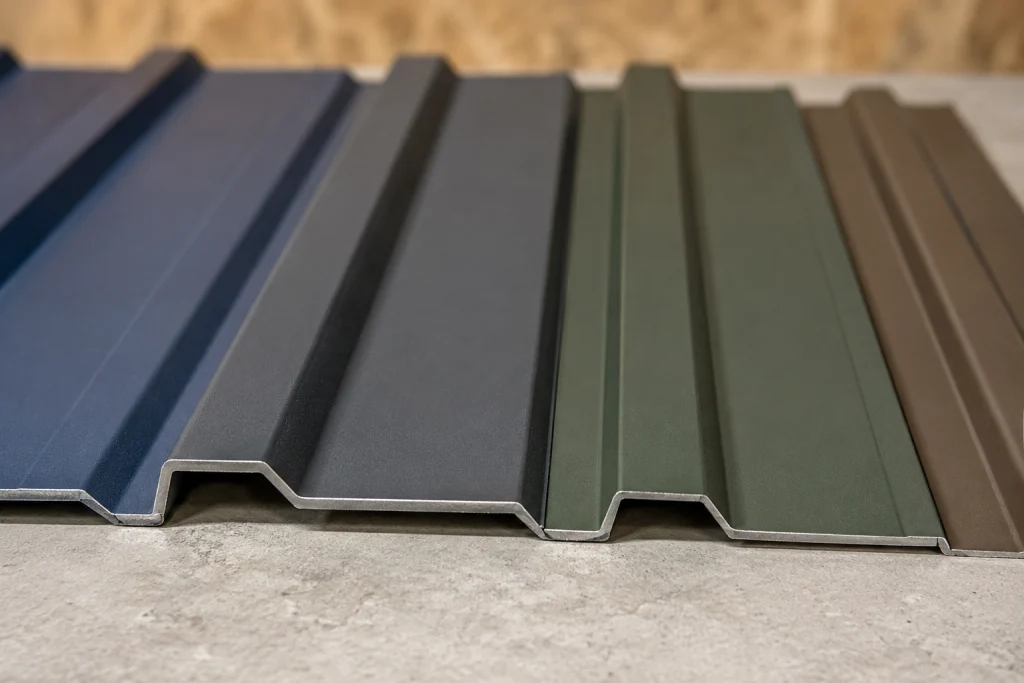
Not necessarily. Gauge is important, but it is only one part of a metal roof system.
A durable roof depends on several connected factors:
- Metal type and grade
- Panel profile and width
- Seam height
- Fastener or clip system
- Fastener spacing
- Roof decking and structural support
- Underlayment
- Flashing design
- Protective metallic coating
- Paint system
- Installer experience
- Local wind, snow, and hail conditions
For example, a tested 26-gauge standing seam system with concealed clips may outperform an untested 24-gauge exposed-fastener roof in certain conditions.
The best panel is therefore not simply the thickest one. It is the panel that has been properly engineered, tested, and installed for the building.
How Climate Affects the Best Roofing Gauge
High-Wind and Hurricane-Prone Areas
Homes in hurricane zones need a roof assembly rated for local wind pressures. While thicker panels may add stiffness, wind resistance depends heavily on attachment details.
Ask the contractor for:
- Product approval or evaluation documentation
- Tested wind-uplift ratings
- Required clip or fastener spacing
- Edge and corner attachment details
- Local building-code compliance
- Manufacturer installation instructions
Roof edges and corners experience particularly strong wind forces. Using thicker panels without the correct fasteners and perimeter details will not solve a weak installation.
Hail-Prone Areas
Thicker steel generally resists minor denting better than thinner steel, but no standard residential metal panel is completely dent-proof.
Hail performance also depends on:
- Hailstone size and speed
- Panel shape
- Metal hardness
- Roof slope
- Support beneath the panel
- Distance between supports
- Whether the panel is steel, aluminum, copper, or zinc
A cosmetic dent does not always mean the roof has lost its ability to shed water. However, severe impacts can damage seams, coatings, flashing, and exposed fastener washers.
Homeowners in hail-prone regions should review impact-resistance information and speak with their insurance provider before selecting a product.
Heavy Snow Areas
Snow loads are transferred through the panels to the roof structure. Thicker panels may be needed when structural metal roofing spans between purlins rather than resting on solid decking.
Do not assume that changing from 26 gauge to 24 gauge automatically makes the roof safe for a heavy snow load. An engineer or qualified roofing professional may need to evaluate:
- Purlin spacing
- Rafter or truss capacity
- Panel span rating
- Roof slope
- Expected snow accumulation
- Drifting around valleys and roof intersections
Hot and Sunny Climates
Gauge has less influence on heat performance than the roof’s color, finish, ventilation, and insulation.
A reflective roof finish can reduce the amount of solar energy absorbed by the roof. The U.S. Environmental Protection Agency explains that an effective cool roof combines solar reflectance and thermal emittance, helping the surface reflect sunlight and release absorbed heat. (ENERGY STAR)
A thicker panel does not automatically make a home cooler.
Panel Type Can Affect the Gauge You Need
Standing Seam Metal Roofing
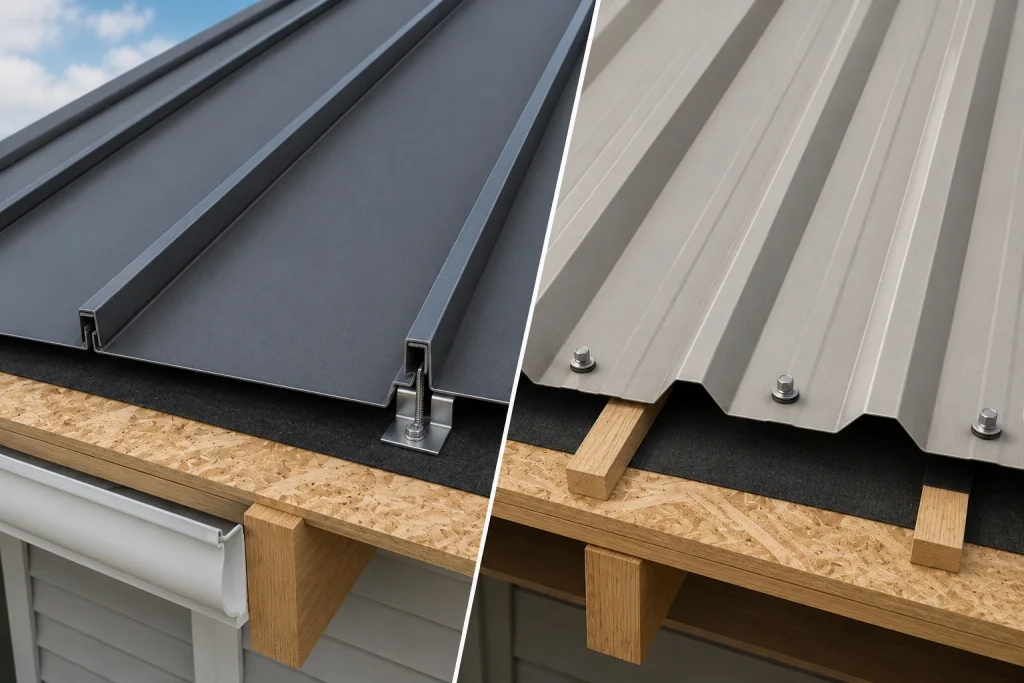
Standing seam systems use raised vertical seams and concealed clips or fasteners. Residential standing seam panels are commonly produced in 24- or 26-gauge steel.
Twenty-four gauge may be preferable for:
- Wide panels
- Long roof runs
- High-wind locations
- Premium architectural projects
- Roofs where appearance is especially important
Some mechanically seamed or structural standing seam systems have specific minimum thickness requirements. Follow the tested assembly specifications instead of selecting gauge separately.
Exposed-Fastener Metal Roofing
Exposed-fastener panels are attached directly through the face of the metal. The screw heads and sealing washers remain visible.
These panels are commonly available in 26 and 29 gauge. Twenty-six gauge generally provides greater rigidity and is less likely to be damaged during handling.
Because exposed fasteners penetrate the roof surface, long-term maintenance is important. Washers may deteriorate, screws may loosen, and thermal movement can enlarge fastener holes.
Metal Shingles and Tiles
Stamped metal shingles and tiles may use thinner metal than standing seam panels because folds, ribs, locks, and stamped patterns add stiffness.
Do not compare their gauge directly with a flat standing seam panel. Instead, evaluate the complete product system, testing, warranty, and installation requirements.
Other Quality Factors to Compare
Metallic Coating
Most residential steel roofing has a zinc-based or aluminum-zinc alloy coating that protects the steel from corrosion.
Ask for:
- The coating type
- Coating weight or designation
- Suitable use near saltwater
- Cut-edge protection
- Manufacturer corrosion exclusions
A thick steel panel with a poor coating may develop corrosion problems sooner than a slightly thinner panel with a high-quality protective system.
Paint Finish
Paint quality affects color retention, chalking, fading, and surface durability.
Common options include:
- PVDF coatings: Often selected for premium color retention and weather resistance
- SMP coatings: Generally more economical and widely used on residential and agricultural panels
Review both the paint warranty and its exclusions. Some warranties cover excessive fading or chalking but do not cover every cosmetic change.
Minimum Thickness Versus Nominal Thickness
Two products advertised as 26 gauge may not contain the same amount of steel.
Ask whether the stated gauge is:
- Nominal thickness
- Minimum thickness
- Thickness before coating
- Thickness after coating
Obtain a written technical data sheet so you can make an accurate comparison.
Warranty Coverage
A metal roof may have several separate warranties:
- Panel substrate warranty
- Metallic coating warranty
- Paint finish warranty
- Weathertightness warranty
- Contractor workmanship warranty
A 40-year paint warranty is not the same as a 40-year guarantee against leaks.
Read the exclusions, maintenance requirements, transfer rules, and claim procedure before signing the contract.
Cost Differences Between Roofing Gauges
Thicker panels contain more metal and usually cost more. However, the total project price also includes underlayment, trim, flashing, clips, fasteners, labor, tear-off, delivery, and disposal.
Moving from 26 gauge to 24 gauge may increase costs because:
- The panels use more steel.
- Heavier panels can be more difficult to handle.
- Premium gauges may be paired with better paint systems.
- Specialized forming equipment may be needed.
- The selected system may require additional clips or details.
The upgrade may be worthwhile for a long-term home in a demanding climate. It may provide less value for a small shed or temporary outbuilding.
Request itemized proposals so you can see exactly what the added price includes.
Expert Tip
Expert Tip: Ask every contractor to identify the panel manufacturer, exact product name, minimum metal thickness, coating, paint system, clip or fastener spacing, and tested wind rating. Comparing these details is more reliable than comparing gauge alone.
How to Choose the Right Gauge
Use the following process when reviewing metal roof estimates.
- Check local requirements.
Confirm the building code, design wind speed, snow load, fire requirements, and any neighborhood restrictions. - Identify the panel system.
Determine whether the roof will use standing seam, exposed-fastener panels, metal shingles, or another profile. - Review the roof support.
Find out whether panels will be installed over solid decking or spaced purlins. - Ask for tested performance.
Request documentation for wind uplift, panel spans, impact resistance, and fire classification where applicable. - Compare actual thickness.
Do not rely only on labels such as “24 gauge” or “26 gauge.” - Compare coatings and warranties.
Review corrosion protection, paint finish, workmanship coverage, and exclusions. - Evaluate the installer.
Choose a contractor experienced with the exact metal roof system being proposed.
Common Mistakes Homeowners Should Avoid
- Assuming the lowest gauge number is always necessary. A 22-gauge roof may add cost without providing a meaningful residential benefit.
- Choosing 29 gauge only because it is cheaper. Thin panels may be more vulnerable to handling damage and visible denting.
- Comparing gauge without comparing metal type. Steel, aluminum, copper, and zinc use different thickness systems and perform differently.
- Ignoring minimum thickness. Two panels with the same advertised gauge may not be identical.
- Focusing on panels while ignoring flashing. Many metal roof leaks begin at penetrations, walls, valleys, ridges, or edges rather than through the panel itself.
- Hiring an installer without system-specific experience. Metal roofing requires different tools and techniques than asphalt shingles.
- Assuming thicker metal eliminates oil canning. Panel width, flat areas, stress, temperature, substrate irregularities, and installation technique can still create visible waviness.
- Walking on the roof without proper training. Metal surfaces can be slippery, particularly when wet, dusty, frosted, or covered with pollen.
When to Call a Roofing Professional
A roofing professional should evaluate your project before you select a panel gauge, particularly when the home has:
- Storm or hail damage
- Active leaks
- Rotten or uneven decking
- Structural movement
- A low roof slope
- Long panel spans
- Multiple valleys, dormers, chimneys, or skylights
- Heavy snow exposure
- Coastal salt exposure
- High-wind or hurricane risk
- An existing roof that may remain beneath the metal
A contractor should also confirm whether the structure can support the proposed installation and whether the existing decking is suitable for fasteners.
Do not attempt to measure panels or inspect steep roof areas without proper fall protection. OSHA’s residential roofing fall-protection guidance highlights the serious risk of falls during roofing work and provides information on appropriate protective systems. (OSHA)
Professional installation is especially important for standing seam roofs. Incorrect clip spacing, seam engagement, flashing, or fastener placement can reduce wind resistance and void product warranties.
Questions to Ask a Metal Roofing Contractor
Before accepting an estimate, ask:
- What exact panel manufacturer and product are you installing?
- Is the metal 24, 26, or 29 gauge?
- What is its minimum thickness before coating?
- Is the panel approved for my local wind and snow conditions?
- Will it be installed over solid decking or purlins?
- What underlayment will be used?
- What coating and paint system are included?
- How are valleys, chimneys, walls, and penetrations flashed?
- Who provides the workmanship warranty?
- Are labor and material warranties transferable?
- Can I see completed roofs using the same system?
- Does the proposal include removal, disposal, permits, and deck repairs?
A trustworthy contractor should answer these questions clearly and provide supporting product documentation.
FAQs
Is 24 gauge or 26 gauge better for a metal roof?
Twenty-four gauge is thicker and generally more resistant to bending and handling damage. However, 26 gauge is suitable for many residential roofs and often provides a better balance of cost and performance. The best choice depends on the tested panel system and local conditions.
Is 29-gauge metal roofing good for a house?
It can be used on some homes, especially when installed over solid decking and approved for local loads. However, it is thinner and easier to dent than 26- or 24-gauge steel. Review the product specifications carefully before choosing it for a primary residence.
What gauge metal roof is best for hail?
Twenty-four-gauge steel generally offers better dent resistance than thinner steel, but gauge alone does not determine hail performance. Panel shape, steel hardness, roof support, slope, and tested impact rating should also be considered.
What gauge metal roofing is best for high winds?
Twenty-four gauge is commonly chosen for demanding high-wind projects, but the complete tested assembly is more important than gauge alone. Panel profile, clips, fasteners, spacing, edge details, decking, and installation quality all affect wind-uplift resistance.
Is 22-gauge metal roofing too thick for a house?
It is not too thick, but it is often more than a typical house needs. Twenty-two gauge is commonly used for heavy-duty architectural or commercial applications. A tested 24- or 26-gauge residential system is usually more cost-effective.
Does thicker metal roofing last longer?
Not automatically. Thicker metal may better resist dents and physical damage, but roof life also depends on corrosion protection, paint quality, flashing, ventilation, fasteners, maintenance, climate, and workmanship.
Can you walk on 29-gauge metal roofing?
Some 29-gauge roofs can support limited foot traffic when properly installed, but walking in the wrong location may bend the panels or damage the coating. Homeowners should avoid roof access and leave inspection or repair work to trained professionals.
Conclusion
For most residential projects, 26 gauge is a dependable and cost-effective choice, while 24 gauge offers added rigidity for premium homes, wider panels, severe weather, and demanding roof designs. Twenty-nine gauge may be appropriate for certain supported systems, but it requires closer evaluation before being used on a primary residence.
When deciding what is the best gauge for metal roofing, do not judge the roof by thickness alone. Compare the complete panel system, actual minimum thickness, protective coating, paint finish, tested ratings, flashing details, warranty, and installer experience.
Ask at least two or three qualified metal roofing contractors for detailed proposals. Then choose the system that meets your local conditions and provides the strongest combination of documented performance, installation quality, and long-term value.