
Roof Hatch Safety OSHA: What Homeowners Need to Know

A roof hatch can make maintenance on a commercial building, multifamily property, or some residential structures much easier. But once that hatch is open, it can also create a serious fall hazard.
If you are researching roof hatch safety OSHA requirements, the most important thing to understand is that OSHA rules are primarily workplace safety rules. They generally apply to employers and workers rather than a homeowner simply accessing a private residence. However, they become highly relevant when roofers, HVAC technicians, maintenance workers, inspectors, or other employees use a roof hatch to reach your metal roof or another elevated work area.
The rules can also differ depending on whether the work falls under OSHA’s general-industry standards or construction standards.
This guide explains what OSHA requires around roof openings, hatchways, ladders, guardrails, fall protection, training, and roof access so you can recognize unsafe conditions before work begins.
Quick Answer
Roof hatch safety OSHA requirements generally require workers to be protected from falling through open hatches and other roof openings. Depending on the work and applicable OSHA standard, protection may include a hatch cover, compliant guardrail system, gate, travel-restraint system, or personal fall-arrest system. Fixed ladders and roof-edge exposure can create additional requirements.
Why Roof Hatches Create a Serious Fall Hazard
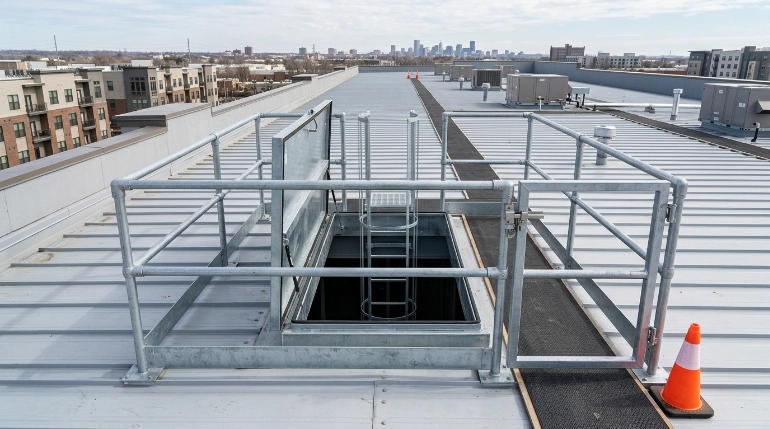
A closed roof hatch may look harmless. Once opened, however, the opening can expose a person on the roof to a significant drop into the building below.
The hazard becomes especially easy to overlook after someone climbs through the hatch. A worker may step backward while carrying tools, inspecting flashing, servicing HVAC equipment, or walking across a metal roof and accidentally move toward the opening.
OSHA defines a fall hazard broadly as a condition on a walking-working surface that exposes an employee to the risk of injury from falling on the same level or to a lower level. Its walking-working surfaces standards address ladders, openings, fall-protection systems, and related training.
For a property owner, the practical lesson is simple:
Do not assume that an open hatch cover by itself provides adequate protection around the opening.
OSHA has specifically explained that when a roof hatch is left open, exposed sides of the opening may require appropriate guarding.
OSHA General Industry vs. Construction Rules
One reason roof hatch safety can be confusing is that there is no single rule that applies identically to every situation.
Two major sets of OSHA standards may come into play.
General Industry
OSHA’s 29 CFR Part 1910 standards commonly apply to routine maintenance, servicing, inspection, and many ongoing workplace activities.
Under OSHA’s general-industry rule for holes, employees generally must be protected from falling through a hole that is 4 feet or more above a lower level using an allowed protection method such as:
- A cover
- A guardrail system
- A travel-restraint system
- A personal fall-arrest system
OSHA also contains specific provisions for ladderway and hatchway openings.
Construction
Construction work is generally addressed under 29 CFR Part 1926.
For holes in construction walking-working surfaces, OSHA requires protection when employees could fall more than 6 feet to a lower level. Acceptable protection can include covers, guardrail systems, or personal fall-arrest systems, depending on the situation.
Roofing work also has specific fall-protection requirements. Workers on low-slope or steep roofs with qualifying fall exposure may need guardrails, safety nets, personal fall-arrest systems, warning-line arrangements, or other protections permitted by the standard. You can review OSHA’s construction fall-protection requirements for the exact provisions.
A homeowner should not try to decide which OSHA standard applies to a contractor’s crew. That responsibility belongs to the employer and qualified safety professionals.
What OSHA Requires Around an Open Hatch
OSHA’s general-industry rules contain detailed requirements for holes, ladderway openings, and hatchways.
For example, OSHA states that a ladderway floor or platform hole must generally have guardrails and toeboards on exposed sides, with a self-closing gate or an offset at the entrance. Hatchway arrangements can use compliant covers and guardrails or other permitted protective configurations.
The exact setup depends on the opening and how it is being used.
A typical safe arrangement may involve:
| Roof Hatch Condition | Main Hazard | Common Protection Approach |
|---|---|---|
| Hatch closed | Unexpected opening or unstable cover | Secure, properly maintained cover |
| Hatch open during access | Fall into hatch | Guardrail or compliant hatch protection |
| Fixed ladder enters hatch | Ladderway fall exposure | Guarding and protected access |
| Materials moved through hatch | Open access area | Guardrail or travel-restraint arrangement |
| Work near roof edge | Fall from roof perimeter | Applicable roof-edge fall protection |
The table is only a practical overview. It is not a substitute for determining which OSHA regulation applies to a particular job.
Guardrail Requirements Around Roof Hatches
A roof-hatch guardrail is one of the most recognizable forms of protection.
Under OSHA’s general-industry guardrail criteria, the top edge of a standard guardrail generally must be 42 inches, plus or minus 3 inches, above the walking-working surface. Additional requirements govern midrails, openings, strength, and other components. See OSHA’s fall-protection system criteria for the complete requirements.
Construction guardrails are also generally required to have their top edge at 42 inches, plus or minus 3 inches, and must meet strength and configuration requirements.
This is important because a decorative railing or improvised pipe barrier is not automatically an OSHA-compliant guardrail.
A proper system must be designed and installed for the hazard it is intended to control.
What About a Self-Closing Gate?
A gate can be important where a ladder enters a guarded area.
Under general-industry rules, OSHA requires protection at a ladderway floor or platform hole entrance through either a self-closing gate or an offset arrangement so a person cannot walk directly into the opening.
For property owners, this means that seeing railings on three sides of a hatch does not automatically tell you the entire access system is adequate.
The entrance arrangement matters too.
Roof Hatch Ladder Safety
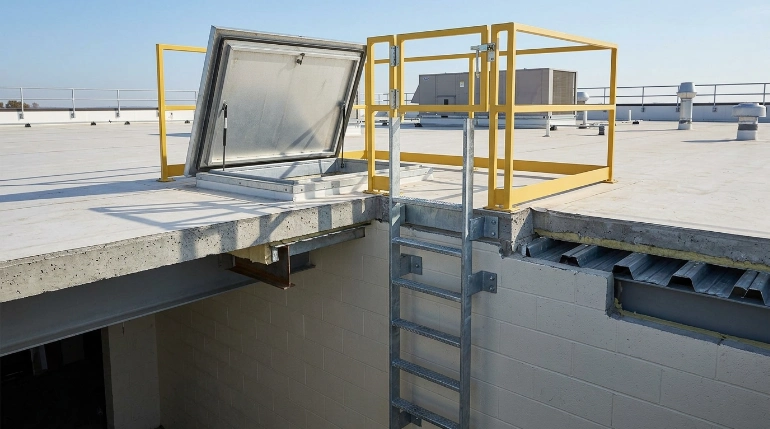
Many roof hatches are reached by a permanently installed fixed ladder.
That ladder is part of the safety system, not simply a convenient way to reach the roof.
OSHA’s general-industry ladder standards require ladders to be maintained and used safely. OSHA also requires a worker climbing a ladder to use at least one hand to grasp it and prohibits carrying loads that could cause a loss of balance.
A safer routine is to hoist tools separately rather than attempting to climb through a hatch while holding a toolbox, roofing materials, or bulky equipment.
What Happens With Long Fixed Ladders?
Fixed ladders can have additional fall-protection requirements.
OSHA has clarified that fixed ladders 24 feet or less generally are not required to have a personal fall-arrest or ladder-safety system solely because of their height, although special configurations can change the analysis. Fixed ladders extending more than 24 feet can trigger additional requirements.
Do not assume an old cage around a long ladder automatically makes a current installation compliant. Ladder requirements have changed over time, and the installation date, ladder length, configuration, and work classification can matter.
Roof Hatch Safety on Metal Roofs
Metal roofing deserves extra attention around access points.
Metal panels can become slick when covered with rain, condensation, frost, dust, pollen, or roofing debris. A person emerging from a hatch may also transition immediately from a stable ladder to a sloped or smooth roof surface.
OSHA’s general walking-working surface rules require workplace surfaces to be maintained free, as far as feasible, from hazards including leaks, spills, snow, ice, corrosion, and similar conditions.
For a metal-roof property, consider the entire route from the interior ladder to the work area:
- Is the hatch easy to open without losing balance?
- Is there a secure handhold during the transition?
- Is the roof surface dry?
- Is the hatch opening guarded once opened?
- Is the walking route clear of loose fasteners and tools?
- Is the roof edge close to the hatch?
- Are workers carrying equipment while climbing?
- Is fall protection available where required?
A safe hatch does not make the rest of the roof safe.
Roof slope, panel profile, weather, roof-edge distance, equipment placement, skylights, penetrations, and surface condition all affect the risk.
Roof Edge Distance Still Matters
A worker can climb safely through a protected hatch and still face a fall hazard at the roof perimeter.
General-industry OSHA standards include requirements for employees working on low-slope roofs. Depending on distance from the roof edge, frequency of work, and other conditions, protection may involve conventional fall protection, designated areas, or specific work rules.
For construction roofing work, separate standards apply, including the fall-protection requirements in 29 CFR 1926.501.
This is why simply adding a hatch railing does not automatically make an entire rooftop OSHA compliant.
Roof Hatch Covers Should Stay Functional
The hatch cover itself must work as intended.
A damaged hinge, corroded frame, broken latch, warped lid, or difficult opening mechanism can turn routine roof access into a hazardous maneuver.
A good property-maintenance inspection should look for:
- Corroded hatch components
- Loose hinges or fasteners
- Damaged seals
- Water infiltration
- Sharp metal edges
- A lid that unexpectedly falls closed
- Obstructions beneath the hatch
- Damaged ladder attachment points
- Deteriorated flashing around the curb
- Standing water or debris near the hatch
On metal roofs, inspect the hatch curb and surrounding flashing carefully. Water entering around the hatch can damage insulation, decking, interior finishes, and nearby structural materials.
How Roof Hatches Affect Leaks, Roof Life, and Maintenance
A roof hatch creates a penetration through the roofing assembly.
That means installation quality is important not only for worker safety but also for waterproofing.
The curb must integrate correctly with the roof system, flashing, underlayment, drainage pattern, and any manufacturer-specific details.
Poor installation may lead to:
- Water entering around the hatch curb
- Corrosion
- Wet insulation
- Deteriorated roof decking
- Interior staining
- Mold-supporting moisture conditions
- Premature roof-system deterioration
A metal roof may last for decades when properly designed, installed, and maintained, but penetrations such as hatches remain areas that deserve regular inspection.
If a leak appears near the hatch, do not immediately assume that the hatch itself needs replacement. The source may be flashing, fasteners, seams, sealant, curb details, condensation, or nearby roofing.
Roof Hatch Cost Considerations
There is no useful single price for adding or correcting a roof hatch system because the project scope varies significantly.
Cost can depend on:
- Hatch size and material
- Existing roof construction
- Metal, membrane, shingle, or other roofing type
- Structural framing modifications
- Fixed-ladder requirements
- Guardrail and gate installation
- Roof height
- Interior access
- Flashing complexity
- Labor rates
- Permits
- Engineering needs
- Existing water damage
Adding a hatch to an existing roof can cost substantially more than replacing a hatch during planned roof replacement because the contractor may need to modify framing and carefully integrate new flashing into an existing system.
Do not choose a hatch or guardrail solely because it is the cheapest option. The roof assembly, structural opening, worker access, applicable code, and safety requirements all need to work together.
Does a Roof Hatch Affect the Roof Warranty?
It can.
Cutting a new opening into an existing metal roof or modifying flashings may affect manufacturer or contractor warranty coverage if the work is not performed according to required details.
Before installing or replacing a roof hatch:
- Review the roof warranty.
- Identify the roofing manufacturer if possible.
- Ask whether approved flashing details are required.
- Confirm whether an authorized installer must perform the work.
- Document the roof condition before modifications.
- Keep invoices, permits, product information, and installation records.
This is especially important when the roof is relatively new and still has meaningful warranty coverage.
Expert Tip
Expert Tip: Treat the roof hatch as part of a complete access system—not as a standalone product. Evaluate the ladder, hatch opening, guardrails, gate, walking path, roof edge, surface condition, and fall-protection plan together before allowing routine rooftop work.
Training Is Part of OSHA Fall Safety
Equipment alone does not solve every fall hazard.
OSHA’s general-industry training standard requires employers to train affected employees about the nature of fall hazards, how to recognize them, procedures used to minimize those hazards, and proper use of fall-protection equipment. The training must be provided by a qualified person. OSHA also requires retraining when circumstances show that a worker no longer has the necessary understanding or skill. See OSHA’s fall-hazard training requirements.
For homeowners and property managers, this means a contractor arriving with harnesses and rails does not by itself prove that the crew is properly prepared.
Safety procedures and worker training matter too.
Common Mistakes Homeowners Should Avoid
- Assuming OSHA applies to every homeowner personally. OSHA primarily regulates workplace safety and employer responsibilities.
- Believing an open hatch lid is enough protection. An exposed opening may require additional guarding.
- Focusing only on the hatch. Ladder access and roof-edge exposure may create separate hazards.
- Letting workers carry bulky tools up the ladder. Loads can interfere with safe climbing.
- Walking onto a wet metal roof. Smooth metal surfaces can become particularly hazardous when contaminated or wet.
- Installing an improvised railing. A railing must meet applicable dimensional, strength, and configuration requirements.
- Ignoring flashing during safety upgrades. Poorly installed hatch rails or curbs can create roof leaks.
- Cutting into structural framing without evaluation. Creating a new roof opening can require structural modifications.
- Assuming every contractor follows the same OSHA standard. Construction and general-industry requirements can differ.
- Relying on an old ladder cage without evaluation. Current fixed-ladder requirements depend on ladder height, configuration, and installation circumstances.
When to Consult a Licensed Roofing Contractor
A roof hatch project should involve a qualified roofing professional whenever the work affects the roof covering, flashing, curb, structural opening, or drainage.
Consult a licensed roofing contractor when:
- You are adding a new hatch.
- The hatch leaks.
- Metal panels around the hatch are corroded or distorted.
- Flashing has separated.
- Roof decking appears soft or damaged.
- The hatch curb needs replacement.
- You are replacing the roof around an existing hatch.
- The opening is near a roof edge.
- Contractors regularly use the hatch for rooftop equipment service.
A structural engineer may also be necessary if installation requires cutting rafters, trusses, joists, decking supports, or other structural components.
For OSHA compliance questions involving employees, the contractor’s safety professional, qualified person, or other appropriately trained specialist should evaluate the jobsite.
Homeowners should not attempt to design an employee fall-protection system from an online article.
FAQs
Does OSHA require railings around a roof hatch?
OSHA can require protection around an exposed hatch or ladderway opening. The exact configuration depends on the applicable standard and how the opening is being used. Guardrails, covers, gates, restraint systems, or other compliant protections may be required.
How high does an OSHA roof hatch guardrail need to be?
Under OSHA’s general-industry guardrail standard, the top edge is generally 42 inches above the walking-working surface, with a permitted variation of plus or minus 3 inches. Other design and strength requirements also apply.
Does the roof hatch lid count as fall protection?
A closed, compliant cover can serve as protection in situations covered by OSHA’s rules. Once the hatch is opened, however, the exposed opening may require another form of protection. OSHA has specifically stated that exposed sides of an open roof hatch may need guarding.
Does OSHA require a self-closing gate at a roof hatch?
Where a ladderway floor or platform opening is involved under general-industry standards, OSHA requires the entrance to be protected by a self-closing gate or an offset that prevents someone from walking directly into the opening. The exact hatch arrangement should be evaluated against the applicable standard.
Are OSHA rules the same for roofers and maintenance workers?
Not necessarily. Construction activities can fall under 29 CFR Part 1926, while routine maintenance and other work may fall under general-industry standards in Part 1910. The applicable rules and fall-height thresholds can therefore differ.
Is a fixed ladder under a roof hatch automatically OSHA compliant?
No. The ladder must meet the applicable requirements for its configuration and use. Longer fixed ladders can also require a personal fall-arrest system or ladder-safety system under current general-industry rules.
Can I install a roof hatch safety railing myself?
For your own private use, local building rules may determine what is legally required. But if employees will use the system, OSHA compliance becomes an employer safety issue. Because incorrect attachment can also damage roofing or create leaks, professional installation and safety review are usually the wiser approach.
Conclusion
Understanding roof hatch safety OSHA requirements starts with recognizing that an open hatch is more than an access point—it is a potential fall hazard.
For workplaces, protection may involve a compliant hatch cover, guardrail system, gate, travel restraint, personal fall arrest, or a combination of measures depending on the applicable OSHA standard. Ladder condition, roof-edge exposure, training, and the surrounding walking surface also matter.
For homeowners and property managers, the safest approach is to evaluate the complete access route rather than buying a hatch or railing in isolation.
If contractors regularly access your metal roof through a hatch, ask a qualified roofing contractor to inspect the hatch, curb, flashing, ladder, and surrounding roof condition. For workplace fall-protection compliance, have the employer or an appropriately qualified safety professional determine the exact OSHA requirements before work begins.
A well-designed access system protects both the people working on the roof and the roofing system underneath them.