
Reliable Rooftop Fall Protection: A Homeowner’s Guide to Metal Roof Safety

Working on a metal roof can look straightforward from the ground. Once someone steps onto the panels, however, the combination of height, slope, smooth surfaces, weather, roof edges, and openings can create serious fall hazards.
That is why reliable rooftop fall protection is more than wearing a harness or placing a ladder against the house. A dependable system must match the roof, the work being performed, the worker, the anchorage, and the conditions that day.
For homeowners hiring a metal roofing contractor, understanding the basics can help you recognize good safety planning without trying to supervise the crew yourself. This guide explains the main fall-protection systems, metal-roof-specific concerns, warning signs, contractor questions, costs, warranties, and situations that should never become DIY projects.
Quick Answer
Reliable rooftop fall protection uses a complete system designed for the actual roof and fall hazard. Depending on the job, that may include guardrails, safety nets, personal fall-arrest equipment, compatible roof anchors, or approved low-slope roof methods. On metal roofs, proper anchorage, dry conditions, training, inspection, and rescue planning are especially important.
Why Reliable Rooftop Fall Protection Matters
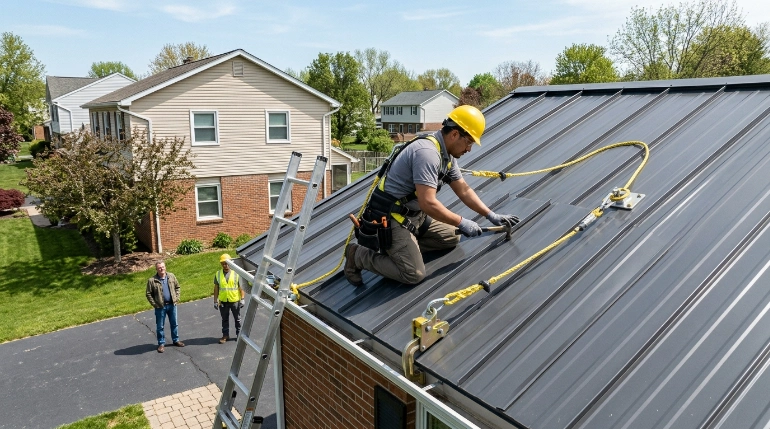
Falls are one of the most serious hazards associated with roofing work. OSHA’s residential fall-protection resources provide standards, compliance assistance, and roofing-specific fall-prevention information for construction employers.
Federal OSHA construction rules generally require protection when employees are exposed to an unprotected side or edge 6 feet or more above a lower level. The permitted method depends partly on the roof configuration and the work being performed.
That six-foot figure is a workplace regulatory threshold. It does not mean a homeowner can safely work six feet above the ground without protection.
A fall from a porch, garage, first-story roof, ladder, or roof edge can still cause severe injury.
Metal roofing adds another concern: traction. Painted steel, aluminum, standing-seam panels, and other smooth roofing surfaces can become slippery because of:
- Rain
- Morning dew
- Frost or ice
- Dust and pollen
- Leaves
- Metal shavings
- Loose underlayment
- Oil or construction debris
If you are considering going onto the roof yourself, our guide to walking on a metal roof without slipping explains why staying on the ground is often the safer decision.
What Makes Rooftop Fall Protection “Reliable”?
A reliable system does not depend on someone simply being careful.
It uses multiple safety elements that work together.
The exact setup can vary, but a properly planned system should address:
- How workers safely access the roof
- Where fall hazards exist
- What protection method matches those hazards
- Where harness systems will be anchored
- Whether the equipment is compatible
- How equipment will be inspected
- What happens if conditions change
- How a fallen worker will be rescued
A harness by itself does not solve the problem. If it is connected to a weak anchor, positioned incorrectly, used with insufficient fall clearance, or left disconnected while someone moves across the roof, protection can fail.
Homeowners interested in the OSHA-specific side of this issue can also review our explanation of OSHA roof tie-off requirements for metal roof work.
Common Types of Rooftop Fall Protection
Different roofs require different approaches.
| Fall-protection method | What it does | Typical consideration |
|---|---|---|
| Guardrail system | Creates a physical barrier at an exposed edge | Useful where properly installed guardrails are practical |
| Safety-net system | Catches a worker after a fall | Requires correct placement and sufficient clearance |
| Personal fall-arrest system | Stops a worker after a fall begins | Requires harness, connector, compatible anchorage, and adequate clearance |
| Fall-restraint system | Prevents a worker from reaching a fall edge | Must be designed so the user cannot enter the fall zone |
| Warning-line system | Marks a controlled work area | Allowed only in certain roofing situations and is not universal protection |
| Roof-opening protection | Protects skylights and holes | May include covers, guardrails, or appropriate fall protection |
OSHA specifically lists several permitted methods for qualifying low-slope roofing work, while workers on steep roofs with qualifying fall exposure generally require guardrails with toeboards, safety nets, or personal fall-arrest systems.
Personal Fall-Arrest Systems
A personal fall-arrest system is what many homeowners picture when they hear “roof safety.”
A typical system may include:
- Full-body harness
- Lanyard or self-retracting lifeline
- Compatible connectors
- Lifeline or rope grab where applicable
- Structural anchorage
The goal is to stop a person before they strike the ground or another lower surface.
But reliability depends on the entire system.
The worker still needs enough fall clearance. The equipment must be compatible. The anchor must be suitable for the load and roof construction. Sharp edges must also be considered.
Fall Restraint vs. Fall Arrest
These terms sound similar but describe different approaches.
Fall restraint attempts to keep the worker from reaching the edge in the first place.
Fall arrest assumes a fall can occur and is designed to stop the worker after it begins.
When site conditions allow it, preventing exposure to an edge can reduce the need to arrest an actual fall.
Metal Roof Anchors Require Special Attention
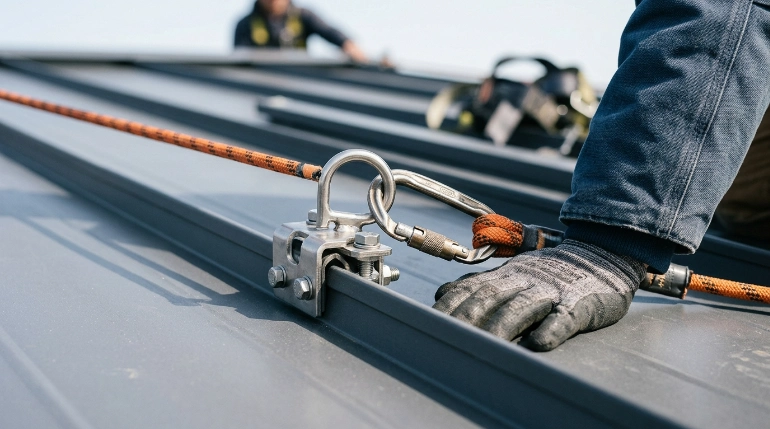
The roof anchor is one of the most important parts of a personal fall-protection system.
It cannot simply be attached to whichever rooftop object looks strong.
Gutters, plumbing vents, ridge caps, snow guards, loose panels, and ordinary roof accessories should never automatically be treated as fall-arrest anchors.
Metal roofing makes anchor selection particularly important because roof systems differ significantly.
A home may have:
- Standing-seam roofing
- Corrugated panels
- Exposed-fastener panels
- Metal shingles
- Structural panels
- Panels installed over solid decking
- Panels installed over battens
Some engineered anchors can clamp onto compatible standing seams without penetrating the metal. Other designs require attachment into suitable structural members.
The correct solution depends on the panel profile, seam geometry, substrate, structural support, equipment instructions, and loading direction.
Improper anchor installation can potentially leave:
- Holes
- Distorted seams
- Scratched coatings
- Damaged fasteners
- Leak paths
- Corrosion-prone areas
- Warranty disputes
Expert Tip: Before metal roof work begins, ask the contractor where fall-protection anchors will be installed and what will happen to those attachment points when the project is finished. A detailed answer is more reassuring than simply hearing, “Everyone wears a harness.”
Roof Pitch Changes the Safety Plan
Roof pitch describes how much a roof rises vertically over a horizontal distance.
A 4:12 roof, for example, rises four inches for every 12 inches of horizontal run.
Under OSHA construction standards, different requirements apply to low-slope and steep roofing situations. For steep roofs with unprotected sides or edges six feet or more above lower levels, OSHA specifies guardrail systems with toeboards, safety nets, or personal fall-arrest systems.
For a homeowner, the simpler rule is:
Do not assume a low-slope roof is safe simply because it looks flat.
A smooth metal surface can allow a person to slide quickly toward an edge. Even experienced workers need a safety plan.
For broader homeowner precautions, see our guide to working on a roof safely.
Weather Can Make a Good Safety Plan Unsafe
A reliable fall-protection plan must account for changing conditions.
Morning dew alone can make metal surprisingly slick. Wind is another concern because large metal panels can behave like sails when carried.
Work may need to stop when there is:
- Rain
- Frost
- Ice or snow
- Strong wind
- Lightning
- Heavy condensation
- Poor visibility
- Excessive heat
- Loose storm-damaged material
Homeowners should not pressure contractors to continue roof work simply because a project is behind schedule.
Delaying a few hours or a day may be the correct safety decision.
Skylights and Roof Openings Need Protection Too
Roof edges are not the only fall hazard.
Skylights, uncovered openings, access hatches, and damaged decking can create fall-through hazards. OSHA requires protection for applicable holes and skylights through measures such as covers, guardrails, or personal fall-arrest systems.
An old skylight should never be assumed to support a person’s weight.
The same caution applies to storm-damaged decking. Water intrusion can weaken wood beneath metal panels or underlayment even when the surface does not look dramatically damaged from outside.
Training and Inspection Matter as Much as Equipment
Expensive equipment does not automatically create reliable rooftop fall protection.
Workers need to understand:
- Harness fitting
- Anchor selection
- Correct connections
- Fall clearance
- Safe movement across the roof
- Roof-edge hazards
- Skylight protection
- Equipment inspection
- Weather limitations
- Material handling
- Rescue procedures
NRCA also maintains roofing-industry fall-prevention resources focused on effective strategies for roofing projects.
Equipment should be inspected as required by its instructions and workplace safety procedures. Damaged stitching, cuts, burns, deformed hardware, corrosion, chemical exposure, or damaged lifelines are warning signs that equipment may need to be removed from service.
Reliable Fall Protection Includes a Rescue Plan
Stopping a fall is not necessarily the end of an emergency.
A worker suspended in a harness still needs prompt assistance. That is why a professional fall-protection plan should consider how rescue will happen if someone falls and cannot return to the roof independently.
Homeowners do not need to design the rescue procedure.
But a contractor should be able to explain that one exists.
A useful question is:
“What is your plan if a worker falls and is left suspended?”
A competent contractor should have a better answer than simply relying on someone eventually calling 911.
How Fall Protection Affects Roofing Cost
Reliable safety practices add legitimate time and cost to a roof project.
A contractor may need labor and equipment for:
- Anchor installation
- Guardrails
- Lifelines
- Harness inspection
- Warning-line systems where permitted
- Safe ladder access
- Moving anchors as installation progresses
- Protecting sharp edges
- Training
- Rescue planning
- Repairing temporary roof penetrations
The exact cost varies greatly with roof height, pitch, size, complexity, access, roof material, and the protection method used.
For homeowners comparing estimates, a quote should not automatically look better simply because it excludes visible safety setup.
A contractor who spends additional time preparing safe access and fall protection may be demonstrating better planning rather than unnecessary expense.
Roof Lifespan and Warranty Considerations
Metal roofing is typically chosen as a long-term roofing system. That makes careless damage during maintenance or repair especially frustrating.
Improper roof traffic or poorly installed safety anchors can potentially affect:
- Panel coatings
- Seams
- Fasteners
- Flashing
- Waterproofing
- Manufacturer warranty coverage
- Contractor workmanship coverage
Before rooftop work begins, ask whether the planned attachment method complies with the roof and fall-protection equipment manufacturers’ instructions.
If the original metal roof warranty is still active, keep documentation of any work performed.
Homeowner Tasks vs. Professional Tasks
| Task | Homeowner approach | Safer choice |
|---|---|---|
| Look for obvious storm damage | Inspect from ground | Use binoculars or zoom photos |
| Check attic for water staining | Usually reasonable | Stay on safe attic walking surfaces |
| Inspect high metal roof panels | Avoid roof access | Hire a roofing contractor |
| Repair flashing | Not recommended for most homeowners | Professional repair |
| Install roof anchors | Not a casual DIY task | Qualified roofing professional |
| Inspect skylight flashing | Avoid climbing onto roof | Professional inspection |
| Replace damaged metal panels | Professional work | Experienced metal roofer |
| Document storm damage | Ground-level photos where possible | Contractor/adjuster inspection |
After severe weather, the National Roofing Contractors Association recommends that homeowners inspect roofs from ground level and use professional roofing contractors for roof-system inspections because of fall risk.
Common Mistakes Homeowners Should Avoid
- Assuming a harness alone equals fall protection. A harness needs the right connector, anchorage, clearance, and system design.
- Climbing onto a wet metal roof. Even a roof with a gentle pitch can become dangerously slick.
- Using a plumbing vent or gutter as an anchor. Rooftop components are not automatically rated for fall protection.
- Treating a ladder as fall protection. A ladder provides access; it does not protect someone walking across the roof.
- Ignoring skylights. Roof openings can create serious fall-through hazards.
- Choosing contractors only by price. Training, insurance, equipment, and safety setup are part of professional roofing work.
- Allowing untrained helpers onto the roof. Friends and family face the same physical hazards as paid workers.
- Inspecting storm damage immediately. Loose panels, wet surfaces, unstable decking, wind, and debris can make a damaged roof even more dangerous.
- Assuming OSHA’s six-foot threshold makes lower heights safe. It does not.
- Forgetting the roof warranty. Incorrect anchor penetrations or careless foot traffic may create expensive disputes later.
When to Consult a Licensed Roofing Contractor
Call a licensed or otherwise properly qualified roofing contractor whenever an inspection, repair, or maintenance task requires walking on a metal roof and you do not have professional training and appropriate equipment.
Professional help becomes especially important when:
- The roof is steep
- The home is two or more stories
- Panels are wet, icy, damaged, or loose
- A storm has lifted panels or flashing
- Roof decking feels soft or may be rotten
- A skylight or roof opening is involved
- Structural movement or sagging is visible
- A leak is close to electrical wiring
- Panels need to be removed
- Fall-protection anchors must be installed
- An insurance claim may be involved
- The roof remains under warranty
A structural assessment may be needed when framing has shifted, decking is sagging, a tree has struck the house, or major wind damage has affected the roof structure.
For repair and maintenance projects, our homeowner guide to fall protection for roof repairs provides additional context on deciding when professional help is the safer option.
Questions to Ask Your Roofing Contractor
You do not need to become your contractor’s safety manager.
You can, however, ask sensible questions before hiring:
- What fall-protection method will your crew use?
- How will workers access the roof?
- Where will anchors be installed?
- Are those anchors compatible with my metal roof system?
- Will any anchor penetrate the panels?
- How will temporary penetrations be sealed?
- What happens if the roof becomes wet or windy?
- Are crew members trained to use the equipment?
- How are skylights and openings protected?
- What is the rescue plan after a fall?
- Do you carry appropriate liability and workers’ compensation insurance?
- Could the planned safety attachments affect my metal roof warranty?
Clear, specific answers are a positive sign.
FAQs
What is the most reliable rooftop fall protection?
There is no single system that is best for every roof. Reliable protection is a correctly designed combination of safe access, hazard controls, compatible equipment, suitable anchors, worker training, inspection, and rescue planning.
Is wearing a safety harness enough on a roof?
No. A harness must be part of a complete system. It needs appropriate connectors and anchorage, sufficient clearance, correct fitting, and proper use.
Does OSHA require roof fall protection at six feet?
For many construction situations, OSHA’s fall-protection requirements are triggered when employees are exposed to falls of six feet or more to a lower level. Specific rules depend on the work and hazard.
Can I install a roof anchor on a standing-seam metal roof?
Do not assume a generic anchor will work. Standing-seam systems can require specialized anchors compatible with the seam profile, roofing system, structure, and equipment manufacturer’s requirements.
Are low-slope metal roofs safe to walk on?
Not automatically. A low-slope roof still has edges and can become extremely slippery from moisture, pollen, dust, frost, or debris.
Can fall-protection anchors cause metal roof leaks?
They can if inappropriate anchors are used or penetrations are installed or repaired incorrectly. Ask how attachment points will be waterproofed and whether the method complies with roofing manufacturer instructions.
Should I inspect my metal roof after a storm?
Inspect from the ground or another safe location whenever possible. NRCA recommends ground-level homeowner inspections after severe weather and professional roof inspections rather than climbing onto storm-damaged roofs.
Conclusion
Reliable rooftop fall protection is not one piece of equipment. It is a complete safety approach involving the correct system, secure anchorage, safe access, training, inspections, weather awareness, adequate fall clearance, and a rescue plan.
Metal roofs deserve extra caution because smooth panels can become slippery quickly and incorrect anchor installation can damage seams, coatings, waterproofing, or warranty coverage.
For homeowners, the safest role is usually to inspect what you can from the ground, ask contractors informed questions, and leave high-risk roof access to trained professionals.
If your metal roof is steep, wet, storm-damaged, structurally questionable, or requires repairs near an edge or opening, contact a qualified roofing contractor rather than testing whether you can handle the climb yourself.