
Google Roof Measuring Tool: What It Is, How It Works, and When It’s Accurate Enough

If you’ve searched for a google roof measuring tool, you’ve probably noticed the same problem I see on jobsites all the time: people use that phrase to mean different things.
Sometimes they mean Google Earth. Sometimes they mean Google Maps. Sometimes they mean a third-party roof measurement app that uses Google imagery underneath the hood. Google itself does not really sell a dedicated “roof measuring” product in the way roofing contractors usually mean it. What Google does offer is measurement features in Google Earth, and those tools can be useful for rough roof takeoffs if you understand the limits.
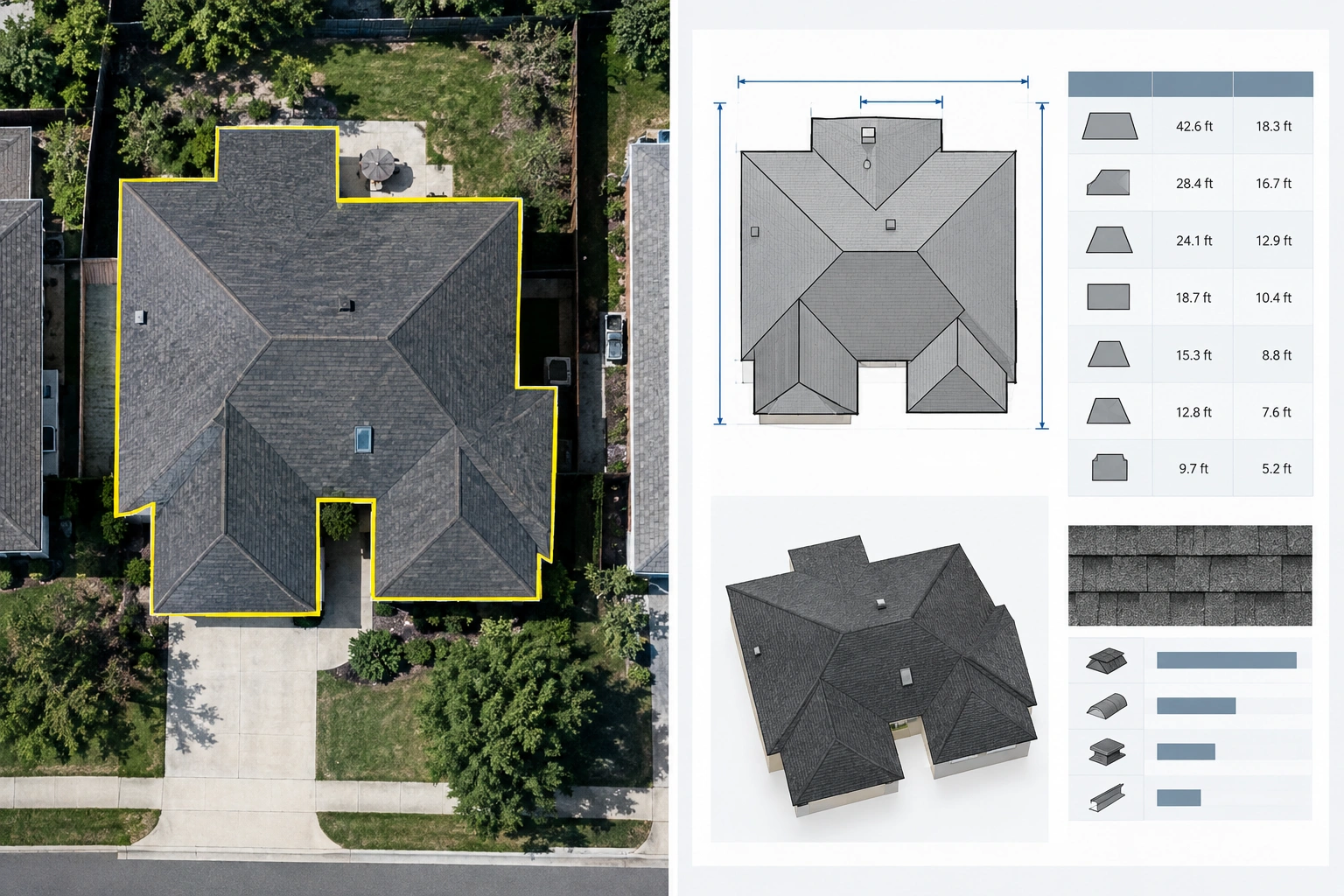
That matters because a roof estimate is only as good as the method behind it. A quick satellite trace can help you budget shingles. It can also mislead you on a hip roof with dormers, valleys, and tree cover. The difference is whether you’re using it as a rough planning tool or treating it like a bid-ready report.
What People Mean by the Google Roof Measuring Tool
In practice, the phrase usually points to one of three things:
- Google Earth measurement tools for drawing distances or polygons over a roof.
- Google Maps-based measuring through a map interface.
- Third-party roof measurement software that pulls from Google imagery or similar aerial data.
That distinction is important. Google Earth does let you measure distances and polygon areas, and Google notes that measurements may not be 100% accurate, especially where there is 3D terrain or buildings. Google also says you’ll get the best result from a top-down view. That’s the closest thing to an official Google answer on the subject. You can read it in Google’s own help documentation on measuring distances and areas in Google Earth.
For a homeowner or small contractor, that means the tool is best treated as a rough estimator, not a final takeoff. For a complex roof or a high-dollar bid, a professional measurement report is the safer call.
How Roof Measurement from Satellite or Map Imagery Works
The basic workflow is simple.
You pull up the address in overhead view, trace the roof outline, and let the software calculate area. If the roof is a simple rectangle, that’s straightforward. If it has multiple planes, you measure each section separately and add them together.
Here’s the practical version I’d use on a basic roof:
- Open the property in a top-down aerial view.
- Zoom in until the roof fills the screen without getting blurry.
- Trace the outside edge of each roof plane.
- Record the area of each section.
- Add the sections together.
- Convert the total into roofing squares if needed.
A roofing square is 100 square feet. So if your traced roof area comes out to 2,400 square feet, you’re looking at 24 squares before waste and pitch adjustments.
The reason top-down matters is simple: angled imagery can distort the roof footprint. Google’s own guidance says to measure from a top-down view for best results. That helps reduce the kind of visual skew that throws off area estimates.
A Google Maps Community reply also describes a basic method: drop a marker at one corner of the roof, then use the measure distance option. That can work for quick checks, but it’s still a rough approach compared with a dedicated roof report.
How Accurate Is a Google-Based Roof Measurement?
For a rough estimate, these tools can be good enough. For a final material order or contractor bid, they usually are not enough by themselves.
A practical rule of thumb: if the roof is a simple gable or basic ranch-style layout and the image is clear, a Google-based measurement can be useful for budgeting and early planning. If the roof has multiple levels, dormers, hips, valleys, or heavy tree cover, treat the result as a starting point only.
That’s the honest answer.
A satellite-based measurement is most reliable when the roof is:
- simple in shape
- clearly visible from above
- free of tree cover or shadows
- not split into lots of small facets
- not dependent on exact pitch for material ordering
The more complicated the roof, the more the estimate can drift. A simple gable roof on a one-story home is a very different problem from a multi-level roof with dormers, valleys, and different slopes. On the latter, a small tracing mistake can turn into a real material error.
Western States Metal Roofing describes Google Earth as a way to get a bird’s-eye view and a ballpark square footage estimate, but it also says that when you’re ready to order materials, you should use accurate field measurements. That’s the right way to think about it: ballpark first, verify later.
What Affects Accuracy: Pitch, Roof Complexity, and Image Quality
Three things move the number the most.
1. Roof pitch
A top-down measurement gives you the roof footprint, not always the full surface area. Steeper roofs have more actual surface than their footprint suggests. If you ignore pitch, you can undercount material.
That’s why pitch matters when you’re converting area into shingles, metal panels, or underlayment. A low-slope roof and a steep roof with the same footprint do not use the same amount of material.
If you need help working that out, our roof pitch calculator guide explains how pitch affects roofing estimates in plain terms.
2. Roof complexity
Dormers, hips, valleys, porches, and additions make tracing harder. Each extra angle creates more chances to miss a section or double-count one. Multi-level roofs are especially tricky because a top-down image can hide where one roof plane ends and another begins.
3. Image quality and obstruction
Trees, shadows, and outdated imagery can all distort the outline. A roof that looks clean in one zoom level may be blocked at another. If the image is old, the roof may also have changed since the satellite photo was taken.
That is why I would not use a quick satellite trace as the only number on a complex reroof. If the roof line is hard to read, the estimate is already on shaky ground.
How to Estimate Roofing Materials from the Measurement
Once you have roof area, you still need to translate that number into materials. That’s where a lot of DIY estimates go wrong.
Shingles
Shingles are usually ordered by square. So if your roof measures 20 squares of actual roof area, you still need to add waste. Waste covers cutoffs, starter rows, ridge cap, valleys, and general handling loss.
Here’s a simple example: if your traced roof area is 2,200 square feet, that equals 22 squares. If you add 10% waste for a fairly simple roof, you get 24.2 squares. In practice, you would round up and order 25 squares. If the roof is more cut up or has more valleys, you might use a higher waste factor and order more.
Underlayment and accessories
Underlayment, drip edge, starter, ridge cap, and flashing all need their own count or linear footage. A roof area number alone won’t tell you how much ridge cap or drip edge you need. You still have to break the roof into parts.
Metal roofing
Metal is less forgiving than shingles when your measurement is off. Panel count, trim, and accessory lengths matter more. A rough roof area estimate can help with budgeting, but it should not be your final order sheet.
The practical rule: use Google-based measurement to get the size of the job, then verify the material breakdown before buying.
Free vs Paid Roof Measurement Options
There’s a real trade-off here: free is fast, paid is usually more reliable.
| Option | Best for | Strengths | Weaknesses |
|---|---|---|---|
| Free Google-based measurement | Rough budgeting, early homeowner planning | No cost, fast, easy to access | Less reliable on complex roofs, limited detail |
| Paid roof measurement report | Bidding, ordering, contractor estimating | More complete data, better documentation | Costs money, still depends on imagery quality |
| On-site manual measurement | Final verification, complex roofs | Direct inspection, can confirm details | Slower, riskier, requires access and care |
For a homeowner trying to estimate whether a reroof is a 20-square job or a 35-square job, a free tool may be enough to start the conversation. For a contractor preparing a real proposal, a paid report is usually worth the cost because it reduces guesswork.
GAF’s QuickMeasure is an example of a professional measurement service that goes beyond a simple trace. GAF says its reports can include complete roof measurements, a bill of materials, interactive 3D rendering, past views and multiple angles, an XML data file, and multiple building summaries. That kind of output is much closer to what contractors actually need when pricing work and ordering materials. See GAF QuickMeasure for the product details.
Google-Based Estimates vs Professional Roof Measurement Services
This is where the buying decision gets real.
A Google-based estimate is usually about speed and convenience. A professional measurement service is about confidence and documentation.
Use the Google-based approach when:
- you need a quick budget number
- the roof is simple
- you’re comparing options
- you want a rough materials estimate before calling contractors
Use a professional roof measurement report when:
- you’re bidding a job
- the roof is complex
- the project has expensive materials
- you need a bill of materials or exportable report
- you want fewer surprises during ordering
The difference is not just accuracy. It’s workflow. A pro report gives you something you can hand to an estimator, office manager, or supplier with much less cleanup.
For a broader comparison of manual, aerial, laser, and app-based methods, our roof measuring tools guide breaks down the trade-offs by job type and user level. If you’re choosing a method from scratch, the roof measurement tool buying guide is the better starting point.
Which Option Is Best for Homeowners, DIYers, and Contractors
Different users need different levels of precision.
Homeowners
If you’re trying to budget a reroof or compare quotes, a Google-based tool is fine for a first pass. It helps you understand whether you’re dealing with a small, medium, or large roof before you talk to contractors.
DIY homeowners
If you’re ordering your own shingles for a simple roof, use the Google estimate only as a starting point. Verify pitch, waste, and any tricky roof sections before placing the order. A few extra bundles are easier to return than a short order is to fix.
Roofing contractors
For bidding, a satellite trace alone is too thin unless the roof is very simple and the job is low risk. Contractors need repeatable numbers. That usually means a professional measurement report or an on-site check before final pricing.
Sales reps and estimators
Use Google-based measurement for lead screening and early budget ranges. Once the prospect is serious, move to a more complete report. That keeps your front-end workflow fast without letting rough numbers leak into final pricing.
When a Google Roof Measuring Tool Is Good Enough—and When It Isn’t
Here’s the decision rule I use:
Good enough
- simple gable roof
- clear overhead imagery
- no heavy tree cover
- rough budget only
- no final ordering yet
Not good enough
- steep or unusual roof geometry
- dormers, hips, or multiple levels
- poor image clarity
- material ordering with tight margins
- contractor bidding on a client job
If the roof is simple and the stakes are low, a Google-based measurement can save time and give you a decent planning number. If the roof is complex or the order is expensive, the risk of being wrong is bigger than the time you save.
Common Mistakes to Avoid When Using Satellite Roof Measurements
The biggest mistakes are usually the simplest ones.
Treating the number as exact is the first mistake. It’s not exact.
Ignoring pitch is the second. Footprint and surface area are not the same thing.
Forgetting waste is the third. A roof estimate without waste is not a real material estimate.
Using one section for the whole roof is another common error. If there are multiple roof planes, measure them separately.
Trusting bad imagery is the last one. If trees, shadows, or image blur make the outline uncertain, the estimate is weak before you even start.
How to Choose the Right Roof Measurement Method
Use this framework:
- Need a rough number fast? Use a Google-based measurement.
- Need to compare bids or budget a project? A paid roof report is safer.
- Need to order materials? Verify with pitch, waste, and roof details before buying.
- Need to bid professionally? Use a contractor-grade report or on-site verification.
- Working with a complex roof? Don’t trust a quick satellite trace alone.
That’s the real buying guide answer. The best tool is the one that matches the risk of the job. A free estimate is fine when the downside is small. Once you’re pricing a job or placing a materials order, the cost of being wrong usually beats the cost of a better measurement method.
When to Call a Roofing Pro
Call a roofing pro when the roof is hard to read, the pitch is steep, the layout is complicated, or the project is too expensive to guess at. That includes reroofs with multiple levels, mixed materials, or sections hidden by trees and neighboring structures.
A good measurement tool can save time. It cannot replace judgment on a roof that needs real verification.
FAQ
Is the Google roof measuring tool an official Google product?
Usually, no. People often use that phrase to describe Google Earth measurement features, Google Maps measuring, or third-party roof tools that rely on Google imagery.
Can I measure roof pitch with Google Earth?
Not reliably. Google Earth can help with area and distance measurements, but pitch usually needs a separate method or a roof report that accounts for slope.
Is a satellite roof measurement accurate enough to order shingles?
Sometimes on a simple roof, but I would not rely on it alone for a complex roof. Add waste, verify pitch, and confirm the roof layout before ordering.
What is the biggest limitation of Google-based roof measurement?
Image quality and roof complexity. Trees, shadows, outdated imagery, and multiple roof planes can all push the result off.
Are paid roof measurement reports worth it?
If you’re bidding jobs, ordering expensive materials, or working on complex roofs, yes. The extra detail usually pays for itself in fewer mistakes.
Can homeowners use Google Earth for a quick estimate?
Yes. For a simple roof, it’s a reasonable way to get a ballpark number before calling contractors or planning a DIY project.
Final word
A Google-based roof measurement is a handy estimating tool, not a substitute for a proper takeoff when the job matters. Use it to size up the roof, not to gamble on the final number.