How to Repair a Metal Roof: A Practical Homeowner’s Guide

A leaking or damaged metal roof can quickly lead to wet insulation, stained ceilings, mold, and structural deterioration. The challenge is that water may enter through one location and travel several feet before appearing inside your home.
Learning how to repair a metal roof begins with identifying the actual source of the problem. Loose screws, damaged washers, separated seams, corrosion, punctures, and failed flashing all require different repair methods.
This guide explains how to inspect common trouble spots, complete minor repairs, recognize unsafe conditions, and decide when professional roof repair or replacement is the smarter choice.
Quick Answer
To repair a metal roof, first locate the true leak source, clean and dry the damaged area, and use materials compatible with the existing roof. Common repairs include replacing loose screws, resealing flashing, installing metal patches, and treating rust. Large leaks, structural damage, and standing-seam problems usually require a professional roofer.
Understand What Type of Metal Roof You Have
Before buying repair materials, identify your metal roofing system. Repair techniques that work on one system may damage another.
Exposed-Fastener Metal Roof
An exposed-fastener roof has visible screws installed through the metal panels. Each screw normally includes a rubber or synthetic sealing washer.
Common problems include:
- Loose or missing screws
- Cracked sealing washers
- Stripped screw holes
- Rust around fasteners
- Leaks at overlapping panels
- Sealant failure at trim and flashing
These roofs are generally easier to inspect because the fasteners and panel overlaps are visible.
Standing-Seam Metal Roof
A standing-seam roof has raised vertical seams with most fasteners concealed beneath the panels. The panels are designed to move slightly as temperatures change.
Common problems include:
- Seams that have separated or opened
- Failed clips beneath the panels
- Damaged seam locks
- Leaks around roof penetrations
- Improperly installed flashing
- Panel movement caused by thermal expansion
Standing-seam repairs usually require specialized tools and system-specific knowledge. Avoid drilling screws through concealed-fastener panels unless the roof manufacturer specifically approves the repair.
Metal Shingles or Tiles
Metal shingles are smaller interlocking pieces designed to resemble asphalt shingles, slate, or tile. Repairs may require lifting surrounding pieces without damaging hidden locks or fasteners.
A roofing professional can often replace individual damaged shingles without replacing the entire roof.
Signs Your Metal Roof Needs Repair
Some metal roof problems are obvious, while others appear only during heavy rain or strong wind.
Look for these warning signs:
- Water stains on ceilings or walls
- Damp insulation in the attic
- Rust streaks on panels
- Loose, crooked, or missing screws
- Cracked or flattened screw washers
- Gaps between overlapping panels
- Deteriorated sealant
- Loose ridge caps or edge trim
- Damaged flashing around vents and chimneys
- Dents or punctures caused by falling branches
- Water collecting behind roof penetrations
- Panels that move, lift, or make unusual noises
Do not assume that the opening directly above an interior stain is the source. Water may travel along panels, underlayment, rafters, or fasteners before dripping into the room.
Safety Comes Before the Repair
Metal roofing can be extremely slippery, particularly when wet, dusty, frosty, or covered with pollen. Its smooth surface also becomes hot in direct sunlight.
According to the OSHA residential fall-protection guidance, roofing work presents serious fall risks and requires appropriate protective systems. Homeowners should not treat a ladder, ordinary shoes, or a rope tied around the waist as adequate fall protection. (OSHA)
Do not climb onto the roof when:
- The roof is wet, icy, or extremely hot
- The slope is steep
- You cannot safely reach the damaged area
- The panels are loose or structurally damaged
- Power lines are nearby
- You do not have proper fall-protection equipment
- Thunderstorms or strong winds are expected
Many initial checks can be completed from the ground with binoculars or from inside the attic. A roofing contractor can perform the exterior inspection when roof access is unsafe.
Tools and Materials for Minor Metal Roof Repairs
The exact materials depend on the roof system and type of damage. A typical minor repair may require:
- Work gloves and eye protection
- Stable extension ladder
- Manufacturer-approved fall-protection equipment
- Soft brush or clean rags
- Mild cleaning solution
- Cordless drill with adjustable clutch
- Compatible replacement roofing screws
- Long-life sealing washers
- Butyl tape
- Metal-roof sealant
- Matching sheet-metal patch
- Metal snips
- Rust-inhibiting primer
- Manufacturer-approved touch-up coating
- Plastic putty knife
Check the roof warranty before making repairs. Using the wrong fastener, coating, sealant, or patching method may damage the finish or affect warranty coverage.
How to Find the Source of a Metal Roof Leak
A successful repair depends on finding the entry point rather than simply covering the interior stain.
Start Inside the Attic
Inspect the attic during or shortly after rainfall when it is safe to do so.
Use a flashlight to look for:
- Wet roof decking
- Dark water trails
- Rusted fastener tips
- Damp insulation
- Water around pipes or vents
- Daylight entering through holes
- Mold or wood discoloration
Mark the general area without touching wet electrical wiring or fixtures.
Inspect the Roof From the Ground
Use binoculars to examine the roof for missing trim, lifted panels, open seams, rust, damaged flashing, and loose fasteners.
Pay special attention to:
- Valleys
- Ridge caps
- Roof edges
- Chimneys
- Plumbing vents
- Skylights
- Solar-panel attachments
- Areas where two roof sections meet
FEMA advises homeowners who notice damaged or stained flashing to seek professional help to identify the leak or replace the failed flashing. Flashing defects can allow water into both the roof covering and the structure beneath it. (FEMA)
How to Repair a Metal Roof Step by Step
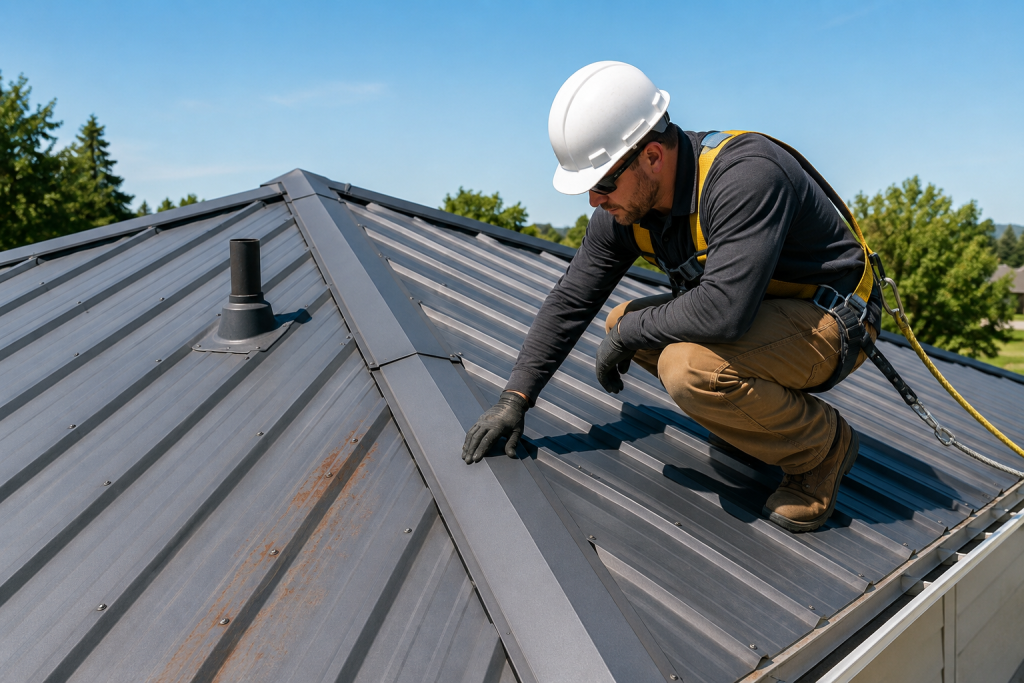
The following process is appropriate only for small, accessible defects on a dry roof. Follow the roofing manufacturer’s repair instructions whenever they are available.
1. Confirm the Damage Is Limited
Determine whether the problem is a single loose fastener, a small puncture, minor surface rust, or isolated sealant failure.
Stop and contact a contractor if you find:
- Soft or rotten roof decking
- Multiple leaking areas
- Large sections of corrosion
- Panels lifting in the wind
- Damaged framing
- Significant storm damage
- Water near electrical equipment
2. Clean and Dry the Repair Area
Remove dirt, loose rust, leaves, old sealant, and metal shavings with a soft brush or clean cloth.
A patch or sealant will not bond correctly to a wet, oily, dirty, or heavily oxidized surface. Use only cleaners approved for the panel coating.
Allow the roof to dry fully before continuing.
3. Repair Loose or Damaged Roofing Screws
Exposed-fastener roofs often leak when sealing washers become cracked, displaced, or improperly compressed.
To correct a minor fastener problem:
- Remove the defective screw carefully.
- Inspect the hole for rust or enlargement.
- Clean and dry the surrounding metal.
- Apply the manufacturer-approved sealant when required.
- Install a compatible replacement fastener with a new sealing washer.
- Tighten it until the washer sits evenly against the panel.
Do not crush the washer. Overdriving can split or deform it. Underdriving can leave a gap where water enters.
A stripped hole may need an approved oversized repair fastener rather than another screw of the same size. Fastener design, washer material, coating compatibility, and panel thickness all affect the correct choice.
4. Repair a Leaking Panel Seam
Leaks can develop where panels overlap or where sealant beneath a seam has deteriorated.
For an exposed panel overlap:
- Remove fasteners only if the panel can be lifted safely.
- Clean between the overlapping metal surfaces.
- Remove failed tape or sealant.
- Install compatible butyl tape or the sealant specified by the manufacturer.
- Reposition the panels.
- Install approved fasteners in the correct locations.
The Metal Construction Association’s metal roof installation resources emphasize following system-specific installation practices. Panel profiles, seam designs, fastener patterns, and sealant locations are not interchangeable. (Metal Construction Association)
Do not depend on a thick bead of surface caulk as a permanent seam repair. A durable repair normally places the correct sealant between secured metal surfaces, where it remains protected and compressed. Manufacturer repair guidance similarly notes that surface-applied sealant is usually a temporary measure. (MBCI)
5. Patch a Small Hole or Puncture
A small hole caused by a removed fastener, branch, or tool may be repaired with a properly designed metal patch.
A typical patching process includes:
- Remove loose rust and damaged coating.
- Cut a patch from compatible metal.
- Make the patch larger than the damaged area.
- Round the corners so they are less likely to lift.
- Apply approved butyl tape or sealant beneath the patch.
- Position the patch so water flows over it rather than against an open edge.
- Secure it using the manufacturer-approved fastener pattern.
- Seal exposed fasteners and edges only where required.
Avoid combining metals that can react with each other. For example, an incompatible patch or fastener may cause galvanic corrosion when moisture is present.
Large punctures, torn panels, or holes near seams normally require partial or full panel replacement.
6. Treat Minor Surface Rust
Small areas of surface rust may be repairable if the metal remains solid.
Use this general process:
- Remove loose rust with a nonaggressive tool approved for the roof finish.
- Clean away all dust and residue.
- Confirm that corrosion has not penetrated the panel.
- Apply a compatible rust-inhibiting primer.
- Apply the manufacturer-approved protective coating.
Do not paint over active rust without preparing the metal. The corrosion will continue beneath the coating.
If the panel has pinholes, deep pitting, flaking metal, or widespread corrosion, replacement is usually more reliable than coating.
7. Repair Flashing and Roof Penetrations
Flashing directs water around chimneys, walls, pipes, skylights, and other roof openings. It must allow for both drainage and normal panel movement.
Minor sealant deterioration may be repairable, but damaged or incorrectly installed flashing should be replaced.
Do not fill every visible gap with caulk. Some openings are part of the drainage or ventilation design. Blocking them can trap water and make the leak worse.
8. Check the Repair
After the repair has cured, inspect the area during the next rainfall. Check the attic and interior surfaces for fresh moisture.
A controlled hose test can sometimes help locate a leak, but it should involve two people and be performed in small sections. Never spray water near electrical service equipment, damaged wiring, or unsafe roof areas.
Expert Tip

Expert Tip: Photograph the roof before touching anything. Take close-up and wide-angle pictures of every damaged area, fastener, seam, and flashing detail. These images help you track changes, explain the problem to contractors, support an insurance claim, and avoid forgetting the original condition.
Should You Repair or Replace the Metal Roof?
A localized defect does not automatically mean the entire roof must be replaced. However, repeatedly repairing a failing system may cost more over time.
| Roof condition | Repair may be reasonable | Replacement may be better |
|---|---|---|
| One loose or missing fastener | Yes, when the surrounding metal is sound | No, unless fastener failure is widespread |
| Small isolated puncture | Yes, with an approved metal patch | Yes, if the panel is torn or badly deformed |
| Minor surface rust | Yes, after correct preparation | Yes, if rust has created holes or deep pitting |
| One leaking penetration | Yes, when flashing can be rebuilt correctly | Possibly, if surrounding panels or decking are damaged |
| Multiple open seams | Sometimes, after professional evaluation | Often, when panel movement or installation defects are widespread |
| Repeated leaks in different areas | A full inspection is needed | Replacement or retrofit may be more cost-effective |
| Rotten decking or structural damage | Not as a surface-only repair | Damaged materials must be exposed and replaced |
| Extensive storm damage | Temporary protection may be possible | Professional repair or replacement is usually required |
The roof’s age alone should not determine the decision. Consider panel condition, coating condition, fastener performance, underlayment, insulation, decking, previous repairs, warranty status, and the availability of matching materials.
What Affects Metal Roof Repair Costs?
Metal roof repair prices vary because two leaks that look similar from inside the house may require very different work.
Important cost factors include:
- Roof height and slope
- Ease of access
- Type of metal roofing system
- Number of damaged areas
- Need for custom-fabricated flashing
- Panel length and availability
- Condition of the roof deck
- Extent of corrosion
- Required fall-protection setup
- Removal of solar panels or rooftop equipment
- Local labor costs
- Emergency or after-hours service
A fastener replacement may be a small service call. Replacing a long standing-seam panel, rebuilding chimney flashing, or repairing rotten decking can become a much larger project.
Ask contractors to separate the estimate into inspection, labor, materials, decking repairs, flashing work, disposal, permits, and warranty coverage.
When to Call a Roofing Professional
Professional help is the safest choice when the repair involves more than an isolated, accessible defect.
Call a qualified metal roofing contractor when:
- The leak source is unclear
- Your roof is steep or difficult to access
- A standing seam has opened
- Panels are lifting or buckling
- Several areas are leaking
- Rust has penetrated the metal
- Flashing must be removed or rebuilt
- Roof decking feels soft
- A chimney, skylight, or wall intersection is involved
- The roof was damaged by hail, wind, fire, or a fallen tree
- The repair may affect a manufacturer’s warranty
- Matching panels or specialty tools are required
Look for a contractor with documented experience repairing your specific roof type. A general roofer may not have the tools or training needed for mechanically seamed panels, copper roofing, concealed clips, or specialty coatings.
Request:
- Proof of licensing where required
- General liability and workers’ compensation insurance
- A written scope of work
- Details about repair materials
- Before-and-after photographs
- Workmanship warranty terms
- An explanation of whether the repair affects the existing roof warranty
For storm damage, document the condition before emergency work and contact your insurer promptly. Temporary work should prevent additional water entry without hiding evidence of the original damage.
Common Mistakes Homeowners Should Avoid
- Covering the entire area with caulk: Excess sealant may hide the leak temporarily while trapping water underneath.
- Using asphalt roof cement: Many asphalt-based products are unsuitable for painted metal panels and may damage finishes or complicate future repairs.
- Mixing incompatible metals: The wrong patch, screw, or flashing material may cause accelerated corrosion.
- Overtightening roofing screws: A crushed washer can split, deform, or lose its ability to seal.
- Installing screws in random locations: Incorrect fastener placement may restrict panel movement or create new leaks.
- Patching over dirt or rust: Sealants and coatings need a properly prepared surface.
- Ignoring damaged underlayment or decking: Repairing only the visible metal will not correct hidden structural or moisture damage.
- Walking carelessly on panels: Foot traffic can dent panels, damage seams, and create unsafe slipping conditions.
- Repairing a wet roof: Moisture prevents proper adhesion and greatly increases the risk of falling.
- Assuming every leak needs more sealant: Open seams, failed clips, poor flashing, condensation, and structural movement require different solutions.
How to Reduce Future Metal Roof Problems
Regular inspections can catch small problems before they damage the interior of your home.
Inspect the roof from a safe location:
- After severe wind, hail, or falling branches
- When you notice new ceiling stains
- After contractors install antennas, solar panels, or HVAC equipment
- When gutters overflow or drain slowly
- When fasteners or trim become visibly loose
- Before the roof warranty expires
Keep gutters, valleys, and drainage paths free of leaves and debris. Remove metal shavings left by drilling or cutting because they can rust and stain the roof.
Avoid allowing unqualified tradespeople to drill through the panels. Every new penetration needs properly designed flashing, compatible materials, and enough flexibility for thermal movement.
FAQs
Can I repair a metal roof myself?
You may be able to complete a small repair on a dry, low-slope, easily accessible roof if you have proper safety equipment and manufacturer-approved materials. Steep roofs, standing seams, flashing failures, structural damage, and widespread leaks should be handled by a metal roofing professional.
What is the best sealant for a leaking metal roof?
The correct sealant depends on the panel system, coating, joint design, and manufacturer. Metal-roof urethane sealant and butyl tape are commonly used in specific applications, but they are not universally interchangeable. Check the roof manufacturer’s instructions before applying any product.
Can I use silicone on a metal roof?
Some silicone products are designed for metal roofing, but ordinary household silicone may not bond correctly or remain compatible with the panel finish. Use only a roofing-grade product approved for your roof material and the specific repair location.
How do you fix a stripped screw hole in a metal roof?
Remove the damaged screw, inspect the metal and substrate, clean the area, and install an approved oversized repair fastener with a new sealing washer. Severely enlarged, rusted, or damaged holes may need a metal patch rather than a larger screw.
Can you patch a rusted metal roof?
Minor surface rust can sometimes be cleaned, primed, and recoated. Metal that has deep pitting, pinholes, flaking, or major section loss should normally be patched or replaced. Coating over severe corrosion will not restore the panel’s strength.
Why does my metal roof keep leaking after being sealed?
The sealant may have been applied to a dirty surface, used in the wrong location, or chosen without considering panel movement. The actual leak may also come from loose fasteners, failed flashing, separated seams, condensation, or damaged underlayment.
How long should a metal roof repair last?
The lifespan depends on the repair design, material compatibility, workmanship, roof movement, and underlying condition. A properly installed panel patch or flashing repair may last many years. A surface bead of caulk placed over an unresolved problem may fail much sooner.
Conclusion
Knowing how to repair a metal roof starts with accurate diagnosis. Loose fasteners, small punctures, minor rust, failed seams, and damaged flashing each require a different solution. The repair materials must also match the metal, coating, fasteners, and movement characteristics of the existing roof.
Begin with a safe inspection, document the damage, and check the manufacturer’s requirements. Complete only minor repairs that are safely within your ability. For standing-seam failures, structural damage, widespread corrosion, recurring leaks, or difficult roof access, schedule an inspection with an experienced metal roofing contractor before the problem spreads.