
When to Restore vs Replace a Metal Roof: A Homeowner’s Practical Guide
Metal roofs are known for lasting a long time, but they are not maintenance-free. If your roof is leaking, fading, rusting, or showing age, you may be wondering when to restore vs replace a metal roof. The right answer depends on the roof’s condition, age, structure, coating, fasteners, leaks, and how much life is still left in the system.
Restoration can save money when the metal panels are still sound. Replacement is usually smarter when the roof has widespread corrosion, serious panel failure, trapped moisture, or structural problems. This guide explains the difference in plain language so you can make a safer, more confident roofing decision before spending thousands of dollars.
Quick Answer
You should restore a metal roof when the panels are structurally sound, leaks are minor, rust is limited, and the roof mainly needs sealing, coating, or fastener repairs. You should replace a metal roof when damage is widespread, panels are badly corroded, leaks keep returning, or the roof deck or structure is compromised.
What Does Metal Roof Restoration Mean?
Metal roof restoration means repairing and renewing the existing roof instead of tearing it off and installing a completely new one.
A typical restoration may include:
- Cleaning the roof surface
- Removing loose rust or damaged coating
- Replacing failed screws or fasteners
- Sealing seams, flashing, penetrations, and laps
- Repairing small leaks
- Applying a roof coating system
- Adding reinforcement fabric at vulnerable areas
The goal is to extend the life of the existing roof. Restoration does not make a failing roof brand new, but it can add years of service when the roof is a good candidate.
For homeowners, the biggest benefit is simple: restoration usually costs less than full replacement and creates less disruption.
What Does Metal Roof Replacement Mean?
Metal roof replacement means removing the existing metal roofing system and installing a new one. Depending on the condition of the home, replacement may also involve repairing the roof deck, insulation, underlayment, flashing, ventilation, gutters, or structural framing.
Replacement is more expensive than restoration, but it may be the better long-term investment if the current roof has reached the end of its useful life.
A replacement may be necessary when:
- Large areas of the roof are rusted through
- Panels are loose, bent, split, or failing
- Leaks are widespread
- The roof deck has water damage
- Previous repairs have failed repeatedly
- The roof was poorly installed
- The roof no longer meets performance needs
A roof coating cannot fix serious structural failure. This is one of the most important points homeowners should understand.
Restore vs Replace a Metal Roof: Key Differences
The easiest way to compare restoration and replacement is to look at the condition of the existing roof.
| Factor | Metal Roof Restoration | Metal Roof Replacement |
|---|---|---|
| Best for | Roofs with sound panels and limited damage | Roofs with major corrosion, leaks, or structural issues |
| Cost | Usually lower | Usually higher |
| Disruption | Less invasive | More invasive |
| Timeline | Often faster | Usually takes longer |
| Tear-off | Minimal or none in many cases | Usually required |
| Lifespan benefit | Extends existing roof life | Starts over with a new system |
| Leak protection | Good if leaks are minor and repairable | Better for severe or recurring leaks |
| Structural improvement | Limited | Can correct deck, framing, and ventilation problems |
| Best decision point | Roof still has usable life | Roof has reached the end of service life |
When Metal Roof Restoration Makes Sense
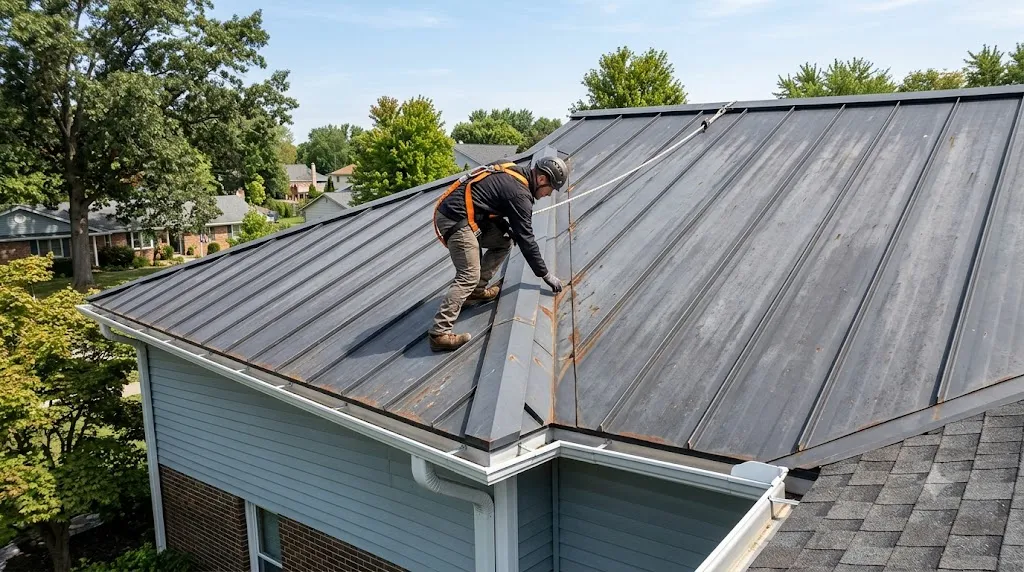
Restoration is often a smart option when the roof is aging but not failing. The metal panels must still be strong enough to hold a coating and resist future weather.
1. The Roof Has Minor Leaks
Small leaks around screws, seams, skylights, vents, chimneys, or flashing may be repairable without replacing the whole roof.
Common leak points include:
- Exposed fasteners
- Panel seams
- Ridge caps
- Pipe boots
- Skylight curbs
- Valley areas
- Wall flashing
If leaks are isolated and the roof deck is dry, restoration may work well.
2. Rust Is Surface-Level Only
Light rust does not always mean the roof must be replaced. If the rust is mainly on the surface and has not eaten through the panels, a contractor may be able to clean, prime, seal, and coat the roof.
However, rust must be handled correctly. Painting over rust without preparation can trap moisture and shorten the life of the repair.
3. The Metal Panels Are Still Solid
A roof can look old but still be structurally sound. If the panels are not soft, brittle, loose, punctured, or corroded through, restoration may be possible.
A roofing professional will usually check:
- Panel strength
- Panel attachment
- Seam condition
- Rust depth
- Fastener condition
- Flashing quality
- Roof slope and drainage
- Moisture under the roof system
4. Fasteners Are Failing but Panels Are Good
Many exposed-fastener metal roofs develop leaks when screws back out, washers crack, or fasteners lose their seal. In that case, the issue may be the attachment system rather than the metal panels themselves.
Restoration may include replacing screws with oversized fasteners, sealing vulnerable areas, and coating the roof to reduce future water entry.
5. The Roof Coating Has Worn Down
Some metal roofs lose their protective finish over time. This can cause fading, chalking, light oxidation, or early rust.
If the metal is still in good shape, a restoration coating can help protect the surface from UV exposure and moisture. ENERGY STAR notes that reflective roof products can reduce surface heat gain, and homeowners can learn more through its cool roof product guidance.
6. You Want to Extend Roof Life Before Full Replacement
Restoration can be a bridge strategy. It may help you delay replacement while improving leak protection and surface durability.
This can be useful if:
- You plan to sell the home in several years
- You need time to budget for replacement
- The roof still has life left
- A full tear-off is not currently necessary
Restoration is best when it protects a roof that is still fundamentally sound.
When Metal Roof Replacement Is the Better Choice
Replacement is the safer decision when the roof is too damaged for coating or spot repairs to perform reliably.
1. Rust Has Eaten Through the Panels
Surface rust can often be treated. Rust-through is different.
If you see holes, flaking metal, soft spots, or panels that crumble when touched, restoration is usually not enough. A coating may temporarily cover the problem, but it cannot rebuild missing metal.
If rust has weakened the panels, replacement is usually the smarter investment.
2. Leaks Keep Coming Back
A single leak may be repairable. Recurring leaks in different areas often mean the roof system is failing.
This may happen because of:
- Poor installation
- Worn-out seams
- Failed flashing
- Incorrect fasteners
- Bad roof slope
- Hidden deck damage
- Thermal movement pulling panels apart
Metal roofs expand and contract with temperature changes. If the roof was not designed or installed correctly, repeated movement can cause ongoing leaks.
3. The Roof Deck Is Damaged
The roof deck is the surface beneath the roofing material. On many homes, it is plywood or oriented strand board. If water has reached the deck, it may rot, weaken, or grow mold.
A coating applied over the metal roof will not repair the damaged deck underneath.
Signs of deck problems may include:
- Sagging areas
- Soft spots
- Interior ceiling stains
- Musty attic smells
- Wet insulation
- Repeated leaks after storms
- Visible rot from the attic
If the roof deck is damaged, replacement allows the contractor to remove the old system and fix the underlying problem.
4. The Roof Was Poorly Installed
Some metal roofs fail early because of installation mistakes.
Common installation problems include:
- Wrong fastener type
- Over-tightened or under-tightened screws
- Poorly sealed penetrations
- Incorrect flashing
- Panels cut too short
- Inadequate expansion allowance
- Bad ridge or valley details
- Mixing incompatible metals
A restoration coating may hide these problems for a while, but it will not correct the original design or installation failure.
5. Large Sections Are Loose or Damaged
If panels are lifting, separating, oil-canning severely, bent from impact, or damaged by storms, replacement may be needed.
This is especially important in wind-prone areas. The Insurance Institute for Business & Home Safety provides guidance on strengthening homes against severe weather through its FORTIFIED home standards, which can be useful for homeowners thinking beyond a basic roof repair.
6. The Roof Is Near the End of Its Life
Metal roofs can last for decades, but no roof lasts forever. Age alone does not decide the answer, but it matters when combined with leaks, rust, worn coatings, and poor attachment.
If the roof is old and already showing multiple failure signs, replacement may be more cost-effective than paying for repeated repairs.
The Most Important Inspection Areas
Before deciding when to restore vs replace a metal roof, a detailed inspection is essential. A proper inspection should look beyond the visible surface.
Exterior Roof Surface
The contractor should check for:
- Rust
- Punctures
- Loose seams
- Failed sealant
- Dented panels
- Missing fasteners
- Backed-out screws
- Damaged washers
- Open laps
- Failing coating
Flashing and Penetrations
Many metal roof leaks happen around roof details, not in the middle of the panels.
Important areas include:
- Chimneys
- Plumbing vents
- Skylights
- HVAC curbs
- Valleys
- Sidewalls
- Endwalls
- Ridge caps
- Dormers
Attic and Interior
The inside of the home can reveal what the roof surface does not show.
Look for:
- Water stains
- Dripping after rain
- Dark wood decking
- Mold-like staining
- Damp insulation
- Rusty nail tips
- Daylight through gaps
- Musty odors
The U.S. Department of Energy explains that proper attic ventilation helps manage heat and moisture in the home, which can affect roof performance and indoor comfort. Its attic ventilation guidance is a helpful resource for understanding why roof issues are not always limited to the outer panels.
Cost Considerations: Restoration vs Replacement
Costs vary by roof size, slope, access, location, coating system, metal type, repair needs, and labor rates. However, restoration is generally less expensive than replacement because it usually avoids full tear-off and new panel installation.
Restoration Cost Factors
Restoration costs may increase if the roof needs:
- Heavy cleaning
- Rust removal
- Primer
- Fastener replacement
- Seam reinforcement
- Flashing repair
- Multiple coating layers
- Leak repairs before coating
- Moisture testing
Replacement Cost Factors
Replacement costs may increase if the project includes:
- Removing old panels
- Disposal fees
- Deck replacement
- New underlayment
- New flashing
- New trim and ridge caps
- Better ventilation
- Structural repairs
- Steeper roof access
- Code upgrades
Do not choose restoration only because it is cheaper. Choose it because the roof is a good candidate.
A low-cost coating over a failing roof can become expensive if leaks return and you still need replacement soon after.
Durability: How Long Can Restoration Last?
A quality restoration may extend the life of a metal roof, but the exact lifespan depends on the coating product, roof condition, climate, preparation quality, and maintenance.
The preparation work matters as much as the coating itself. If the roof is dirty, rusty, wet, or poorly sealed before coating, the system may fail early.
Good restoration depends on:
- Proper cleaning
- Dry surface conditions
- Correct primer
- Rust treatment
- Seam reinforcement
- Compatible coating
- Correct coating thickness
- Skilled application
- Regular maintenance
The coating is only as reliable as the surface underneath it.
Safety Considerations for Homeowners
Metal roofs can be slippery, steep, sharp-edged, and dangerous. Even a one-story home can create serious fall risks.
Avoid walking on a metal roof unless you have the right equipment, experience, and safety setup. OSHA emphasizes fall protection because roofing work exposes workers to serious hazards, and homeowners can review its fall protection guidance for residential construction.
You should not attempt roof inspection or repair if:
- The roof is wet
- The roof is steep
- You are uncomfortable with heights
- You do not have fall protection
- Panels are loose or unstable
- There is storm damage
- Electrical lines are nearby
- You cannot safely access the roof
For homeowners, the safest first step is usually a ground-level visual check followed by a professional inspection.
Expert Tip
Expert Tip:
Before paying for a metal roof coating, ask the contractor to show you photos of the roof after cleaning and before coating. This helps confirm that rust, seams, fasteners, and flashing were repaired instead of simply covered.
Repair, Restore, or Replace: How to Decide
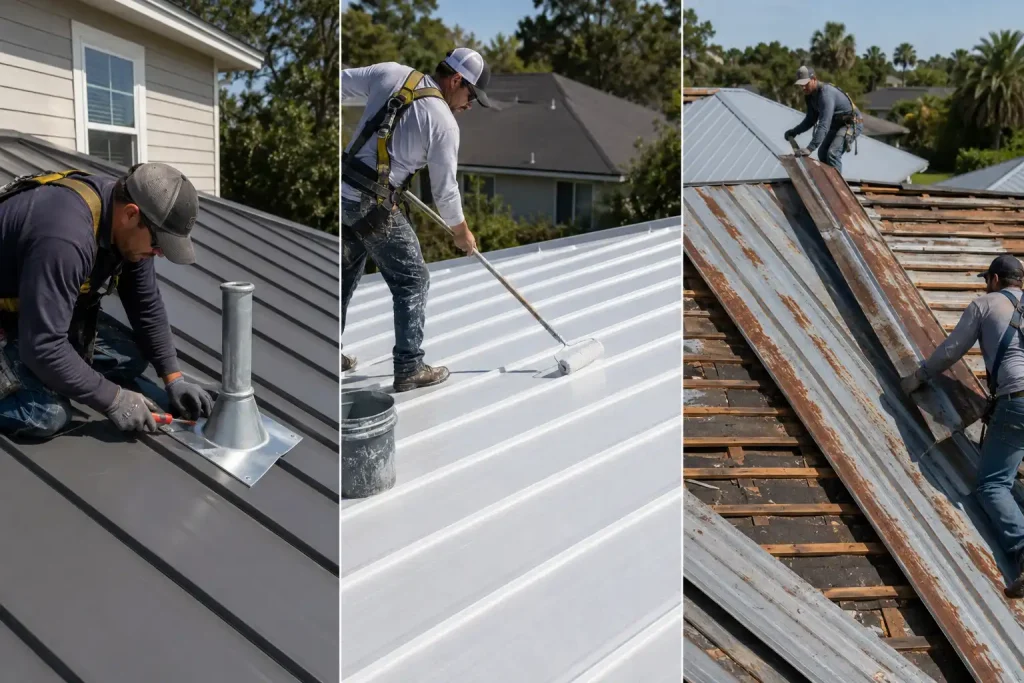
Not every metal roof problem requires the same solution. Here is a practical decision path.
Choose Repair When:
- One or two small leaks are present
- A few fasteners are loose
- A single flashing area is damaged
- A pipe boot has failed
- The rest of the roof is in good condition
Small repairs make sense when the problem is isolated.
Choose Restoration When:
- The roof has general wear but solid panels
- Fasteners and seams need attention
- Surface rust is manageable
- The coating has faded or worn
- Leaks are minor and traceable
- The roof deck is dry and stable
Restoration makes sense when the roof has value left and can be renewed.
Choose Replacement When:
- Rust has penetrated the metal
- Leaks are widespread
- Panels are loose or failing
- The deck is damaged
- Repairs keep failing
- The roof was poorly installed
- The roof is near the end of its service life
Replacement makes sense when restoration would only delay the inevitable.
Common Warning Signs Your Metal Roof Needs Attention
Do not wait until water is dripping into the living room. Metal roof problems often show smaller signs first.
Watch for:
- Rust spots spreading across panels
- Screws backing out
- Cracked rubber washers
- Loose ridge cap
- Open seams
- Water stains on ceilings
- Damp attic insulation
- Peeling interior paint
- Mold-like attic staining
- New leaks after heavy rain
- Panels lifting in wind
- Sealant pulling away from flashing
- Coating chalking or peeling
Any active leak should be inspected quickly. Water damage gets more expensive the longer it continues.
When to Call a Roofing Professional
Call a roofing professional when you see leaks, rust, loose panels, storm damage, or signs of water inside the attic. You should also call before buying a coating system or agreeing to replacement.
A good roofing contractor should be able to explain:
- Whether the roof is repairable, restorable, or ready for replacement
- Where the leaks are coming from
- Whether the deck is dry
- How severe the rust is
- What coating system is compatible
- Whether fasteners need replacement
- Whether flashing needs rebuilding
- What warranty applies
- What maintenance will be required
Ask for photos, written findings, and a clear scope of work. A trustworthy contractor should not pressure you into the most expensive option without explaining the roof’s actual condition.
Questions to Ask Before Choosing Restoration
Before approving restoration, ask:
- Is the metal structurally sound?
- Is there any rust-through?
- Are the seams and fasteners repairable?
- Is the roof deck dry?
- What coating system will be used?
- How will the roof be cleaned and prepared?
- Will rusted areas be primed?
- Will seams and penetrations be reinforced?
- How many coating layers are included?
- What warranty is provided?
These questions help protect you from poor coating jobs that only make the roof look better for a short time.
Questions to Ask Before Choosing Replacement
Before approving replacement, ask:
- Does the entire roof need replacement, or only one section?
- Will the old roof be removed?
- Will the deck be inspected after tear-off?
- What underlayment will be installed?
- How will ventilation be handled?
- What type of metal panel is recommended?
- What gauge or thickness is being used?
- What paint or finish warranty applies?
- How will flashing details be improved?
- How will debris and cleanup be handled?
Replacement is a major investment, so the details matter.
Common Mistakes Homeowners Should Avoid
- Coating a roof with hidden moisture: This can trap problems instead of solving them.
- Ignoring small leaks: Small leaks can damage decking, insulation, drywall, and framing.
- Choosing the cheapest coating bid: Low bids may skip cleaning, priming, seam work, or proper thickness.
- Assuming all rust means replacement: Surface rust may be restorable if treated early.
- Assuming coating fixes everything: Coatings cannot repair rotten decking or failed structure.
- Walking on the roof without safety gear: Metal roofs can be extremely slippery.
- Not asking for photos: Photos help verify the contractor’s findings and repairs.
- Delaying replacement when the roof is clearly failing: Repeated repairs can cost more over time.
- Forgetting ventilation: Poor attic ventilation can worsen moisture and heat problems.
- Not reading the warranty: Some warranties require specific maintenance and inspections.
FAQs
How do I know if my metal roof can be restored?
Your metal roof may be restorable if the panels are still solid, rust is only surface-level, leaks are minor, and the roof deck is dry. A professional inspection is the best way to confirm this.
Is it cheaper to restore or replace a metal roof?
Restoration is usually cheaper than replacement because it often avoids tearing off the old roof. However, replacement may be more cost-effective if the roof has major rust, recurring leaks, or structural damage.
Can a coating stop a metal roof from leaking?
A coating can help stop leaks when the roof is properly cleaned, repaired, sealed, and prepared first. It will not reliably fix major panel failure, rust-through, bad flashing, or damaged decking.
When should a metal roof be replaced instead of repaired?
A metal roof should usually be replaced when panels are rusted through, leaks keep returning, the deck is damaged, or the roof system was poorly installed. Replacement is also better when the roof is near the end of its useful life.
Can I restore a metal roof myself?
Most homeowners should not restore a metal roof themselves. The work requires safe roof access, surface preparation, rust treatment, seam repair, product compatibility, and correct coating thickness. Mistakes can lead to leaks and wasted money.
Does restoration add value to a home?
Restoration can add value if it extends the roof’s life, improves leak protection, and makes the roof look better. However, it is most valuable when the work is done properly and the roof is a good candidate.
How often should a metal roof be inspected?
A metal roof should generally be inspected at least once a year and after major storms. Regular inspections help catch loose fasteners, failing sealant, rust, and small leaks before they become expensive problems.
Conclusion
Knowing when to restore vs replace a metal roof comes down to one question: does the existing roof still have enough strength and service life to justify restoration?
If the panels are sound, leaks are minor, rust is limited, and the roof deck is dry, restoration may be a smart way to extend roof life and control costs. If the roof has widespread corrosion, recurring leaks, loose panels, or hidden water damage, replacement is usually the safer long-term choice.
The best next step is to schedule a detailed metal roof inspection, ask for photos, compare repair and replacement options, and choose the solution that protects your home—not just the one with the lowest upfront price.