How to Stop a Roof Leak Temporarily on a Metal Roof

A leaking metal roof can turn a rainy day into an urgent home-repair problem. Water may drip through the ceiling, soak attic insulation, stain drywall, or reach electrical fixtures long before you can schedule a permanent roof repair.
Knowing how to stop a roof leak temporarily can help limit that damage while you wait for a licensed roofing contractor. The safest approach is usually to control the water from inside first, identify the likely entry point, document the damage, and use an exterior temporary repair only when weather and roof conditions make it safe.
This guide explains practical temporary fixes for metal roof leaks, which materials may help, what not to do, and when a temporary patch is no longer enough.
Quick Answer
To stop a roof leak temporarily, first contain dripping water indoors, protect furniture and electrical areas, and trace the moisture from the attic if it is safe. For a metal roof, a compatible roofing sealant, repair tape, or secured waterproof tarp may provide temporary protection. Never climb onto a wet or storm-damaged roof.
What to Do Immediately When Your Roof Starts Leaking
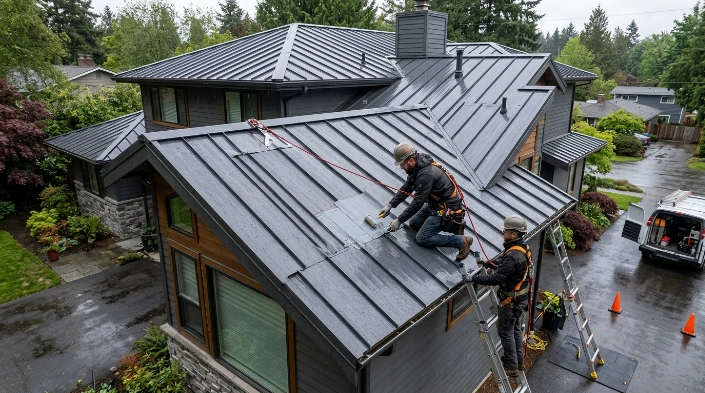
When water suddenly appears inside your home, your first goal is not repairing the metal panel. It is preventing additional interior damage without putting yourself at risk.
1. Protect the Area Below the Leak
Move furniture, electronics, rugs, and valuables away from the dripping area.
Place a large bucket or waterproof container underneath the leak. If water is splashing out of the bucket, place an old towel around the bottom or run a string from the drip point toward the container so water follows the string.
If the ceiling is bulging because water is trapped above it, keep people away from the area. A saturated section of drywall can suddenly collapse.
Do not stand beneath a badly sagging ceiling.
2. Watch for Electrical Hazards
Water near recessed lights, ceiling fans, outlets, wiring, or an electrical panel creates a serious hazard.
Do not touch wet electrical equipment.
If you can safely turn off the affected circuit from a dry location, do so. When you are unsure whether wiring has become wet, contact an electrician along with your roofing contractor.
3. Check the Attic From Inside
If your attic is safely accessible, use a flashlight to inspect the area above the visible ceiling leak.
Look for:
- Wet roof decking
- Damp insulation
- Water running along rafters
- Rust stains
- Moisture around screws or penetrations
- Drips near vents, chimneys, or skylights
- Water trails running down the underside of metal panels
Remember that the ceiling stain may not be directly underneath the roof opening. Water frequently travels along framing, insulation, fasteners, or roofing components before it finally drips into the room.
Industry guidance available through the National Roofing Contractors Association’s roof-leak investigation resources emphasizes identifying the actual leakage path instead of simply applying repair material wherever water happens to appear indoors.
How to Contain a Roof Leak From Inside
If the storm is still active, working from inside is generally safer than attempting an exterior roof repair.
Create a Temporary Water Channel
If you can safely reach the attic and identify dripping water, heavy plastic sheeting can sometimes be positioned beneath the leak to direct water toward a bucket.
The plastic should act as a small channel rather than simply collecting a large pool of water.
Do not attach plastic where you could damage wiring, plumbing, ventilation equipment, or structural components.
Check the bucket frequently during prolonged rain.
Remove Wet Items When Safe
Wet stored belongings should be moved away from the leak.
If insulation is saturated, do not immediately assume that drying the ceiling solves the problem. Wet insulation may hold moisture against wood framing and roof decking.
ENERGY STAR recommends professional attention when an attic contains wet insulation, moldy or rotted framing, difficult access, or significant moisture problems. ENERGY STAR’s attic moisture guidance provides additional information about these warning signs.
Temporary Metal Roof Leak Repair Options

The right temporary repair depends on the leak source.
| Leak Situation | Possible Temporary Measure | Limitation |
|---|---|---|
| Small failed sealant area | Metal-roof-compatible sealant | Surface normally must be clean and dry |
| Minor seam opening | Compatible roofing repair tape or sealant | Movement may cause the seam to reopen |
| Loose or failed fastener area | Professional fastener repair or temporary sealing | Incorrect tightening can damage the washer |
| Small puncture or damaged panel | Proper roofing patch or compatible repair membrane | Usually not a permanent structural repair |
| Larger storm-damaged area | Secure waterproof tarp installed safely | Wind can loosen an improperly installed tarp |
| Unknown leak source | Interior water containment | Does not stop water entering the roof |
Temporary means temporary. Even if dripping stops, the underlying defect still needs to be diagnosed.
How to Stop a Metal Roof Leak Temporarily From the Exterior
Exterior work should only be considered when the weather is completely dry, the roof is safely accessible, and you have appropriate equipment and experience.
Metal roofing can become extremely slippery from rain, condensation, frost, algae, dust, or loose surface coatings.
OSHA’s residential roofing fall-protection guidance illustrates how seriously professional roofing operations treat fall exposure and roof-edge hazards. Homeowners without suitable training and fall-protection equipment should leave rooftop repairs to qualified professionals.
Step 1: Identify the Most Likely Entry Point
Common metal roof leak locations include:
- Exposed screws and fasteners
- Rubber fastener washers
- Horizontal or vertical panel seams
- Ridge caps
- Roof valleys
- Chimney flashing
- Plumbing vent flashing
- Skylights
- Roof-to-wall transitions
- HVAC or other roof penetrations
- Rust holes and punctures
- Damaged panel edges
Do not automatically assume that the spot directly above the ceiling stain is the problem.
Step 2: Allow the Area to Dry
Most temporary roofing tapes and sealants perform poorly on dirty or wet surfaces unless the manufacturer specifically states otherwise.
Remove loose debris and allow the repair area to dry.
Never attempt this step during rain, lightning, high winds, or immediately after a storm while metal panels remain wet.
Step 3: Use a Product Designed for Metal Roofing
For a small localized opening, a roofing sealant or repair tape specifically compatible with the roof’s metal and coating may temporarily reduce water entry.
Follow the product manufacturer’s surface-preparation and application instructions.
Avoid random household caulk, duct tape, spray foam, or general-purpose adhesives. These products may fail quickly, trap water, interfere with the permanent repair, or damage the roof coating.
Step 4: Do Not Coat the Entire Area With Sealant
More sealant is not automatically better.
Covering multiple screws, seams, and flashing details with thick layers of sealant can make it harder to locate the actual leak later.
It can also hide corrosion or improperly installed components.
A temporary repair should be targeted and reversible whenever practical.
Can You Put a Tarp Over a Leaking Metal Roof?
A waterproof tarp can protect a damaged roof temporarily, especially after wind, hail, or falling debris.
However, tarping a metal roof is not as simple as throwing plastic over the damaged area.
Wind can lift unsecured material. Sharp metal edges can tear the tarp. Improper fasteners can also create additional holes in otherwise watertight panels.
A tarp should extend beyond the damaged area so water cannot easily run underneath it. The method used to secure it must resist wind without creating unnecessary roof damage.
For a large damaged section, steep roof, standing-seam roof, or storm-damaged structure, professional tarping is the safer choice.
Temporary roof coverings are recognized as short-term measures rather than permanent repairs; FEMA materials describing rapid temporary roof repair likewise characterize tarps and plastic coverings as protection until qualified permanent repairs can be completed.
Why Metal Roofs Develop Leaks
Understanding the cause helps you avoid treating the symptom instead of the problem.
Loose or Failed Fasteners
Exposed-fastener metal roofs often use screws with sealing washers.
Over time, thermal movement, weather exposure, incorrect installation, or deteriorated washers can weaken the seal.
A contractor may need to replace the fastener rather than simply tighten it.
Failed Seams
Metal expands when temperatures rise and contracts when temperatures fall.
Repeated movement can stress seams and sealants. A small opening may allow wind-driven rain underneath the panel system.
Flashing Problems
Flashing is the shaped roofing material installed where the roof meets walls, chimneys, vents, skylights, valleys, and other transitions.
Poorly installed or damaged flashing is a common water-entry point.
Penetrations
Every opening through a roof creates additional waterproofing details.
Plumbing vents, exhaust vents, skylights, solar equipment, HVAC components, antennas, and other penetrations require correctly installed flashing and seals.
Corrosion or Physical Damage
Branches, hail, foot traffic, dropped tools, or long-term corrosion can damage metal panels.
Small punctures can sometimes be repaired. Significant corrosion or widespread deterioration may require panel replacement.
Drainage Problems
Leaves and debris can restrict gutters and valleys.
During heavy rain, backed-up water may reach seams or flashing details that normally remain dry.
Temporary Repair vs. Permanent Repair
A temporary patch buys time. A permanent repair corrects the actual failure.
| Factor | Temporary Fix | Permanent Repair |
|---|---|---|
| Main purpose | Limit immediate water entry | Correct the leak source |
| Expected service | Short term | Long term |
| Leak diagnosis | May be limited | Should identify actual cause |
| Materials | Tarp, temporary tape, compatible sealant | Correct flashing, fasteners, panels, seams, or roofing components |
| Warranty impact | May affect coverage if done incorrectly | Can preserve coverage when completed to manufacturer requirements |
| Best use | Emergency protection | Final solution |
A roof that repeatedly needs emergency patches is telling you something important.
If the same section keeps leaking, the problem may involve poor installation, damaged underlayment, panel movement, deteriorated flashing, widespread corrosion, or a larger roofing-system defect.
Cost, Roof Age, Labor, and Warranty Considerations
Temporary leak control may be inexpensive when the problem involves only interior water containment or a very small accessible defect.
Professional costs increase when a roofer needs to:
- Diagnose a difficult leak
- Install an emergency tarp
- Work after normal business hours
- Access a steep or high roof
- Remove and reinstall metal panels
- Repair custom flashing
- Replace damaged decking
- Address multiple leak locations
Metal roofs can last for decades, so age alone does not determine whether replacement is necessary. Condition matters more.
A relatively young roof with one damaged flashing detail may be worth repairing. An older system with widespread corrosion, repeated seam failures, damaged underlayment, and multiple leaks may justify discussing replacement.
Before applying coatings, sealants, drilling new holes, or replacing fasteners yourself, check your roof warranty. Unauthorized repairs or incompatible materials may affect manufacturer or workmanship coverage.
What About Storm Damage and Insurance?
If your leak appeared after hail, strong wind, a fallen limb, or another sudden event, document the condition before making major changes.
Take photos or videos of:
- Interior water stains
- Wet belongings
- Damaged ceilings
- Visible exterior damage from the ground
- Fallen branches or debris
- Temporary protective measures
Keep receipts for emergency work and materials.
Do not delay necessary steps to prevent additional damage merely to preserve evidence, but avoid discarding damaged materials before checking your insurer’s documentation requirements.
Storms also attract questionable repair offers. The Federal Trade Commission’s guidance for avoiding post-weather-emergency scams recommends checking contractor licensing and insurance, getting written agreements, and being cautious about demands for full payment upfront.
Expert Tip
Expert Tip: Mark the indoor leak location and take photos during the rain, then photograph the attic water trail if you can do so safely. These records can help a roofer trace the source after the roof has dried and the active drip has disappeared.
When to Consult a Licensed Roofing Contractor
Call a qualified roofing contractor when:
- The roof is steep or difficult to access
- The metal surface is wet
- The leak is active during a storm
- Water is near electrical equipment
- Panels are bent, lifted, or missing
- Flashing has separated
- Multiple areas are leaking
- The roof has significant rust
- Decking or framing appears soft or rotten
- The leak returns after a temporary patch
- You suspect hail or wind damage
- Warranty or insurance coverage may apply
- The leak source cannot be confidently identified
You should also request professional evaluation if ceiling sagging, structural movement, extensive mold, or substantial water saturation is present.
A licensed roofer can determine whether the problem requires a simple fastener or flashing repair, removal of panels, replacement of damaged decking, or larger roof work.
Common Mistakes Homeowners Should Avoid
- Walking on a wet metal roof. Metal can be extremely slippery even when the roof slope appears mild.
- Climbing onto the roof during a storm. Lightning, wind, rain, and unstable materials make emergency rooftop work dangerous.
- Assuming the ceiling stain identifies the leak. Water frequently travels before becoming visible.
- Using household caulk everywhere. The material may not bond properly or remain compatible with the roof.
- Overtightening metal roof screws. Excess pressure can damage sealing washers and deform panels.
- Covering every fastener with sealant. This can hide the real defect and complicate permanent repairs.
- Ignoring wet insulation. Moisture can remain trapped after visible dripping stops.
- Treating a tarp as a permanent roof. Temporary coverings deteriorate and can shift in wind.
- Making undocumented repairs after storm damage. Photograph conditions first when insurance coverage may apply.
- Waiting because the leak stopped. A roof may leak only during wind-driven rain or certain storm directions.
FAQs
How long can a temporary roof leak repair last?
It depends on the repair method, weather exposure, roof condition, and material used. Some temporary patches may survive weeks or longer, but they should never be treated as permanent simply because the leak has stopped.
Can I use roofing sealant on a leaking metal roof?
A metal-roof-compatible sealant may temporarily stop a small, clearly identified leak. The surface typically needs proper preparation, and the product must be compatible with the roof’s metal and coating. Large seam or flashing failures usually require professional repair.
Can I stop a roof leak from inside the attic?
You can usually contain water from inside using plastic sheeting and a bucket, but this does not repair the roof opening. Interior containment is useful during bad weather when exterior work would be unsafe.
Should I tarp a metal roof during rain?
No. Climbing onto a wet metal roof during rain is extremely dangerous. Control water from inside and arrange professional emergency service instead.
What is the most common place for a metal roof to leak?
Fasteners, seams, flashing, valleys, ridge details, and penetrations such as vents or skylights are common trouble areas. The exact source should still be traced because water can travel before appearing inside.
Should I replace my metal roof because of one leak?
Not necessarily. A localized fastener, sealant, flashing, or panel problem may be repairable. Replacement becomes more reasonable when leaks are widespread, corrosion is severe, panels are failing, decking is deteriorated, or previous repairs repeatedly fail.
Is a roof leak an emergency?
It can be. Active water near electrical wiring, severe ceiling sagging, structural damage, major storm damage, or rapid water entry requires prompt professional attention. Even a small leak deserves timely repair because hidden moisture can continue damaging insulation and building materials.
Conclusion
Learning how to stop a roof leak temporarily can help protect your home until proper repairs are available, but safety should come before stopping the drip.
Start indoors. Move belongings, contain the water, check the attic only when access is safe, document what you see, and keep water away from electrical systems. A compatible sealant, roofing repair tape, or properly installed tarp may provide temporary protection for certain metal roof leaks, but rooftop work should only be attempted under safe, dry conditions.
Most importantly, do not mistake a temporary patch for a finished repair. Metal roof leaks often involve fasteners, seams, flashing, penetrations, drainage problems, or damaged panels that require a proper diagnosis.
Once the immediate water entry is controlled, schedule an inspection with a qualified roofing professional. Finding and correcting the real source now can prevent repeated leaks, damaged decking, wet insulation, interior repairs, and much larger expenses later.