How to Prevent Roof Damage From Standing Water

Standing water on a roof may look harmless after a heavy rain, but water that repeatedly collects instead of draining can shorten the life of roofing materials and eventually contribute to leaks, corrosion, damaged insulation, and structural problems.
Knowing how to prevent roof damage from standing water is especially important on low-slope roofs and metal roof sections where drainage depends on carefully designed slopes, gutters, drains, scuppers, seams, and flashing.
A small puddle immediately after rain is not always an emergency. The real concern is water that remains long after the weather clears or repeatedly returns to the same low spot.
This guide explains why standing water develops, how it can damage a metal roof, what homeowners can safely check, and when drainage problems require professional correction.
Quick Answer
To prevent roof damage from standing water, keep gutters and roof drains clear, correct low spots that trap water, maintain flashing and seams, and inspect the roof after severe weather. Water that remains on a low-slope roof for about 48 hours after rainfall deserves professional attention because persistent ponding can damage the roof system.
What Is Standing or Ponding Water on a Roof?
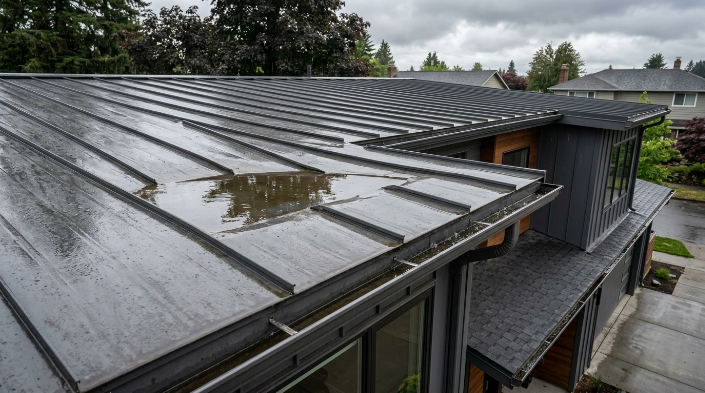
Standing water is rainwater or melted snow that collects in a depression instead of flowing toward a gutter, drain, or roof edge.
Roofing professionals commonly use the term ponding water when water remains on a low-slope roof for an extended period after rainfall.
The National Roofing Contractors Association explains in its guidance on slope and drainage that roof systems should provide positive drainage because persistent ponding can be harmful to roofing systems. NRCA guidance on roof slope and drainage
NRCA materials also discuss roughly 48 hours as an important benchmark when evaluating persistent ponding under conditions that allow normal drying.
That does not mean every puddle visible an hour after a thunderstorm indicates roof failure. Drainage speed depends on rainfall intensity, temperature, roof geometry, evaporation, and the condition of the drainage system.
The warning sign is water that consistently remains in the same location after surrounding roof surfaces have dried.
Why Standing Water Can Damage a Roof
Water creates several problems when it remains where the roof was intended to drain.
Added Weight on the Roof Structure
Water is heavy.
Even a relatively shallow pond spread across a large section of roof places additional load on the roof deck and framing.
FEMA notes that rainfall ponding on flat or low-slope roofs can add substantial downward loading and that excessive accumulation can contribute to progressive deflection and instability.
Once a roof deck begins to sag, the depression may hold even more water during the next storm. This can create a cycle:
- Water collects in a low spot.
- The additional weight increases deflection.
- The depression becomes deeper.
- More water collects during future storms.
- Structural stress increases.
A noticeably sagging roof area with standing water should be treated as a professional inspection issue, not a DIY drainage problem.
Leaks at Seams and Flashing
Metal panels themselves can be highly water-resistant, but a metal roof contains many connections.
Potential leak points include:
- Panel seams
- End laps
- Exposed fasteners
- Pipe penetrations
- Skylights
- Chimney flashing
- HVAC curbs
- Valley details
- Roof-to-wall transitions
Standing water keeps these details wet longer than normal runoff would.
A seam or flashing joint that performs well when exposed to moving rainwater may become vulnerable when water repeatedly sits against it.
Corrosion and Coating Damage
Modern metal roofing usually has protective coatings or finishes that resist corrosion. However, trapped moisture can still become a concern when coatings are damaged, cut edges are exposed, debris holds moisture against the surface, or dissimilar metals create a corrosion problem.
Rust stains, bubbling finishes, or visible deterioration near a persistent puddle deserve investigation.
Wet Insulation and Roof Decking
Once water passes through the roof covering, it may reach the underlayment, insulation, decking, framing, and interior finishes.
The roof deck is the structural surface underneath the roofing system. On many homes it is plywood or oriented strand board, while some buildings use metal or concrete decking.
Repeated moisture can cause wood decking to soften or decay. Wet insulation may also lose performance and take a long time to dry.
Interior Water Damage
A roof leak does not always appear directly underneath the puddle.
Water may travel along panels, fasteners, framing, or decking before reaching the ceiling.
Watch for:
- Brown or yellow ceiling stains
- Peeling paint
- Damp attic insulation
- Musty odors
- Wet rafters
- Rusted fastener tips
- Dripping after prolonged rain
These signs suggest the drainage problem may already have progressed beyond the roof surface.
Why Water Collects on a Metal Roof
Metal roofing is often installed on sloped roofs where rainwater sheds quickly. Persistent standing water is therefore more common on low-slope metal roof assemblies, additions, porches, commercial-style roof sections, and poorly designed transitions.
Several problems can interfere with drainage.
Clogged Gutters and Downspouts
Leaves, pine needles, roofing granules, seed pods, nests, and other debris can restrict the flow of water.
When gutters cannot carry rainfall away quickly enough, water may back up toward the roof edge.
FEMA recommends maintaining roof drainage and notes that gutters and downspouts can become clogged or overwhelmed during heavy rainfall. FEMA guidance on improving roof drainage
Blocked Roof Drains or Scuppers
Low-slope roofs may use internal drains or scuppers rather than conventional eave gutters.
A scupper is an opening through a roof edge or parapet that allows water to drain away.
Leaves or debris around these openings can create surprisingly large ponds after a storm.
Incorrect Roof Slope
A low-slope roof still needs enough slope to direct water toward drainage points.
If framing, insulation, or the roof surface was installed incorrectly, water may collect between drains or behind raised sections.
Roof Deck Deflection
Structural members can deflect slightly under loads.
If the roof deck sags more than intended, a low area can develop even when the original roof was properly sloped.
Persistent or worsening depressions may require evaluation by a roofing professional and, in some situations, a structural engineer.
Poorly Located Drains
A drain cannot work effectively when it sits higher than the area where water actually collects.
Correcting this problem may require relocating drains, adding drainage points, or reshaping the roof slope rather than simply installing a larger drain.
Debris on the Roof
Branches, leaves, dirt, and other material can slow runoff and hold moisture against metal panels.
Debris is particularly troublesome around:
- Valleys
- Behind chimneys
- Skylights
- Rooftop equipment
- Parapet walls
- Drain openings
Keeping these areas clear can prevent small drainage restrictions from becoming larger problems.
How to Prevent Roof Damage From Standing Water

Prevention begins with helping water leave the roof as quickly and predictably as the roof design allows.
1. Keep Gutters and Downspouts Clear
Inspect gutters periodically and after severe storms.
From the ground, look for:
- Water spilling over gutter edges
- Vegetation growing in gutters
- Sagging gutter sections
- Detached downspouts
- Staining on fascia or siding
- Water collecting near the foundation
IBHS also recommends checking and clearing gutters and downspouts so debris does not restrict water flow. IBHS severe-weather roof and gutter guidance
2. Monitor Roof Drainage After Rain
You do not need to climb onto the roof to identify many drainage problems.
From a safe location, note where water remains after rain. Take photographs from the ground or an upper-story window if possible.
Compare the same area several hours later and again the following day.
Persistent water in the same location is much more useful diagnostic information than a single photograph taken during a storm.
3. Keep Drains and Scuppers Functional
Low-slope roof drains should remain unobstructed.
A qualified roofer can check:
- Drain baskets
- Scuppers
- Strainers
- Drain connections
- Surrounding flashing
- Low spots around drains
Do not reach into a drain while a large volume of ponded water is rapidly emptying.
4. Correct Low Spots Instead of Repeatedly Sealing Them
Applying sealant around a puddle does not correct the reason water is there.
Depending on the roof construction, a contractor may recommend:
- Tapered insulation
- Additional drains
- Modified scuppers
- Drain relocation
- Roof deck repairs
- Framing correction
- Replacement of saturated insulation
- Reconstruction of improperly sloped areas
The correct repair depends on whether the problem is at the roof surface, insulation level, deck, framing, or drainage system.
5. Maintain Metal Roof Seams and Flashing
A drainage problem is more likely to become a leak when vulnerable roof details are already deteriorating.
A professional inspection may identify:
- Separated seams
- Loose fasteners
- Failed washers
- Deteriorated sealant
- Corroded flashing
- Improper roof penetrations
- Damaged panel coatings
Repairing these defects early may prevent standing water from finding a path into the building.
6. Inspect After Major Storms
Heavy wind, hail, falling branches, and extreme rainfall can change how a roof drains.
A storm may loosen gutters, move flashing, block drains with debris, or damage roof panels.
Perform a ground-level inspection once conditions are safe. If anything appears displaced or damaged, arrange a professional inspection before the next major storm.
Standing-Water Warning Signs at a Glance
| Warning Sign | Possible Cause | Recommended Response |
|---|---|---|
| Small puddle shortly after rain | Normal drainage delay | Monitor |
| Water repeatedly remains in same spot | Low slope or deck depression | Schedule inspection |
| Overflowing gutters | Debris or inadequate capacity | Clean or evaluate gutters |
| Water around a roof drain | Blockage or poor drain placement | Professional drainage check |
| Rust near ponding area | Coating damage or trapped moisture | Inspect metal condition |
| Ceiling stain below roof | Active or previous leak | Locate source promptly |
| Soft or sagging roof area | Deck or structural damage | Urgent professional evaluation |
| Multiple persistent ponds | Systemic drainage problem | Roofing/design assessment |
Does Standing Water Mean You Need a New Roof?
Not necessarily.
A drainage problem on an otherwise sound roof may be repairable without replacing the entire roofing system.
For example, a contractor might correct a blocked drain, rebuild a localized low area, repair flashing, or replace wet insulation.
Replacement becomes more reasonable when the roof has additional problems such as:
- Widespread corrosion
- Multiple recurring leaks
- Severely deteriorated seams
- Saturated insulation across a large area
- Damaged roof decking
- Structural deterioration
- Repeated unsuccessful repairs
- A roof already near the end of its useful service life
Metal roofing can serve a home for decades, so roof condition is more important than age alone.
Cost and Warranty Considerations
Standing-water repairs vary widely because the visible puddle is only a symptom.
A simple gutter blockage costs far less to address than replacing damaged decking or redesigning a low-slope roof drainage system.
Major cost factors include:
- Size of the affected area
- Roof height and accessibility
- Metal roof system type
- Number of drains or scuppers
- Condition of insulation
- Condition of the decking
- Need for tapered insulation
- Flashing complexity
- Structural repairs
- Labor rates in your area
Before approving work, ask for a written estimate explaining what caused the ponding and how the proposed repair corrects that cause.
Also review your roofing warranty. Manufacturers may place requirements or limitations on drainage, maintenance, compatible repair products, and installation methods.
Do not assume an unauthorized coating, sealant, or modification will preserve warranty coverage.
Expert Tip: Photograph persistent ponding at consistent intervals after rainfall. Showing a roofer where the water sits immediately after rain, several hours later, and the next day can make the drainage problem much easier to diagnose.
DIY Maintenance vs. Professional Repair
Homeowners can perform useful observations without walking on the roof.
Reasonable DIY tasks may include:
- Watching drainage from the ground
- Photographing problem areas
- Checking ceilings for new stains
- Inspecting accessible attic areas with a flashlight
- Keeping ground-accessible downspout outlets clear
- Recording when leaks occur
Roof-level work is different.
Metal roofs can be extremely slippery when wet, and low-slope roofs can still have dangerous edges.
OSHA publishes extensive fall-protection guidance for roofing and residential construction, illustrating how serious roof-related fall hazards are. OSHA residential fall-protection guidance
Do not climb onto a wet, icy, damaged, steep, or unfamiliar roof to investigate standing water.
When to Consult a Licensed Roofing Contractor
Contact a qualified roofing contractor when water remains after normal drying conditions or when you notice signs that drainage is damaging the roof.
Professional evaluation is especially important when:
- Water remains for roughly 48 hours after rainfall
- The same area ponds after every storm
- The roof surface appears to sag
- Water is entering the attic or living space
- Metal panels show corrosion
- Flashing or seams appear damaged
- Roof drains repeatedly clog or overflow
- Insulation appears wet
- Storm damage is suspected
- Previous repairs have failed
- Insurance documentation may be required
Contractor licensing requirements vary by state and locality. Check applicable licensing and insurance requirements where you live.
A roofer may also recommend a structural engineer if the deck or framing shows significant deflection, rot, deterioration, or excessive loading.
Common Mistakes Homeowners Should Avoid
- Ignoring recurring puddles. A problem that returns after every storm deserves investigation.
- Assuming all standing water means immediate roof replacement. Many drainage defects can be repaired.
- Covering everything with roof sealant. Sealant cannot correct inadequate slope or structural sagging.
- Walking across a wet metal roof. Metal surfaces can become extremely slippery.
- Clearing a roof drain while standing in deep ponded water. Rapid drainage can create additional hazards.
- Using incompatible coatings or sealants. Repair products should match the roofing system and manufacturer requirements.
- Waiting for an interior drip before taking action. Roof damage can progress before water becomes visible inside.
- Ignoring gutters and downspouts. Roof drainage includes the entire path that carries water away from the building.
FAQs
How long can water safely sit on a roof?
A small amount of water immediately after rainfall is not automatically a problem. Persistent water remaining around 48 hours after rain under normal drying conditions is commonly treated as ponding and deserves investigation.
Can standing water cause a metal roof to leak?
Yes. Persistent water can expose seams, fasteners, flashing, penetrations, and damaged coatings to moisture for longer periods. If one of those details has deteriorated, water may enter the roof assembly.
Is ponding water normal on a low-slope roof?
Brief puddling can occur, particularly after heavy rain, but repeated long-term ponding is not something to ignore. A properly functioning roof should move water toward its designed drainage points.
Can clogged gutters cause standing water on a roof?
Yes. Restricted gutters and downspouts can slow drainage and cause water to back up near the roof edge. Low-slope roofs can also experience ponding when drains or scuppers become blocked.
Can I use roof coating to fix ponding water?
A coating may be part of certain professionally designed roofing systems, but coating a low spot does not create proper drainage. The underlying reason for the ponding should be identified first.
Does ponding water mean the roof structure is unsafe?
Not always. However, deep water, growing depressions, sagging decking, unusual cracking, or noticeable structural movement require prompt professional evaluation because accumulated water adds weight to the roof.
Should I file an insurance claim for standing-water damage?
Routine maintenance or drainage defects may be treated differently from sudden storm damage. If ponding began after hail, wind, falling debris, or another covered event, document the condition and review your policy before repairs remove evidence of the damage.
Conclusion
Learning how to prevent roof damage from standing water comes down to maintaining good drainage and responding early when water repeatedly collects in one place.
Keep gutters, drains, and scuppers clear. Watch how the roof drains after heavy rain. Pay attention to rust, leaks, damaged flashing, sagging areas, and persistent puddles. Most importantly, correct the cause of ponding rather than repeatedly covering the symptom with sealant.
For a metal or low-slope roof that holds water for an extended period, the smartest next step is a professional drainage and roof-condition assessment. Catching the problem early may turn a potentially expensive roof failure into a manageable repair.