
Roof Coating Material Safety Data Sheets: A Metal Roof Homeowner Guide

Applying a coating to an aging metal roof can look like a straightforward maintenance project. But before anyone opens a bucket, mixes a primer, or starts spraying, there is an important document worth checking: the Safety Data Sheet, or SDS.
Roof coating material safety data sheets explain the chemical hazards, safe handling practices, protective equipment, first-aid measures, storage requirements, and emergency procedures associated with a coating or related product. For homeowners, that information can help you understand what a contractor is bringing onto your property and whether a DIY coating project involves risks you were not expecting.
OSHA’s Hazard Communication Standard requires hazard information for covered workplace chemicals to be communicated through tools including labels and safety data sheets. Roofing construction is also subject to OSHA’s construction hazard-communication requirements.
This guide explains how to read an SDS for a metal roof coating, which sections matter most to homeowners, how acrylic and silicone products may differ, what an SDS does not tell you, and when professional help is the safer choice.
Quick Answer
Roof coating material safety data sheets identify a coating’s chemical hazards, required protective equipment, first-aid measures, safe storage, fire precautions, and exposure controls. Before coating a metal roof, review the SDS for the exact coating, primer, cleaner, and sealant being used. Do not rely only on the product label.
What Is a Roof Coating Safety Data Sheet?
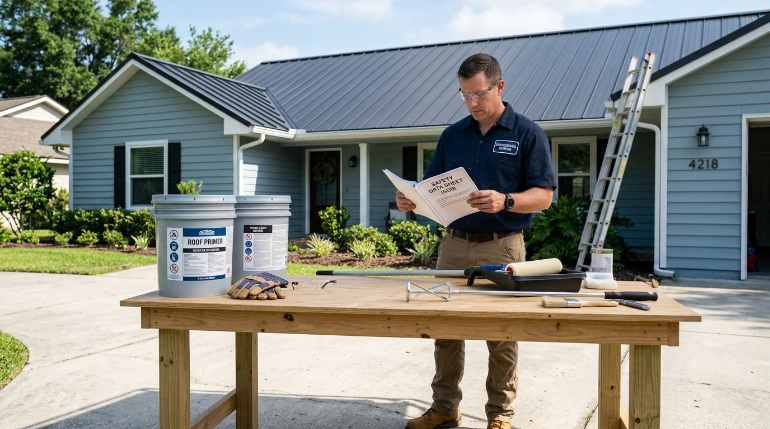
A Safety Data Sheet is a standardized document that communicates information about a chemical product and its hazards.
Under OSHA’s SDS format, safety data sheets use 16 numbered sections. OSHA specifies required information for Sections 1 through 11 and Section 16, while Sections 12 through 15 cover subjects regulated by other agencies and are not enforced by OSHA in the same way.
A roof coating SDS may contain information about:
- Product identification
- Hazard classifications
- Chemical ingredients
- First-aid procedures
- Firefighting measures
- Spill response
- Safe handling and storage
- Exposure limits
- Personal protective equipment
- Physical and chemical properties
- Stability and reactivity
- Health effects
- Disposal and transportation information
- Revision date
The exact warnings depend on the specific formulation. Two products described as “silicone roof coating,” for example, should not automatically be assumed to have identical handling requirements.
Always use the SDS for the exact product and formulation being applied.
SDS vs. Product Data Sheet vs. Product Label
Homeowners sometimes treat an SDS, technical data sheet, and container label as interchangeable. They serve different purposes.
| Document | Main Purpose | Useful Information for Homeowners |
|---|---|---|
| Safety Data Sheet (SDS) | Chemical safety and hazard communication | PPE, health hazards, first aid, storage, spills, fire precautions |
| Technical/Product Data Sheet | Product performance and installation | Coverage rate, substrate preparation, application temperature, cure time |
| Product Label | Immediate product identification and warnings | Basic directions, warnings, precautionary statements |
| Warranty Document | Coverage and exclusions | Approved applications, required system components, maintenance obligations |
Manufacturer documentation illustrates this difference clearly. For example, GAF’s silicone roof-coating product information provides separate technical documentation and Safety Data Sheets for coating products.
A homeowner evaluating a coating project should ideally review all applicable documents, not only the SDS.
The SDS tells you how to work around the chemical safely. The technical sheet tells you how the product is supposed to be installed.
The 16 SDS Sections and What Homeowners Should Look For
You do not need to be a chemist to get useful information from an SDS.
Here are the areas that matter most during a metal roof coating project.
Section 1: Identification
Start here.
This section identifies the product, manufacturer or supplier, recommended use, and emergency contact information.
Confirm that the SDS matches the exact product being used.
For a complete restoration system, you may need separate sheets for:
- Roof cleaner
- Rust treatment
- Primer
- Seam sealer or mastic
- Main roof coating
- Specialty repair products
Do not assume the coating’s SDS also covers the primer or cleaner.
Section 2: Hazard Identification
This is one of the most important sections.
It summarizes the product’s classified hazards and may include signal words, hazard statements, pictograms, and precautionary information. OSHA’s hazard-communication system uses standardized label elements to help communicate classified chemical hazards.
For a homeowner, this section answers a basic question:
What could go wrong if this product is handled incorrectly?
Pay attention to warnings involving:
- Skin irritation
- Eye irritation or damage
- Harmful vapors
- Respiratory concerns
- Flammability
- Environmental hazards
- Sensitization or allergic response
A product marketed as easy to apply should still be handled according to its SDS.
Section 3: Composition and Ingredients
This section identifies ingredients or chemical components that must be disclosed under applicable requirements.
You normally do not need to memorize chemical names.
Instead, use this section when:
- A household member has a known chemical sensitivity
- A contractor is planning spray application
- You need medical advice after an exposure
- You want to compare different coating formulations
If a chemical name is unfamiliar, avoid guessing about its safety based only on whether it sounds dangerous.
Sections 4–6: First Aid, Fire, and Accidental Release
These sections become especially important when something has already gone wrong.
Section 4 explains first-aid measures.
Section 5 addresses firefighting considerations.
Section 6 explains what to do after a spill or accidental release.
Before a large coating project begins, homeowners should know whom to contact if coating reaches skin or eyes, spills into landscaping, enters a drain, or creates another exposure concern.
Keep the SDS accessible while work is underway rather than searching for it after an accident.
Section 7: Handling and Storage
Roof coatings may sit in a garage, shed, truck, or staging area before application.
Section 7 tells you how the product should be handled and stored.
Look for directions involving:
- Container closure
- Temperature
- Ventilation
- Moisture
- Direct sunlight
- Incompatible materials
- Ignition sources
- Food or living areas
Do not automatically store leftover coating inside your home simply because the container is sealed. Follow the manufacturer’s storage instructions.
Section 8: Exposure Controls and Personal Protection
For a homeowner considering DIY application, Section 8 deserves close attention.
It may identify appropriate:
- Gloves
- Eye protection
- Protective clothing
- Respiratory protection
- Ventilation or engineering controls
The required precautions can also depend on how the coating is applied.
Rolling a material outdoors and spraying it into a fine mist are not necessarily equivalent exposure situations.
If an SDS calls for respiratory protection, specialized ventilation, or exposure controls you do not understand, that is a strong reason to discuss the job with a qualified professional rather than improvising protective equipment.
Sections 9–11: Properties, Reactivity, and Health Effects
Sections 9 through 11 provide more technical details about how a product behaves and how exposure may affect health.
You may see information concerning:
- Odor
- Flash point
- Vapor characteristics
- Solubility
- Stability
- Incompatible substances
- Routes of exposure
- Symptoms following exposure
These sections can be particularly useful when comparing coatings that appear similar on a store shelf but have different formulations.
Sections 12–15: Environmental, Disposal, Transport, and Regulatory Information
These sections can help answer practical questions such as whether special disposal or transportation considerations apply.
OSHA notes that Sections 12 through 15 are part of the 16-section SDS format but are not enforced by OSHA because those areas fall under other agencies’ authority.
Do not pour leftover coating, solvent, primer, or cleaning solution into a storm drain simply because you are finished with the project. Follow the SDS and applicable local disposal rules.
Section 16: Other Information
Check the preparation or revision date.
A manufacturer can update an SDS as hazard information, formulations, or regulatory information changes. Section 16 is where the preparation or last-revision information is generally provided.
If you find several versions online, use documentation associated with the exact product currently being purchased.
Why Metal Roof Coating Type Matters
“Roof coating” is a broad category rather than one chemical recipe.
Metal roof restoration systems may use acrylic coatings, silicone coatings, primers, mastics, cleaners, or other materials.
Acrylic Roof Coatings
Acrylic roof coatings are commonly water-based products. Some are easier to clean up than solvent-heavy alternatives, but water-based does not mean hazard-free.
EPA notes more generally that water-based acrylic latex coatings are often lower in VOCs than solvent-based coatings, while also emphasizing that product selection should consider overall composition and performance rather than VOC claims alone.
Review the SDS instead of relying on terms such as “water-based,” “eco-friendly,” or “low odor.”
Silicone Roof Coatings
Silicone coatings are another common restoration option for compatible roof systems. Manufacturers offer high-solids, moisture-cure silicone products for applications that can include metal roof restoration.
Again, the product category does not replace the SDS.
Check the exact formulation plus any primer, mastic, cleaner, or accessory material required by the system.
VOCs and Roof Coating Safety
VOC stands for volatile organic compound.
VOCs can be emitted as gases from certain liquids and solids. EPA explains that some VOCs can cause short- or long-term health effects depending on the chemical and exposure conditions.
That makes VOC information useful, but it should not become your only safety test.
A coating advertised as “low VOC” does not automatically mean:
- No ventilation precautions are required
- Skin contact is harmless
- Eye protection is unnecessary
- Spraying requires no special controls
- Every ingredient is nonhazardous
Use the product’s SDS for the full safety picture.
How to Review Roof Coating Material Safety Data Sheets Before Work Starts
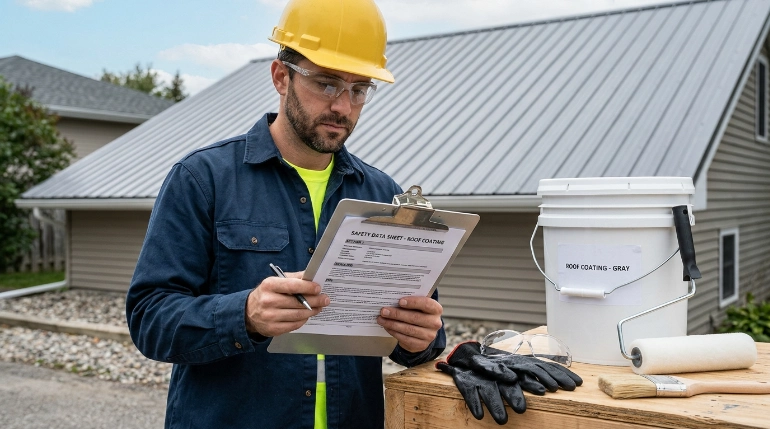
A simple review can prevent confusion on project day.
1. Get the Exact Product Names
Ask the contractor for the exact manufacturer and product name of every coating-system component.
2. Obtain the Current SDS
Get the SDS from the manufacturer or supplier whenever possible.
OSHA’s hazard-communication rules require safety data sheets for covered hazardous workplace chemicals and require them to be accessible to affected employees.
3. Read Sections 1, 2, 4, 7, and 8 First
These give most homeowners the fastest overview of identity, hazards, emergency response, handling, storage, and protective equipment.
4. Compare the SDS With the Planned Application Method
Ask whether the contractor will:
- Roll the coating
- Brush details
- Spray the coating
- Use solvents or cleaners
- Sand or mechanically prepare existing surfaces
The planned process can matter as much as the bucket of coating itself.
5. Discuss Occupant Protection
Tell the contractor if children, older adults, pets, or people sensitive to odors will be present.
Ask where products will be mixed and stored and whether doors, windows, HVAC intakes, vehicles, or outdoor living areas require temporary protection.
6. Keep the Documents
Save the SDS, technical data sheet, invoice, product names, warranty documentation, and contractor paperwork.
That record may be useful during future maintenance, recoating, warranty work, or emergency response.
Safety Data Sheets Do Not Tell You Whether the Roof Is Ready for Coating
This is an important limitation.
An SDS explains chemical safety. It does not determine whether coating your metal roof is structurally or financially sensible.
Before restoration, a contractor may need to evaluate:
- Active leaks
- Rust or corrosion
- Loose fasteners
- Failed seams
- Flashing defects
- Wet insulation
- Damaged decking
- Previous incompatible coatings
- Drainage problems
A coating should not be treated as a cosmetic shortcut for serious roof failure.
If the deck is deteriorated, structural components are compromised, or large sections of metal are badly corroded, repair or replacement may be more appropriate than coating.
Cost, Roof Lifespan, Labor, and Warranty Considerations
The SDS itself does not tell you what a coating job should cost or exactly how many years it will last.
Those questions depend on the roof and coating system.
Cost can be affected by:
- Roof square footage
- Roof pitch and height
- Access difficulty
- Amount of rust or surface preparation
- Seam and fastener repairs
- Number of coating layers
- Primer requirements
- Labor rates
- Existing roof condition
Likewise, coating life depends on factors such as preparation, product selection, application thickness, weather exposure, drainage, workmanship, and maintenance.
For performance claims, use the manufacturer’s technical data and warranty documents rather than the SDS.
Warranty requirements matter as well. Using an unapproved primer, applying coating over an incompatible surface, ignoring required preparation, or changing the specified system can potentially affect the manufacturer’s coverage. Check written warranty terms before work begins rather than relying on verbal assurances.
Expert Tip
Expert Tip: Ask your roofer for the SDS and technical data sheet before signing off on the coating system. The SDS tells you how the chemical should be handled safely; the technical data sheet helps confirm whether the product is appropriate for your roof and how it must be installed.
Do Not Ignore Fall Safety While Focusing on Chemical Safety
Reading the SDS addresses only one part of roof-coating safety.
A metal roof can also present a serious fall hazard.
Wet coatings may make an already smooth metal surface even more difficult to walk on. Roof edges, skylights, steep slopes, ladders, hoses, tools, and changing weather add additional risks.
OSHA emphasizes fall protection for residential construction and explains that effective fall-restraint systems must prevent workers from reaching a fall hazard.
For homeowners, the practical message is simpler:
Do not climb onto a metal roof just to inspect coating work unless you have the appropriate training and safety equipment.
Photos, drone inspection, attic inspection, or a professional roof evaluation can often provide safer ways to monitor the project.
Common Mistakes Homeowners Should Avoid
- Reading only the front label. The SDS contains substantially more safety information.
- Using an SDS for a similar product. Get the sheet for the exact formulation.
- Reviewing only the top coat. Primers, cleaners, mastics, sealants, and repair compounds may need their own SDS.
- Assuming low odor means low risk. Smell is not a reliable measure of chemical hazard.
- Ignoring application method. Spraying can create different exposure conditions than rolling or brushing.
- Buying PPE without reading Section 8. Protective equipment should match the product and exposure.
- Using the SDS as an installation manual. Consult the technical data sheet for preparation, coverage, cure time, and application requirements.
- Walking on freshly coated metal. This may create both fall risk and coating damage.
- Keeping unidentified leftovers. Preserve product labels and documentation and follow manufacturer storage and disposal instructions.
- Coating over serious roof damage. Chemical safety information cannot determine whether the roof needs structural repair or replacement.
When to Consult a Licensed Roofing Contractor
A licensed or appropriately qualified roofing contractor should evaluate the job when coating involves more than simple, accessible maintenance.
Professional help is especially important if:
- The roof is steep or more than one story high
- You see extensive corrosion
- Metal panels feel loose or damaged
- Water may be trapped beneath the roof system
- Leaks continue after previous repairs
- Flashing or seams are failing
- Spray equipment will be used
- Several primers or chemical products are required
- You cannot determine coating compatibility
- The manufacturer requires professional installation for warranty coverage
- Storm or insurance damage is involved
If structural movement, deteriorated decking, sagging, major corrosion, or widespread water intrusion is present, ask whether additional structural assessment or roof replacement is necessary.
A coating is useful only when the underlying roof is suitable for restoration.
FAQs
What information is included in a roof coating SDS?
A typical SDS covers product identification, hazards, ingredients, first aid, fire response, spills, handling, storage, exposure controls, protective equipment, physical properties, health information, and other regulatory or technical information.
Do I need an SDS for a DIY metal roof coating?
Reviewing the SDS is a smart safety step even for a homeowner project. It can identify protective equipment, storage precautions, first-aid measures, and hazards that may not be obvious from the marketing label.
Where can I get a roof coating Safety Data Sheet?
Start with the product manufacturer’s website or supplier. Many manufacturers provide SDS documents through their product-document libraries. OSHA also requires manufacturers, importers, and distributors to provide SDS information in covered workplace situations.
Is a low-VOC roof coating automatically safe?
No. VOC content addresses only part of the safety picture. A low-VOC product can still have handling, skin, eye, ventilation, or other precautions. Review the complete SDS.
Does an SDS tell me whether a coating works on my metal roof?
Not usually. Use the manufacturer’s technical data sheet, installation instructions, compatibility information, and warranty documents for that question. The SDS is primarily a safety and hazard-communication document.
Should every coating product have the same PPE requirements?
No. PPE requirements can differ between formulations and application conditions. Check Section 8 of the specific SDS rather than copying the precautions from another product.
Can a roof coating fix a badly rusted or leaking metal roof?
Not always. Coatings can be part of a restoration system, but severe corrosion, damaged panels, failed decking, trapped moisture, or structural problems may require repair or replacement first. Have questionable roof conditions evaluated professionally.
Conclusion
Roof coating material safety data sheets are one of the most useful documents homeowners can review before a metal roof restoration project. They explain what a coating contains from a safety perspective, what hazards require attention, what protective measures may be necessary, and what to do if an exposure, fire, or spill occurs.
Start with the SDS for every coating, primer, cleaner, mastic, and sealant involved. Then review the technical data sheet and warranty separately so you understand how the product should be installed and whether it is appropriate for your roof.
Most importantly, do not let a bucket of roof coating turn a serious roof problem into a DIY experiment. If the roof is steep, badly corroded, leaking extensively, structurally questionable, or requires complex chemical handling, have a qualified roofing contractor inspect it first.
The smartest next step is simple: ask for the product documentation before the work begins, review the safety requirements, and make sure the roof itself is suitable for coating.