
OSHA Rooftop Safety: A Homeowner’s Guide to Metal Roof Work

Metal roofs are durable, but working on one can become dangerous very quickly. Smooth panels, steep slopes, roof edges, skylights, loose debris, and changing weather can turn a simple inspection or repair into a serious fall hazard.
That is why understanding OSHA rooftop safety is useful even if you are a homeowner rather than a roofing professional. OSHA rules are primarily workplace requirements for employers and workers, but they provide a strong safety framework for understanding why professional roofers use fall protection, secure ladders, proper anchor points, and trained crews.
This guide explains the most important rooftop safety principles for metal roofs, how fall protection works, what homeowners should look for when hiring a contractor, and when staying off the roof is the safest choice.
Quick Answer
OSHA rooftop safety rules generally require construction employers to protect workers exposed to falls of 6 feet or more. On metal roofs, professional protection may include guardrails, safety nets, personal fall arrest systems, or other approved methods. Homeowners doing their own work are not generally OSHA-regulated employees, but the hazards remain just as serious.
What Does OSHA Rooftop Safety Mean?
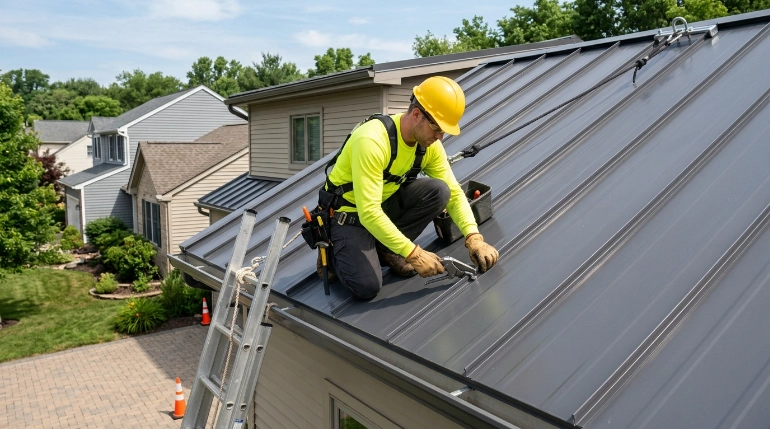
OSHA, the Occupational Safety and Health Administration, establishes workplace safety requirements intended to protect employees from hazards such as falls.
For construction work, OSHA generally requires fall protection when workers are 6 feet or more above a lower level. Roofing-specific requirements vary depending on the type of roof and work being performed. You can review OSHA’s fall protection requirements for construction for the regulatory details.
Typical fall-protection methods include:
- Guardrail systems
- Safety net systems
- Personal fall arrest systems
- Certain warning-line systems on qualifying low-slope roofing work
- Other approved protection methods for specific circumstances
For a homeowner, the most important point is not memorizing OSHA regulations. It is recognizing that professional roof work requires much more than wearing shoes with good traction.
A safe roofing setup considers roof height, slope, access, openings, anchorage, weather, surface conditions, and how workers will move materials without creating additional hazards.
Does OSHA Apply to Homeowners Working on Their Own Roof?
Usually, OSHA rules do not directly regulate an individual homeowner doing personal DIY work with no employees.
OSHA states that self-employed workers are generally outside coverage under the Occupational Safety and Health Act. The regulations are designed primarily around employer-employee relationships.
That distinction does not make DIY roof work safe.
A 15-foot fall can cause the same injury whether the person falling is a professional roofer or a homeowner. Using OSHA principles as a safety benchmark can help you recognize when a project has moved beyond reasonable DIY maintenance.
If you hire a roofing company, its responsibilities are different. Employers must protect workers who are exposed to applicable workplace hazards and comply with relevant federal or state requirements.
Why Metal Roofs Require Extra Caution
Metal roofing creates several challenges that homeowners may underestimate.
Smooth Surfaces Can Lose Traction
Painted metal panels can become slippery from:
- Rain
- Morning dew
- Frost or ice
- Dust
- Pollen
- Leaves
- Algae or organic buildup
A roof does not have to look wet to have reduced traction.
The risk becomes greater as roof pitch increases. Once a person begins sliding on a smooth metal surface, stopping before reaching an edge may be extremely difficult.
Panels Can Be Damaged by Foot Traffic
Personal safety is not the only concern.
Walking incorrectly on some metal roof systems may dent panels, scratch protective coatings, loosen components, or damage seams and flashing. The correct walking areas depend on the particular panel profile and supporting structure.
That is another reason homeowners should check manufacturer instructions and warranty terms before allowing unnecessary roof traffic.
Roof Openings Create Hidden Hazards
Skylights, roof hatches, vents, and other openings deserve special attention.
OSHA’s residential re-roofing fall-prevention guidance specifically addresses protection around skylights and roof openings. Professional crews may use approved covers, guardrails, or personal fall arrest systems depending on the situation.
A homeowner should never assume a skylight can support body weight simply because the surface looks solid.
OSHA Fall Protection Basics for Roofing Work
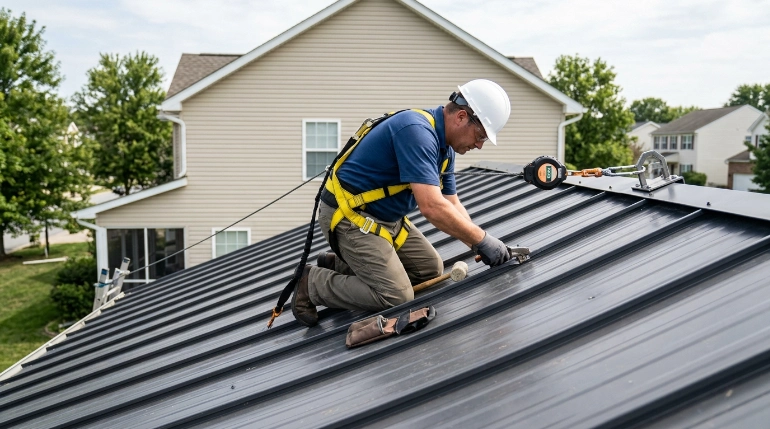
Understanding the basic systems helps homeowners evaluate whether a roofing crew appears prepared for safe work.
Personal Fall Arrest Systems
A personal fall arrest system typically combines components such as a:
- Full-body harness
- Connector or lanyard
- Lifeline or self-retracting device
- Properly designed anchorage
These components work together. A harness by itself is not fall protection.
The anchorage is especially important. OSHA requires personal fall arrest anchorages to meet significant strength or engineered-system requirements. One permitted approach requires an anchorage capable of supporting at least 5,000 pounds per attached employee; another permits a properly designed complete system meeting a specified safety factor under qualified supervision.
That is why attaching a rope to a plumbing vent, gutter, ridge cap, random screw, or other convenient roof component is not a safe substitute for an engineered anchorage.
Guardrail Systems
Guardrails physically separate workers from roof edges or openings.
They can be useful on certain projects because they reduce reliance on an individual worker remaining continuously tied to a lifeline.
However, guardrails must be properly installed and meet applicable strength and configuration requirements. A temporary piece of lumber placed near an edge is not automatically a compliant guardrail.
Safety Nets
Safety nets are another recognized form of fall protection in certain construction settings.
They are less common on a typical small residential reroofing project because installation conditions and available space can make them impractical. Still, they are part of OSHA’s recognized fall-protection framework.
Warning Lines
Warning lines sometimes cause confusion.
OSHA permits warning-line systems in certain low-slope roofing situations and under defined combinations with other protective measures. They should not be interpreted as permission to put a rope several feet from a roof edge and consider the problem solved.
A warning line does not physically arrest a fall.
For homeowners, this distinction matters when comparing contractors. Ask what actual fall-protection system will be used instead of assuming a visible perimeter line is sufficient for every roof.
Low-Slope vs. Steep Metal Roof Safety
Roof pitch affects both footing and fall-protection planning.
A low-slope roof may feel safer because it looks relatively flat. Yet an unprotected edge can still result in a serious fall.
Steeper roofs add another problem: gravity constantly works against the person standing on the surface. On slick metal panels, even a small loss of footing can become a slide toward the eave.
OSHA has different provisions for roofing work depending on roof conditions, but the homeowner takeaway is straightforward:
Do not judge safety by appearance alone.
A one-story low-slope roof can still be hazardous, while a steep two-story roof generally requires extensive professional planning and fall protection before work begins.
Expert Tip: Ask your roofer to explain the fall-protection plan before work begins. A professional should be able to clearly describe roof access, edge protection or tie-off methods, anchor locations, and how workers will handle skylights or other openings.
Ladder Safety Is Part of Rooftop Safety
Many roofing accidents begin before a worker ever reaches the roof surface.
OSHA’s construction ladder requirements include specific rules covering placement, condition, access, loading, and stability. For example, portable ladders used to access an upper landing normally extend at least 3 feet above that landing, and non-self-supporting ladders use approximately a 4-to-1 setup relationship.
Important ladder principles include:
- Place the ladder on a stable, level surface.
- Keep the top and bottom areas clear.
- Do not exceed the ladder’s rated capacity.
- Do not use damaged ladders.
- Secure ladders where displacement is possible.
- Face the ladder when climbing.
- Avoid carrying objects that can cause loss of balance.
For homeowners, climbing a ladder while carrying sealant, tools, sheet metal, or roofing materials can be especially risky.
Whenever possible, keep inspections at ground level and leave roof access to trained professionals.
Rooftop Safety Risks Homeowners Often Overlook
| Situation | Main Hazard | Safer Homeowner Approach |
|---|---|---|
| Checking storm damage | Loose panels, wet roofing, hidden structural damage | Inspect from the ground and call a roofer |
| Looking for a leak | Slippery panels and uncertain leak location | Check attic evidence first |
| Cleaning gutters | Working near the roof edge | Use appropriate ground-access methods or hire a professional |
| Inspecting skylights | Fall through an opening | Stay off the roof and request professional inspection |
| Repairing flashing | Edge exposure and incorrect repairs | Hire an experienced roofing contractor |
| Working after rain | Major traction loss | Delay roof access |
| Removing snow or ice | Extremely slippery surface and falling snow | Use professional roof-snow services where necessary |
After severe weather, remaining on the ground is particularly important.
The National Roofing Contractors Association advises property owners to assess storm damage from ground level and leave close roof assessment and repairs to roofing professionals.
What Homeowners Can Inspect Without Walking on the Roof
You can learn a surprising amount about roof condition without stepping onto metal panels.
From the Ground
Using binoculars or a camera with zoom, look for:
- Bent or lifted panels
- Loose ridge caps
- Missing flashing
- Storm debris
- Damaged gutters
- Tree limbs touching the roof
- Obvious punctures or dents
- Missing roof accessories
From Inside the Attic
If conditions allow safe attic access, look for:
- Water stains
- Damp insulation
- Darkened roof decking
- Daylight through unexpected openings
- Mold-like staining
- Wet rafters or trusses
Decking is the structural surface beneath the roofing material. Water appearing on the decking may not be directly below the actual exterior leak because water can travel along framing or roofing components.
Around the House
Check ceilings and walls for:
- New water stains
- Peeling paint
- Damp drywall
- Musty odors
- Dripping after storms
These observations give a contractor useful information without exposing you to roof-level fall hazards.
Warning Signs That Mean You Should Stay Off the Roof
Do not attempt rooftop inspection when you see or suspect:
- Wet, icy, or frosted metal panels
- A steep roof pitch
- High winds
- Loose or visibly damaged panels
- Sagging roof areas
- Fire damage
- Significant hail or tree impact
- Open skylights or damaged roof openings
- Electrical lines near the work area
- Structural damage after a major storm
- Snow accumulation
- Unstable ladders or poor access conditions
Never climb onto a structurally questionable roof to determine whether it is structurally questionable.
A professional can often begin with ground observation, attic inspection, drones, cameras, or other methods before deciding whether direct access is appropriate.
Safety, Roofing Costs, Labor, and Contractor Quotes
Fall protection takes planning, equipment, setup time, and trained labor.
Consequently, two roofing estimates may differ even when they appear to cover similar materials. A contractor working on a steep, tall, complicated roof may need more labor and safety preparation than a contractor working on a simple, low-slope structure.
Factors that can affect labor and safety planning include:
- Roof height
- Pitch
- Number of stories
- Valleys and dormers
- Skylights
- Chimneys
- Limited ladder access
- Landscaping around the house
- Solar panels
- Roof condition
- Material-handling requirements
The cheapest quote is not necessarily the best value. NRCA recommends evaluating roofing contractors carefully rather than choosing solely by price.
Ask contractors what their estimate includes and how they plan to protect both workers and your property.
Metal Roof Lifespan and Warranty Considerations
Homeowners often choose metal roofing because they expect long-term performance. Safe maintenance helps protect that investment.
Unnecessary foot traffic can potentially damage finishes, seams, flashings, fasteners, or other components depending on the system. An incorrectly installed fall-protection anchor can also create roof penetrations or waterproofing problems.
Before allowing new anchors, rooftop equipment, solar mounts, or major repairs, ask:
- Is the installer experienced with this specific metal roof system?
- Will panels need to be penetrated?
- How will penetrations be flashed and sealed?
- Does the manufacturer require approved attachment methods?
- Could the work affect the material or workmanship warranty?
- Who is responsible if a panel is dented or scratched?
Safety equipment and waterproofing details should be planned together.
When to Consult a Licensed Roofing Contractor
A roofing professional should generally handle work involving:
- Active leaks requiring rooftop diagnosis
- Steep metal roofs
- Two-story or higher roofs
- Storm or hail damage
- Loose panels
- Structural concerns
- Skylight repairs
- Chimney flashing
- Valley repairs
- Ridge-cap problems
- Large roof penetrations
- Significant corrosion
- Full roof replacement
- Insurance-related damage documentation
NRCA’s homeowner roofing resources emphasize that most roof repair and replacement work is better handled by roofing professionals because improper techniques can damage the roof and falls can cause severe injury.
If storm damage may become an insurance claim, document visible damage from a safe location and contact your insurer and qualified contractor before making permanent repairs that could affect the claim.
Questions to Ask a Roofing Contractor About Safety
Before hiring a contractor, ask straightforward questions such as:
- How will workers access my roof safely?
- What type of fall protection will you use?
- Where will fall-protection anchors be installed?
- Will those anchors penetrate my metal roofing?
- How will skylights and other openings be protected?
- How do you prevent workers from damaging metal panels?
- Who supervises safety on the project?
- Are workers trained for the fall hazards involved?
- Do you carry appropriate liability insurance and workers’ compensation coverage where required?
- Will safety-related roof penetrations be properly repaired or permanently incorporated into the roof system?
OSHA requires employers to provide fall-hazard training to workers who may be exposed to fall risks, including instruction that enables them to recognize hazards and understand procedures for minimizing them.
A contractor should not become defensive because a homeowner asks reasonable safety questions.
Common Mistakes Homeowners Should Avoid
- Walking onto a wet metal roof. A little moisture can drastically change footing.
- Assuming a low roof is safe. Fall height and edge exposure still matter.
- Using a random tie-off point. Gutters, vents, pipes, and ordinary roof fasteners are not automatically fall-arrest anchors.
- Working alone. A minor problem can become a serious emergency with nobody nearby.
- Carrying heavy tools up a ladder. Loads can interfere with balance and safe climbing.
- Walking around skylights casually. Roof openings require serious fall-hazard planning.
- Ignoring the weather forecast. Wind and moisture can quickly change conditions.
- Choosing a contractor only by price. Safety, workmanship, insurance, experience, and warranty protection also matter.
- Assuming a harness solves everything. Harnesses need compatible connectors, lifelines, anchorages, proper setup, and training.
- Attempting storm repairs immediately. Damaged roofing may be less stable than it appears.
FAQs
Does OSHA require roofers to wear harnesses?
Not in every roofing situation. OSHA allows different fall-protection systems depending on the work and roof conditions. Personal fall arrest systems using harnesses are common, but guardrails, safety nets, and certain other approved methods may also be permitted.
At what height does OSHA require fall protection for roof work?
For construction work, the commonly applicable threshold is 6 feet above a lower level, although the exact regulation and permitted protection methods depend on the activity and situation.
Does OSHA rooftop safety apply to homeowners doing DIY repairs?
OSHA generally regulates employer-employee workplace relationships, and self-employed individuals are generally not covered by the OSH Act. However, the physical fall hazards remain the same, so homeowners should still treat OSHA principles as useful safety guidance.
Can I tie a safety rope to a roof vent?
Do not assume a roof vent is a suitable fall-arrest anchorage. OSHA imposes significant anchorage requirements for professional personal fall arrest systems. A qualified person should select or design appropriate anchorage.
Is a flat metal roof safe to walk on?
Not automatically. A low-slope roof can still have dangerous edges, skylights, weak areas, moisture, debris, or other hazards. Professional fall protection may still be required for workers.
Is it safe to inspect my metal roof after a storm?
The safer approach is to begin from the ground. Storm damage can leave panels, flashing, decking, trees, or electrical components unstable. NRCA specifically recommends ground-level assessment rather than homeowners attempting storm repairs themselves.
What should I look for when hiring a roofer for a steep metal roof?
Look for appropriate licensing where required, insurance, metal-roof experience, written estimates, warranty information, references, and a clear explanation of how the crew will manage fall protection and roof access.
Conclusion
Understanding OSHA rooftop safety helps homeowners recognize that metal roof work is not ordinary DIY maintenance. Professional roofing involves planning for fall hazards, safe ladder access, roof edges, openings, proper anchorage, weather conditions, and the unique challenges of walking on metal panels.
You do not need to become an OSHA expert to make a smarter decision. Start by inspecting problems from the ground or attic whenever possible. Stay off wet, steep, damaged, icy, or structurally questionable roofs.
When repairs, storm damage, leaks, flashing, skylights, or replacement work require rooftop access, hire an experienced roofing contractor and ask how the crew will handle fall protection before the project starts.
Protecting the person working on the roof is always more important than completing a repair a few hours sooner.