
How to Clean a Metal Roof From the Ground Safely and Effectively

A metal roof can collect pollen, dust, leaves, bird droppings, mildew, algae, and tree sap. Over time, this buildup may leave the roof looking stained and neglected. It can also trap moisture around seams, fasteners, valleys, and roof penetrations.
Many homeowners want to know how to clean a metal roof from the ground without climbing onto a slippery surface. Ground-based cleaning can work well for light dirt and reachable stains, especially on a single-story home. However, the method has limits. Steep roofs, heavy moss, stubborn staining, and damaged panels usually require professional help.
This guide explains the safest tools, cleaning solutions, step-by-step methods, common mistakes, and signs that it is time to call a roofing contractor.
Quick Answer
To clean a metal roof from the ground, use a garden hose, hose-end sprayer, and telescoping soft-bristle brush. Apply a manufacturer-approved mild cleaning solution, allow it to work briefly, and rinse downward toward the gutters. Avoid harsh chemicals, abrasive brushes, and high-pressure spraying that may damage the coating or force water beneath seams.
Can You Really Clean a Metal Roof From the Ground?
Yes, but the results depend on the roof’s height, slope, design, and condition.
Ground cleaning is most effective on:
- Single-story homes
- Low roof sections
- Porches, carports, and attached garages
- Roofs with light dust, pollen, or surface mildew
- Panels that can be reached with a telescoping tool
- Roofs with open access around the home
It is less effective on tall or steep roofs because water and cleaning solution may not reach the ridge. Ground cleaning also cannot provide the close inspection needed to identify loose fasteners, cracked sealant, damaged flashing, or early corrosion.
Do not treat ground cleaning as a substitute for a roof inspection. It is mainly a safer way to improve appearance and remove light surface contamination.
What Type of Roof Buildup Can Be Cleaned From the Ground?
Use the following guide to decide whether a ground-based method is appropriate.
| Roof condition | Ground cleaning suitability | Recommended approach |
|---|---|---|
| Dust and pollen | Good | Water rinse or mild soap solution |
| Light mildew or algae film | Moderate to good | Manufacturer-approved cleaner and gentle brushing |
| Bird droppings | Moderate | Pre-soak, mild detergent, and soft brush |
| Tree sap | Limited | Use only a coating-safe cleaner approved by the manufacturer |
| Heavy moss or lichen | Poor | Professional cleaning is usually safer |
| Rust stains or exposed metal | Poor | Inspection and possible coating repair are needed |
| Peeling or chalking paint | Poor | Stop cleaning and have the finish evaluated |
| Loose screws or damaged seams | Unsafe for DIY cleaning | Call a metal roofing professional |
Start With the Roof Manufacturer’s Instructions
Metal roofing is available with many different finishes. Common examples include galvanized steel, Galvalume, aluminum, copper, and painted steel with polyester or PVDF coatings.
A cleaning product that is safe for one finish may discolor or damage another. Before mixing any solution, check:
- The roof manufacturer’s maintenance instructions
- The panel coating manufacturer’s instructions
- Your material and paint warranties
- Restrictions on bleach, solvents, or pressure washing
- Recommended detergent concentration
Guidance from MBCI on cleaning metal panels notes that water and mild detergent are generally suitable for simple cleaning, while bleach may harm or discolor certain finishes. (MBCI)
Sherwin-Williams also explains that many coated metal surfaces are low-maintenance and can often be cleaned with basic soap and water. (industrial.sherwin-williams.com)
Never assume that household bleach, roof wash, or deck cleaner is safe for painted metal. Use it only when the roof or coating manufacturer specifically allows it.
Safety Rules Before You Begin
Cleaning from the ground reduces fall exposure, but it does not remove every risk. Long poles, wet walkways, overhead power lines, slippery hoses, and chemical overspray can still cause injuries.
The OSHA residential fall-protection guidance highlights the serious risks associated with roofing work. Although OSHA regulations are written for workers and employers, homeowners should take the same roof-height hazards seriously. (OSHA)
Follow these basic precautions:
- Stay completely off the roof.
- Do not stand on a ladder while operating a long spray wand.
- Keep telescoping poles away from overhead electrical lines.
- Wear safety glasses, gloves, long sleeves, and slip-resistant footwear.
- Keep children and pets inside during cleaning.
- Stop if wind begins carrying spray toward people, vehicles, or neighboring property.
- Do not work during rain, thunderstorms, freezing conditions, or strong winds.
- Avoid cleaning when the roof is extremely hot.
Choose a cool, overcast day or work during the morning. A hot roof can cause detergent to dry before it can be rinsed, leaving streaks or residue.
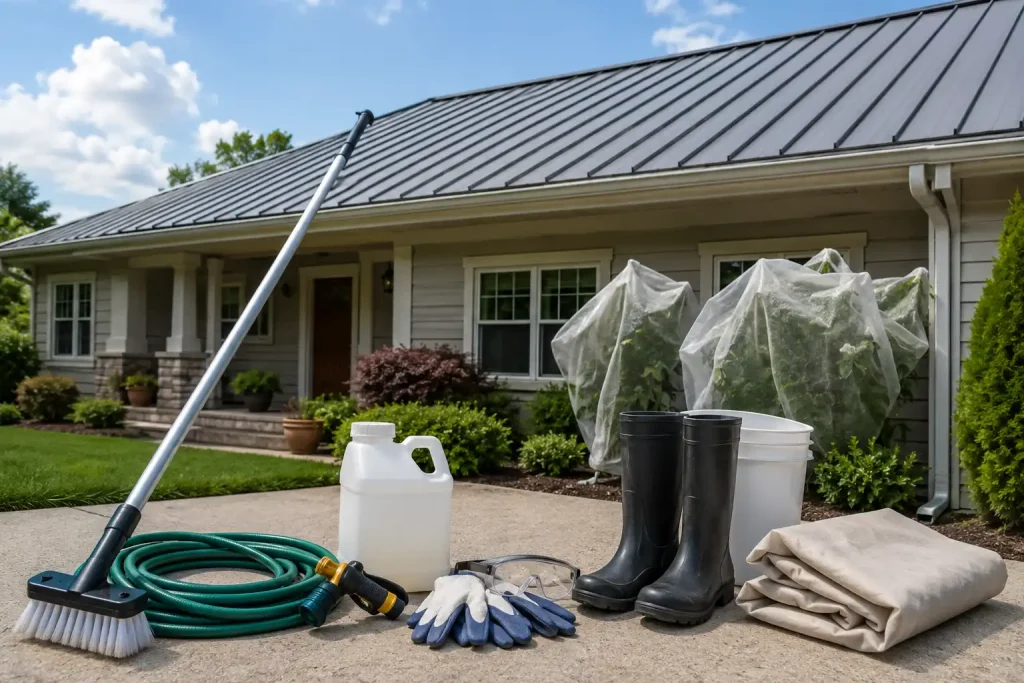
Tools and Supplies You May Need
A basic ground-cleaning setup may include:
- Garden hose with adequate water pressure
- Adjustable hose nozzle
- Hose-end detergent sprayer
- Telescoping soft-bristle roof or siding brush
- Extension pole rated for wet use
- Manufacturer-approved mild detergent
- Measuring container
- Bucket
- Safety glasses
- Chemical-resistant gloves
- Waterproof boots
- Plastic sheeting or breathable plant covers
- Clean water for rinsing landscaping
- Gutter downspout extensions or collection containers
Choose a brush with soft synthetic bristles. Do not use wire brushes, scouring pads, stiff deck brushes, or abrasive sponges. These can scratch the protective coating and create areas where corrosion may begin.
How to Clean a Metal Roof From the Ground Step by Step
1. Inspect the Roof From a Safe Position
Walk around the house and examine the roof from several angles. Binoculars or a camera with optical zoom can help you see the upper panels.
Look for:
- Loose or missing screws
- Lifted panel edges
- Open seams
- Damaged flashing
- Rust or exposed metal
- Peeling paint
- Dented panels
- Clogged valleys
- Heavy moss
- Damaged gutters
Do not spray a roof with visible openings or loose panels. Water may enter beneath the roofing and reach the underlayment, insulation, attic, or ceiling.
2. Protect the Area Below the Roof
Move patio furniture, grills, toys, vehicles, and decorations away from the cleaning area.
Cover sensitive plants loosely. Do not seal plants under plastic for long periods in hot weather. Wet the surrounding grass and landscaping before applying detergent. Pre-wetted leaves absorb less cleaning solution.
Block or redirect downspouts if necessary. Avoid allowing concentrated detergent to flow directly into ponds, storm drains, or neighboring property. The EPA explains that runoff from roofs and paved surfaces can carry pollutants through storm drains into local waterways. (US EPA)
3. Test the Cleaner in a Small Area
Mix the solution exactly as directed. Stronger is not necessarily better.
Apply a small amount to an inconspicuous lower panel. Allow it to sit for the recommended time, then rinse it thoroughly.
Wait for the surface to dry and check for:
- Color changes
- Loss of gloss
- Streaking
- White residue
- Softened paint
- Uneven appearance
Stop if the finish changes.
4. Pre-Rinse Loose Dirt
Use a garden hose to rinse dust, pollen, and loose debris from the lowest accessible roof section.
Direct water down the roof slope, following the same direction rain normally travels. Keep the spray away from the underside of ridge caps, panel laps, flashing edges, vents, and siding transitions.
Never aim water upward beneath an overlapping panel.
5. Apply the Cleaning Solution
Attach a hose-end sprayer or other ground-rated applicator. Work in small sections so the detergent does not dry.
Apply enough solution to wet the surface without flooding it. Follow the product label for dwell time. Many mild cleaners need several minutes to loosen grime, but they should not be allowed to bake onto the roof.
Do not mix separate cleaning chemicals. Combining bleach, ammonia, acids, solvents, or other products can create dangerous fumes or damage the roof coating.
6. Gently Brush Reachable Areas
Use a telescoping soft-bristle brush on low sections that can be reached comfortably from the ground.
Apply light pressure. Let the detergent loosen the stain instead of scrubbing aggressively. Move the brush along the panels rather than forcing it across raised seams or fasteners.
If the pole bends heavily or becomes difficult to control, shorten it. A long wet pole can become surprisingly heavy.
7. Rinse From the Highest Reachable Point Downward
Rinse the cleaned section thoroughly with plain water.
Start at the highest point you can safely reach and work toward the eave. This helps carry detergent and loosened dirt toward the gutter instead of leaving residue above the cleaned area.
Continue rinsing until:
- No foam remains
- Gutter water runs clear
- The panel has no visible soap film
- Nearby siding and windows are clean
8. Rinse Plants and Hard Surfaces
Remove plant covers promptly and rinse the landscaping with clean water. Also rinse siding, windows, decks, walkways, and outdoor equipment that received overspray.
Keep people away from wet concrete and decking until the surfaces are no longer slippery.
9. Inspect the Roof After It Dries
View the roof again after it has dried completely. Wet metal often hides streaks, faded areas, and remaining stains.
A second mild application may be used if the manufacturer allows it. Do not keep increasing chemical strength or scrubbing pressure when a stain does not respond. The mark may be corrosion, coating damage, or permanent discoloration rather than dirt.
Expert Tip:
Clean one small roof plane first and let it dry before treating the entire roof. This test area reveals whether the solution causes streaking, color changes, or uneven gloss.
Should You Pressure Wash a Metal Roof From the Ground?

A pressure washer may seem faster, but it creates several problems.
High-pressure water can:
- Damage or dull painted finishes
- Remove loose coating
- Force water beneath seams and flashing
- Disturb sealing washers
- Spread water into vents
- Damage sealant around penetrations
- Leave visible spray marks
- Create strong kickback through a long extension wand
Pressure-washing from the ground also makes it difficult to control the angle. The stream often travels upward toward the roof, which is exactly the direction that should be avoided around laps and flashing.
For most homeowners, a garden hose, mild detergent, and soft brush are safer. Where pressure washing is approved, it should be performed at a controlled setting by someone familiar with the specific panel system and coating.
How to Handle Different Types of Stains
Dirt, Dust, and Pollen
Begin with plain water. A gentle rinse may remove most loose contamination without detergent.
Use mild soap only if a water rinse leaves a visible film.
Light Algae or Mildew
Use a cleaner approved for painted metal. Allow proper dwell time, brush lightly, and rinse thoroughly.
Algae may return quickly if the roof is heavily shaded by trees. Trimming branches can improve sunlight and airflow, but tree work near a roof should be handled carefully.
Moss and Lichen
Heavy moss and lichen attach firmly to the surface. Pulling or aggressive scrubbing may scratch the coating.
These growths may also conceal corrosion, trapped debris, or damaged sealant. Professional treatment is usually the better option, especially when growth extends near seams or fasteners.
Bird Droppings
Pre-soak the area with water before applying mild detergent. Dried droppings can be abrasive, so do not scrape them from the coating.
Tree Sap and Grease
Do not automatically use mineral spirits, paint thinner, or household degreaser. Solvents may alter the roof’s color or gloss.
Ask the panel or coating manufacturer which product is approved for the specific stain.
Rust-Colored Marks
A rust-colored stain may come from a steel fastener, nearby chimney cap, HVAC component, or exposed panel edge.
Cleaning the stain without correcting the source will not solve the problem. Have the affected area inspected before corrosion spreads.
Protecting the Roof Finish and Warranty
A metal roof’s painted finish is part of its weather protection. Damage to that coating may expose the underlying metal to moisture.
To protect it:
- Use only approved cleaners.
- Follow dilution instructions.
- Test the solution first.
- Use soft cleaning tools.
- Rinse completely.
- Do not allow detergent to dry.
- Avoid strong solvents.
- Avoid abrasive powders.
- Keep records of products used.
- Save photographs before and after cleaning.
Review the warranty before cleaning. Some warranties require specific maintenance practices or exclude damage caused by chemicals, pressure washing, improper tools, or neglected debris.
DIY Ground Cleaning vs. Professional Cleaning
| Consideration | DIY from the ground | Professional roof cleaning |
|---|---|---|
| Cost | Lower equipment and supply cost | Higher service cost |
| Safety | Safer when the homeowner remains on level ground | Crew should use proper access and fall protection |
| Cleaning reach | Limited on high or steep roofs | Can reach ridges, valleys, and upper sections |
| Inspection quality | Mostly visual from a distance | Close inspection may reveal hidden defects |
| Stubborn growth | Often difficult to remove | Better equipment and stain-specific treatments |
| Risk to coating | Low when mild methods are followed | Depends on contractor knowledge and methods |
| Best use | Light dirt on low roof sections | Large roofs, heavy growth, tall homes, or damaged systems |
Professional cleaning costs vary according to roof size, pitch, height, access, contamination, local labor rates, and whether repairs are needed. Obtain a written estimate describing the cleaning method and chemicals before approving the job.
Common Mistakes Homeowners Should Avoid
- Climbing onto a wet metal roof. Metal becomes extremely slippery when water or detergent is applied.
- Using a ladder as a work platform. Sprayer recoil and long poles can easily affect balance.
- Aiming water upward. This may drive moisture beneath panel overlaps, ridge caps, vents, and flashing.
- Using full-strength bleach without approval. Bleach can discolor some finishes and harm plants.
- Mixing cleaning products. Chemical combinations may produce toxic fumes or damaging reactions.
- Using a wire brush. Abrasive tools can remove the roof’s protective finish.
- Letting detergent dry. Dried cleaner may create streaks and residue.
- Cleaning in direct midday sun. Hot panels cause rapid drying and uneven results.
- Ignoring loose fasteners or damaged flashing. Washing may worsen an existing opening.
- Using excessive pressure. More pressure does not always mean better cleaning.
- Assuming every dark mark is algae. It may be coating failure, corrosion, or environmental staining.
- Failing to protect gutters and landscaping. Concentrated runoff can harm plants and contaminate drainage areas.
When to Call a Roofing Professional
Stop the DIY process and contact a qualified metal roofing contractor when:
- The home has two or more stories.
- The roof has a steep pitch.
- The ridge cannot be reached from the ground.
- Heavy moss or lichen covers multiple panels.
- Rust, peeling paint, or exposed metal is visible.
- Fasteners appear loose, tilted, or missing.
- Panel seams are lifted or separated.
- Flashing looks cracked or displaced.
- Water stains are visible in the attic or ceiling.
- The roof was recently damaged by hail or wind.
- Cleaning would require walking on the roof.
- The manufacturer requires professional maintenance.
- You cannot identify the panel material or coating.
Ask the contractor whether the company has experience with your specific type of metal roof. A contractor who mainly cleans asphalt shingles may not understand painted metal coatings, exposed-fastener systems, or standing seams.
Request proof of insurance and a written scope of work. The proposal should identify the cleaning product, application method, water pressure, plant-protection plan, and any warranty limitations.
FAQs
Can I clean my metal roof with only a garden hose?
Yes. A garden hose may be enough for loose dust, pollen, and light surface dirt. Use moderate water flow and direct the spray downward along the roof slope. Avoid spraying upward beneath seams, flashing, ridge caps, or vents.
What is the safest soap for cleaning a metal roof?
A mild, non-abrasive detergent approved by the roof or coating manufacturer is usually the safest choice. Do not assume dish soap, bleach, degreaser, or general roof cleaner is compatible with every metal finish.
Can I use bleach to clean algae from a metal roof?
Use bleach only when the panel or coating manufacturer specifically approves it and provides a safe dilution ratio. Bleach can discolor certain finishes, damage nearby materials, and harm landscaping when it is used incorrectly.
How often should a metal roof be cleaned?
Inspect the roof at least once or twice a year and after major storms. Cleaning frequency depends on nearby trees, pollen, shade, coastal salt, industrial pollution, and local humidity. Many roofs need only occasional rinsing rather than a full cleaning every year.
Can a telescoping brush scratch a metal roof?
Yes, if the bristles are stiff, dirty, or abrasive. Use a clean soft-bristle brush and light pressure. Never use a wire brush, scouring pad, or hard deck brush on a painted metal panel.
Why does my metal roof still look stained after cleaning?
The mark may be fading, chalking, corrosion, sap damage, mineral deposits, or permanent coating discoloration rather than removable dirt. Stop repeated scrubbing and have the area inspected if a gentle manufacturer-approved cleaner does not work.
Is professional soft washing safe for a metal roof?
It can be safe when the contractor uses coating-compatible chemicals, controlled pressure, correct spray direction, and thorough rinsing. Ask for the exact cleaning process in writing and confirm that it follows the roof manufacturer’s requirements.
Conclusion
Learning how to clean a metal roof from the ground can help you remove light dirt, pollen, bird droppings, and minor organic staining without stepping onto a slippery roof. The safest method uses a garden hose, manufacturer-approved mild detergent, and a telescoping soft-bristle brush.
Work in small sections, keep water flowing downward, protect landscaping, and rinse the roof completely. Avoid high pressure, abrasive tools, unapproved chemicals, and any method that requires balancing on a ladder.
Before cleaning, inspect the roof carefully. When you see rust, damaged flashing, loose fasteners, heavy moss, leaks, or coating failure, schedule an evaluation with an experienced metal roofing contractor. A cautious approach protects both your roof and your home.