
Residential Roof Fall Protection for Metal Roofs: A Homeowner Safety Guide
Getting onto a metal roof may look simple from the ground. In reality, even a small inspection can expose you to slippery panels, steep slopes, roof edges, skylights, loose materials, and ladder hazards.
That is why residential roof fall protection matters whenever work is being performed on a metal roof. Professional roofers use fall-prevention and fall-arrest systems because a single slip can lead to a serious injury.
For homeowners, understanding these systems is useful even if you never plan to climb onto the roof yourself. It helps you recognize unsafe work practices, ask contractors better questions, and decide when a roof problem should be left to a trained professional.
This guide explains fall protection, OSHA safety benchmarks, metal-roof hazards, ladders, anchors, harnesses, contractor considerations, costs, warranties, and the warning signs that mean DIY roof access is not worth the risk.
Quick Answer
Residential roof fall protection uses equipment and work practices such as harnesses, anchors, lifelines, guardrails, safe ladders, and controlled access to reduce fall risks. Metal roofs deserve extra caution because panels may become very slippery when wet, dusty, icy, or steep. Most homeowners should leave elevated metal-roof work to trained roofing professionals.
Why Fall Protection Matters on a Residential Metal Roof
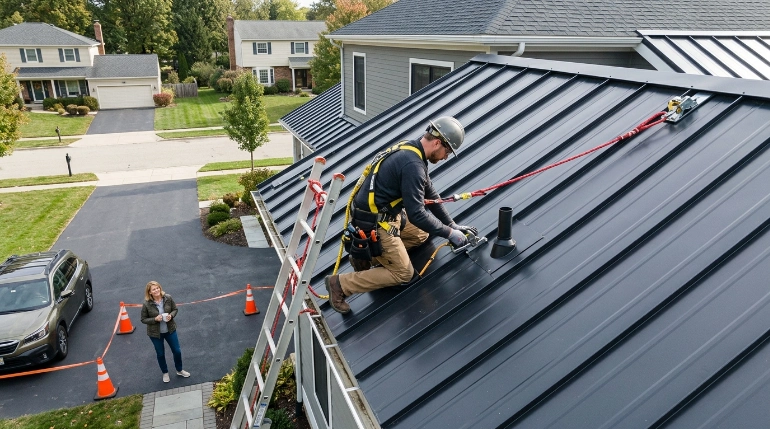
Metal roofing is durable, but durability does not make the surface safe to walk on.
Standing-seam panels, exposed-fastener panels, metal shingles, and other systems can all become slippery. Water, morning dew, frost, pollen, dust, loose leaves, sealant, and even certain roof coatings can reduce traction.
Wind creates another problem. A sudden gust can affect your balance or move loose material across the roof. OSHA specifically warns that workers installing standing-seam roofing can encounter unpredictable hazards from wind, loose roofing materials, and slick surfaces.
The OSHA fall-protection guidance explains that construction employers generally must protect workers exposed to falls of six feet or more.
That six-foot threshold should not be misunderstood as meaning a homeowner is safe below six feet. A fall from a porch roof, garage roof, or extension ladder can still cause serious injury.
Also, OSHA rules primarily regulate workplace safety. A homeowner performing personal DIY work is not automatically treated as an employee under the Occupational Safety and Health Act. OSHA states that genuinely self-employed individuals without employees are generally outside its enforcement authority.
For homeowners, OSHA guidance is best viewed as a strong safety benchmark, not permission to perform dangerous roof work yourself.
What Is Residential Roof Fall Protection?
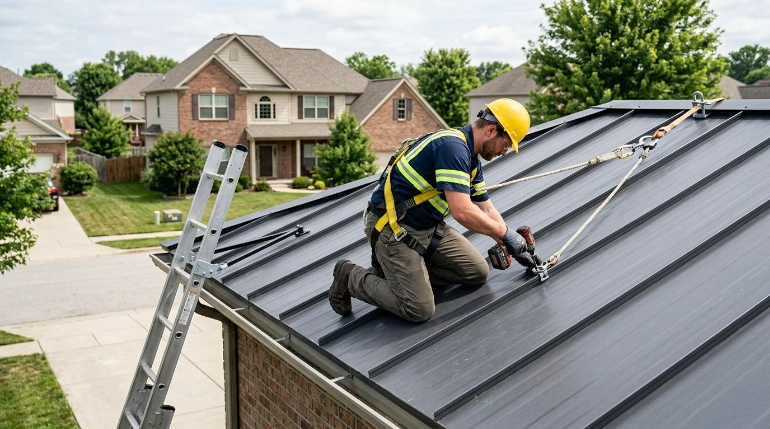
Residential roof fall protection is a combination of equipment, planning, training, and work practices designed either to prevent someone from falling or to stop a fall before the person reaches a lower level.
A professional system may include:
- A full-body harness
- Roof anchors
- Lifelines
- Shock-absorbing lanyards
- Self-retracting lifelines
- Guardrails
- Safety nets
- Warning-line systems where appropriate
- Scaffolding or aerial lifts
- Properly positioned ladders
- Protected skylights and roof openings
The correct system depends on the roof design, slope, work location, height, anchor options, and job being performed.
Simply owning a harness does not mean someone has adequate fall protection.
The harness must be compatible with the connecting equipment, attached to an appropriate anchorage, adjusted correctly, and used with enough clearance to arrest a fall before the worker strikes the ground, a lower roof, an awning, or another obstruction.
Fall Prevention vs. Fall Arrest
These terms sound similar but describe different safety approaches.
Fall Prevention or Restraint
Fall prevention attempts to stop a person from reaching the hazard in the first place.
A restraint system, for example, may limit movement so the worker cannot physically reach the roof edge.
OSHA recognizes properly designed fall-restraint systems as an option in certain situations when they are rigged so the worker cannot reach the fall hazard.
Fall Arrest
A personal fall arrest system allows some movement but is designed to stop a fall after it begins.
A typical system involves:
- A full-body harness
- An appropriate connector or lifeline
- A suitable anchor point
- Sufficient fall clearance
- A rescue plan
Fall arrest is more complicated than attaching a rope to something that appears strong.
An incorrect anchor, excessive slack, improper harness fit, or inadequate clearance can make the system ineffective.
Common Fall-Protection Options for Metal Roofs
| Protection Method | Main Purpose | Common Application | Homeowner Consideration |
|---|---|---|---|
| Personal fall arrest system | Stops an active fall | Steep or elevated roofing work | Requires training and proper anchorage |
| Fall restraint system | Prevents reaching an edge | Certain accessible roof layouts | Must be correctly sized and positioned |
| Guardrails | Creates a physical barrier | Roof edges and work zones | Usually installed by professionals |
| Scaffolding | Provides a working platform | Edge repairs and larger projects | Must be properly erected and stabilized |
| Safety nets | Reduces consequences of a fall | Specialized construction situations | Uncommon for small homeowner projects |
| Warning-line systems | Defines controlled work areas | Certain low-slope roofing situations | Not appropriate as a universal DIY solution |
| Aerial lift | Avoids walking across some roof areas | Repairs near edges or elevations | Requires suitable equipment and trained operation |
The right solution is job-specific.
For example, a system appropriate for a low-slope porch roof may not be suitable for a steep two-story standing-seam roof.
Why Metal Roofs Need Special Attention
Metal Can Become Extremely Slippery
Rain is an obvious problem, but visible rain is not required for a metal panel to lose traction.
Morning condensation, frost, algae, dust, pollen, or a thin film of moisture can make footing unpredictable.
The safest approach is straightforward:
Never assume a metal roof is safe simply because it looks dry from the ground.
Steeper Pitch Increases Risk
Roof pitch describes how steep a roof is.
A low-slope metal roof may feel manageable while standing near the ladder. As pitch increases, maintaining balance becomes more difficult and slipping can accelerate rapidly.
Steep roofs require a more carefully designed fall-protection strategy.
Panel Profiles Affect Footing
Metal roofing is not one uniform surface.
Standing seams, ribs, fasteners, valleys, ridges, flashing, penetrations, and transition areas can change how a person must move across the roof.
Walking in the wrong location can also dent panels or damage seams.
Metal Edges Can Be Sharp
Repairs may expose cut panel edges and flashing. These surfaces can damage gloves, clothing, ropes, or skin.
Fall-protection equipment must also be protected from conditions that could cut, abrade, or otherwise damage it.
Safe Ladder Access Is Part of Fall Protection
A worker can have excellent fall-protection equipment on the roof and still be injured while getting there.
Ladders deserve the same attention as the roof itself.
OSHA’s construction ladder requirements state that when a portable ladder is used to access an upper landing, its side rails generally must extend at least three feet above that landing, unless an alternative secured arrangement and grasping device are provided.
For homeowners, practical ladder precautions include:
- Place the ladder on stable, level ground.
- Keep the base away from mud, loose gravel, or slippery surfaces.
- Inspect rails, feet, locks, and rungs before use.
- Do not carry bulky roofing materials while climbing.
- Keep your body centered between the rails.
- Prevent the ladder from sliding or shifting.
- Do not place a ladder where doors or vehicles can strike it.
- Avoid ladder use during strong wind, rain, ice, or thunderstorms.
The transition between the ladder and roof is one of the most awkward parts of roof access.
If that transition feels unstable, the correct response is not to climb faster or stretch farther. Stop and reconsider the setup.
Roof Anchors and Harnesses: Why Proper Setup Matters
Homeowners sometimes assume any solid-looking roof component can be used as an anchor.
That is unsafe.
Plumbing vents, gutters, satellite mounts, snow guards, chimneys, vent pipes, and random fasteners should never automatically be assumed capable of handling fall-arrest forces.
Professional roofers select anchorage based on the structure and the fall-protection system being used.
On metal roofing, the situation can become even more specialized because standing-seam systems may use engineered clamps or attachment systems designed for specific panel profiles.
The wrong attachment can:
- Fail during a fall
- Distort a metal panel
- Damage a seam
- Create a leak
- Void part of a roof warranty
- Transfer dangerous loads into an unsuitable part of the structure
OSHA’s guidance on installing standing-seam metal roofs emphasizes planning and appropriate fall protection rather than relying on experience or balance alone.
Do Not Forget Skylights and Roof Openings
Roof edges are not the only fall hazards.
Skylights, open roof hatches, damaged decking, unfinished penetrations, and concealed weak areas can create fall-through hazards.
This is especially important during replacement work.
Once roofing material or damaged decking is removed, areas that previously looked solid may become dangerous.
OSHA’s residential reroofing guidance recommends protecting workers around skylights and openings using appropriate systems such as guardrails, personal fall arrest systems, or suitable protective covers.
Homeowners should never assume a skylight can support body weight.
Weather Can Change a Safe-Looking Job Quickly
Roof work should not be evaluated based only on the weather when the ladder first goes up.
Conditions can change.
Stop or postpone roof access when there is:
- Rain
- Frost or ice
- Strong or gusty wind
- Lightning nearby
- Wet leaves
- Heavy morning dew
- Extreme heat
- Poor visibility
Metal panels can also become very hot in direct sunlight.
Extreme heat may affect concentration, footwear comfort, tools, and physical endurance.
A small repair is rarely important enough to justify working in unsafe weather.
How Homeowners Should Evaluate a Roofing Contractor’s Safety Practices
You do not need to understand every OSHA regulation to recognize a professional approach.
Before work starts, ask the contractor:
1. How Will Your Crew Handle Fall Protection?
A reputable contractor should be able to explain the general safety approach clearly.
You do not need a technical lecture. You should hear more than, “We’ve been doing this for years.”
2. How Will You Access the Roof?
Look for deliberate ladder placement, stable footing, controlled access, and attention to landscaping, electrical lines, walkways, and occupants.
3. What Will You Use for Anchoring?
This question is particularly important on standing-seam and other metal roofs.
Ask whether the attachment method is compatible with your roof system.
4. Will Safety Equipment Damage My Roof?
Some temporary anchors require penetrations. Others may attach differently.
Ask how temporary attachment points will be installed, removed, sealed, or documented.
5. Are You Properly Insured?
Request appropriate proof of insurance and confirm licensing requirements in your state or local area.
Insurance does not replace safe work practices, but it is an important part of contractor screening.
The National Roofing Contractors Association’s homeowner resources also recommend relying on professional roofers for work that could expose homeowners to falls or improper roofing techniques.
Expert Tip: Ask how the crew will protect themselves before signing the roofing contract. A clear safety answer is a useful indicator of how carefully the contractor plans the rest of the project.
What Does Fall Protection Add to Roofing Cost?
Fall protection is part of professional roofing work, not an optional accessory that should disappear to make a quote cheaper.
Safety-related costs may include:
- Harnesses and connectors
- Anchors or engineered seam attachments
- Lifelines
- Guardrail systems
- Scaffolding
- Lift equipment
- Equipment inspections
- Worker training
- Setup and removal time
- Additional labor for difficult access
A steep two-story metal roof will usually require more planning and labor than a low, easily accessible roof.
Do not choose a contractor simply because one quote is much cheaper after safety-related setup appears to have been removed.
Ask what each estimate includes.
Roof Material, Lifespan, and Long-Term Safety
Metal roofs are commonly chosen for long service life, but a long-lasting roof still requires periodic inspection and maintenance.
Over time, a roof may develop:
- Loose or damaged panels
- Sealant deterioration
- Corrosion
- Fastener problems
- Damaged flashing
- Storm dents
- Leaks around penetrations
- Loose snow-retention components
- Debris accumulation
An aging roof can create additional walking hazards if panels, decking, or attachment points have deteriorated.
Never assume that because a roof has supported workers before, it remains safe to access today.
Warranty Considerations Before Attaching Safety Equipment
Your roof warranty may contain rules covering panel penetrations, approved accessories, sealants, repairs, and installation methods.
Before permanent anchors or other devices are installed, review:
- Roofing manufacturer requirements
- Workmanship warranty terms
- Approved attachment details
- Approved sealants and fasteners
- Whether penetrations must be documented
- Whether repairs must be completed by an authorized contractor
A safety device should protect workers without unnecessarily creating a future leak or warranty problem.
This is one reason professional evaluation matters on modern standing-seam systems.
Common Mistakes Homeowners Should Avoid
- Climbing up “just for a quick look.” Many roof accidents begin with tasks expected to take only a few minutes.
- Walking on wet metal. Even light moisture can dramatically reduce traction.
- Using a harness without understanding the anchor. A harness attached to an unsuitable point may provide false confidence.
- Tying off to vents or gutters. These components should not automatically be treated as fall-arrest anchors.
- Ignoring ladder stability. Safe roof work starts before anyone steps onto the roof.
- Working alone. A fall or medical emergency becomes more dangerous when nobody is available to call for help.
- Walking near skylights without protection. Skylights and roof openings can present serious fall-through hazards.
- Assuming experience replaces equipment. Experienced roofers are still exposed to changing weather, loose materials, and slips.
- Choosing the cheapest contractor without asking about safety. A lower quote is not a bargain if basic job-site protection has been ignored.
- Performing storm inspections from the roof. After storms, hidden damage and slippery conditions make roof access especially risky.
NRCA specifically recommends that property owners evaluate storm-related roof damage from ground level rather than attempting rooftop repairs themselves.
When to Consult a Licensed Roofing Contractor
Call an experienced roofing contractor rather than attempting roof access yourself when:
- The roof is steep.
- The home is two stories or higher.
- Panels are wet, icy, dusty, or unusually slippery.
- You notice loose metal panels.
- There is storm or hail damage.
- The roof is leaking around a chimney, skylight, valley, or wall transition.
- Roof decking may be damaged.
- You cannot identify a safe anchorage location.
- Structural movement or sagging is visible.
- A repair involves removing metal panels.
- Electrical equipment or overhead power lines are nearby.
- You are unsure whether walking will damage the roofing system.
- The work could affect a manufacturer warranty.
- You need an inspection for an insurance claim.
A professional evaluation becomes especially important when there may be structural damage.
If decking, framing, trusses, rafters, or roof supports are sagging or water-damaged, avoid the area and request an appropriate structural assessment.
A Safer Homeowner Approach to Roof Inspection
You often do not need to climb onto the roof to identify a problem.
Start with safer locations.
From the Ground
Use binoculars or a camera with zoom to look for:
- Lifted panels
- Bent flashing
- Missing trim
- Storm debris
- Damaged gutters
- Visible corrosion
- Loose ridge components
From the Attic
When safely accessible, inspect for:
- Water stains
- Damp insulation
- Daylight through openings
- Mold-like discoloration
- Wet decking
- Rust around penetrations
Do not walk across unsupported attic insulation or ceiling material.
From Inside the Home
Look for:
- Ceiling stains
- Peeling paint
- Musty odors
- Dripping water
- Damp walls
- Changes after wind-driven rain
Document what you see with photographs and give that information to your contractor.
Ground-level documentation is particularly useful after storms because it lets you start an insurance or repair conversation without putting yourself on the roof.
FAQs
What is residential roof fall protection?
Residential roof fall protection includes equipment and procedures designed to prevent roof falls or reduce injuries if a fall occurs. Systems may include harnesses, anchors, lifelines, guardrails, scaffolding, restraint systems, and safe ladder access.
Does OSHA require fall protection on residential roofs?
For covered construction employers, OSHA generally requires appropriate fall protection when employees are exposed to unprotected roof edges six feet or more above lower levels. Requirements vary depending on the work and roof conditions. DIY homeowners are not automatically covered in the same way as employees.
Are metal roofs more dangerous to walk on?
They can be especially slippery when wet, dusty, frosty, or steep. Panel profile, roof pitch, coatings, weather, and footwear also affect traction. Homeowners should avoid walking on unfamiliar metal roofing.
Can I attach a safety harness to my chimney?
Do not assume a chimney is an appropriate fall-arrest anchor. Anchors must be selected for the specific system and structure. Improvised attachment points can fail or damage the building.
Can I inspect storm damage myself?
You can perform a basic inspection from the ground, attic, or another safe location. Avoid climbing onto a storm-damaged roof because panels, decking, flashing, and other components may be unstable.
Is a harness enough to make roof work safe?
No. A harness is only one component. Proper anchorage, connectors, fall clearance, equipment condition, training, positioning, and rescue planning are also important.
Should I ask my roofing contractor about fall protection?
Yes. Ask how workers will access the roof, what fall-protection methods will be used, whether attachments are compatible with your metal roofing system, and how temporary penetrations or anchors will be handled.
Conclusion
Good residential roof fall protection is not simply a harness and rope. It is a complete approach involving safe access, suitable anchors, correct equipment, careful planning, weather awareness, trained workers, and a clear understanding of the roof itself.
Metal roofs deserve extra respect because smooth panels, steep slopes, moisture, seams, and changing weather can quickly turn a routine task into a serious fall hazard.
Homeowners do not need to become fall-protection experts. You do need to recognize when the risk is beyond reasonable DIY work.
Inspect from the ground whenever possible. Ask roofing contractors how they protect workers and your roof system. And when a roof is steep, high, damaged, wet, unfamiliar, or structurally questionable, hire a qualified roofing professional instead of climbing onto it yourself.