
Are Metal Roofs Impact Resistant? What Homeowners Should Know

Hail, falling branches, windblown debris, and severe storms can cause expensive roof damage. If you are considering a metal roof, you may wonder whether it can handle these impacts better than shingles, tile, or other roofing materials.
So, are metal roofs impact resistant? In most cases, yes. Metal roofing is generally strong enough to resist cracking, splitting, and puncturing during ordinary hailstorms. However, no roof is completely damage-proof. Panel thickness, metal type, roof design, decking, installation quality, and hail size all affect how well a metal roof performs.
This guide explains impact ratings, hail damage, cosmetic dents, material differences, inspection signs, insurance considerations, and when professional help is necessary.
Quick Answer
Yes, metal roofs are generally impact resistant and often perform well against hail, branches, and windblown debris. Impact-rated metal panels can provide even stronger protection. However, severe hail may dent the panels, damage coatings, loosen seams, or cause leaks. A Class 4 rating offers the highest UL 2218 impact classification.
What Does Impact Resistance Mean for a Metal Roof?
Impact resistance describes a roofing material’s ability to withstand contact with hailstones, branches, tools, or windblown debris without losing its ability to protect the home.
For metal roofing, impact damage generally falls into two categories.
Cosmetic damage
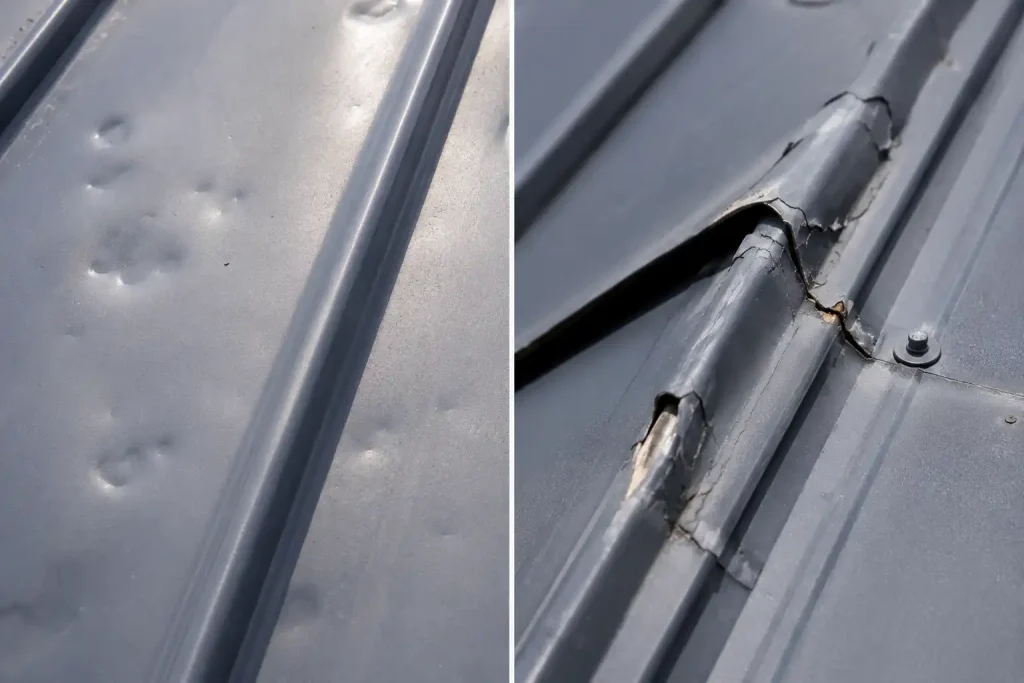
Cosmetic damage changes the roof’s appearance but does not prevent it from shedding water. Examples include:
- Small shallow dents
- Slight surface rippling
- Minor paint scuffs
- Marks that are visible only from certain angles
A dented panel may still remain completely watertight. However, cosmetic damage can reduce curb appeal and may affect property value.
Functional damage
Functional damage affects the roof’s performance or service life. It may include:
- Holes or punctures
- Split seams
- Disconnected panel locks
- Cracked protective coatings
- Damaged flashing
- Loose or broken fasteners
- Openings that allow water intrusion
Functional damage should be repaired promptly. Even a small opening can allow moisture to reach the roof deck, insulation, attic, or framing.
The IBHS guidance for steep-slope metal roofing explains that metal roof systems can withstand severe weather, including hail, when the roof assembly is properly selected and installed. (IBHS)
How Metal Roof Impact Ratings Work
Not every metal roofing product provides the same level of protection. Manufacturers may have their panels or metal shingles tested under recognized impact-resistance standards.
Understanding UL 2218 ratings
UL 2218 is a widely recognized test for the impact resistance of prepared roof-covering materials. Products are assigned one of four classifications:
| Impact classification | General resistance level | Homeowner consideration |
|---|---|---|
| Class 1 | Basic | Limited protection against stronger impacts |
| Class 2 | Moderate | Better than unrated roofing |
| Class 3 | High | Suitable for areas with occasional hail |
| Class 4 | Highest | Preferred for hail-prone regions |
Class 4 is the highest UL 2218 classification, but it does not mean the roof is hail-proof. It means the tested product resisted a specified laboratory impact without failing under the test conditions.
UL Solutions includes the UL 2218 impact test among its roofing testing and certification services. Homeowners should request documentation showing that the exact panel system—not simply the general roofing brand—has the claimed rating. (UL Solutions)
The FORTIFIED Roof guidance requires metal panels to meet UL 2218 Class 4 when a roof is seeking its optional hail designation. This provides a useful benchmark for homeowners in areas that experience frequent severe storms. (FORTIFIED – A Program of IBHS)
Important: A rating applies to a tested product and assembly. Changing the deck, underlayment, panel thickness, fasteners, or installation method may affect real-world performance.
Are All Metal Roofs Equally Impact Resistant?
No. Metal roofing is a broad category that includes different materials, panel profiles, thicknesses, coatings, and installation systems.
Metal type
The material itself affects resistance to denting and puncturing.
- Steel roofing: Usually offers strong impact performance and is widely used on residential homes.
- Aluminum roofing: Resists corrosion well but may dent more easily than comparable steel panels.
- Copper roofing: Can last for decades, but its softer surface may show visible dents.
- Zinc roofing: Durable and corrosion-resistant, although substantial impacts can still leave marks.
- Stone-coated steel: Uses shaped steel panels with a protective granular surface that may make minor dents less noticeable.
Material alone does not determine performance. A thicker aluminum panel may outperform a very thin steel panel under certain conditions.
Panel thickness or gauge
For steel roofing, the gauge number indicates thickness. A lower gauge number generally means thicker metal.
For example, a 24-gauge steel panel is normally thicker than a 29-gauge panel. Thicker panels usually resist denting and deformation better, but they also cost more and add weight.
Homeowners in severe hail areas may benefit from asking contractors about:
- Panel gauge
- Yield strength
- Impact classification
- Manufacturer testing
- Approved installation assembly
Do not choose a panel based on gauge alone. Metal strength, panel shape, support spacing, and roof decking also matter.
Panel profile
Ribs, seams, corrugations, and stamped shapes can add stiffness to the metal.
Standing-seam and corrugated panels contain raised areas that help resist bending. However, broad flat sections between ribs may still show dents when struck by large hail.
Textured and stone-coated metal products may hide small dents better than smooth, glossy panels.
Roof deck and underlayment
A metal panel installed over solid plywood or oriented strand board has continuous support beneath it. That support can reduce panel movement during an impact.
Panels installed over widely spaced purlins have unsupported sections between framing members. Those sections may flex or dent more noticeably.
The entire roof assembly—not just the visible metal—contributes to impact performance.
Installation quality
Even a strong panel can perform poorly when installed incorrectly. Common installation weaknesses include:
- Improper fastener spacing
- Loose screws
- Overtightened sealing washers
- Poorly locked standing seams
- Unsupported panel edges
- Incorrect flashing
- Insufficient deck attachment
- Incompatible sealants or fasteners
A properly installed mid-range panel may perform better than a premium panel installed with shortcuts.
Metal Roof Performance Against Different Impacts
Hail
Metal roofing generally handles ordinary hail well because it does not become brittle and crack in the same way some rigid or aging materials can.
Small or moderate hail may leave no visible damage. Larger hail can create dents, especially in flat areas of the panel. Very large, hard, or wind-driven hail may damage seams, coatings, flashing, vents, gutters, and skylights.
A watertight roof can still have visible hail dents. Whether those dents require repair depends on their location, severity, coating condition, and insurance coverage.
Falling branches
Small twigs and lightweight branches rarely cause serious damage. A large falling limb can:
- Deeply crease a panel
- Puncture the metal
- Damage the roof deck
- Bend seams
- Break flashing
- Damage structural framing
After a substantial branch strike, inspect the attic and roof structure even when the panel has no obvious hole.
Windblown debris
High winds can carry tree limbs, signs, loose construction materials, and other objects onto a roof.
Metal panels may resist minor debris impacts, but sharp or heavy objects can puncture the surface. Impacts near panel seams, fasteners, roof edges, or penetrations can be particularly damaging.
Foot traffic
Metal roofing can also be damaged by improper walking. Stepping between supports may dent a panel, while walking on seams or ribs can distort important connections.
Homeowners should not climb onto a metal roof to look for dents. Metal surfaces can be steep, slippery, and difficult to walk on safely.
Factors That Determine Real-World Hail Performance
The same storm can affect two nearby metal roofs differently. Important factors include:
- Hailstone size, hardness, shape, and speed
- Wind speed and impact angle
- Metal type and thickness
- Panel width and profile
- Distance between structural supports
- Solid decking versus open framing
- Roof slope
- Age and condition of the protective coating
- Quality of seams, fasteners, and flashing
- Previous damage or corrosion
A steep roof may receive more glancing impacts, while a low-slope roof may take more direct blows. However, wind direction can change the impact angle significantly.
Cosmetic Dents Versus Damage That Needs Repair
Homeowners often assume every dent means the roof must be replaced. That is not always true.
| Roof condition | Likely concern | Typical response |
|---|---|---|
| Small shallow dents in panel centers | Mainly cosmetic | Document and monitor |
| Dents near seams or locks | Possible connection damage | Professional inspection |
| Paint scuffs without exposed metal | Limited cosmetic concern | Check manufacturer guidance |
| Coating cracked to bare steel | Corrosion risk | Repair coating or panel |
| Loose exposed fasteners | Possible leak risk | Replace or reset correctly |
| Split seam or open lap | Water-entry risk | Prompt professional repair |
| Hole or puncture | Immediate functional damage | Temporary protection and repair |
| Dented vents or flashing | Possible hidden leakage | Detailed inspection |
A roofer should inspect more than the visible panel surface. Flashing around chimneys, vents, skylights, valleys, edges, and wall connections may suffer more serious damage than the main roof panels.
Signs of Metal Roof Impact Damage
After a hailstorm or debris strike, look for the following warning signs from the ground or attic:
- Deep or sharp dents
- Creased panels
- Open standing seams
- Lifted panel edges
- Scratched or missing coating
- Exposed bare metal
- Cracked sealant
- Bent ridge caps
- Damaged pipe boots
- Loose or missing screws
- Cracked sealing washers
- Dented gutters and downspouts
- Water spots in the attic
- Wet insulation
- Ceiling stains
- Dripping during rain
Dented gutters, vents, air-conditioning equipment, siding, and vehicles may also indicate that the roof received a strong impact.
What to Do After a Hailstorm or Major Impact
1. Stay off the roof
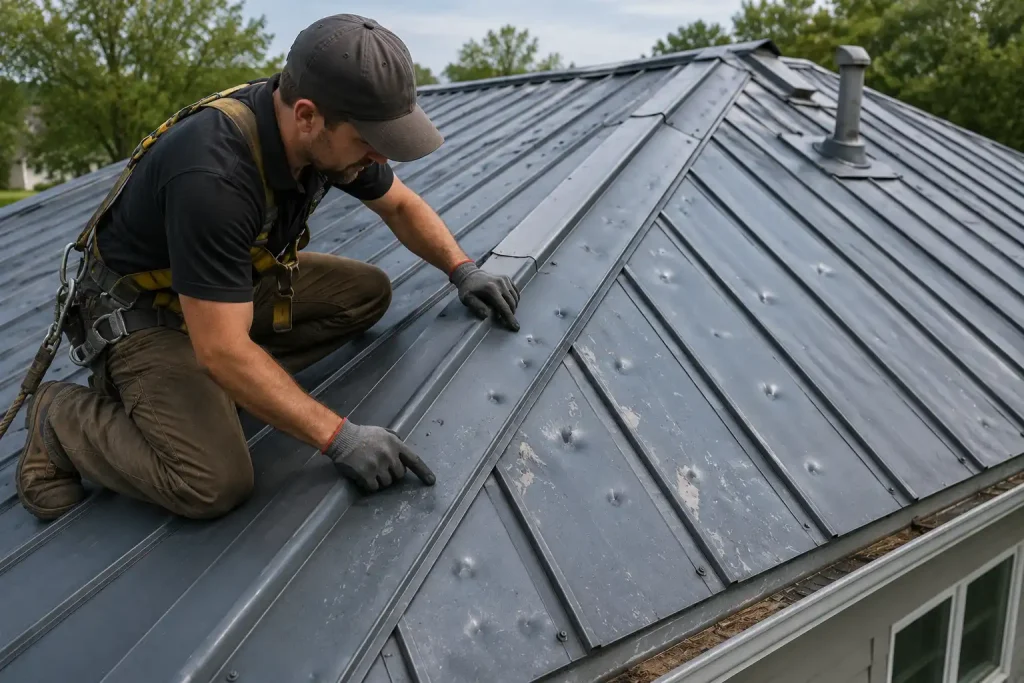
Do not climb onto wet, icy, damaged, or steep metal roofing. Panels can be extremely slippery, and storm damage may weaken certain areas.
OSHA’s residential construction fall-protection guidance explains that workers exposed to falls of six feet or more generally require proper fall-protection systems. A homeowner without roofing training and anchored safety equipment should arrange a professional inspection instead. (OSHA)
2. Photograph the property from the ground
Take clear pictures of:
- Hailstones beside a ruler or coin
- Dented gutters and downspouts
- Damaged siding
- Fallen branches
- Visible roof dents
- Damaged outdoor equipment
Record the storm date and approximate time.
3. Check the attic
Use a flashlight to look for moisture, water trails, damp insulation, darkened decking, or daylight entering through a puncture.
Do not touch exposed wiring or enter an attic with structural damage.
4. Review your insurance policy
Check whether your policy covers:
- Functional hail damage
- Cosmetic metal-roof damage
- Matching undamaged panels
- Full replacement versus actual cash value
- Code-required upgrades
- Emergency temporary repairs
Some policies exclude cosmetic damage to metal roofing. Ask the insurer for a written explanation rather than assuming all dents are covered.
5. Arrange a qualified inspection
Choose a contractor experienced with your specific metal roof system. Standing-seam, exposed-fastener, metal shingle, and stone-coated systems require different inspection and repair methods.
6. Prevent further water entry
When a puncture or opening exists, contact a roofer for temporary weatherproofing. Avoid applying random roof cement, spray foam, or household caulk. Incompatible materials can trap moisture, damage coatings, and complicate permanent repairs.
Expert Tip: Ask the contractor to identify each damaged component as cosmetic or functional in writing. This creates a clearer repair scope and can help prevent unnecessary full-roof replacement recommendations.
Does an Impact-Resistant Metal Roof Cost More?
Impact-rated panels may cost more than thin, unrated products. The final price depends on:
- Metal type
- Panel gauge
- Roof size and complexity
- Coating system
- Deck repairs
- Underlayment
- Flashing
- Fastener system
- Local labor costs
- Product availability
- Tear-off and disposal
A more impact-resistant system may reduce the likelihood of punctures or premature replacement. However, it may still develop visible dents during severe hail.
Repair costs can also be affected by panel matching. Colors fade over time, and older profiles may no longer be manufactured. Replacing one damaged panel may leave a noticeable color difference.
Before installation, ask your insurer whether an impact-rated metal roof qualifies for a premium discount. Requirements and savings vary by state, insurer, product, and policy.
Questions to Ask Before Buying a Metal Roof
Ask each contractor these questions:
- Does the exact roofing product have a UL 2218 rating?
- Is it rated Class 4?
- What metal and gauge will be installed?
- Will the roof be installed over solid decking?
- Is the entire proposed assembly covered by the test documentation?
- What damage is excluded from the manufacturer’s warranty?
- Does the warranty cover coating failure after hail?
- How are damaged panels removed and replaced?
- Will replacement panels remain available?
- Can you provide written product specifications and installation instructions?
Do not accept “hail-resistant” as a complete answer. Request the product name, rating, technical data sheet, warranty, and installation details.
When to Call a Roofing Professional
Arrange a professional inspection when:
- Hail was one inch or larger
- A large branch struck the roof
- You see deep dents or sharp creases
- Seams appear open or distorted
- Fasteners are loose or missing
- The coating is cracked to bare metal
- Flashing or vents are damaged
- Water stains appear indoors
- The attic smells damp
- Your insurer requires documentation
- The roof is steep, wet, high, or difficult to access
Call promptly when active leaking, punctures, structural movement, or electrical hazards are present.
A qualified metal-roofing contractor should examine the panels, seams, fasteners, flashing, deck, underlayment, insulation, and attic. Depending on the findings, the roof may need coating repair, fastener replacement, seam repair, individual panel replacement, or more extensive work.
Common Mistakes Homeowners Should Avoid
- Assuming every dent requires replacement: Many shallow dents are cosmetic rather than functional.
- Ignoring dents near seams: Damage to seams, locks, and flashing can cause leaks even when panel centers remain intact.
- Walking on the roof after hail: Wet or damaged metal roofing presents a serious fall hazard.
- Hiring storm chasers immediately: Verify the contractor’s business address, insurance, references, and metal-roof experience.
- Accepting verbal impact claims: Ask for written UL 2218 documentation for the exact product.
- Using household caulk: General-purpose caulk may not bond properly or tolerate metal movement.
- Pressure-washing damaged panels: High-pressure water can enter weakened seams or remove loose coating.
- Failing to check the attic: Hidden water entry may appear before an interior ceiling stain develops.
- Waiting too long to document damage: Photograph the property and contact the insurer within the required reporting period.
- Confusing impact resistance with impact proofing: Class 4 roofing can still dent or fail under extreme conditions.
FAQs
Are metal roofs impact resistant against hail?
Yes. Most metal roofs resist cracking and puncturing during ordinary hailstorms. However, large or wind-driven hail may create dents, damage coatings, loosen seams, or harm roof accessories.
Can hail damage a Class 4 metal roof?
Yes. Class 4 is the highest UL 2218 impact classification, but it does not make a metal roof indestructible. Severe hail may still cause cosmetic dents or functional damage.
Do dents in a metal roof cause leaks?
Shallow dents in the middle of a panel usually do not cause immediate leaks. Dents near seams, fasteners, flashing, or panel edges are more concerning and should be inspected.
Which metal roofing material resists dents best?
Steel generally offers strong dent resistance, particularly when thicker panels and supportive decking are used. Actual performance also depends on panel profile, metal strength, installation, and impact rating.
Is 24-gauge metal more impact resistant than 29-gauge metal?
A 24-gauge steel panel is generally thicker and may resist denting better than a comparable 29-gauge panel. However, gauge alone does not determine performance. Metal strength, panel shape, decking, and installation also matter.
Will insurance replace a dented metal roof?
It depends on the policy and whether the damage is cosmetic or functional. Some policies exclude cosmetic hail damage to metal roofing. Review your coverage and request a written inspection report.
Should I inspect my own metal roof after a storm?
You can photograph visible damage from the ground and check the attic for moisture. Do not walk on the roof without proper training, equipment, and fall protection. Hire an experienced metal-roofing contractor for the exterior inspection.
Conclusion
So, are metal roofs impact resistant? Yes, metal roofing is one of the more durable options for homes exposed to hail, falling branches, and windblown debris. A properly installed Class 4 system can provide strong protection, especially when supported by solid decking and quality flashing.
Still, impact resistant does not mean damage-proof. Severe storms may cause cosmetic dents, coating damage, loose seams, punctures, or leaks.
Choose a tested product, verify its rating, hire an experienced metal-roofing contractor, and keep all product and installation documents. After a major storm, inspect the home from a safe location and schedule a professional assessment when damage is visible or suspected.