
How Much Does Roof Decking Replacement Cost?

If your roofer removes old shingles and discovers soft, rotted, or damaged wood underneath, your roof replacement can suddenly become more expensive. That underlying material is called roof decking, or roof sheathing, and it provides the structural surface that supports your roofing system.
So, how much does roof decking replacement cost? In 2026, homeowners can generally expect to pay about $2 to $6 per square foot installed for replacement decking. The final bill depends heavily on how much decking must be replaced, the material used, roof accessibility, labor rates, and whether deeper structural damage is discovered.
Below, we’ll break down typical costs, explain what affects the price, show how contractors calculate decking replacement, and help you determine when replacement is actually necessary.
Quick Answer
Roof decking replacement typically costs about $2 to $6 per square foot installed. Replacing a few damaged sheets may add several hundred dollars to a roofing project, while replacing most or all of the decking on a large roof can cost several thousand dollars. Roof size, material, pitch, labor, and hidden water damage all affect the final price.
What Is Roof Decking?
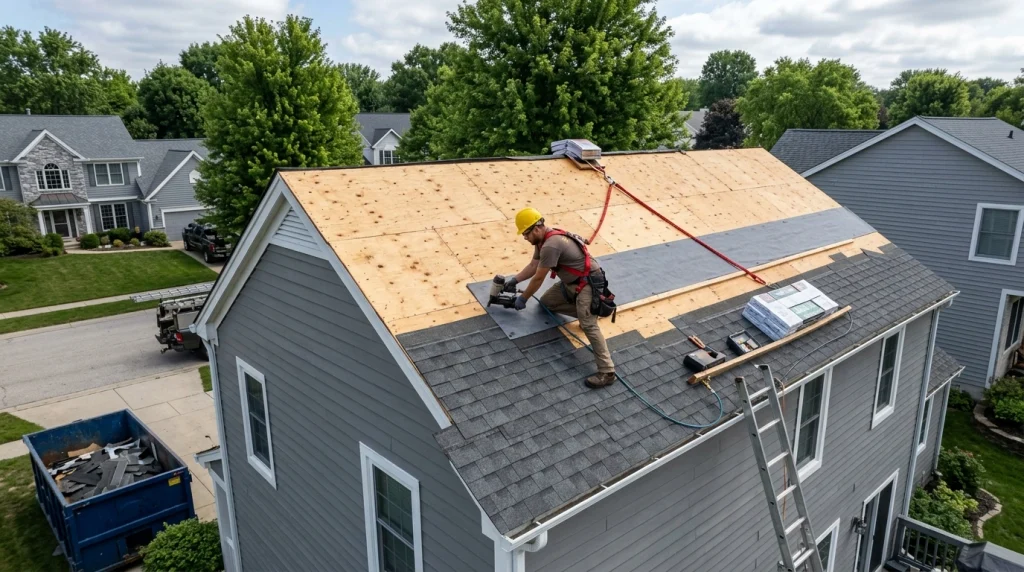
Roof decking is the solid layer attached directly to your home’s rafters or roof trusses. It creates the surface on which underlayment, shingles, metal panels, or another roofing material is installed.
You may also hear contractors call it:
- Roof sheathing
- Plywood decking
- OSB decking
- Roof sheathing panels
Modern homes commonly use plywood or oriented strand board (OSB).
The decking does more than hold shingles. It helps transfer loads across the roof structure and provides a stable surface for the roofing system.
The APA roof sheathing guidance illustrates how rated structural panels are installed over rafters or trusses, including proper panel spacing and support.
Decking that has become severely rotted, weakened, delaminated, or structurally unsound should generally be replaced before new roofing materials are installed.
Average Roof Decking Replacement Cost
Current national cost estimates vary somewhat between sources. HomeGuide reports roughly $2 to $5 per square foot installed, while Angi’s 2026 estimate places many roof sheathing projects around $2 to $6 per square foot.
A practical planning range is therefore:
| Amount of Decking Replaced | Approximate Cost at $2–$6/Sq. Ft. |
|---|---|
| 100 sq. ft. | $200–$600 |
| 250 sq. ft. | $500–$1,500 |
| 500 sq. ft. | $1,000–$3,000 |
| 1,000 sq. ft. | $2,000–$6,000 |
| 1,500 sq. ft. | $3,000–$9,000 |
| 2,000 sq. ft. | $4,000–$12,000 |
These figures should be treated as budgeting estimates rather than contractor quotes.
Your price may be higher in expensive labor markets, on steep or difficult roofs, or when structural repairs are required.
Partial Decking Replacement
Fortunately, discovering one damaged area does not automatically mean every sheet of decking must be replaced.
A roofer may find damage around:
- Chimneys
- Skylights
- Plumbing vents
- Roof valleys
- Eaves
- Previously leaking areas
- Failed flashing
If the surrounding decking is dry and structurally sound, the contractor may replace only the affected sheets.
For example, replacing several sheets damaged by a long-term flashing leak might add hundreds of dollars rather than thousands to a roof replacement.
Full Roof Decking Replacement
A complete redeck becomes much more expensive because hundreds or thousands of square feet of material may be involved.
Full replacement may be considered when:
- Widespread moisture damage exists.
- Large sections are rotten or soft.
- Existing boards cannot adequately hold roofing fasteners.
- An older spaced-board roof requires structural panels for the new roofing system.
- The existing decking does not meet applicable project requirements.
- Severe storm or structural damage has compromised much of the roof.
The National Roofing Contractors Association notes in its roof replacement guidance that roof decks should be adequately dry, clean, smooth, and prepared before a replacement roofing system is installed.
What Determines Roof Decking Replacement Cost?
The amount of damaged wood is the biggest factor, but several other conditions can significantly change your quote.
1. Amount of Decking That Needs Replacement
Replacing three plywood sheets costs far less than redecking an entire 2,000-square-foot roof.
The challenge is that contractors often cannot see all decking damage until the old roofing materials and underlayment have been removed.
That is why roofing contracts sometimes include a separate decking price.
For example, a contract might specify:
- A certain number of sheets included
- A price for each additional sheet
- A square-foot price for unexpected decking replacement
Ask about this charge before signing the roofing contract.
It can prevent an unpleasant surprise once tear-off begins.
2. Plywood vs. OSB
Plywood and OSB are the two most common modern roof sheathing products.
OSB is made from compressed wood strands bonded into structural panels. Plywood is made from thin layers of wood veneer laminated together.
Material prices vary by thickness, grade, local availability, and market conditions.
HomeGuide’s current estimates place roof decking materials themselves roughly between $0.30 and $2.60 per square foot, before installation labor.
Your contractor should choose decking that is appropriate for your roof design, local requirements, fasteners, and roofing material rather than simply choosing the cheapest panel available.
3. Roof Pitch
Roof pitch describes how steep the roof is.
A steep roof requires more precautions, slower movement, and often additional safety equipment. That means labor can be more expensive than on a simple, low-slope roof.
Roof complexity matters too.
Dormers, valleys, chimneys, multiple roof levels, skylights, and unusual roof shapes can increase labor time.
4. Roof Height and Accessibility
A single-story ranch with straightforward access is typically easier to work on than a tall two- or three-story home.
Limited driveway access, landscaping, neighboring buildings, power lines, or other site conditions can also make material handling and debris removal more difficult.
5. Labor Costs
Labor rates vary significantly across the United States.
Replacing decking involves more than laying down a new panel. Workers may need to:
- Remove damaged material.
- Inspect rafters or trusses.
- Cut replacement sheets accurately.
- Fit panels around penetrations.
- Fasten the new decking correctly.
- Prepare the surface for underlayment.
If structural framing is damaged underneath the decking, the job becomes more complicated.
6. Hidden Water or Structural Damage
Removing rotten decking can expose damaged rafters, trusses, insulation, fascia, or other components.
That can turn a relatively simple decking repair into a structural roof repair.
Sagging or seriously weakened framing should be evaluated professionally.
Decking alone cannot correct a failing rafter or truss.
How Many Sheets of Roof Decking Will You Need?
Standard plywood and OSB panels are commonly sold in 4-by-8-foot sheets.
One sheet covers approximately:
4 × 8 = 32 square feet
In theory, 320 square feet would require about 10 sheets.
Real projects may require additional material because of:
- Panel cuts
- Valleys
- Roof edges
- Waste
- Irregular roof shapes
- Damaged areas extending beyond initial estimates
Remember that your home’s floor area and roof area are not necessarily the same.
A 2,000-square-foot house can have substantially more than 2,000 square feet of roofing surface because of roof pitch, overhangs, garages, porches, and different roof sections.
Signs Your Roof Decking May Need Replacement

You cannot always diagnose decking problems from the ground. However, several warning signs justify a professional inspection.
Watch for:
- Sagging sections of the roof
- Recurring roof leaks
- Soft or spongy wood
- Water stains in the attic
- Visible rot
- Delaminating plywood
- Mold or persistent moisture
- Daylight entering through damaged areas
- Roofing fasteners that no longer hold properly
A leak does not automatically mean the decking needs replacement.
If a leak is repaired quickly, the decking may still be structurally sound.
However, moisture that remains trapped for months or years can cause serious deterioration.
What Causes Roof Decking to Rot?
The main cause is prolonged moisture exposure.
That moisture may come from:
- Missing or damaged shingles
- Failed flashing
- Wind or hail damage
- Plumbing-vent leaks
- Ice dams
- Poor attic ventilation
- Condensation
- Clogged drainage
- Long-standing roof leaks
Fixing the damaged decking without fixing the moisture source simply sets the roof up for another failure.
Can New Roofing Be Installed Over Damaged Decking?
New roofing should have a sound, stable substrate.
Installing shingles over severely deteriorated decking can create multiple problems. Fasteners may not hold correctly, the roof surface may become uneven, and weak decking can continue deteriorating beneath the new roof.
A contractor should inspect the deck after the existing roofing materials are removed.
Minor cosmetic staining does not necessarily mean the panel must be replaced. Structural condition matters more than appearance alone.
Is Roof Decking Included in a Roof Replacement Quote?
Not always.
Many roof replacement proposals include removing the old roof, installing underlayment, flashing, shingles, and related components but treat unexpected decking replacement separately.
That is understandable because a contractor often cannot determine the exact amount of damaged decking until the roof is opened.
Before accepting an estimate, ask:
- How much decking replacement is included?
- What is the cost per additional sheet?
- Is labor included in that price?
- What type and thickness of panel will be installed?
- Will I be contacted before substantial additional decking is replaced?
Written answers make comparing contractor quotes much easier.
Does Homeowners Insurance Pay for Roof Decking?
It depends on why the decking was damaged and what your policy covers.
Decking damaged suddenly during a covered event may be treated differently from decking that deteriorated gradually because of age, deferred maintenance, or a long-term leak.
Do not assume insurance will automatically pay for every sheet discovered during tear-off.
If storm damage may be involved, document the condition carefully and review your policy and insurer’s requirements before authorizing major work.
For a significant claim, keep:
- Photographs
- Inspection reports
- Contractor estimates
- Receipts
- Written descriptions of damage
If structural damage is discovered after tear-off, ask the contractor to document it before covering the area.
Roof Decking, Underlayment, and Shingles Are Different
Homeowners sometimes confuse these layers.
Think of the system from bottom to top:
Roof framing → decking → underlayment → roofing material
The framing consists primarily of structural components such as rafters or trusses.
Decking sits on that framing.
Underlayment creates an additional protective layer over the deck.
Shingles, metal, tile, or another roof covering form the exterior weather surface.
Damage to one layer does not automatically mean every layer needs structural replacement, although roof replacement often exposes problems that were previously hidden.
Expert Tip
Expert Tip: Before signing a roof replacement contract, ask for the decking replacement price in writing. A clearly stated per-sheet or per-square-foot charge makes it much easier to understand change orders if hidden rot is discovered during tear-off.
Can You Replace Roof Decking Yourself?
For most homeowners, extensive roof decking replacement is not a good DIY project.
Removing sheathing can expose open rafters or trusses, creating serious fall hazards. Incorrect panel thickness, fastening, spacing, or structural repairs can also affect the performance of the new roofing system.
Roof work itself carries substantial fall risk. OSHA’s residential construction fall-protection guidance emphasizes fall-protection measures during roof sheathing and roofing activities.
Even experienced workers use specialized fall-protection systems and procedures.
Do not walk onto a wet, icy, badly damaged, or visibly sagging roof to inspect the decking yourself.
An attic inspection from a safe location can sometimes reveal staining or deterioration, but it does not replace a professional roof evaluation.
When to Consult a Licensed Roofing Contractor
Contact a qualified roofing contractor when you notice:
- Sagging roof sections
- Persistent leaks
- Widespread attic moisture
- Storm damage
- Soft or deteriorated decking
- An aging roof nearing replacement
- Multiple failed roofing areas
You should also seek professional help if a contractor discovers damaged rafters or trusses.
Significant structural deterioration may require evaluation beyond ordinary roof-deck replacement.
When comparing roofing contractors, request written estimates that clearly identify:
- Roofing material
- Decking material and thickness
- Decking replacement allowance
- Labor
- Tear-off and disposal
- Underlayment
- Flashing
- Ventilation work
- Permits where applicable
- Warranty terms
- Change-order procedures
Getting more than one detailed quote can make cost differences easier to understand.
Common Mistakes Homeowners Should Avoid
Avoid these common problems when dealing with damaged roof decking:
- Choosing a contractor based only on the lowest quote. A cheap estimate may exclude necessary decking work.
- Ignoring the decking price in the contract. Find out what additional sheets will cost before tear-off.
- Assuming stained wood is automatically rotten. Decking should be evaluated for structural condition.
- Covering severe deterioration with new roofing. A new roof needs a sound substrate.
- Ignoring the source of moisture. Replace damaged wood and correct the leak, ventilation, or drainage problem that caused it.
- Walking across questionable decking yourself. Rotten sheathing may not safely support your weight.
- Assuming insurance will cover the repair. Coverage depends on your policy and cause of loss.
- Ignoring damaged framing. New plywood cannot compensate for structurally compromised rafters or trusses.
FAQs
How much does roof decking replacement cost per square foot?
Roof decking replacement generally costs around $2 to $6 per square foot installed, although local labor rates, decking material, roof complexity, and the extent of damage can move the price outside that range.
How much does it cost to replace one sheet of roof decking?
The exact price varies because a contractor’s charge includes material, labor, removal, cutting, fastening, and project overhead. Ask your roofer for the installed price per replacement sheet before the project starts.
Does all roof decking need to be replaced during a roof replacement?
No. Sound decking can often remain in place. Contractors typically replace sections that are rotten, structurally weak, badly damaged, or unsuitable for the new roofing system.
Is plywood better than OSB for roof decking?
Both plywood and properly rated OSB can be used as structural roof sheathing when suitable for the specific application. Cost, availability, roof design, local requirements, and contractor specifications can influence which material is selected.
Can roof decking be replaced without replacing the entire roof?
Localized decking repairs may sometimes be performed during roof repair work, but accessing the deck requires removing the roofing materials above the affected area. The appropriate approach depends on the location and extent of damage.
How do roofers know when decking needs replacement?
Roofers usually inspect exposed decking during tear-off. They look for rot, softness, delamination, severe water damage, inadequate fastener holding, structural deterioration, and other conditions that could prevent the new roofing system from being installed properly.
Does rotten roof decking mean the rafters are damaged?
Not necessarily. Decking can deteriorate before the framing underneath it does. However, long-term water intrusion can damage rafters and trusses too, which is why severely deteriorated areas deserve closer inspection.
Conclusion
So, how much does roof decking replacement cost? A reasonable 2026 planning range is roughly $2 to $6 per square foot installed, but the amount of decking that actually needs replacement will usually have the biggest impact on your total bill.
A few damaged panels may be a manageable addition to a roof replacement. Widespread rot, difficult access, steep slopes, or damaged framing can increase costs substantially.
The most important step is to avoid treating decking as an unexpected blank check. Ask your roofer how decking replacement will be priced before work starts, get that rate in writing, and request documentation if extensive damage is uncovered.
A sound roof begins with a sound deck. Taking care of deteriorated sheathing now can give your new roofing system the solid foundation it needs.