
How Many Times Can a Roof Be Repaired Before Replacement?

A roof can develop more than one problem during its life. A few missing shingles, damaged flashing, a leaking pipe boot, or minor storm damage may all be repairable without replacing the entire roofing system.
But how many times can a roof be repaired before replacement becomes the better choice?
There is no universal number. Some roofs can handle several successful repairs over many years, while another roof may need replacement after only one or two major problems. The decision depends on the roof’s age, material, location of the damage, condition of the decking, repair history, warranty, and how much useful life remains.
This guide explains how to tell when another repair makes sense and when repeated repairs may simply delay an unavoidable roof replacement.
Quick Answer
There is no fixed limit to how many times a roof can be repaired. A healthy roof may receive several localized repairs during its life. Replacement becomes more reasonable when leaks keep returning, damage is widespread, the roof is near the end of its expected lifespan, decking is deteriorating, or repair costs continue increasing.
Is There a Maximum Number of Roof Repairs?
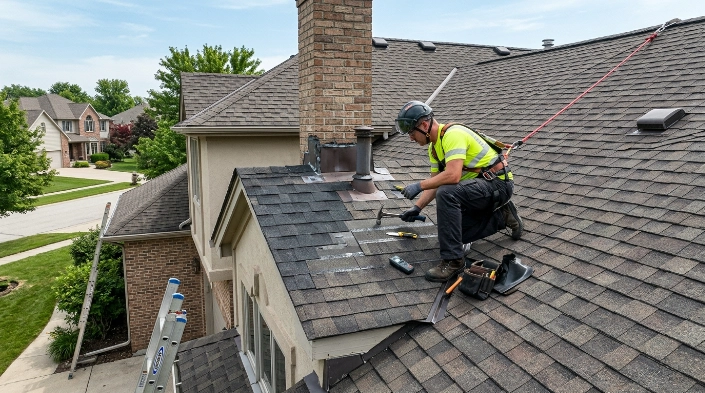
No building rule says that a roof can only be repaired two, three, or five times.
The quality and reason for each repair matter more than the number of repairs.
Imagine two homeowners.
The first has a 10-year-old asphalt-shingle roof. Over several years, a roofer replaces a damaged pipe boot, fixes flashing near a chimney, and replaces several shingles damaged by wind.
Those three repairs do not necessarily mean the roof is failing.
The second homeowner has an older roof that has developed leaks in four unrelated areas within two years. Each patch stops one leak, but another appears somewhere else.
That pattern is more concerning because the roofing system itself may be deteriorating.
Repeated repairs are therefore best viewed as a pattern, not simply a number.
When Multiple Roof Repairs Can Still Make Sense
Another repair may be reasonable when the problem is isolated and the rest of the roof remains in good condition.
The Damage Is Localized
A damaged flashing detail does not mean every shingle needs replacement.
Localized problems may include:
- A few missing or cracked shingles
- A damaged roof vent
- Failed flashing around a chimney
- A worn plumbing vent boot
- A small puncture
- A limited area of wind damage
- An isolated metal-roof seam or fastener problem
- Small sections of damaged membrane on a low-slope roof
If the surrounding roof remains sound, correcting that specific defect may restore reliable protection.
The Roof Still Has Substantial Life Remaining
Roof age matters because replacing a relatively young roof can waste years of potential service life.
Typical planning ranges vary considerably by product, climate, installation quality, maintenance, and exposure, but homeowners commonly see:
| Roofing Material | General Service-Life Context | Repair Considerations |
|---|---|---|
| Asphalt shingles | Often around 20–30 years | Local repairs may make sense while surrounding shingles remain flexible and secure |
| Metal roofing | Often 40–70 years or more | Fasteners, seams, flashing, coatings, and isolated panels may be repairable |
| Wood shake | Often around 20–40 years | Splits, rot, moss, and moisture exposure matter |
| Tile | Frequently 50 years or longer | Individual tiles can often be replaced, but underlayment condition is important |
| EPDM/TPO and similar membranes | Often around 20–30 years | Seams, penetrations, punctures, and membrane condition affect repairability |
These are rough planning ranges, not warranties or guarantees. Local conditions can shorten or extend roof life considerably.
Previous Repairs Solved Different Problems
Three repairs over fifteen years are very different from three leak repairs within six months.
A roof may experience unrelated problems caused by storms, falling branches, flashing deterioration, or work performed by another trade.
What matters is whether previous repairs were successful and whether the surrounding roof remains healthy.
When Repeated Repairs Become a Warning Sign
Roof replacement deserves more serious consideration when repairs stop being isolated events and begin forming a pattern.
Leaks Keep Appearing in Different Areas
One leak can result from a single defect.
Multiple unrelated leaks may indicate broader deterioration involving shingles, seams, flashing, underlayment, or installation details.
The National Roofing Contractors Association notes in its guidance on investigating roof leaks that successful leak diagnosis requires identifying the actual water-entry path rather than simply treating the visible symptom.
That distinction is important.
Water can travel along rafters, decking, insulation, fasteners, or roofing components before appearing inside the house. A ceiling stain does not always sit directly beneath the roof opening.
Repairs Keep Failing
A repair that repeatedly fails may mean:
- The original leak source was misdiagnosed.
- Water is entering from more than one location.
- Roofing materials around the repair are deteriorated.
- Flashing details were improperly installed.
- The underlayment has failed.
- The roof deck has moisture damage.
- The roofing system has reached a stage where patching individual defects is no longer dependable.
Do not automatically assume the last roofer performed poor work. The roof may simply have several aging components failing at approximately the same time.
Repair Areas Are Getting Larger
Replacing five damaged shingles is one thing.
Removing a large section of roofing, underlayment, flashing, and decking is different.
As the repair area grows, labor and material costs increase. Eventually, homeowners can reach a point where a major partial repair offers poor value compared with replacing a much larger portion—or all—of the roof.
Roof Age Changes the Repair-or-Replace Decision
Age alone should not determine whether a roof needs replacement.
However, it changes the economics.
Suppose a roof is relatively young and has one damaged flashing detail. Repairing it could protect many remaining years of service.
Now suppose the same repair is needed on a roof already approaching the end of its expected service life. Spending heavily on the repair may only postpone replacement for a short period.
Consider these questions:
- How old is the roofing material?
- How long does this particular product normally last?
- Have previous repairs been necessary?
- Are shingles brittle, curled, cracked, or missing?
- Are metal panels significantly corroded?
- Is the membrane cracking or separating?
- Does the contractor see deterioration across the roof or only in one area?
Condition should always be considered together with age.
Roof Decking Can Determine Whether Repair Is Still Practical
Roof decking is the wood or structural panel surface below the roofing material.
It provides the base to which much of the roofing system is attached.
A small leak that is discovered quickly may leave the decking intact. A leak that has gone unnoticed for months or years can cause the decking to soften, rot, swell, or lose its ability to hold fasteners properly.
Warning signs can include:
- Sagging sections of roof
- Soft or deteriorated decking
- Dark moisture staining in the attic
- Wet insulation
- Repeated ceiling stains
- Mold or mildew associated with moisture
- Visible wood decay
The U.S. Department of Energy’s guidance on durable attics and moisture control explains that roof leaks, faulty flashing, and poor moisture management can contribute to wet insulation, mold, warped materials, and wood deterioration.
Sagging, extensive rot, or suspected structural damage should be professionally assessed rather than treated as a simple patching project.
Storm Damage Can Change the Situation Quickly
A roof that was repairable yesterday may need a different plan after severe wind or hail.
Storm damage may affect:
- Shingles
- Tile
- Metal panels
- Flashing
- Ridge materials
- Gutters
- Underlayment
- Roof decking
- Roof-mounted vents and equipment
Hail damage is particularly difficult for an untrained homeowner to evaluate.
Research from the Insurance Institute for Business & Home Safety shows that severe hail impacts can tear or breach asphalt shingles and affect their ability to shed water. IBHS research on hail and roof-cover damage
After significant storms, document visible damage from a safe location and consider arranging a professional inspection before approving permanent repairs.
Cost: When Does Another Repair Stop Making Financial Sense?
There is no universal percentage at which repair automatically becomes a bad investment.
Instead, compare repair cost with remaining roof life.
Another repair is easier to justify when:
- The roof has considerable service life remaining.
- Damage is limited.
- The underlying structure is sound.
- Previous repairs have held successfully.
- The repair addresses a clearly identified cause.
- The rest of the roof is performing normally.
Replacement deserves closer consideration when:
- Large areas need repair.
- Additional failures are likely soon.
- Significant decking must be replaced.
- Labor-intensive removal is required.
- Multiple repairs have already been completed.
- The roofing material is heavily aged.
- A major repair provides only a short expected extension of roof life.
Do not compare only today’s lowest repair quote with today’s replacement quote.
Ask what you are likely to spend over the next several years.
Paying repeatedly for emergency service, interior water damage, temporary patches, and increasingly large repairs can sometimes cost more than addressing a failing roofing system comprehensively.
Material Type Matters
Different roofing materials fail differently.
Asphalt Shingles
Asphalt shingles are commonly repaired when damage involves a limited number of shingles, flashing details, vents, or other localized components.
Replacement becomes more likely when shingles throughout the roof are brittle, cracked, curling, losing adhesion, or failing in multiple areas.
Metal Roofs
Many metal-roof problems can be repaired.
A contractor may correct failed fasteners, washers, sealant, flashing, penetrations, seams, or isolated damaged panels.
Widespread corrosion, systemic seam problems, failing coatings, extensive installation defects, or deteriorated underlayment can make repeated spot repairs less attractive.
Tile Roofs
Individual broken tiles can often be replaced.
However, the visible tile is only part of the system. Aging underlayment or widespread flashing problems may require substantially more work even when many tiles still look good.
Flat and Low-Slope Roofs
EPDM, TPO, and similar systems may develop problems around seams, penetrations, drains, flashing, or punctures.
One repair can be straightforward. Widespread membrane deterioration, repeated seam failures, trapped moisture, or saturated insulation can shift the decision toward larger restoration or replacement.
Ventilation Problems Can Make Roof Damage Return
Sometimes repairing the exterior symptom does not correct the condition contributing to deterioration.
Poor attic ventilation and uncontrolled moisture can contribute to:
- Condensation
- Damp insulation
- Mold
- Wood deterioration
- Ice-dam problems in cold climates
- Excess heat buildup
If roof repairs are repeatedly needed near moisture-damaged areas, ask the contractor to evaluate more than the surface roofing.
The problem may involve ventilation, insulation, air leakage, drainage, or attic moisture management.
Warranty Coverage Should Be Checked Before Repairs
Before authorizing major roofing work, locate any available:
- Manufacturer warranty
- Contractor workmanship warranty
- Installation records
- Previous repair invoices
- Insurance documentation
Some warranties contain specific requirements about who can perform repairs and which materials or installation methods must be used.
An unauthorized repair does not automatically void every roofing warranty, but you should understand the terms before allowing major alterations.
Ask the contractor whether the proposed repair affects existing coverage and request that important warranty-related statements be provided in writing.
Expert Tip
Expert Tip: Keep a simple roof history file containing installation records, photos, contractor invoices, storm dates, warranty paperwork, and every repair location. A pattern of repairs on a roof diagram can reveal whether you are dealing with isolated defects or widespread deterioration.
Repair or Replace? A Practical Decision Table

| Situation | Another Repair May Make Sense | Replacement Deserves Consideration |
|---|---|---|
| One isolated leak | Yes | Usually not |
| A few storm-damaged shingles | Often | If damage is widespread |
| Young roof, otherwise healthy | Usually | Rarely |
| Several unrelated leaks | Sometimes | Often |
| Repeated failed patches | Less attractive | Often |
| Significant decking rot | Limited | Often |
| Roof near expected end of life | Possibly as a short-term measure | Often |
| Widespread material deterioration | Rarely | Often |
| One flashing failure | Usually | Usually not |
| Major system-wide installation defects | Rarely | Often |
A contractor should still inspect the roof before making a final decision. The table is a decision aid, not a roof diagnosis.
When to Consult a Licensed Roofing Contractor
Call a qualified roofing professional when:
- Leaks keep returning.
- Several areas are damaged.
- A storm has affected the roof.
- Decking appears soft or deteriorated.
- The roof is sagging.
- Water is entering near electrical equipment.
- You cannot safely identify the leak source.
- The roof has a steep pitch.
- Repairs may affect a warranty or insurance claim.
- You are deciding between a major repair and replacement.
Where roofing contractors must be licensed in your state or locality, verify the appropriate license and insurance before work begins.
Ask for a written inspection report or estimate describing:
- The cause of the problem.
- The damaged area.
- The proposed repair.
- The condition of nearby roofing.
- Any damaged decking or underlayment.
- Expected remaining roof life.
- Warranty coverage for the work.
Comparing two or three detailed proposals can be useful when a project is expensive or when contractors disagree about whether replacement is necessary.
Roof Inspection and DIY Safety
Homeowners can often inspect gutters, ceilings, attic areas, and portions of the roof from the ground.
Climbing onto the roof is different.
Wet roofing, steep slopes, loose shingles, damaged decking, ice, metal panels, and storm debris can create serious fall hazards.
The National Roofing Contractors Association recommends that property owners assess storm damage from ground level and leave closer inspection and repairs to roofing professionals. NRCA storm roof repair guidance
Do not climb onto a wet, icy, visibly damaged, or structurally questionable roof simply to decide whether it can be repaired again.
Common Mistakes Homeowners Should Avoid
- Counting repairs instead of evaluating condition. Five small repairs over 20 years may be less concerning than three new leaks in one season.
- Patching the visible symptom without finding the water source. Water can travel before appearing indoors.
- Ignoring roof age. A repair that makes sense on a younger roof may offer poor value near the end of its service life.
- Using sealant as a universal solution. Roof cement and caulk cannot permanently correct every flashing, underlayment, decking, or installation problem.
- Ignoring attic moisture. Some apparent roofing problems involve condensation or ventilation issues.
- Automatically choosing the cheapest estimate. Compare scope, materials, warranty, diagnosis, and expected service life.
- Walking on a damaged roof after a storm. Hidden decking damage can make apparently solid areas unsafe.
- Failing to document repairs. Good records make future repair-versus-replacement decisions much easier.
FAQs
How many times can a roof be repaired?
There is no set maximum. A roof can receive several repairs if each problem is localized and the rest of the roofing system remains healthy. Frequent leaks, widespread deterioration, or repeated failed repairs may indicate replacement is becoming more practical.
Is it worth repairing an old roof?
Sometimes. A small repair may be worthwhile if it is inexpensive and the roof remains generally sound. Major repairs are harder to justify when the roof is already near the end of its expected service life.
How many leaks mean I need a new roof?
There is no specific number. One severe leak caused by widespread deterioration may be more serious than several small, unrelated leaks repaired over many years. The cause, location, roof age, and underlying damage matter more than leak count.
Can you keep patching a roof indefinitely?
Usually not. Patching can solve isolated defects, but it cannot reverse widespread aging, rotted decking, failing underlayment, extensive corrosion, or system-wide installation problems.
Does repairing a roof extend its lifespan?
A proper repair can preserve the useful life of an otherwise healthy roofing system by stopping localized damage from spreading. It does not reset the age of the entire roof or make surrounding old materials new again.
Should I repair or replace a roof after storm damage?
It depends on the extent of damage. A small affected area may be repairable, while widespread wind, hail, decking, or water damage may justify replacement. Document damage and obtain a professional inspection before making major decisions.
Conclusion
So, how many times can a roof be repaired? There is no magic number.
A sound roof may be repaired several times during its lifespan without needing replacement. What matters is whether each repair corrects a localized problem and whether the surrounding roofing, flashing, underlayment, and decking remain in good condition.
Replacement becomes increasingly reasonable when leaks return frequently, repairs involve larger areas, roofing materials are broadly deteriorated, the deck is damaged, the roof is near the end of its expected service life, or repair bills keep accumulating.
Instead of asking only, “How many repairs has this roof had?” ask a better question:
“Will this repair give me reliable service for enough years to justify its cost?”
If the answer is unclear, arrange a professional roof inspection, request a written repair-versus-replacement assessment, review your warranty, and compare the long-term cost of both options before committing your money.