
Can a Roof Be Repaired Instead of Replaced? A Homeowner’s Guide

A roof problem can create an expensive question almost immediately: can a roof be repaired instead of replaced, or is a full replacement unavoidable?
The good news is that many roof problems can be repaired. A small leak, several missing shingles, damaged flashing, a puncture, or localized storm damage does not automatically mean the entire roof must come off.
However, repair is not always the smartest long-term choice. If damage is widespread, leaks keep returning, the roof is near the end of its useful life, or the decking underneath is deteriorated, replacement may provide better protection and value.
The right decision depends on the roof’s age, material, damage location, underlying structure, repair history, warranty, ventilation, and expected remaining service life. This guide explains how homeowners can evaluate those factors without assuming that every roof problem requires the most expensive solution.
Quick Answer
Yes, a roof can often be repaired instead of replaced when damage is localized, the remaining roofing material is in good condition, and the roof still has substantial useful life. Replacement becomes more appropriate when deterioration is widespread, leaks repeatedly return, structural components are damaged, or continued repairs are unlikely to provide reliable protection.
When Can a Roof Be Repaired Instead of Replaced?
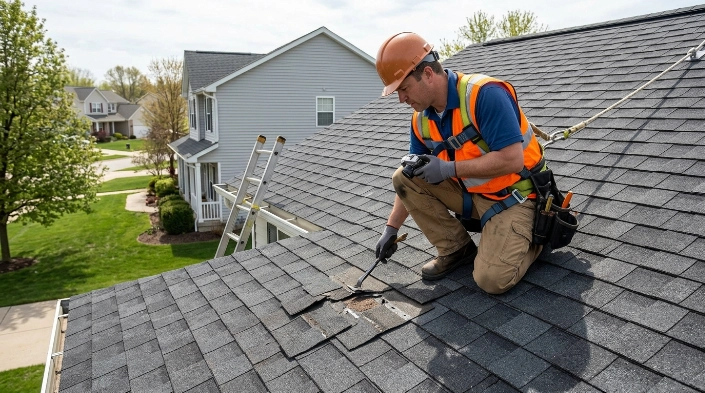
Roof repair usually makes sense when the contractor can identify a specific problem and correct it without disturbing large portions of an otherwise healthy roofing system.
The important word is localized.
A repair addresses a limited defect. Replacement becomes more likely when the defect is part of a larger pattern of deterioration.
A Few Missing or Damaged Shingles
Strong wind can lift or remove individual asphalt shingles while leaving most of the roof intact.
If only several shingles are affected and the surrounding shingles remain flexible, securely attached, and free from widespread deterioration, replacing the damaged shingles may be enough.
The contractor should still inspect beneath the affected area for damaged underlayment or decking.
Localized Flashing Problems
Flashing is the metal or waterproof material installed around chimneys, walls, valleys, skylights, vents, and other roof transitions.
When flashing loosens, corrodes, or was installed incorrectly, water may enter even though the main roofing material remains healthy.
Repairing or replacing localized flashing can often stop the leak without replacing the entire roof.
One Identifiable Roof Leak
A leak does not automatically mean the roof has failed.
Water can enter through:
- Damaged flashing
- A cracked pipe boot
- A loose fastener
- A puncture
- A damaged shingle
- An improperly sealed roof penetration
- A localized membrane seam failure
A roofing contractor should trace the moisture to its actual source before recommending major work. Water can travel along decking or framing before becoming visible on a ceiling, so the stain inside your house may not be directly below the exterior defect.
Limited Storm Damage
Hail, falling branches, and strong wind can damage only one part of a roof.
The Insurance Institute for Business & Home Safety and its RICOWI roofing guidance emphasize evaluating the existing roof’s overall condition, age, weathering, and type of damage rather than automatically assuming storm damage requires total replacement. Its roof-system evaluation and repair guidance specifically notes that proper evaluation may identify opportunities to repair damaged roofing instead of replacing the entire system.
When Is Roof Replacement More Likely to Be Necessary?
Repair becomes less attractive when several parts of the roofing system are failing simultaneously.
A patch may stop today’s leak without solving the larger deterioration that caused it.
Damage Covers a Large Area
If many sections contain cracked, curled, loose, deteriorated, or missing roofing material, replacing individual pieces can become inefficient.
This is particularly important with aging asphalt shingles. When shingles throughout several roof slopes become brittle, repairing one area may simply be followed by another failure elsewhere.
Roof Leaks Keep Returning
One isolated leak can be repairable.
Multiple unrelated leaks are different.
Repeated water intrusion can indicate deterioration involving the roofing surface, flashing, underlayment, penetrations, or decking.
Keep records of every repair. If contractors are returning repeatedly to different parts of the roof, ask for an assessment of the entire roofing system rather than another isolated patch.
Decking Is Extensively Damaged
Roof decking is the wood structural surface, commonly plywood or oriented strand board, attached to the roof framing beneath the roofing material.
Long-term moisture exposure can cause decking to:
- Rot
- Swell
- Delaminate
- Become soft
- Lose its ability to hold fasteners
- Sag between framing members
A small damaged decking section may sometimes be replaced during a localized repair.
Extensive deterioration is much more serious. Large areas may need to be exposed so damaged decking can be removed and the underlying structure inspected.
A visibly sagging roof should receive prompt professional evaluation.
Repairs Have Become Frequent
A roof can become expensive without ever receiving one enormous repair bill.
Imagine paying for a leak repair this year, replacing damaged shingles next year, fixing flashing after that, and then discovering another leak.
Individually, each repair may appear reasonable. Collectively, they may represent a roofing system that is approaching the end of reliable service.
Compare the total expected repair cost over the next several years with the cost and expected longevity of replacement.
Roof Repair vs. Replacement Decision Table

| Roof Condition | Repair May Make Sense | Replacement May Make More Sense |
|---|---|---|
| One small leak | Yes, if the cause is isolated | If leaks occur in several areas |
| A few missing shingles | Usually | If widespread shingle loss exists |
| Local flashing failure | Often | If flashing and roofing are deteriorated throughout |
| Small storm-damaged area | Often | If several roof slopes are damaged |
| Young roof | Usually | If major structural or installation problems exist |
| Aging roof | Sometimes | If deterioration is widespread |
| Local decking damage | Possibly | If decking damage is extensive |
| Repeated previous repairs | Less attractive | Increasingly likely |
| Sagging roof section | Requires professional assessment | Often considered if structural damage is widespread |
| Widespread material failure | Rarely | Usually |
This table is a starting point, not a roof diagnosis. Some serious problems cannot be evaluated accurately from the ground or from an attic alone.
How Roof Age Affects the Decision
Age matters, but roof age alone should not determine whether you repair or replace it.
Typical planning ranges vary significantly:
| Roofing Material | Approximate Planning Range |
|---|---|
| Asphalt shingles | 15–30 years |
| Wood shake | 20–40 years |
| EPDM or similar flat-roof membrane | 20–30 years |
| TPO membrane | About 20–30 years |
| Metal roofing | 40–70+ years |
| Tile roofing | 50+ years |
These are broad estimates, not guarantees.
Installation quality, climate, ventilation, maintenance, storm exposure, material grade, roof pitch, tree coverage, and manufacturer specifications can shorten or extend actual performance.
For example, repairing wind damage on a relatively young asphalt roof can make excellent financial sense. Spending heavily on widespread repairs to an aging roof that already has recurring problems may provide much less value.
How Roofing Material Changes What Can Be Repaired
Different materials fail differently.
Asphalt Shingles
Asphalt roofs are often repairable when damage involves a limited number of shingles, a pipe boot, flashing, or another isolated component.
Repair becomes harder when the roof has widespread cracking, curling, brittleness, heavy granule loss, or repeated wind damage.
Color matching can also become difficult as shingles age.
Metal Roofing
Metal roofs can often be repaired by correcting isolated fastener, flashing, seam, coating, or panel damage.
Replacement may become necessary when corrosion is widespread, attachment systems are failing throughout the roof, or major installation defects affect the entire system.
Tile Roofing
Individual cracked clay or concrete tiles can often be replaced.
However, the visible tile is only one part of the system. Problems with old underlayment beneath otherwise reusable tiles can require much more extensive work.
Flat, EPDM, and TPO Roofing
Small membrane punctures and certain localized seam failures may be repairable.
Replacement becomes more likely if the membrane has become brittle, deteriorated across large areas, separated extensively, or developed recurring leaks in several locations.
Wood Shake Roofing
Individual damaged shakes can sometimes be replaced.
Widespread splitting, rot, biological deterioration, moisture damage, or failure across multiple areas may indicate that continued spot repair will not restore dependable protection.
Consider the Cause, Not Just the Visible Damage
Two roofs can have the same ceiling stain and require completely different solutions.
A contractor should determine why the failure happened.
Possible underlying causes include:
- Poor original installation
- Inadequate flashing
- Storm damage
- Aging materials
- Blocked drainage
- Moisture trapped in the roof system
- Poor attic ventilation
- Structural movement
- Incorrect previous repairs
Correcting the symptom without correcting the cause can lead to another leak.
Roof Ventilation Can Affect Roof Performance
A roofing problem is not always limited to the exterior surface.
Poor attic airflow and excessive moisture can contribute to condensation, moisture accumulation, and roof-deck problems. In cold climates, attic heat can also contribute to ice-dam conditions.
ENERGY STAR explains that a combination of proper air sealing, insulation, and attic ventilation helps control attic heat and moisture while protecting roof components. It also warns homeowners not to block soffit vents with insulation.
If roof damage appears connected to ventilation or moisture, replacing shingles without addressing the underlying attic condition may not solve the problem.
Compare Repair Cost With Remaining Roof Life
The lowest estimate today is not always the lowest-cost decision over time.
Suppose one contractor recommends a repair while another recommends replacement. Instead of comparing price alone, ask:
- What exact defect is being repaired?
- How much of the roof is affected?
- What condition is the surrounding material in?
- Is the decking sound?
- How much useful life does the rest of the roof realistically have?
- Are more repairs likely in other areas?
- What workmanship warranty comes with the repair?
- Will the repair affect an existing manufacturer warranty?
- Would replacement correct several existing problems at once?
A modest repair that restores a healthy roof for many more years can be excellent value.
A large repair on a roof already experiencing widespread deterioration may only postpone replacement.
Expert Tip: Ask your contractor to show you photographs of the damaged area and explain separately what can be repaired, what cannot, and why. A repair-versus-replacement recommendation is easier to evaluate when you can see the specific defects behind it.
What About Roof Warranties?
Check warranty terms before authorizing repairs.
Roofing systems may have separate warranties covering materials and contractor workmanship. Certain repairs, incompatible products, unauthorized modifications, or installation methods may affect coverage.
Ask:
- Is the current problem covered?
- Who must perform the work?
- Are approved materials required?
- Does repairing one section affect coverage elsewhere?
- Will the contractor document the completed repair?
Do not assume that an old “lifetime” label means every form of damage is covered for the full life of the roof. Warranty terms, exclusions, transfer rules, and prorated coverage vary.
Storm Damage and Insurance Claims
If your roof was damaged during a recent wind, hail, or tree-impact event, document conditions before permanent work begins when it is safe to do so.
Take ground-level photographs, note the date of the event, photograph interior water damage, keep emergency-repair receipts, and contact your insurer if you believe the loss may be covered.
Temporary measures may be necessary to prevent additional water entry, but avoid authorizing unnecessary permanent replacement simply because someone arrives immediately after a storm.
The Federal Trade Commission warns that home-improvement scams can increase after severe weather. Its guidance for avoiding home-improvement scams recommends checking licensing and insurance, comparing written estimates, reviewing contracts carefully, and avoiding pressure to make an immediate decision.
Can You Repair a Roof Yourself?
Homeowners can safely perform some observations from the ground or from inside the attic.
You may be able to look for:
- Ceiling stains
- Wet insulation
- Daylight entering the attic
- Visible missing shingles from the yard
- Damaged gutters
- Debris
- Displaced flashing visible from the ground
Climbing onto a roof is different.
Steep slopes, moisture, loose shingles, damaged decking, algae, ice, and unfamiliar surfaces can create serious fall hazards.
The National Roofing Contractors Association’s residential roof maintenance guidance advises homeowners and inexperienced personnel not to walk on roofs without the necessary experience and equipment and recommends using experienced roofing contractors when repairs are required.
Do not turn an inspection for a small leak into a fall injury.
When to Consult a Licensed Roofing Contractor
Contact a qualified roofing contractor when:
- Water is actively entering the home.
- Several roof areas are leaking.
- You notice sagging.
- Storm damage covers a large area.
- Roofing materials are missing from several slopes.
- The roof deck appears soft or damaged.
- Repairs have failed repeatedly.
- You are considering an insurance claim.
- The roof is approaching its expected lifespan.
- One contractor recommends replacement and you want a second opinion.
For major sagging, extensive rot, or suspected framing movement, the contractor may recommend evaluation by a structural professional.
Ask for a written inspection summary and a detailed scope of work rather than relying solely on a verbal statement that the roof is “bad.”
Common Mistakes Homeowners Should Avoid
- Assuming one leak means complete replacement. Many leaks have localized repairable causes.
- Assuming every leak is minor. Hidden decking or structural damage can make an apparently small leak more serious.
- Patching repeatedly without finding the source. Sealant over the visible area may not address where water is actually entering.
- Focusing only on roof age. Condition and damage extent matter as much as the calendar.
- Choosing the lowest estimate automatically. Compare materials, scope, flashing work, decking allowances, cleanup, warranties, and contractor qualifications.
- Ignoring ventilation or moisture problems. A new roofing surface cannot correct every attic problem.
- Walking on a damaged roof. Professional evaluation is safer when the roof is steep, wet, storm-damaged, or unfamiliar.
- Waiting too long after active leakage appears. Continued moisture can damage insulation, drywall, decking, and other building components.
- Signing immediately after a storm. Verify credentials and understand the proposed work first.
FAQs
Can part of a roof be repaired instead of replacing the whole roof?
Yes. Localized damaged shingles, flashing, roof penetrations, membrane sections, or individual panels can often be repaired when the surrounding roof remains in good condition.
Is it worth repairing a 20-year-old roof?
Possibly. The answer depends on the roofing material, current condition, cause of damage, and expected remaining lifespan. A small isolated repair can still make sense, while widespread deterioration on an aging asphalt roof may make replacement more practical.
Does a leaking roof always need replacement?
No. Many leaks originate from repairable flashing, vents, penetrations, shingles, fasteners, or seams. Multiple recurring leaks or extensive moisture damage make replacement more likely.
Can roof decking be repaired without replacing the entire roof?
Localized damaged decking can sometimes be replaced by removing roofing materials in that section. Extensive rot, sagging, or structural deterioration may require much more extensive work.
How many roof repairs are too many?
There is no universal number. Focus on frequency, location, cost, and the roof’s overall condition. Repeated repairs in unrelated areas can indicate that the roofing system is deteriorating broadly.
Should I repair storm damage or replace the roof?
It depends on how much of the roof was affected and whether the underlying system remains sound. Localized storm damage can often be repaired. Widespread wind, hail, decking, or structural damage may justify replacement.
Should I get a second opinion before replacing my roof?
For a costly replacement, a second professional opinion can be useful, especially when the roof appears to have localized damage or contractors disagree about its condition. Compare inspection findings and scopes of work, not just the final prices.
Conclusion
So, can a roof be repaired instead of replaced? In many cases, yes.
Localized leaks, damaged flashing, a few missing shingles, individual damaged panels, or small storm-damaged areas can often be repaired successfully when the rest of the roofing system remains sound.
Replacement becomes more reasonable when damage is widespread, leaks keep returning, decking or structural components have deteriorated, roofing materials are failing across several areas, or the roof has little reliable service life remaining.
Do not make the decision based only on one leak, roof age, or the cheapest estimate. Ask a qualified roofing contractor to identify the cause, show you the affected areas, explain the condition of the surrounding roof, and compare the expected value of repair with replacement.
A careful diagnosis now can help you avoid paying for unnecessary replacement—or repeatedly repairing a roof that is already failing.