
Roof Repair vs Roof Replacement: How to Decide

A roof leak does not automatically mean you need a new roof. At the same time, repeatedly patching an old or badly damaged roof can cost more in the long run than replacing it.
That is what makes roof repair vs roof replacement: how to decide such an important question for homeowners. The right choice depends on more than the visible problem. Roof age, the amount of damage, the condition of the decking, previous repairs, roofing material, ventilation, warranty coverage, and future plans for the home can all change the answer.
This guide explains how to look at those factors one by one, when a repair is usually reasonable, when replacement deserves serious consideration, and when you should bring in a licensed roofing contractor rather than trying to diagnose the roof yourself.
Quick Answer
For roof repair vs roof replacement: how to decide, consider the roof’s age, how widespread the damage is, whether leaks have reached the decking, and how often problems return. Localized damage on a healthy roof often makes sense to repair. Widespread deterioration, structural damage, or repeated leaks usually makes replacement more practical.
Start With the Cause, Not Just the Visible Damage
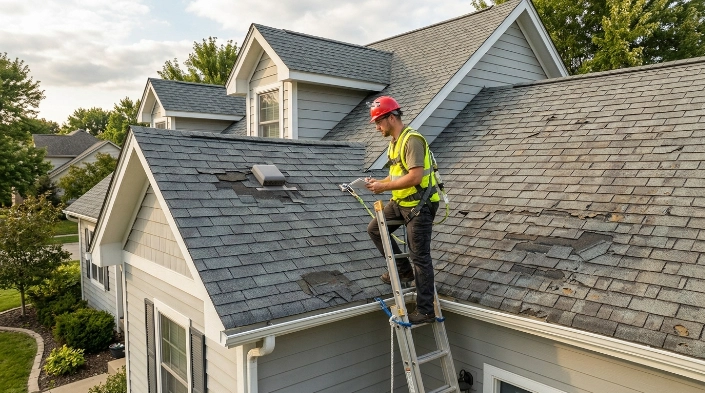
A water stain on the ceiling tells you that moisture reached the interior. It does not tell you where the roof failed.
Water may enter around:
- Missing or damaged shingles
- Chimney or wall flashing
- Plumbing vents
- Skylights
- Valleys
- Roof-to-wall connections
- Low-slope membrane seams
- Damaged underlayment
- Rotted roof decking
The actual entry point can be several feet away from where water appears inside the house.
This is why simply sealing the spot directly above an interior stain can fail. A proper inspection follows the moisture path and identifies why water entered.
The National Roofing Contractors Association emphasizes regular inspection and preventive maintenance because catching small problems early can prevent them from becoming more widespread. Its residential guidance also recommends additional inspections after severe weather. NRCA residential roof maintenance guidance
Roof Repair vs Replacement at a Glance

| Situation | Repair May Make Sense | Replacement May Make More Sense |
|---|---|---|
| One small leak | Yes, if the surrounding roof is healthy | If leaks are appearing in several areas |
| A few missing shingles | Often | If shingles are brittle or failing across the roof |
| Recent isolated storm damage | Often | If damage covers large sections |
| Older roof | Possibly for a minor problem | More likely if near the end of its service life |
| Damaged flashing | Often repairable | If flashing failure is part of widespread deterioration |
| Rotted decking | Small isolated areas may be replaced | Extensive deck deterioration favors replacement |
| Repeated repairs | Less attractive | Increasingly reasonable |
| Major hail or wind damage | Depends on extent | Often considered when damage is widespread |
| Cosmetic issue only | Usually no replacement needed | Rarely justified by appearance alone |
| Multiple roofing layers | Repairs may become difficult | Tear-off and replacement may be more practical |
A table can help narrow the choice, but no single sign should make the decision by itself.
1. Consider the Age of the Roof
Age is one of the first factors contractors look at because every roofing material has a limited service life.
Approximate planning ranges include:
| Roofing Material | General Service-Life Range* |
|---|---|
| Asphalt shingles | About 15–30 years |
| Architectural asphalt shingles | About 20–35 years |
| Wood shingles or shakes | About 20–40 years |
| EPDM or TPO membrane | About 20–30 years |
| Metal roofing | About 40–70 years |
| Concrete or clay tile | Often 50+ years |
These are general planning ranges, not guarantees. Climate, installation quality, maintenance, ventilation, roof pitch, storm exposure, and the specific product can substantially change actual lifespan.
A ten-year-old asphalt-shingle roof with one damaged area may have many useful years remaining. Repairing it can be entirely reasonable.
A roof in its final years is different. Spending significant money on another repair may only delay a replacement that is already approaching.
Age alone does not prove that a roof needs replacement. Its physical condition matters more. But age changes how much sense another major repair makes.
2. Look at How Widespread the Damage Is
Localized damage and system-wide deterioration are very different problems.
Imagine wind removes eight shingles from one slope while the remaining roof is still flexible, securely attached, and in good condition. That is typically a repair-type situation.
Now imagine curling shingles, missing granules, cracking, exposed fasteners, failing flashing, and previous patches on multiple slopes. Fixing one section may not meaningfully extend the life of the overall roof.
Signs that deterioration may be widespread include:
- Numerous cracked or curling shingles
- Large areas of granule loss
- Multiple active leaks
- Repeated shingle blow-offs
- Failed seams across a low-slope roof
- Extensive corrosion on susceptible metal components
- Numerous cracked tiles
- Significant deterioration around several penetrations
- Multiple previous patches
The more widespread the problem becomes, the less useful spot repairs tend to be.
3. Find Out Whether the Decking Is Damaged
Roof decking is the structural surface beneath the roofing system, commonly plywood or oriented strand board.
Shingles, metal panels, tiles, or membranes sit above this deck.
A damaged shingle can sometimes be replaced fairly easily. Rotten or structurally weakened decking is more serious because the roofing material depends on a solid base.
Possible warning signs include a sagging roof area, unusually soft spots, recurring moisture in the attic, visible staining beneath the decking, or deterioration discovered when roofing material is removed.
Do not walk across a roof to test for soft decking yourself. A weakened deck can create a serious fall-through hazard.
Limited damaged decking can sometimes be replaced during a targeted repair. If moisture damage is extensive, however, removing larger sections—or the entire roof covering—may be necessary to expose and replace the affected material.
4. Take Storm, Wind, and Hail Damage Seriously
Storm damage can make the repair-versus-replacement decision more complicated because roof damage is not always obvious from the ground.
Wind can lift or remove roofing. Hail may bruise asphalt shingles, break tiles, damage coatings, or dent metal.
The Insurance Institute for Business & Home Safety notes that hail affects roofing materials differently. Asphalt shingles can experience dents, tears, or granule displacement, while tile can crack or shatter. Metal roofing may dent without necessarily losing its ability to function as a roof covering. IBHS research on hail and roof damage
That distinction matters. Visible damage does not always equal functional failure.
After a major storm:
- Inspect from the ground where possible.
- Photograph visible damage.
- Check the attic and ceilings for water intrusion.
- Avoid climbing onto wet, steep, unstable, or damaged roofing.
- Arrange a professional inspection when damage is suspected.
- Review your insurance policy before authorizing major permanent work.
For insurance-related damage, good documentation can become especially important.
5. Consider the Roofing Material
Not every roof is equally easy to repair.
Asphalt shingles
Asphalt shingles are commonly repaired when damage is limited. Individual shingles or a localized section may be replaced.
Matching becomes harder as the roof ages because existing shingles fade and manufacturers discontinue colors and product lines.
Metal roofing
Metal roofs can have repairable problems such as loose fasteners, damaged flashing, failed sealant, or localized panel damage.
However, diagnosing leaks on metal roofing can be complicated because expansion, contraction, seams, penetrations, and attachment systems all play a role.
Tile roofing
Individual broken tiles can often be replaced, but walking on tile may break additional pieces. Underlayment beneath an older tile roof may also deteriorate even when many tiles remain usable.
Wood shake and shingles
Individual pieces can sometimes be repaired. Widespread splitting, decay, moss-related deterioration, or repeated leakage may point toward a larger problem.
EPDM, TPO, and other low-slope systems
Small membrane punctures and seam problems can often be repaired. Widespread membrane deterioration, saturated insulation, or extensive seam failure may require a more comprehensive solution.
6. Compare Repair Cost With Remaining Roof Life
Do not look at the repair price in isolation.
Instead, ask:
How much useful roof life am I buying with this repair?
Suppose a substantial repair costs several thousand dollars but the roof is already nearing the end of its expected service life. If replacement is likely soon anyway, the repair may offer poor long-term value.
On a relatively young roof, that same repair could preserve many years of service and be financially sensible.
Replacement estimates can vary dramatically based on:
- Roof size
- Roof pitch
- Number of stories
- Roofing material
- Tear-off requirements
- Existing layers
- Deck replacement
- Flashing work
- Chimneys and skylights
- Ventilation improvements
- Disposal fees
- Labor rates
- Permits
- Local building-code requirements
- Property access
That is why comparing detailed written estimates is more useful than relying on a single national price-per-square-foot figure.
Expert Tip: Ask each contractor to separate the estimate into roofing materials, tear-off, decking allowance, flashing, ventilation, labor, disposal, permits, and optional upgrades. Itemized quotes make true comparisons much easier.
7. Do Not Ignore Ventilation and Attic Conditions
Sometimes what appears to be a roofing-material problem is influenced by conditions underneath the roof.
Poor attic ventilation can contribute to excessive heat and moisture. Condensation may create damp insulation, stained decking, mold-like growth, or moisture symptoms that homeowners mistake for an exterior roof leak.
In cold climates, attic heat loss can also contribute to uneven snow melting and ice-dam conditions.
A roof replacement without correcting a ventilation or moisture problem may leave the underlying cause unresolved.
Before approving major work, ask whether the contractor inspected:
- Intake ventilation
- Exhaust ventilation
- Attic moisture
- Insulation condition
- Bathroom or dryer exhaust ducts
- Roof decking
A well-planned roof project considers the complete roof assembly, not just the visible surface.
8. Review Warranty Coverage Before Making Major Repairs
Roof warranties can involve more than one type of coverage.
A manufacturer warranty generally relates to roofing products, while a contractor’s workmanship warranty relates to installation.
Coverage, exclusions, transfer rules, maintenance requirements, and claim procedures vary.
Do not assume that a long warranty automatically means every roof problem will be covered. NRCA notes that roofing warranties may contain limitations and that maintenance can be required.
Before paying for substantial work, locate your paperwork and determine:
- Whether the warranty is still active
- Whether the issue may qualify
- Whether repairs must be completed by an approved contractor
- Whether unauthorized work could affect coverage
- What documentation is required
When Roof Repair Usually Makes Sense
Repair is often worth considering when the roof is otherwise healthy and the defect is clearly limited.
Examples include a few wind-damaged shingles, a small flashing failure, a minor membrane puncture, one leaking penetration, or a handful of broken tiles.
Repair is especially attractive when the roof has substantial expected life remaining and there is no significant deck deterioration.
The key word is localized.
A professional should be able to explain what failed, how the repair will address the failure, and what condition the rest of the roof is in.
When Roof Replacement Deserves Serious Consideration
Replacement becomes more reasonable when problems are no longer isolated.
Common situations include extensive material deterioration, repeated leaks in different areas, widespread storm damage, major underlayment failure, substantial deck deterioration, or an aging roof that has required multiple repairs.
Replacement can also create an opportunity to address related components at the same time, including flashing, underlayment, ventilation, deteriorated decking, drip edge, and outdated installation details.
That does not mean every old roof automatically needs replacement. It means the value of another significant repair should be weighed against the roof’s remaining service life.
A Practical Five-Step Decision Process
Step 1: Document the symptoms
Write down where you see water, when it appears, and whether it occurs during heavy rain, wind-driven rain, snowmelt, or every storm.
Photograph visible exterior and interior damage.
Step 2: Determine the roof’s approximate age
Look for old contracts, permits, seller disclosures, warranty paperwork, or previous inspection reports.
Step 3: Get the entire roof evaluated
Do not ask only, “Can you stop this leak?”
Ask about the condition of the complete roofing system, flashing, penetrations, decking, ventilation, and drainage.
Step 4: Request repair and replacement options when appropriate
For an older roof with substantial damage, ask the contractor to explain both options rather than presenting only one.
A useful estimate should explain what each choice accomplishes and what it does not fix.
Step 5: Compare long-term value
Consider remaining roof life, likelihood of additional repairs, warranty implications, future homeownership plans, and total project cost.
The cheapest short-term option is not automatically the least expensive long-term option.
When to Consult a Licensed Roofing Contractor
A professional evaluation is especially important when:
- Water is entering several rooms
- The roof appears to sag
- Decking feels or looks deteriorated
- Significant storm damage is suspected
- Large areas of shingles or roofing material are missing
- The roof is steep or difficult to access
- A chimney, skylight, or complex flashing detail is leaking
- You are preparing an insurance claim
- You are considering a full replacement
- Previous repairs keep failing
Roof work also carries serious fall risk.
OSHA’s residential roofing guidance identifies falls as a major roofing hazard and provides specific fall-protection and ladder-safety resources. OSHA residential roofing and fall-safety guidance
Homeowners should avoid walking on steep, wet, icy, damaged, or unfamiliar roofs. Ground-level observations, attic inspection where safely accessible, and professional roof evaluation are safer approaches.
When hiring a contractor, verify any licensing requirements in your state or municipality, check insurance, request references, obtain a written scope of work, and understand the payment schedule.
The Federal Trade Commission also warns homeowners about contractors who use high-pressure tactics, demand full payment upfront, appear unexpectedly claiming to have leftover materials, or pressure the homeowner into immediate financing decisions. FTC guidance for avoiding home-improvement scams
Common Mistakes Homeowners Should Avoid
- Assuming every leak requires replacement. Many localized leaks can be repaired.
- Assuming a patch fixes the underlying cause. A visible leak may originate elsewhere.
- Waiting until water enters the living space repeatedly. Delay can increase damage to decking, insulation, ceilings, and walls.
- Choosing replacement solely because the roof is old. Condition matters along with age.
- Choosing repair solely because it is cheaper today. Consider the roof’s remaining useful life.
- Walking on the roof without proper equipment. Falls and fragile roofing surfaces create significant risks.
- Ignoring attic ventilation. Moisture or heat problems may shorten roof-system life.
- Failing to document storm damage. Photographs, dates, and inspection reports can be important for insurance.
- Accepting an estimate that does not explain the scope. You should know what materials and components are included.
- Hiring immediately after a storm without checking credentials. High-pressure post-storm sales deserve extra scrutiny.
FAQs
Is it better to repair or replace a leaking roof?
It depends on the source of the leak and the overall roof condition. A localized flashing or shingle problem on a healthy roof may only need repair. Multiple leaks, widespread deterioration, extensive decking damage, or an aging roof may make replacement more practical.
How many roof repairs are too many?
There is no fixed number. Pay attention to frequency, repair cost, roof age, and whether new problems are developing in different areas. Repeated repairs over a short period can indicate broader deterioration.
Should I replace a 20-year-old roof that has one leak?
Not automatically. Some roofs still have useful life at that age. Have the leak and overall roof evaluated. A small repair may be sensible if the roof remains in good condition, while widespread aging may change the calculation.
Can I replace only part of my roof?
Sometimes. A separate roof section or slope may be repaired or replaced independently when construction allows it. Matching materials, flashing transitions, warranty requirements, and overall roof condition should be considered.
Does hail damage mean I need a new roof?
No. Hail damage varies by roofing material and severity. Some damage is cosmetic or localized, while severe impacts may affect the roof’s ability to shed water. A qualified inspection is the best way to determine the extent.
Will homeowners insurance pay for roof replacement?
Coverage depends on the policy and cause of damage. Sudden covered events such as wind or hail may be treated differently from normal aging, wear, poor maintenance, or long-term leakage. Review your policy and document damage before making assumptions about coverage.
Can I inspect my own roof before calling a contractor?
You can inspect many things safely from the ground and inside the attic. Look for missing roofing, debris, damaged gutters, stains, visible daylight, or moisture. Avoid climbing onto the roof when doing so would expose you to fall or structural hazards.
Conclusion
The choice between repairing and replacing a roof becomes easier when you stop looking only at the immediate leak or damaged shingle.
For roof repair vs roof replacement: how to decide, evaluate the roof’s age, the extent of damage, decking condition, roofing material, storm exposure, previous repair history, ventilation, warranty coverage, and remaining useful life.
A localized defect on a generally healthy roof often favors repair. Widespread deterioration, recurring leaks, major structural damage, or an aging system with mounting repair costs makes replacement increasingly worth considering.
Before spending thousands of dollars either way, get a thorough professional inspection and a written explanation of your options. Compare the long-term value—not just today’s invoice—so the work you approve solves the real problem and protects your home for years to come.