
Do Frequent Roof Leaks Mean You Need a New Roof?

Seeing a ceiling stain once is frustrating. Seeing water come back after you have already paid for roof repairs is much more concerning.
So, do frequent roof leaks mean you need a new roof? Sometimes they do, but repeated leaks are not an automatic replacement verdict. The right answer depends on why the roof is leaking, whether the problems are isolated or widespread, how old the roofing system is, and what condition the decking, flashing, underlayment, and other components are in.
A newer roof with two leaks around the same poorly installed vent may need a focused repair. An aging roof with leaks in several areas, deteriorated shingles, damaged decking, and repeated repair bills may be telling you that replacement is becoming the more dependable option.
This guide explains how to tell the difference, what warning signs matter most, how roof material and age affect the decision, and when you should stop patching problems and request a full professional evaluation.
Quick Answer
Frequent roof leaks can mean you need a new roof when leaks occur in several areas, keep returning after proper repairs, or are accompanied by widespread roofing deterioration or damaged decking. However, repeated leaks caused by one repairable flashing, drainage, or installation problem may not require full replacement.
Why Frequent Roof Leaks Deserve Attention
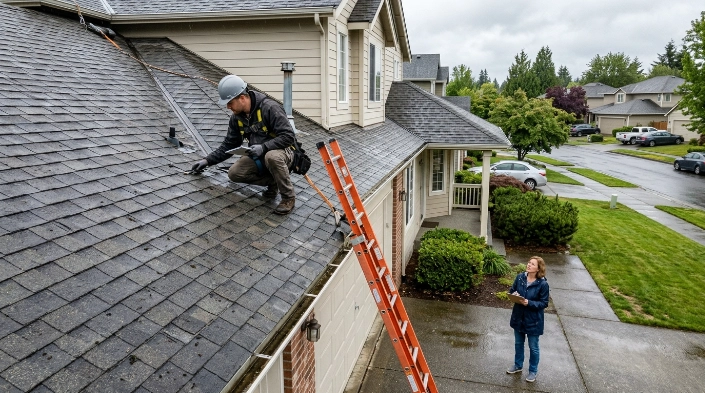
One roof leak does not necessarily mean the entire roof has failed.
Water may enter through a surprisingly small defect, including:
- Cracked or missing shingles
- Failed flashing
- Loose fasteners
- Deteriorated pipe boots
- Damaged roof valleys
- Open metal-roof seams
- Failed sealant
- Storm damage
- Skylight installation defects
The problem becomes more serious when new leaks keep appearing in different areas.
A roofing system is made of multiple layers and components. The visible roofing material—such as shingles, metal panels, tile, or membrane—is only the outer layer.
Beneath it may be underlayment and roof decking, which is the plywood or structural sheathing that supports the roofing system.
If water repeatedly reaches these lower layers, repairing only the visible entry point may not address the larger deterioration underneath.
The National Roofing Contractors Association describes proper leak investigation as a process of identifying and verifying the actual water-entry path rather than simply making a surface repair where moisture appears indoors. NRCA guidance on investigating roof leaks
That distinction is important because water can travel along decking, rafters, insulation, seams, or flashing before becoming visible on your ceiling.
Frequent Leaks: Repair or Replacement?

The following comparison can help you understand what a roofing contractor may consider.
| Roof Condition | Repair May Make Sense | Replacement Becomes More Likely |
|---|---|---|
| Number of leak areas | One isolated area | Multiple unrelated areas |
| Roof age | Relatively young | Near expected service-life limit |
| Roofing material | Mostly sound | Widespread deterioration |
| Decking | Dry and structurally sound | Soft, rotten, sagging, or damaged |
| Flashing | One failed detail | Multiple failing details |
| Storm damage | Localized | Extensive |
| Previous repairs | Few and successful | Frequent or short-lived |
| Warranty | Repair may remain covered | Replacement may be more practical |
| Overall condition | Strong | Declining across large areas |
No single row should decide the issue.
The pattern of problems across the entire roof matters more than simply counting leaks.
For a broader comparison, RoofersGazette’s guide to when to replace a roof instead of repairing it explains how damage extent, roof age, and underlying condition affect the decision.
Signs Frequent Leaks May Mean You Need a New Roof
1. Leaks Keep Appearing in Different Places
One recurring leak around a chimney may indicate one unresolved flashing problem.
Leaks appearing near a chimney this year, a valley several months later, and another roof section after the next storm suggest a different situation.
Multiple leak locations can indicate that several parts of the roofing system are deteriorating at the same time.
That is especially concerning when the roof is already old.
2. Proper Repairs Do Not Last
There is a difference between a failed repair and a failing roof.
If a contractor incorrectly patches a leak and water returns, that does not necessarily justify replacing the entire roof.
But if properly diagnosed repairs repeatedly solve one problem only for another leak to appear elsewhere, the roof may be reaching the point where continued patching offers poor long-term value.
3. Roofing Materials Are Deteriorating Across Large Areas
Look beyond the leaks themselves.
On an asphalt shingle roof, widespread warning signs may include:
- Curling or cracked shingles
- Missing shingles
- Bald areas from heavy granule loss
- Brittle shingles
- Exposed underlayment
- Repeated wind damage
Metal roofs may show widespread corrosion, failed seams, damaged coatings, deteriorated fastener systems, or recurring flashing problems.
Tile roofs may have numerous broken tiles or deteriorated underlayment beneath otherwise durable tile.
Flat roofs may develop membrane splitting, open seams, punctures, drainage problems, or repeated areas of trapped water.
RoofersGazette’s guide to signs you may need a new roof covers additional visible warning signs homeowners can monitor.
4. The Roof Deck Is Damaged
Decking damage can significantly change the repair-versus-replacement calculation.
Water that repeatedly penetrates the roofing layers can wet plywood or oriented strand board underneath.
Possible warning signs include:
- Sagging roof sections
- Soft or deteriorated wood
- Dark staining in the attic
- Visible rot
- Rusted fasteners
- Wet insulation
- Persistent musty odors
A contractor may not know the full extent of hidden decking damage until roofing materials are removed.
A sagging roof deserves prompt professional attention. Do not climb onto it to investigate.
5. The Roof Is Near the End of Its Useful Life
Age by itself does not prove that a roof needs replacement.
However, age becomes much more important when combined with repeated leakage.
For planning purposes, homeowners often encounter general service-life ranges such as:
| Roofing Material | General Planning Range |
|---|---|
| Asphalt shingles | Around 20–30 years |
| Wood shake | Around 20–40 years |
| EPDM or TPO membranes | Around 20–30 years |
| Metal roofing | Around 40–70 years |
| Clay or concrete tile | Often 50+ years |
These are not guaranteed replacement dates. Installation, climate, product quality, ventilation, maintenance, slope, and storms can substantially change actual service life.
RoofersGazette’s guide explaining how long a well-maintained roof may last provides more context on lifespan by roofing material.
Research from the Insurance Institute for Business & Home Safety also shows why age cannot be ignored. Its long-term roof-aging research examines how years of UV exposure, weather, temperature changes, and other environmental conditions affect roofing performance. IBHS Roof Aging Farm research
When Frequent Leaks May Still Be Repairable
Repeated leaks do not always mean replacement.
Imagine a relatively new roof where several leaks develop around improperly installed skylights.
Although water has entered more than once, the primary roofing field may still be in excellent condition. Correcting the skylight flashing system could potentially solve the problem without replacing the entire roof.
Other situations that may favor repair include:
- Several leaks tied to the same chimney flashing
- A limited section damaged by falling branches
- Localized wind damage
- One failed pipe boot
- An isolated valley problem
- A small membrane puncture
- A limited group of improperly installed fasteners
The important question is whether the problem is localized and correctable.
Consider the Cost of Repeated Roof Repairs
A small repair usually costs much less than a full roof replacement.
That does not automatically make repeated repair the cheaper long-term choice.
Suppose an older roof needs a $700 repair this year, another $1,200 repair next year, and additional interior repairs after another leak.
Those costs begin to accumulate without resetting the age of the underlying roof.
By contrast, spending thousands of dollars to replace an otherwise healthy roof because of one repairable flashing failure can also be wasteful.
A useful question to ask a contractor is:
“If I make this repair, what condition will the rest of the roofing system be in afterward?”
That shifts the conversation from today’s invoice to the roof’s remaining useful service life.
RoofersGazette also examines this issue in its guide comparing whether it is cheaper to repair or replace a leaking roof.
Do Not Ignore Ventilation and Moisture Problems
Not every stain in the attic proves rainwater is coming through the roofing material.
Poor attic ventilation, air leakage, condensation, HVAC problems, or plumbing leaks can sometimes create moisture that looks like a roof leak.
That is why diagnosis matters.
Proper attic ventilation helps control heat and moisture. ENERGY STAR explains that attic airflow, insulation, and air sealing work together to reduce moisture problems and protect the building envelope. ENERGY STAR guidance on attic ventilation
Replacing roofing materials will not solve an attic condensation problem if the real cause remains uncorrected.
Storm Damage Can Change the Decision Quickly
A roof that was previously repairable may become a replacement candidate after a major wind or hailstorm.
Storm damage can affect:
- Shingles
- Flashing
- Ridge caps
- Metal panels
- Tile
- Gutters
- Vents
- Underlayment
- Roof decking
Document visible damage from a safe location and contact your insurer promptly if you believe a covered storm caused the loss.
Avoid signing a rushed contract simply because someone arrives at your door after a storm.
The Federal Trade Commission recommends checking licensing and insurance where applicable, obtaining written estimates, carefully reviewing contracts, and avoiding contractors who pressure homeowners into immediate decisions or demand full payment upfront. FTC guidance for avoiding home-improvement scams
Check Your Roofing Warranties Before Authorizing Work
Roofing projects may involve more than one warranty.
You could have:
- A manufacturer’s material warranty
- A manufacturer’s system warranty
- A contractor workmanship warranty
- A separate warranty on certain roof components
Read the actual terms before assuming a leak is covered.
Some warranties cover defective materials but exclude installation errors. Others require approved contractors, documented maintenance, or specific repair procedures.
Using an unauthorized repair method may affect coverage in some situations.
Keep your original contract, product information, inspection records, photographs, invoices, and previous repair documentation.
Expert Tip
Expert Tip: Ask the contractor to show you why the roof is leaking—not just where water appeared indoors. Request photographs of the failed roofing detail, surrounding materials, and any damaged decking. A documented diagnosis makes it easier to compare repair and replacement recommendations.
A Practical 5-Step Repair-or-Replace Decision
Step 1: Identify the Actual Leak Sources
Determine whether the leaks come from one defective area or several unrelated areas.
Step 2: Evaluate the Entire Roof
Do not evaluate only the places currently leaking.
Check the condition of the remaining shingles, panels, flashing, penetrations, drainage components, and visible decking.
Step 3: Consider Age and Expected Remaining Life
A repair may be much more attractive on a five-year-old roof than on a deteriorated roof already near the end of its normal service life.
Step 4: Compare Long-Term Costs
Ask for written estimates for both repair and replacement when the roof’s condition makes both options reasonable.
Include expected future maintenance and likely additional repairs in your thinking.
Step 5: Review Warranty and Insurance Issues
Determine what may be covered before authorizing major work.
For storm-related damage, document conditions before repairs whenever safely possible.
When to Consult a Licensed Roofing Contractor
Arrange a qualified professional inspection when:
- Leaks continue after previous repairs
- Several rooms show moisture
- The roof has visible sagging
- You suspect decking damage
- A major storm affected the home
- Large areas of roofing material are deteriorated
- The roof is approaching its expected service life
- You cannot safely identify the problem from the ground or attic
- Repair estimates are becoming expensive
- You are considering a full replacement
Where roofing contractors are licensed, verify the appropriate state or local credential.
Ask the contractor to separate the diagnosis from the recommendation. A useful inspection should explain the problem, not simply announce that you need a new roof.
Do not climb onto a wet, steep, damaged, icy, or unstable roof. Homeowners can often gather useful information from the ground, attic, windows, or photographs without exposing themselves to a fall.
Common Mistakes Homeowners Should Avoid
- Assuming every leak requires replacement. A localized flashing problem can sometimes be repaired successfully.
- Assuming every leak is minor. Repeated water entry can damage decking, insulation, ceilings, and framing.
- Patching the interior symptom instead of the roof defect. Painting a ceiling stain does nothing to stop water entry.
- Applying sealant everywhere. Roof components must be repaired using methods appropriate for the roofing system.
- Ignoring repeated repairs. A growing repair history can be evidence that the larger roof system deserves evaluation.
- Choosing a contractor only because the bid is cheapest. Compare scope, materials, warranties, licensing, insurance, and diagnosis.
- Failing to document leaks. Keep photos, dates, weather conditions, invoices, and inspection reports.
- Walking on a questionable roof. The risk of a fall or stepping through weakened decking is not worth a DIY inspection.
FAQs
Does having two roof leaks mean I need a new roof?
Not necessarily. Two leaks caused by the same localized flashing or installation problem may be repairable. Replacement becomes more likely when leaks occur in unrelated areas and the roofing system shows widespread deterioration.
How many roof repairs are too many?
There is no universal number. What matters is how often problems return, whether they occur in different areas, the roof’s age, and whether repairs provide lasting results. Several repairs within a short period deserve a broader roof evaluation.
Is it worth repairing an old roof that leaks?
Sometimes. A minor repair may be worthwhile if the rest of the roof remains serviceable. However, investing heavily in repeated repairs on a deteriorated roof with little remaining life may provide poor value.
Can a roof leak even if the shingles look good?
Yes. Water can enter around flashing, vents, skylights, chimneys, valleys, fasteners, penetrations, or hidden installation defects even when the visible roofing material looks acceptable.
Can frequent roof leaks damage the roof decking?
Yes. Repeated moisture exposure can deteriorate wood decking over time. A professional should investigate soft, rotten, stained, or sagging areas and determine whether damaged sections require replacement.
Should I replace my roof before filing an insurance claim?
For suspected covered storm damage, contact your insurer promptly and document the condition before major permanent work whenever possible. Emergency steps may still be necessary to prevent additional damage. Coverage and claim procedures vary by policy.
Should I get more than one roofing estimate?
For a major replacement project, comparing multiple detailed written estimates can help you understand differences in scope, materials, labor, warranties, ventilation work, decking allowances, and cleanup. Make sure contractors are evaluating the same underlying problem.
Conclusion
So, do frequent roof leaks mean you need a new roof? They can—but the frequency of leaks alone is not enough to make the decision.
A repair may still be appropriate when leaks come from one identifiable and correctable defect and the rest of the roof remains in good condition.
Replacement becomes more reasonable when leaks keep appearing in multiple areas, roofing materials are deteriorating, decking is damaged, previous repairs are failing, or the roof is already approaching the end of its useful service life.
Do not keep paying for temporary patches without understanding the larger condition of the roof.
Have a qualified roofing contractor identify the actual sources of water entry, document the condition of the complete roofing system, and give you a clear explanation of what repair would accomplish compared with replacement.
That information gives you the best chance of spending your roofing budget once—and spending it on the solution your home actually needs.