
Do Curling Shingles Mean You Need a New Roof?

Seeing shingles curl at the edges can make a homeowner wonder whether a full roof replacement is right around the corner. Curling often means asphalt shingles are aging, drying out, or no longer lying flat enough to shed water as effectively as they once did. However, it does not automatically mean the entire roof has failed.
So, do curling shingles mean you need a new roof? Sometimes—but the decision depends on how widespread the curling is, the roof’s age, whether leaks or granule loss are also present, the condition of the decking and ventilation, and whether repairs would provide a lasting solution.
Below, we’ll explain what curling shingles mean, when repairs may still make sense, when replacement becomes more practical, and what homeowners should check before committing to a major roofing project.
Quick Answer
Curling shingles do not always mean you need a new roof. A few curled shingles may be repairable, especially on a relatively young roof. However, widespread curling on an aging asphalt roof—particularly with cracks, granule loss, leaks, or brittle shingles—often indicates deterioration that may make roof replacement the better long-term solution.
What Are Curling Shingles?
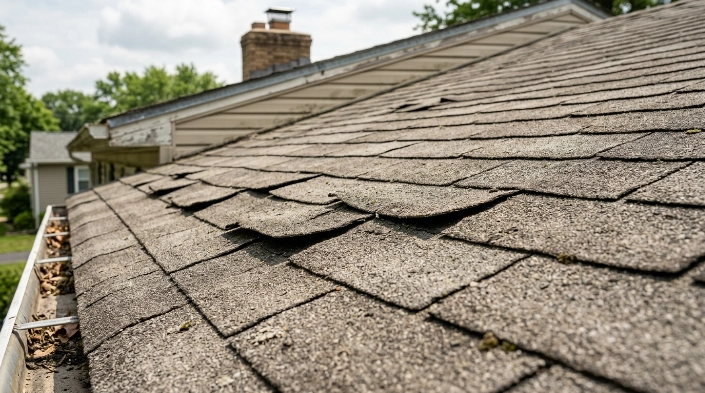
Curling shingles are asphalt shingles whose edges or corners no longer sit flat against the roof.
Instead, portions of the shingle may bend upward, turn under, or appear distorted.
You may hear roofing contractors describe two common patterns:
- Edge curling: The outer edges of the shingle turn upward.
- Clawing: The center of the shingle rises while the edges or corners turn downward.
Either condition suggests that the shingle is no longer behaving like a new, flexible roofing material.
The National Roofing Contractors Association identifies curling or splitting asphalt shingles as evidence of deterioration and recommends periodic roof inspections to identify developing problems. NRCA residential roof maintenance guidance
Curling matters because asphalt shingles are designed to overlap and lie relatively flat. Once they become distorted, wind can catch exposed edges more easily, and the roof covering may become increasingly vulnerable to weather.
Why Do Roof Shingles Curl?
Curling is usually a symptom rather than the actual cause of a roofing problem.
Understanding why shingles are curling helps determine whether a local repair or complete replacement is appropriate.
Normal Aging
Age is one of the most common causes.
As asphalt shingles spend years exposed to sunlight, heat, rain, wind, freezing temperatures, and daily temperature swings, the material gradually loses flexibility.
Older shingles can become:
- Dry
- Brittle
- Cracked
- Curled
- Loose
- More prone to granule loss
When curling appears throughout an older roof, the problem is usually more significant than one isolated damaged shingle.
Poor Attic Ventilation
Heat and moisture trapped in an attic can contribute to premature roof-system deterioration.
A properly designed ventilation system helps move excess heat and moisture out of the attic. When ventilation is inadequate, roofing components may experience more stressful conditions.
Do not assume ventilation is the cause simply because shingles are curling. A contractor should evaluate the entire system, including intake vents, exhaust vents, insulation, roof decking, and roofing materials.
Installation Problems
Curling can occasionally appear earlier than expected because of installation issues.
Possible problems include:
- Improper fastening
- Incorrect nail placement
- Installing shingles over an unsuitable surface
- Poorly prepared decking
- Failure to follow manufacturer installation instructions
- Problems with underlayment or ventilation
A relatively young roof with significant curling deserves professional evaluation because premature deterioration may involve workmanship or product-warranty questions.
Moisture Problems
Moisture beneath the roofing system can damage decking and other roof components.
Persistent attic condensation, leaks, or wet decking may create conditions that affect the roof covering.
If curling is accompanied by attic stains, soft decking, mold-like growth, damp insulation, or recurring leaks, the problem needs more than a cosmetic shingle repair.
Does a Few Curling Shingles Mean the Whole Roof Is Bad?
No.
A small number of damaged shingles does not automatically justify replacing thousands of square feet of roofing.
A repair may be reasonable when:
- Only a few shingles are affected.
- Damage is limited to one small area.
- The roof is relatively young.
- Nearby shingles remain flexible and secure.
- There are no recurring leaks.
- The decking underneath is sound.
- Matching replacement shingles are available.
- The cause is isolated rather than roof-wide deterioration.
For example, suppose a 7-year-old asphalt roof has several curled shingles around one poorly installed roof vent. Repairing the affected shingles and correcting the vent flashing may make more sense than replacing the entire roof.
The situation changes when curling appears across several roof slopes.
When Curling Shingles Are a Sign You May Need Roof Replacement
The most important factor is not simply whether curling exists. It is how much of the roof is affected and what other problems are appearing at the same time.
Curling Is Widespread
If shingles are curling across large areas of the front, rear, and sides of the roof, individual repairs may become impractical.
Replacing ten damaged shingles is one thing.
Replacing dozens or hundreds while the remaining shingles are aging at approximately the same rate is another.
Widespread deterioration generally deserves a full roof assessment.
The Roof Is Already Old
Curling becomes more meaningful when an asphalt roof is approaching the later portion of its expected service life.
Roof lifespan varies significantly with:
- Shingle quality
- Climate
- Ventilation
- Installation quality
- Roof slope
- Sun exposure
- Maintenance
- Severe weather exposure
A roof does not suddenly expire on a specific birthday.
Still, an older roof showing widespread curling, cracking, granule loss, and leaking presents a much stronger replacement case than a newer roof with one localized defect.
Shingles Are Brittle or Cracking
Curling often appears alongside brittleness.
A contractor trying to replace one shingle may discover that surrounding shingles crack or break when lifted.
That makes spot repairs harder and may indicate that the material has deteriorated throughout the roof.
Granule Loss Is Heavy
The mineral granules on asphalt shingles help protect the underlying asphalt from weather and sunlight.
Some loose granules are normal.
More concerning signs include:
- Large amounts collecting in gutters
- Bald-looking patches
- Dark areas where granules are missing
- Curling combined with cracking and surface wear
NRCA homeowner resources note that inspections may reveal curled, warped, missing, or deteriorating shingles along with excessive granules in gutters and downspouts. NRCA homeowner roofing resources
Roof Leaks Keep Returning
One leak does not automatically justify replacement.
Leaks can result from localized failures involving:
- Flashing
- Plumbing vents
- Chimneys
- Skylights
- Missing shingles
- Roof valleys
However, repeated leaks in several unrelated locations suggest that the roofing system deserves a broader assessment.
If an older curled roof has already required several repairs and new leaks continue developing, replacement may eventually be more economical than continuing to patch individual failures.
Curling Shingles: Repair or Replace?

Use the following comparison as a starting point.
| Roof Condition | Repair May Make Sense | Replacement Becomes More Likely |
|---|---|---|
| Number of curled shingles | A few isolated shingles | Curling across large roof areas |
| Roof age | Relatively young | Near expected end of service life |
| Leaks | None or one localized leak | Multiple or recurring leaks |
| Granule loss | Minor | Heavy or widespread |
| Shingle flexibility | Surrounding shingles still flexible | Shingles brittle and cracking |
| Decking | Dry and structurally sound | Soft, rotten, sagging, or damaged |
| Storm damage | Limited area | Multiple roof slopes affected |
| Previous repairs | Few | Frequent repairs |
| Installation | Local defect | Widespread installation problems |
No single row should determine the decision. Look at the roof as a complete system.
What Else Should You Check Before Replacing the Roof?
Curling shingles are only one part of the assessment.
Check the Attic
When you can safely access the attic, look for:
- Water stains
- Damp insulation
- Darkened decking
- Rusted fasteners
- Moisture around penetrations
- Sagging or damaged wood
- Unusual daylight entering through the roof
Do not step between ceiling joists or onto questionable surfaces.
Look at the Roof From the Ground
You can identify many roofing problems without climbing onto the roof.
Look for:
- Missing shingles
- Lifted edges
- Curling
- Cracks
- Sagging rooflines
- Damaged flashing visible from below
- Debris
- Damaged gutters
- Uneven roof surfaces
Binoculars or a zoom camera can help you inspect details while remaining safely on the ground.
Consider Recent Storm Damage
Strong wind and hail can accelerate problems on older asphalt shingles.
Research from the Insurance Institute for Business & Home Safety shows that wind loads can lift shingles and that hail can dent shingles, displace granules, or cause breaches depending on the impact. IBHS research on weather damage to roofing
After severe weather, document visible damage before making temporary repairs whenever it is safe to do so.
If an insurance claim may be involved, retain photographs, repair invoices, inspection reports, and communication with your insurer.
How Roof Age and Material Affect the Decision
Curling is primarily associated with asphalt shingles, but roof replacement decisions vary greatly by roofing material.
| Roofing Material | General Planning Lifespan | Typical Replacement Concerns |
|---|---|---|
| Asphalt shingles | About 15–30 years | Curling, cracking, granule loss, leaks |
| Wood shakes/shingles | About 20–40 years | Splitting, rot, moisture damage |
| EPDM/TPO roofing | About 20–30 years | Open seams, punctures, membrane deterioration |
| Metal roofing | Often 40–70+ years | Corrosion, seam or fastener failure |
| Clay/concrete tile | Often 50+ years | Broken tiles, failed underlayment or flashing |
These ranges are only planning estimates.
A well-installed roof in favorable conditions can outperform a poorly installed roof of the same age. Severe storms, ventilation problems, workmanship, roof geometry, and maintenance can all change real-world service life.
How Much Does Cost Matter in the Repair-vs.-Replacement Decision?
Roof replacement is a major expense, so homeowners naturally want to avoid replacing a roof prematurely.
At the same time, repeatedly repairing a roof that is failing everywhere can become expensive.
Roof replacement cost depends on factors such as:
- Total roof area
- Roof pitch
- Number of stories
- Valleys, dormers, and penetrations
- Roofing material
- Local labor rates
- Tear-off requirements
- Disposal fees
- Decking repairs
- Flashing replacement
- Underlayment
- Ventilation upgrades
- Permit requirements
- Accessibility
When comparing estimates, make sure each contractor is quoting roughly the same scope.
One estimate may include removal, upgraded underlayment, flashing, ventilation work, permits, and cleanup while another appears cheaper because several items are excluded.
Compare what you are buying, not just the bottom-line number.
What About Roofing Warranties?
Before authorizing major work, locate paperwork from the original roof installation if available.
There may be separate coverage for:
- Roofing materials
- Contractor workmanship
- Specific roofing-system components
Warranty terms vary widely.
Premature curling does not automatically mean a manufacturer will replace the roof. Coverage may depend on the product, installation requirements, ventilation, documentation, transfer rules, maintenance conditions, and the actual cause of failure.
Do not remove large sections of roofing before documenting suspected warranty problems.
Expert Tip
Expert Tip: When getting a roof-replacement estimate, ask the contractor to photograph the curled shingles, flashing, roof decking, ventilation components, and any moisture damage. Then ask them to explain why replacement is recommended instead of repair. Good documentation makes competing estimates much easier to compare.
Should You Try to Flatten or Repair Curling Shingles Yourself?
DIY roof work can create both safety and roofing problems.
Simply pushing curled shingles flat does not reverse aging or restore deteriorated asphalt.
Applying roofing cement indiscriminately may also:
- Trap moisture
- Create unattractive patches
- Make future repairs harder
- Interfere with proper water shedding
- Conflict with some product instructions
Most importantly, working on a roof creates serious fall hazards.
OSHA’s residential roofing guidance demonstrates why professional roofing crews use fall-protection systems and specialized procedures when working at height. OSHA residential roofing fall-protection guidance
Do not climb onto a steep, wet, icy, storm-damaged, sagging, or structurally questionable roof.
Homeowners can usually gather enough initial information from the ground and attic to decide whether a professional inspection is warranted.
When to Consult a Licensed Roofing Contractor
Have a qualified roofing contractor evaluate the roof when:
- Curling affects many shingles.
- Several roof slopes show deterioration.
- The roof is older and increasingly brittle.
- Leaks keep returning.
- Shingles are cracking or losing large amounts of granules.
- Decking appears soft or sagging.
- Significant wind or hail damage occurred.
- The roof has already needed repeated repairs.
- You suspect poor installation or ventilation.
- An insurance or warranty claim may be involved.
If the roof structure itself appears distorted, sagging, or severely damaged, additional evaluation by an appropriately qualified structural professional may be necessary.
For a major replacement, obtaining multiple detailed written estimates is useful.
The Federal Trade Commission advises homeowners to verify contractor licensing and insurance where applicable, obtain multiple written estimates, review contracts carefully, and be cautious about high-pressure demands or large upfront payments. FTC guidance on choosing home-improvement contractors
Common Mistakes Homeowners Should Avoid
- Assuming one curled shingle means total replacement. Localized damage may be repairable.
- Ignoring widespread curling because the roof is not leaking yet. Visible deterioration can develop before water shows up inside.
- Judging only by roof age. Condition, installation, storms, ventilation, and maintenance also matter.
- Covering symptoms without finding the cause. Replacing several shingles will not solve wet decking or ventilation problems.
- Walking onto the roof to inspect it. Falls are a serious hazard, especially on damaged or steep roofs.
- Choosing the cheapest estimate without comparing scope. A lower price may omit flashing, decking, underlayment, permits, ventilation, or disposal.
- Signing immediately after storm damage. Document conditions, check credentials, and review contracts carefully.
- Ignoring warranty documents. Premature problems may require documentation before roofing materials are removed.
FAQs
Can curled shingles be repaired?
Sometimes. If curling affects only a few shingles and the surrounding roof remains in good condition, replacing those shingles may be practical. Widespread curling usually requires a broader roof evaluation.
How long can a roof last once shingles start curling?
There is no reliable universal timeline. Curling may progress slowly or accompany other advanced deterioration. The roof’s age, leakage history, brittleness, weather exposure, ventilation, and extent of damage matter more than the curling alone.
Do curling shingles cause leaks?
Curling shingles can increase vulnerability because edges no longer lie flat as designed. However, visible curling does not prove that water is already entering the home. Check the attic and have widespread deterioration evaluated.
Does poor ventilation cause shingles to curl?
Poor attic ventilation can contribute to conditions that shorten roofing-system life, but curling can also result from age, installation problems, moisture, or material deterioration. The underlying cause should be identified before repairs are recommended.
Can I replace only the curled shingles?
Yes, when damage is truly localized and the surrounding roof remains serviceable. On an older brittle roof, removing individual shingles can damage adjacent material, which may make spot repairs less practical.
Will homeowners insurance pay for curling shingles?
Insurance commonly distinguishes sudden covered damage from deterioration caused by age, maintenance, or normal wear. Coverage depends on the policy and cause of damage. Review your policy and discuss storm-related damage directly with your insurer.
Do curling shingles mean you need a new roof immediately?
Not necessarily. A few curled shingles may only require repair. Widespread curling combined with advanced age, cracking, granule loss, repeated leaks, storm damage, or deteriorated decking makes replacement more likely. A professional inspection can confirm the condition of the overall system.
Conclusion
So, do curling shingles mean you need a new roof? The answer depends on context.
A handful of curled shingles on an otherwise healthy roof may be a repair issue. Curling across large sections of an older roof—especially when accompanied by cracking, granule loss, brittleness, repeated leaks, storm damage, or decking problems—can indicate that the roof is approaching the end of its practical service life.
Avoid deciding based on appearance alone.
Inspect what you can safely see from the ground and attic, gather information about the roof’s age and repair history, review applicable warranties, and have widespread deterioration evaluated professionally.
If replacement is recommended, request photos and a written explanation of the failed components and compare multiple detailed estimates before signing a contract. That gives you a much clearer basis for deciding whether repairing or replacing your roof is the smarter long-term choice.