
What Should You Do if Your Roof Is Leaking at Night?

Hearing water drip from the ceiling in the middle of the night can be alarming. You may see a growing ceiling stain, water running down a wall, or moisture appearing around a light fixture while rain is still falling outside.
So, what should you do if your roof is leaking at night? Your first priority is not finding the hole in the roof. It is keeping people safe, protecting the interior of your home, controlling the water as much as possible, and arranging a proper roof inspection when conditions are safe.
This is especially important with a metal roof leak. Water can enter around fasteners, seams, flashing, vents, or penetrations and then travel along panels, decking, or framing before appearing indoors.
Here is how to handle a nighttime roof leak without creating a bigger problem.
Quick Answer
If your roof is leaking at night, keep people away from wet ceilings and electrical fixtures, place containers under safe-to-reach drips, move belongings out of the area, document the damage, and call an emergency roofer if necessary. Do not climb onto a wet roof at night. Wait for safe conditions before inspecting or repairing the exterior.
What to Do Immediately When Your Roof Starts Leaking at Night
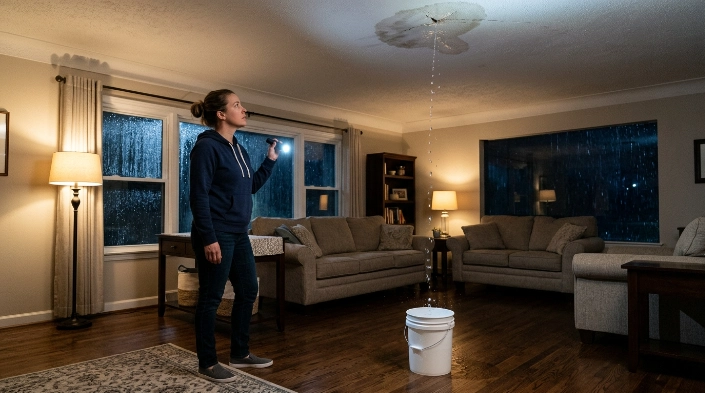
Your goal during an active leak is damage control, not permanent roof repair.
Follow these steps in order.
1. Keep Everyone Away From the Leak Area
Move children, pets, furniture, electronics, and valuables away from the affected part of the room.
Pay particular attention to:
- Bulging or sagging drywall
- Water around ceiling lights
- Wet outlets
- Water running down electrical cords
- Cracking or falling ceiling material
- A ceiling that appears unusually heavy or bowed
A water-soaked ceiling can become heavy enough to fail. Do not stand directly under a sagging ceiling.
If a large section appears unstable, close off the room and stay out until the condition can be evaluated.
2. Treat Water Near Electricity as an Emergency
Water and electrical systems are a dangerous combination.
If the leak is entering through a ceiling light, outlet, electrical panel, fan, or another electrical device, do not touch the fixture or the surrounding water.
The CDC’s electrical-hazard guidance advises shutting off power when electrical circuits or equipment have become wet or are near water, but only when the electrical panel can be reached safely. Never enter standing water to reach a breaker panel.
If you cannot safely disconnect power, stay away from the area and contact an electrician or emergency service provider.
Sparks, smoke, burning odors, or visible electrical arcing require immediate attention.
3. Catch the Water
If the drip is in a safe location, put a bucket, plastic storage container, or other waterproof container underneath it.
Place towels around the container to catch splashes.
For larger leaks, you may need several containers.
If water is spreading across the floor, move rugs, electronics, extension cords, furniture, and other belongings before they become soaked.
Plastic sheeting can also help protect furniture or flooring when it can be installed safely from inside the room.
4. Do Not Automatically Puncture a Bulging Ceiling
You may see advice online suggesting that homeowners puncture a swollen ceiling to release trapped water.
That can sometimes provide controlled drainage, but it also creates risks.
The ceiling may collapse unexpectedly. Electrical wiring may be hidden above the drywall. Wet insulation or other materials may also fall through the opening.
If you are unsure whether electricity or structural damage is involved, stay away from the bulge rather than attempting to drain it yourself.
A controlled drainage procedure should only be considered when the area is known to be electrically safe and the person doing it understands the hazards.
5. Move Valuable Items Before They Get Wet
Water damage becomes more expensive when it reaches furniture, computers, documents, flooring, mattresses, cabinets, or other personal property.
Move what you reasonably can without walking beneath damaged ceilings.
Prioritize:
- People and pets
- Electronics
- Important documents
- Furniture
- Rugs and other absorbent materials
Do not risk an injury to save an item that can be replaced.
6. Photograph and Record the Damage
Take clear photos and short videos showing:
- The active drip
- Ceiling stains
- Damaged drywall
- Wet flooring
- Damaged furniture
- Visible storm damage from the ground
- Water around walls or windows
Also write down when the leak started and what the weather was doing.
Documentation can help the roofing contractor diagnose the problem and may be useful if you later file a homeowners insurance claim.
Avoid throwing away heavily damaged items until you have documented their condition unless keeping them creates a safety or health concern.
Should You Go Into the Attic at Night?
Sometimes an attic inspection helps identify the general area where water is entering.
However, only enter the attic if it has safe access, stable flooring or walkways, adequate lighting, and no obvious electrical hazard.
Do not step between ceiling joists. Drywall is not designed to support your weight.
Use a flashlight to look for:
- Water dripping from roof decking
- Wet rafters
- Damp insulation
- Dark water stains
- Moisture around vents
- Wet areas around chimneys
- Water around roof penetrations
- Rust or moisture beneath a metal roof
Remember that the wet area inside the attic may not be directly below the exterior leak.
Water can run along decking, rafters, fasteners, or metal panels before it drips.
If the attic is difficult to access or you see damaged framing, soaked electrical wiring, or significant water accumulation, leave the inspection to a professional.
Should You Climb Onto the Roof at Night?
No. An actively leaking roof during rain, wind, or darkness is not a safe place for an inexperienced homeowner.
A wet metal roof can be particularly slippery.
Even professional roof work requires appropriate access and fall protection. OSHA provides dedicated roof-repair and fall-prevention guidance because falls remain a major hazard when working at roof height. OSHA guidance also recognizes adverse weather such as rain and high winds as hazardous conditions for roofing operations.
Do not attempt to climb onto the roof to:
- Apply sealant
- Tighten screws
- Replace shingles
- Inspect flashing
- Install a tarp
- Walk along metal panels
- Search for the leak source
Wait until weather improves and the roof can be evaluated safely.
Why a Metal Roof May Suddenly Leak at Night

A metal roof can last a long time, but the roofing material itself is only part of the system.
Fasteners, flashing, sealants, penetrations, seams, and transition points can eventually develop problems.
Loose or Failed Fasteners
Exposed-fastener metal roofs commonly use screws with sealing washers.
A screw can loosen, back out, corrode, or lose proper washer compression over time.
Water may then enter around the fastener hole.
Failed Seams
Metal panels join together at seams.
Thermal expansion and contraction continually move the roofing materials slightly as temperatures change. If a seam, sealant, or fastening detail fails, rain may enter the opening.
Damaged Flashing
Flashing directs water away from vulnerable roof joints.
Common flashing areas include:
- Chimneys
- Skylights
- Sidewalls
- Roof valleys
- Vents
- Plumbing pipes
- Roof-to-wall connections
Failed flashing can allow significant water entry even when the metal panels themselves remain in good condition.
Damaged Pipe Boots or Roof Penetrations
Any object passing through the roof creates a potential leak location.
Plumbing vents, exhaust vents, HVAC equipment, skylights, and other penetrations depend on properly installed flashing and seals.
Wind-Driven Rain
A roof may appear leak-free during ordinary rain but leak during wind-driven storms.
IBHS research shows that wind-driven rain can enter vulnerable roofing assemblies after roof-cover damage, which is one reason storm-related leaks can behave differently from ordinary rainfall.
Corrosion or Physical Damage
Older metal panels may develop corrosion, punctures, damaged edges, or previous repair failures.
Hail, falling branches, wind-blown debris, and foot traffic can also damage metal roofing.
What Can You Safely Do Until Morning?
Once everyone is safe and the water is contained, focus on preventing additional interior damage.
| Situation | Safe Nighttime Action | What to Avoid |
|---|---|---|
| Small ceiling drip | Use a bucket and towels | Climbing onto the roof |
| Water near a light fixture | Keep away and disconnect power if safely possible | Touching the fixture |
| Wet furniture | Move it to a dry room | Standing beneath damaged drywall |
| Sagging ceiling | Leave the immediate area | Standing underneath it |
| Metal roof leaking during rain | Call a roofer and wait for safe conditions | Walking on wet metal |
| Storm-created opening | Protect the interior and document damage | Installing a tarp during dangerous weather |
| Suspected structural damage | Leave the affected area | DIY structural inspection |
The most important idea is simple: temporary interior damage control is reasonable; risky exterior roofing work is not.
What About Putting a Tarp Over the Roof?
A properly installed tarp can temporarily limit water intrusion after certain types of roof damage.
But a tarp is not a permanent repair.
FEMA guidance describes temporary roof coverings and tarps as short-term protection intended to prevent additional damage until permanent repairs can be completed by a qualified professional.
Do not try to install a tarp during nighttime rain, strong wind, lightning, or other dangerous conditions.
A tarp that is poorly secured can also tear, blow away, damage roofing materials, or create additional openings.
If immediate exterior protection is necessary, an emergency roofing company may have trained crews and equipment designed for temporary weatherproofing.
How Urgent Is a Roof Leak?
Every active roof leak deserves attention.
That does not mean every leak requires a complete roof replacement.
The National Roofing Contractors Association’s homeowner roofing resources note that a leak can sometimes result from localized problems such as damaged roofing or loose flashing rather than complete roof-system failure. NRCA also advises that most roofing work should be handled by trained professionals because improper techniques can damage the roof and create serious fall hazards.
A leak becomes particularly urgent when you notice:
- Water around electricity
- Rapidly increasing water flow
- Multiple leaking areas
- A sagging ceiling
- Damaged roof decking
- Structural movement
- A tree or large branch on the roof
- Major storm damage
- Water entering several rooms
- Significant attic flooding
If a tree impact, collapse, fire, or electrical emergency creates an immediate danger to occupants, leave the affected area and contact the appropriate emergency service.
How Roof Age Affects the Repair Decision
One leak does not automatically mean an older roof must be replaced.
Likewise, a relatively new roof is not automatically protected from leaks.
The contractor should consider the roof as a complete system.
For a metal roof, that includes:
- Panel condition
- Fasteners
- Flashing
- Seams
- Underlayment
- Roof decking
- Penetrations
- Previous repairs
- Corrosion
- Drainage
An otherwise healthy roof with one failed flashing detail may be an excellent repair candidate.
An aging roof with widespread corrosion, repeated leaks, deteriorated fasteners, damaged decking, and numerous old patches may justify a discussion about replacement.
The decision should consider the roof’s expected remaining lifespan rather than age alone.
What Will a Nighttime Roof Leak Repair Cost?
The cost depends on what actually failed.
A minor localized repair may involve replacing fasteners, sealing a properly identified joint, or repairing flashing.
A larger project may require removing roofing panels, replacing damaged decking, replacing insulation, rebuilding flashing, or repairing storm damage.
Labor costs may also increase for true emergency service outside normal business hours.
Important cost factors include:
- Roof height
- Roof pitch
- Accessibility
- Material type
- Number of leak locations
- Extent of water damage
- Flashing complexity
- Storm conditions
- Emergency service requirements
- Local labor rates
Do not choose a repair only because it has the lowest initial price.
Ask what failed, how the contractor identified the leak source, what materials will be used, and whether the repair includes a workmanship warranty.
Insurance and Warranty Considerations
If the leak started after wind, hail, falling debris, or another sudden event, document the damage before permanent repairs begin when it is safe to do so.
Your insurer may want photographs, contractor findings, repair estimates, and other documentation.
Coverage varies by policy and cause of loss, so contact your insurer rather than assuming a particular repair will be covered.
Also check your roofing warranty.
A manufacturer or contractor warranty may contain requirements about who can perform repairs and which materials may be used.
Using an incompatible sealant, coating, fastener, or repair method could complicate future warranty claims.
Expert Tip
Expert Tip: Mark the location of the indoor drip with painter’s tape and photograph it before the area dries. Tell the roofer whether the leak happens during ordinary rain, wind-driven rain, or only severe storms. That information can help narrow down the actual water-entry point.
When to Consult a Licensed Roofing Contractor
Contact a licensed or appropriately qualified roofing contractor when the leak source is uncertain, the roof is steep or difficult to access, or exterior repair is required.
Professional evaluation is especially important when:
- The roof has multiple leaks
- The same leak keeps returning
- Metal panels are corroded
- Flashing has failed
- A skylight or chimney is involved
- Roof decking appears damaged
- A storm caused the leak
- The roof is under warranty
- Structural damage is possible
- Significant insulation is wet
- Several previous repairs have failed
A qualified contractor should identify the actual defect instead of simply applying sealant over the area where water appears indoors.
Water can travel before becoming visible, so the ceiling stain is a clue—not necessarily the source of the leak.
Common Mistakes Homeowners Should Avoid
- Climbing onto a wet roof at night. Poor visibility and slippery materials make falls more likely.
- Assuming the drip is directly below the roof hole. Water frequently travels before appearing indoors.
- Applying random caulk everywhere. Excess sealant may hide the defect without solving it.
- Ignoring electrical hazards. Water near wiring or fixtures requires extra caution.
- Standing under sagging drywall. A water-loaded ceiling may fail unexpectedly.
- Waiting weeks because the leak stopped when the rain stopped. The opening may still exist and leak again during the next storm.
- Throwing away damaged property before documenting it. Photographs and records may be useful for an insurance claim.
- Hiring someone who cannot explain the cause of the leak. A lasting repair begins with diagnosis.
- Assuming one leak means the whole roof needs replacing. Localized repairs may be appropriate when the surrounding roofing system is still sound.
FAQs
Can I wait until morning if my roof is leaking at night?
You can usually wait for exterior inspection until daylight if you have safely controlled the interior water and there is no electrical, structural, or severe flooding hazard. A wet roof is generally safer to leave alone overnight than to climb onto during rain or darkness.
Should I call an emergency roofer for a small leak?
A small, controlled drip may be manageable until normal business hours. Call for emergency help sooner if water is entering rapidly, electrical fixtures are affected, the ceiling is sagging, storm damage is severe, or the structure may be unsafe.
Why does my metal roof leak only during heavy rain?
Wind-driven rain can push water into vulnerable seams, flashing, penetrations, or failed fastener locations that do not leak during lighter rain. The direction and intensity of a storm can therefore change how a roof leak behaves.
Can I seal a leaking metal roof myself?
Applying sealant without identifying the actual defect can create a temporary patch or even hide a larger problem. Fastener, flashing, seam, and penetration repairs should use materials compatible with the metal roofing system. Difficult or unsafe repairs should be handled professionally.
Does a leaking roof need to be completely replaced?
Not necessarily. A localized flashing, fastener, seam, or penetration problem may be repairable. Replacement becomes more likely when there are widespread failures, significant corrosion, deteriorated decking, repeated leaks, or extensive storm damage.
What should I do if water is coming through a ceiling light?
Do not touch the light, switch, or surrounding water. Keep people away. If you can safely shut off the appropriate circuit without entering water, do so. Otherwise, contact a qualified electrician or emergency professional.
Can a roof leak cause structural damage?
Yes. Long-term moisture can damage roof decking, framing, insulation, ceilings, and other building materials. A leak that repeatedly returns or has remained unnoticed for a long period deserves a thorough inspection.
Conclusion
If you are wondering what should you do if your roof is leaking at night, focus first on safety and damage control.
Keep people away from sagging ceilings and wet electrical fixtures. Catch water where it is safe to do so. Move valuables, photograph the damage, and avoid walking on a wet roof—especially a metal roof—during darkness or bad weather.
Once conditions are safe, have the roof inspected to identify the actual source of the leak.
A loose fastener, failed flashing detail, seam problem, or damaged penetration may need only a targeted repair. Repeated leaks, widespread corrosion, damaged decking, or major storm damage may require more extensive work.
Protect the home tonight, diagnose the cause properly, and choose a repair that fixes the roofing problem rather than only hiding the visible drip.