
How to Handle a Roof Leak During Heavy Rain

A roof leak during a downpour can turn from a small drip into damaged drywall, soaked insulation, ruined belongings, and electrical hazards surprisingly fast. The problem can feel even more urgent with a metal roof because wind-driven rain may enter through a loose fastener, open seam, failed flashing, or roof penetration that does not leak during lighter weather.
Knowing how to handle a roof leak during heavy rain is mainly about protecting people first, limiting interior water damage, documenting what happened, and waiting for safe weather before attempting exterior repairs.
This guide explains what to do immediately, how to recognize common metal roof leak sources, which temporary measures are reasonable, what repairs may be needed after the storm, and when a licensed roofing contractor should take over.
Quick Answer
To handle a roof leak during heavy rain, keep people away from wet electrical fixtures or sagging ceilings, place containers under active drips, move valuables, document the damage, and control indoor water when it is safe. Do not climb onto a wet roof. Arrange a professional inspection after conditions improve.
What to Do Immediately When Your Roof Starts Leaking
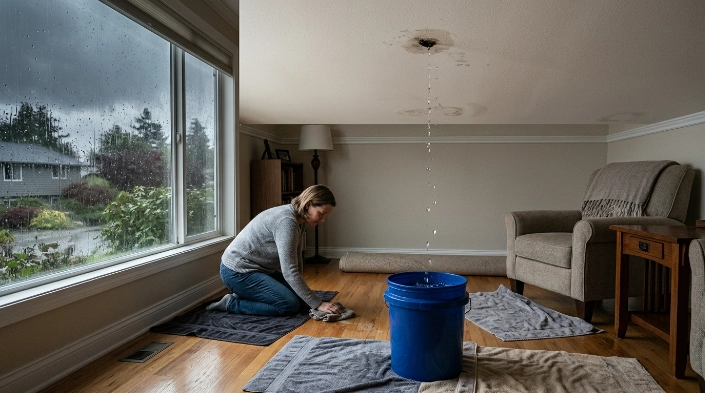
Your first goal is not to permanently repair the roof while rain is falling. It is to prevent injuries and reduce additional damage inside the home.
1. Keep Everyone Away From Electrical Hazards
Water leaking through a ceiling can travel along framing, wires, recessed lights, ceiling fans, and electrical boxes.
If water is dripping near:
- Light fixtures
- Ceiling fans
- Wall outlets
- Electrical panels
- Extension cords
- Powered appliances
keep people away from the area.
If you can safely shut off the affected electrical circuit from a dry location, do so. Do not touch wet switches, fixtures, wiring, or electrical equipment. Contact an electrician if you suspect water has reached the electrical system.
Water and electricity are a more immediate danger than the roofing problem itself.
2. Catch the Water
Place buckets, storage tubs, or other waterproof containers beneath active drips.
For splashing water, place an old towel inside the bucket. This can reduce droplets bouncing onto nearby flooring or furniture.
Check containers frequently during prolonged rain so they do not overflow.
If water is spreading across the floor, use towels or absorbent material to keep it from reaching baseboards, cabinets, flooring seams, and electrical devices.
3. Move Furniture and Valuables
Move furniture, electronics, rugs, artwork, documents, and other belongings away from the leak.
When something is too heavy to move safely, cover it with plastic sheeting or another waterproof covering.
Pay special attention to hardwood and laminate flooring. Water that remains around seams can penetrate below the finished surface and create swelling or other damage.
4. Watch for a Sagging Ceiling
A bulging or sagging ceiling can indicate that water has accumulated above the drywall.
Do not stand underneath it.
Wet drywall and insulation can become extremely heavy. Keep children, pets, and other occupants away from the area and contact a qualified professional if the ceiling appears unstable.
Do not blindly puncture a ceiling bulge when electrical wiring or other hazards may be hidden above it.
5. Photograph the Damage
When it is safe, take clear photos and videos showing:
- The active leak
- Ceiling stains
- Wet walls
- Damaged flooring
- Damaged belongings
- The approximate location of the leak
- Any visible storm damage from ground level
FEMA recommends documenting structural and personal-property damage after severe weather and retaining receipts related to repairs or damaged property. FEMA guidance on documenting storm damage
Documentation can be especially helpful when storm damage may lead to an insurance claim.
Never Climb Onto a Wet Roof During Heavy Rain
A leaking roof creates a strong temptation to grab a ladder, carry up a tarp, and search for the opening.
That is usually unsafe.
Metal roofing becomes particularly slippery when wet. Wind, lightning, poor visibility, loose debris, and moving panels can make the danger worse.
OSHA’s roofing guidance states that roofing operations should be suspended when rain, high winds, snow, or other adverse weather creates hazardous conditions. Homeowners should be even more conservative because most do not have professional fall-protection equipment or roofing training. OSHA roofing safety guidance for bad weather
Wait until the roof is dry and weather conditions are stable before any exterior inspection.
Even then, steep, high, damaged, or unfamiliar roofs are best inspected by a qualified roofing professional.
Why Roofs Leak More During Heavy Rain
A roof may appear perfectly dry during light rain but leak heavily during a storm.
Heavy rainfall changes how water moves across a roof.
Water may:
- Move rapidly through valleys
- Back up behind leaves and debris
- Overflow clogged gutters
- Reach higher beneath flashing
- Be pushed sideways by strong wind
- Enter small gaps around penetrations
- Overwhelm poorly designed drainage areas
Wind-driven rain is particularly important. IBHS research has shown that once a roof covering is compromised, rain can enter through vulnerable areas and create substantial interior water damage. IBHS research on wind-driven rain entry
That is why a leak that appears only during major storms should not be ignored simply because the roof stays dry during ordinary rain.
Common Metal Roof Leak Sources During Heavy Rain

Metal roofing can remain serviceable for decades, but the panels are only part of the waterproofing system.
The connections between components are often where leaks begin.
Loose or Failed Fasteners
Exposed-fastener metal roofing uses screws with washers that seal the holes where fasteners pass through the panels.
Over time, fasteners may:
- Back out
- Corrode
- Become loose
- Develop cracked washers
- Strip enlarged screw holes
- Become damaged by thermal movement
Wind-driven rain can then enter around the fastener.
Simply tightening every screw is not necessarily the correct solution. Overtightening may crush the washer or damage the metal panel.
Open Seams and Panel Connections
Metal expands and contracts as temperatures change.
Repeated movement may stress seams, overlaps, sealants, and attachment points. A small opening may remain unnoticed until heavy rain or strong wind pushes water through it.
Failed Flashing
Flashing directs water away from vulnerable roof transitions.
Common flashing locations include:
- Chimneys
- Skylights
- Plumbing vents
- Sidewalls
- Valleys
- Roof edges
- Exhaust vents
- HVAC penetrations
Cracked sealant, loose flashing, improper overlaps, corrosion, or installation defects can create a path for water.
Damaged Pipe Boots
Rubber or flexible boots around plumbing vents can eventually crack, split, or pull away from the surrounding metal.
A leak near a bathroom or plumbing wall may point to a failed vent-pipe flashing system.
Ridge and Valley Problems
Roof valleys carry concentrated amounts of water. During a severe storm, the volume can become substantial.
Debris, incorrect overlaps, damaged sealant, displaced metal, or poorly installed valley flashing can cause water to back up.
Ridge caps may also admit wind-driven rain if closures, sealants, or flashing details fail.
Corrosion or Punctures
A healthy metal panel normally does not allow water through its center.
However, rust, fallen branches, previous repairs, satellite installations, or other damage may create openings.
Extensive corrosion deserves professional evaluation rather than repeated applications of caulk.
Condensation That Looks Like a Roof Leak
Not every drip beneath a metal roof is caused by rain entering from outside.
Poor attic ventilation, humid indoor air, inadequate insulation, or improperly vented bathroom exhaust fans can produce condensation beneath metal roofing.
A contractor may need to distinguish between exterior leakage and interior moisture before recommending repairs.
Leak Location vs. Actual Roof Damage
The ceiling drip is not always directly below the roof opening.
Water can travel along:
- Rafters
- Roof decking
- Metal panel ribs
- Underlayment
- Pipes
- Insulation
- Fasteners
before finally appearing inside the living space.
The National Roofing Contractors Association notes that unsuccessful repairs often occur when people attempt to patch a roof without correctly identifying the actual water-entry path. A systematic investigation is more reliable than simply sealing the area above the visible stain. NRCA guidance on investigating roof leaks
Temporary Actions That Are Reasonable During the Storm
Most useful emergency steps happen inside the home.
| Situation | Safer Immediate Response | Avoid |
|---|---|---|
| Small ceiling drip | Use a bucket and move belongings | Climbing onto the wet roof |
| Water near a light | Keep away and isolate power if safely possible | Touching wet fixtures |
| Sagging ceiling | Clear the room and call for help | Standing underneath it |
| Wet attic insulation | Avoid disturbed or unstable areas | Walking across hidden ceiling joists without experience |
| Storm-damaged roof | Photograph from a safe location | Installing a tarp during lightning, wind, or heavy rain |
| Multiple leak areas | Control indoor water and arrange an inspection | Applying random sealant everywhere |
An exterior tarp may sometimes serve as a temporary repair after the storm, but installing one usually requires roof access. For most homeowners, that makes professional installation the safer choice.
What to Check Once the Rain Stops
Wait until daylight, dry conditions, and safe weather return.
Start from the ground rather than immediately climbing onto the roof.
Look for:
- Bent or lifted metal panels
- Missing trim
- Loose ridge-cap sections
- Damaged flashing
- Fallen limbs
- Gutter overflow
- Detached downspouts
- Open seams
- Visible rust
- Missing fasteners
- Debris in valleys
- Damaged roof penetrations
Binoculars or zoomed photographs can help you inspect without stepping onto the roof.
Inside the attic, when it is safely accessible, look for damp decking, wet insulation, water tracks, rust stains, or moisture around penetrations.
Do not assume the first wet location you find is the actual entry point.
Expert Tip
Expert Tip: Mark the indoor leak location and record whether the storm wind was coming from a particular direction. That information can help a roofer narrow the inspection to sidewall flashing, ridge details, panel seams, or other areas exposed to wind-driven rain.
Repair or Replace the Metal Roof?
A roof leak does not automatically mean you need a new roof.
A localized problem may require only a targeted repair.
Repair may make sense when:
- One flashing detail has failed
- A small number of fasteners are damaged
- A pipe boot has deteriorated
- One seam has opened
- A limited panel area was damaged
- The remaining roof is in good condition
Replacement or major restoration becomes more reasonable when there is:
- Widespread corrosion
- Repeated leakage in many locations
- Extensive storm damage
- Deteriorated roof decking
- Serious installation defects
- Multiple failed seams
- Large areas of damaged panels
- A roof approaching the end of its useful service life
Approximate service life also varies substantially by material and installation quality.
| Roof Material | Typical Service-Life Range | Leak Considerations |
|---|---|---|
| Asphalt shingles | 15–30 years | Aging, missing shingles, flashing failure |
| Metal | 40–70+ years | Fasteners, seams, flashing, corrosion |
| Tile | 50+ years | Broken tiles, underlayment, flashing |
| Flat/EPDM/TPO | 15–30 years | Seams, penetrations, ponding water |
| Wood shake | 20–40 years | Splitting, decay, flashing, maintenance |
These ranges are general estimates. Climate, workmanship, maintenance, ventilation, coatings, storm exposure, and roof design can significantly shorten or extend actual service life.
What Does Roof Leak Repair Cost?
The cost of repairing a roof leak can vary widely because the visible drip does not tell you the full scope of work.
Important cost factors include:
- Roof height and pitch
- Material type
- Accessibility
- Emergency service requirements
- Number of leak locations
- Flashing complexity
- Panel replacement
- Underlayment damage
- Wet insulation
- Damaged roof decking
- Interior drywall repairs
- Electrical damage
- Mold remediation
- Local labor rates
A small failed pipe boot or fastener problem may involve a relatively limited repair. Replacing damaged decking, several metal panels, or complicated flashing can require substantially more labor and material.
Get a written estimate describing both the source of the leak and the proposed repair whenever possible.
Insurance and Warranty Considerations
Before making major storm-related repairs, photograph the damage and review your insurance policy.
Coverage varies by policy and cause of loss. Sudden wind, hail, or falling-object damage may be handled differently from deterioration, installation defects, corrosion, or long-term maintenance problems.
If you believe the leak was storm-related, contact your insurer promptly and ask what documentation is required.
Also check any roofing material and workmanship warranties. Some warranties have specific requirements regarding approved fasteners, sealants, maintenance, inspection, or who performs repairs.
Using an incompatible repair product could potentially create future warranty problems.
Common Mistakes Homeowners Should Avoid
- Climbing onto the roof during rain. Wet metal and wind are a dangerous combination.
- Assuming the ceiling stain identifies the roof opening. Water often travels before dripping.
- Covering every fastener with caulk. This can hide rather than correct the actual defect.
- Overtightening roofing screws. Excessive pressure can damage washers or strip the attachment.
- Ignoring clogged gutters and valleys. Drainage problems can push water into vulnerable roof details.
- Waiting because the leak stopped with the rain. Intermittent leaks can still damage insulation and decking.
- Throwing away evidence immediately after storm damage. Photograph damage before cleanup when safe.
- Hiring someone who cannot explain the cause. A good repair should address the water-entry path, not merely the visible indoor stain.
- Assuming every leak requires replacement. Many isolated metal-roof leaks are repairable.
- Continuing endless patch repairs on a failing roof. Widespread corrosion or installation defects may justify a larger solution.
When to Consult a Licensed Roofing Contractor
Contact a qualified roofing contractor when:
- The leak continues through multiple storms
- Water is entering in several rooms
- Metal panels are loose or lifted
- Flashing is visibly damaged
- A tree or large branch struck the roof
- Significant hail or wind occurred
- Roof decking appears soft or deteriorated
- Multiple fasteners or seams have failed
- You cannot identify the source
- The roof is steep or difficult to access
- Previous repairs have failed
- You are considering an insurance claim
You should also seek professional help if the ceiling is sagging significantly, structural movement is visible, or substantial sections of the roof have been displaced.
A qualified roofer can inspect the roof covering, flashing, underlayment, decking, drainage system, penetrations, and interior evidence together.
That complete assessment is much more useful than treating each ceiling stain as an isolated problem.
FAQs
Can I temporarily fix a roof leak while it is raining?
You can reduce interior damage with buckets, waterproof coverings, and by moving belongings. Exterior roof repairs should normally wait until conditions are dry and safe. Do not climb onto a wet roof during heavy rain.
Why does my metal roof leak only during heavy rain?
Heavy rain may expose loose fasteners, open seams, failing flashing, blocked drainage, damaged pipe boots, or ridge and valley defects. Wind can also push water sideways into openings that do not leak during light rain.
Should I put a tarp on my roof during the storm?
No. Installing a tarp during rain, strong wind, or lightning can create a serious fall hazard. A tarp may be useful after the storm when installed safely, preferably by someone equipped for roofing work.
Can I use roof sealant to stop a metal roof leak?
Sealant can be part of certain repairs, but it is not a universal solution. The cause must be identified first. Improper sealant application can trap moisture or temporarily hide defective flashing, seams, fasteners, or panels.
Does one metal roof leak mean I need a new roof?
Usually not. A localized flashing, fastener, boot, or seam problem can often be repaired. Replacement becomes more likely when corrosion, storm damage, installation defects, or repeated leaks are widespread.
How quickly should I repair a roof leak?
Arrange an inspection as soon as reasonably possible after conditions become safe. Even an intermittent leak can wet insulation and decking and damage ceilings, walls, finishes, or electrical components over time.
Who should I call if water is coming through a ceiling light?
Keep people away from the wet area. If the affected circuit can be turned off safely from a dry location, do so. Contact an electrician for the electrical hazard and a qualified roofer to identify and repair the water-entry source.
Conclusion
Knowing how to handle a roof leak during heavy rain starts with one rule: protect people before property.
Stay off the wet roof, keep away from electrical hazards and unstable ceilings, contain indoor water where possible, move valuables, and document the damage. Once the weather clears, have the roof inspected to determine exactly where water entered.
For a metal roof, the cause is often a fastener, seam, flashing detail, penetration, drainage problem, or storm-damaged component rather than the metal panel itself.
Do not rely on repeated patches when the source remains unclear. A properly diagnosed repair can protect your insulation, decking, ceilings, and belongings while helping you avoid a much more expensive problem later.
If the leak is active, recurring, storm-related, or difficult to locate, schedule an inspection with a qualified roofing contractor and address the underlying cause before the next heavy rain.