How Can Gutters Help Prevent Roof Leaks? A Homeowner’s Guide

A roof can be in good condition and still develop moisture problems when rainwater has nowhere to go. Clogged, damaged, undersized, or poorly pitched gutters can cause water to overflow near the roof edge, soak fascia boards, and repeatedly wet areas that should normally stay dry.
So, how can gutters help prevent roof leaks? A properly working gutter system collects rainwater from the roof and moves it safely into downspouts and away from the house. That simple job reduces water buildup around eaves, flashing, siding, and the foundation.
This matters on asphalt shingle, metal, tile, wood shake, and many low-slope roofs. It is especially worth watching on a metal roof, where repeated moisture around seams, fasteners, edge flashing, and trim can contribute to corrosion or expose an existing weakness.
This guide explains how gutters protect your roof, what happens when they fail, the warning signs homeowners should watch for, maintenance costs, material considerations, and when a roofing contractor should inspect the system.
Quick Answer
Gutters help prevent roof leaks by collecting rainwater and directing it away from roof edges, fascia, walls, and the foundation. Clean, properly sloped gutters reduce overflow and water backup that can expose weak flashing, damaged roofing materials, or vulnerable eaves to repeated moisture.
How Gutters Protect Your Roof From Water
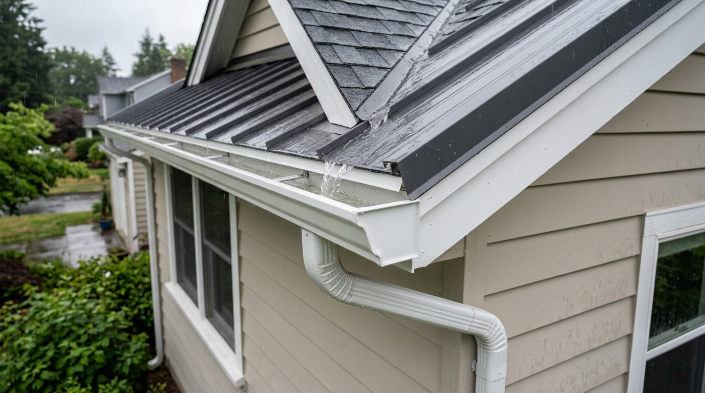
A roofing system is designed to shed water. Rain lands on the roof covering and travels downhill toward the eaves.
The gutter catches that water before it pours directly over the roof edge. Downspouts then carry it toward the ground and discharge it away from the home.
When everything is working properly, gutters help reduce:
- Water collecting near the roof edge
- Constant wetting of fascia and trim
- Water running behind the gutter
- Soil erosion near the foundation
- Moisture near exterior walls
- Ice buildup in cold climates
- Water exposure around vulnerable roofing details
The Insurance Institute for Business & Home Safety’s storm-preparation guidance recommends checking gutters and downspouts so they remain secure and free of debris that restricts water flow.
Gutters do not make a damaged roof waterproof. Instead, they reduce unnecessary water exposure and help the rest of the roof perform as designed.
How Clogged Gutters Can Contribute to Roof Leaks

A few leaves may not seem serious. During heavy rain, however, even a partial blockage can slow water enough to cause overflow.
Water Can Spill Back Toward the Roof Edge
A clogged gutter fills faster than it can drain. Water may spill over the front, but it can also reach the back of the gutter near the fascia and roof edge.
If flashing is damaged, incorrectly installed, or missing, moisture may reach wood components behind the gutter.
Repeated wetting can eventually contribute to:
- Rotted fascia
- Damaged roof decking
- Peeling exterior paint
- Mold or mildew
- Wet insulation
- Ceiling stains near exterior walls
The gutter is not always the actual leak point. It may simply create conditions that expose another weakness in the roofing system.
Overflow Can Expose Damaged Flashing
Flashing is thin material—usually metal—installed around roof edges, chimneys, valleys, vents, and other transitions.
At the eave, drip-edge flashing helps direct water away from the roof decking and into or beyond the gutter.
If the flashing is loose or poorly positioned, overflowing water may reach areas that normally receive little direct moisture.
Debris Keeps Roof Edges Wet Longer
Leaves, pine needles, roofing granules, twigs, and organic debris can hold moisture.
Instead of drying shortly after a storm, the edge of the roof may remain damp for hours or even days.
That is bad news for exposed wood and aging roofing components.
Can Bad Gutters Cause a Metal Roof Leak?
Metal roofs are excellent at shedding water, but they still depend on correct drainage.
A metal roof leak often begins around:
- Panel seams
- Fasteners
- Flashing
- Roof penetrations
- Skylights
- Valleys
- Eave details
- Damaged sealant
Poor gutter drainage can make these vulnerabilities worse.
For example, imagine a gutter filled with leaves below a metal roof. During a strong storm, water rushes down the smooth panels much faster than the blocked gutter can drain it.
Water repeatedly overflows at the eave. If edge flashing is loose or the fascia has already deteriorated, moisture may reach the roof deck or wall assembly.
The gutter did not create the loose flashing, but poor drainage helped turn a weakness into a water problem.
Proper Gutter Slope and Downspout Placement Matter
A clean gutter can still perform badly if it was installed incorrectly.
Gutters need a slight slope toward their downspouts. A gutter that is too level may hold standing water. One that slopes in the wrong direction may overflow at the opposite end.
Downspouts must also have enough capacity to handle the amount of water collected by the roof.
Problems may occur when:
- Too few downspouts are installed
- Downspouts are clogged
- Gutters sag between hangers
- Sections pull away from fascia
- Seams leak
- The gutter is too small for the roof area
- Water discharges directly beside the foundation
FEMA’s guidance on protecting homes from water damage recommends routinely maintaining gutters and downspouts so roof runoff can move freely away from the building.
Warning Signs Your Gutters May Be Increasing Leak Risk
You do not need to climb onto the roof to notice many gutter problems.
Watch the system from a safe location during or shortly after rainfall.
Common warning signs include:
| Warning Sign | What It May Mean | Why It Matters |
|---|---|---|
| Water spilling over gutter edges | Clog or inadequate capacity | Roof edges and fascia stay wet |
| Water running behind the gutter | Loose gutter or flashing issue | Moisture may reach fascia or decking |
| Sagging gutter sections | Failed hangers or excess weight | Water cannot drain correctly |
| Standing water after rain | Poor gutter pitch | Debris accumulates and corrosion may develop |
| Stained or rotted fascia | Long-term moisture exposure | Hidden wood damage may exist |
| Downspout barely flowing | Internal blockage | Water backs up into the gutter |
| Ceiling stain near an exterior wall | Possible roof-edge leak | Professional diagnosis may be needed |
| Rust around metal roof edges | Repeated moisture exposure | Coating, flashing, or drainage should be checked |
One isolated symptom does not prove you have a roof leak. Several symptoms appearing together deserve closer attention.
How Often Should Gutters Be Cleaned?
There is no perfect schedule for every property.
Many homes benefit from inspection and cleaning at least once or twice a year, but homes surrounded by mature trees may need attention more often.
Check gutters after:
- Major thunderstorms
- High winds
- Heavy leaf fall
- Hail events
- Snow or ice accumulation
- Nearby tree trimming
- A roof replacement or repair
Roofing granules can also collect inside gutters, particularly as asphalt shingles age.
A small amount of granule loss is normal. Heavy accumulation combined with cracked, curled, or missing shingles should be discussed with a roofer.
Expert Tip
Expert Tip: Do not wait for water to enter your ceiling before checking drainage. Watching your gutters from the ground during one strong rainstorm can reveal overflowing sections, blocked downspouts, or drainage problems that are easy to miss during dry weather.
Gutter Maintenance and Repair Costs
Gutter maintenance is usually much less expensive than repairing extensive roof decking, framing, insulation, drywall, or mold damage.
Exact prices vary significantly by location, house height, gutter length, accessibility, material, and the amount of debris.
Typical cost considerations include:
Routine Cleaning
Cleaning is generally the least expensive form of gutter maintenance.
Labor increases when the house has:
- Multiple stories
- Steep roof areas
- Difficult ladder access
- Heavy debris
- Gutter guards that must be removed
- Long or unusually complex gutter runs
Gutter Repairs
Repair costs depend on what failed.
Minor work may involve:
- Reattaching a loose hanger
- Sealing a leaking joint
- Clearing a downspout
- Correcting a small slope problem
More extensive repairs may require replacing damaged fascia, rebuilding an entire gutter run, adding downspouts, or correcting installation errors.
Hidden Roof Damage
Costs increase substantially if water has already reached the roof decking.
Decking is the structural wood surface beneath most residential roofing materials. Once it becomes soft, rotted, or structurally damaged, covering it with sealant does not solve the problem.
The affected section may need to be opened, dried, repaired, or replaced.
Gutter Performance by Roofing Material
Different roofs move water differently.
Asphalt Shingles
Asphalt shingles shed water effectively when installed correctly.
Clogged gutters may contribute to wet eaves and fascia. Aging shingles may also release granules that collect inside gutters and slow drainage.
Metal Roofing
Metal panels shed water quickly because their surfaces are smooth.
That means a large volume of runoff may reach the gutter in a short period during heavy rain.
Correct sizing, attachment, and drainage are especially important.
Tile Roofing
Tile roofs can produce substantial runoff and may have fragile edges.
Cleaning should be handled carefully because walking on tile incorrectly can crack individual pieces.
Wood Shake
Wood roofing benefits from good drainage and drying.
Constant moisture around roof edges can contribute to premature deterioration.
Low-Slope and Flat Roofs
Many low-slope systems use internal drains, scuppers, gutters, or combinations of drainage components.
Standing water on these roofs may indicate a drainage or slope problem that requires professional evaluation.
Will Better Gutters Extend Roof Lifespan?
Gutters cannot stop normal roof aging.
Asphalt shingles, metal panels, coatings, flashing, underlayment, sealants, and fasteners all have their own service lives.
However, good drainage can help prevent premature moisture damage around roof edges and related building components.
A roof that repeatedly stays wet around deteriorated fascia, decking, or flashing can develop avoidable problems long before the main roof covering reaches the end of its expected lifespan.
Think of gutter maintenance as supporting the roofing system rather than extending its life by a guaranteed number of years.
What About Gutter Guards?
Gutter guards can reduce the amount of leaves and large debris entering a gutter.
They are not maintenance-free.
Fine debris, seeds, pine needles, shingle granules, and organic material may still accumulate.
Some guard designs can also make inspection or cleaning more complicated.
Before buying a system, consider:
- Tree types around your house
- Roof pitch
- Typical rainfall intensity
- Gutter size
- Ease of future cleaning
- Product warranty
- Installation method
Be cautious when a salesperson promises that you will never need to inspect or clean your gutters again.
Roof and Gutter Warranties
Gutter problems can become more complicated when a roof is under warranty.
A roofing warranty may have maintenance requirements, exclusions, or rules about modifying roof-edge components.
If a gutter installer must disturb:
- Drip edge
- Metal panels
- Roof flashing
- Fascia
- Fasteners
- Roof coatings
check the roofing manufacturer’s instructions and your contractor’s workmanship warranty first.
Do not assume a roofing warranty covers damage caused by clogged gutters, neglected maintenance, improper drainage, or work performed by another contractor.
Keep invoices, inspection reports, photographs, and maintenance records when practical.
They may help if a warranty or insurance question arises later.
Can You Clean Gutters Yourself?
Ground-level maintenance is often reasonable for homeowners. Roof-level work is different.
Gutter cleaning commonly involves ladders, wet surfaces, uneven ground, overhead electrical hazards, and working near a roof edge.
OSHA’s fall-prevention resources include dedicated roofing and ladder-safety guidance because falls are a serious hazard during elevated work.
If you cannot safely reach the gutter, hire someone equipped for the job.
Never climb onto a wet, icy, storm-damaged, very steep, or unfamiliar roof just to investigate a drainage problem.
A pair of binoculars, photographs from the ground, or observation during rain can often tell you enough to decide whether professional help is needed.
When to Consult a Licensed Roofing Contractor
Gutter cleaning companies can handle many drainage problems, but certain signs suggest the roof itself needs professional attention.
Contact a qualified or licensed roofing contractor where licensing is required if you notice:
- Water stains inside the attic or ceiling
- Rotted roof decking
- Damaged or missing flashing
- Loose metal roof panels
- Open seams
- Corroded fasteners
- Damaged shingles
- Sagging roof sections
- Repeated leaks near the same eave
- Storm damage
- Water entering after every heavy rain
A contractor should identify why the water is entering before recommending a repair.
Replacing gutters alone will not solve a leak caused by damaged flashing, failed underlayment, deteriorated decking, an open metal roof seam, or structural movement.
If several roof areas are failing and the roof is near the end of its practical service life, replacement may make more financial sense than repeated patch repairs.
Common Mistakes Homeowners Should Avoid
- Ignoring occasional gutter overflow. Overflow during ordinary rain is a warning that drainage capacity or maintenance needs attention.
- Assuming every ceiling stain is caused by gutters. Plumbing, flashing, condensation, roof penetrations, and damaged roofing can create similar symptoms.
- Sealing over rotted wood. Caulk cannot restore structural strength to damaged fascia or decking.
- Cleaning only the gutter and forgetting the downspout. A clear gutter with a blocked downspout will still overflow.
- Installing guards and never inspecting again. Gutter guards reduce debris; they do not eliminate maintenance.
- Climbing onto a wet roof to find a leak. The safety risk is not worth it.
- Hiring based only on the lowest quote. For repairs involving roofing, flashing, or fascia, compare experience, insurance, scope of work, warranty terms, and materials as well as price.
FAQs
Can clogged gutters actually cause a roof leak?
They can contribute to one. Clogged gutters may allow water to overflow or repeatedly wet roof-edge components. If flashing, fascia, decking, or roofing materials are already vulnerable, moisture may find a path into the house.
How can gutters help prevent roof leaks during heavy rain?
Working gutters move a large volume of roof runoff into downspouts instead of allowing water to collect or overflow near vulnerable eaves, fascia, and flashing.
Why does water run behind my gutter?
Possible causes include a clogged gutter, loose attachment, incorrect pitch, damaged fascia, or improperly positioned drip-edge flashing. A roofer or gutter professional can determine the exact cause.
Can clogged gutters cause a metal roof leak?
Poor drainage can worsen leak conditions around a metal roof’s edge flashing, seams, fasteners, or nearby components. However, the actual entry point should be diagnosed before repairs are made.
Should gutters have standing water in them?
Small droplets are normal after rain, but noticeable pools of standing water can indicate poor slope, sagging sections, or blocked drainage.
Do gutter guards prevent roof leaks?
Not directly. Gutter guards can reduce debris accumulation, which may improve drainage, but they cannot repair defective flashing, damaged roofing, bad gutter pitch, or an existing leak.
Should I call a roofer or a gutter company?
For routine cleaning, loose gutters, or a blocked downspout, a gutter professional may be enough. If you have interior water damage, damaged flashing, roofing deterioration, storm damage, or repeated leaks, a roofing contractor should inspect the system.
Conclusion
So, how can gutters help prevent roof leaks? They keep rainwater moving in the direction your roofing system was designed to handle—off the roof, into the gutter, through the downspouts, and away from the house.
Clean gutters cannot repair damaged shingles, failed metal seams, worn flashing, or rotten decking. What they can do is reduce unnecessary water buildup and repeated moisture exposure around some of the roof’s most vulnerable edges.
Check your gutters regularly, watch how they perform during heavy rain, keep downspouts clear, and pay attention to staining, overflow, sagging, rust, or damaged fascia.
If water has already reached your ceiling, attic, roof decking, or metal roofing components, the smartest next step is to have a qualified roofing contractor identify the true leak source before the damage spreads.