
How to Prevent Roof Leaks With Proper Ventilation: Metal Roof Guide

A roof can appear perfectly watertight from the outside and still create moisture problems inside your attic. Poor airflow may allow warm, humid air to collect beneath the roof deck, where it can condense on cold surfaces and eventually soak insulation, stain ceilings, damage wood, or imitate an exterior roof leak.
Learning how to prevent roof leaks with proper ventilation is especially useful for homeowners with metal roofing because condensation can form on cool metal surfaces when indoor moisture is not controlled.
Proper ventilation does not repair loose screws, damaged flashing, or open seams. Instead, it helps manage heat and moisture so condensation, ice dams, and moisture-related deterioration are less likely to damage the roof system.
This guide explains how roof ventilation works, what warning signs homeowners should watch for, how metal roofs are affected, and when professional inspection is the safer choice.
Quick Answer
To prevent roof leaks with proper ventilation, keep intake vents at the eaves open and provide adequate exhaust near the roof peak. Combine ventilation with attic air sealing and insulation so indoor moisture does not collect beneath the roof. Proper airflow can reduce condensation, ice-dam risk, and moisture damage, but it cannot repair an actual roofing defect.
Why Poor Ventilation Can Look Like a Roof Leak
When most homeowners see water in an attic, they naturally assume rain has passed through the roof covering.
That is not always what happened.
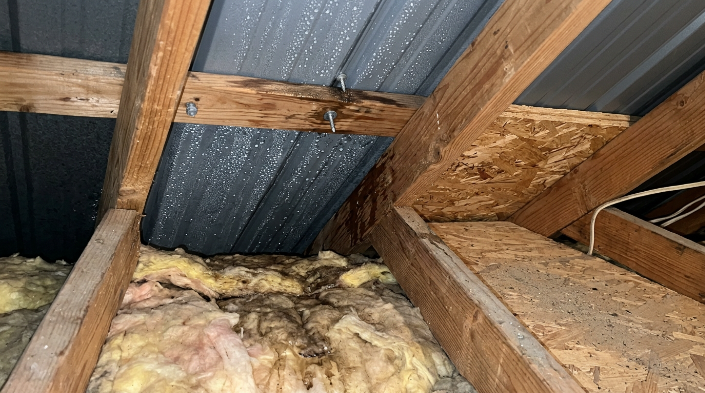
Warm household air contains moisture. When that air leaks through ceiling openings and enters a cold attic, the moisture may condense on roof decking, nails, fasteners, framing, or the underside of metal roofing.
Over time, water droplets can become large enough to drip.
The result may look almost identical to a leaking roof.
ENERGY STAR’s attic ventilation guidance explains that natural attic airflow helps remove moisture and can reduce ice-dam risk in cold weather while releasing excess attic heat during warm weather.
Poor moisture control can contribute to:
- Damp attic insulation
- Mold or mildew
- Dark stains on roof decking
- Rust around metal components
- Wood deterioration
- Ceiling stains
- Musty odors
- Ice dams
- Repeated moisture around roofing fasteners
A wet attic does not automatically mean the exterior roof covering is leaking.
Determining whether the water is rain entry or condensation is the first important step.
How Proper Roof Ventilation Works
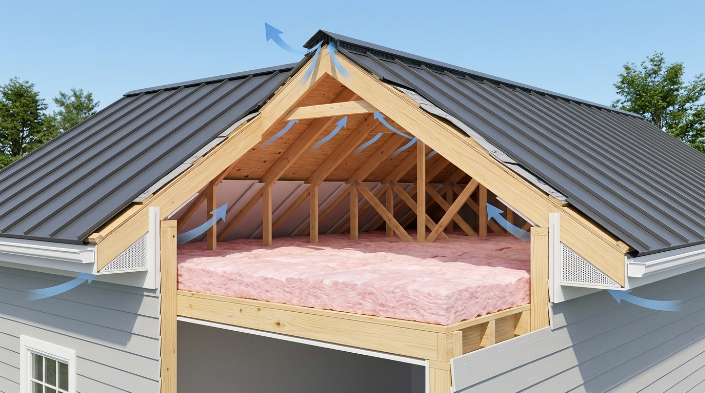
Most traditional vented attics rely on two types of airflow.
Intake Ventilation
Intake vents bring outdoor air into the lower portion of the attic.
They are commonly installed at:
- Soffits
- Eaves
- Lower roof edges
Soffit vents are among the most common intake systems.
Air entering near the eaves moves upward through the attic as warmer air rises.
Exhaust Ventilation
Exhaust vents allow warm, moisture-laden air to leave near the upper portion of the roof.
Common exhaust systems include:
- Ridge vents
- Roof vents
- Gable vents
- Properly designed mechanical ventilation systems
For many conventional attic designs, the goal is balanced airflow from low intake points toward high exhaust points.
NRCA roofing guidance on attic ventilation notes that ventilation can be particularly valuable for controlling excess attic moisture and helping prevent condensation and ice dams in appropriate roof assemblies.
Adding more exhaust openings without adequate intake is not necessarily better. A ventilation system needs a reliable path for replacement air to enter.
Ventilation Alone Is Not Enough
One of the most important things homeowners should understand is that attic ventilation is only one part of moisture control.
A durable attic usually depends on three systems working together:
- Air sealing
- Insulation
- Ventilation
Air sealing limits warm, humid household air from leaking into the attic.
Insulation slows heat transfer between the living space and attic.
Ventilation helps carry excess heat and moisture away.
For example, adding a large ridge vent may provide disappointing results if bathroom exhaust fans discharge directly into the attic or if large ceiling openings allow humid household air to continuously enter.
Likewise, adding insulation without protecting soffit vents can restrict airflow.
ENERGY STAR specifically warns homeowners not to cover soffit vents with insulation and recommends maintaining clear air channels with rafter vents or baffles where needed.
Why Metal Roofs Need Careful Moisture Control
Metal roofing is durable, but metal responds quickly to temperature changes.
During cold weather, the underside of a metal roof or nearby structural components may become cold enough for airborne moisture to condense.
This can produce droplets even when every exterior seam is watertight.
Signs Condensation May Be the Problem
Condensation becomes more likely when:
- Moisture appears without rainfall
- Dampness covers a wide attic area
- Many fastener tips appear wet at once
- Water appears during cold mornings
- Insulation is damp across several areas
- Bathroom or dryer exhaust enters the attic
- The attic has little airflow
- Moisture appears seasonally
Signs an Actual Metal Roof Leak May Be More Likely
Rainwater intrusion becomes more likely when:
- Water appears only during storms
- Leakage worsens with wind-driven rain
- One specific roof area repeatedly becomes wet
- Flashing appears damaged
- Exposed fasteners are loose or corroded
- Panel seams have separated
- Sealants around penetrations have failed
- Storm damage is visible
A home can have both condensation and an exterior roof leak at the same time, which is why repeated patching without diagnosing the moisture source may fail.
Warning Signs Your Roof Ventilation Needs Attention
Homeowners should periodically check accessible attic areas for moisture or airflow problems.
Watch for these warning signs:
| Warning Sign | Possible Cause | Recommended Action |
|---|---|---|
| Damp insulation | Roof leak or condensation | Identify moisture source before adding insulation |
| Mold or dark decking | Long-term moisture | Professional moisture and roof assessment |
| Rusted fastener tips | Condensation or water entry | Check ventilation and roofing penetrations |
| Blocked soffit vents | Insulation or debris | Restore airflow safely |
| Ice dams | Heat loss and attic temperature problems | Check air sealing, insulation, and ventilation |
| Musty attic odor | Persistent moisture | Inspect for leaks and condensation |
| Ceiling stains | Leak or dripping condensation | Trace water path before repairing |
| Hot attic with poor airflow | Inadequate ventilation | Evaluate intake and exhaust balance |
Visible mold, rotten framing, or widespread wet insulation deserves professional attention rather than simple vent cleaning.
How to Check Your Roof Ventilation Safely
You usually do not need to walk on the roof to identify basic ventilation problems.
1. Inspect the Attic
Choose a dry day.
Use a flashlight and look for:
- Damp insulation
- Dark water trails
- Mold
- Rust
- Wet fastener tips
- Stained decking
- Blocked eave areas
- Crushed or missing ventilation baffles
Do not touch exposed wiring or electrical equipment if moisture is present.
2. Check Soffit Vents From the Ground
Walk around the exterior and look beneath the roof edges.
Confirm that vent openings are not covered by:
- Paint
- Dirt
- Bird nests
- Stored materials
- Insulation
- Previous remodeling work
3. Look for Exhaust Ventilation
From the ground, identify whether the roof appears to have ridge vents, roof vents, or another exhaust system.
Do not climb onto the roof simply to verify this.
4. Check Bathroom and Dryer Exhaust
Bathroom fans, kitchen exhaust systems, and clothes dryers should not dump humid air into the attic.
Directing moisture into the attic can overwhelm normal ventilation.
5. Document Moisture Patterns
Take photographs and note:
- Whether it recently rained
- Outdoor temperature
- Location of moisture
- Time of day
- Whether the problem happens repeatedly
These details can help a roofing or building-performance contractor distinguish condensation from rainwater intrusion.
Do Not Block Soffit Vents With Insulation
This is one of the most common ventilation mistakes during attic insulation work.
Homeowners naturally want insulation to extend all the way to the edge of the attic floor. Unfortunately, loose-fill or batt insulation can cover the intake vents beneath the eaves.
Once those vents are blocked, the ridge vent may have little fresh air available to draw through the attic.
Rafter vents, often called baffles, create a protected air channel between the soffit area and the attic.
They allow insulation to reach the perimeter without closing the ventilation path.
More insulation is not helpful if its placement stops the attic from working as designed.
Expert Tip
Expert Tip: Before paying to add roof vents, ask the contractor to identify both the intake and exhaust path. Installing additional ridge or roof vents while the soffit vents remain blocked may add cost without correcting the actual airflow problem.
A Practical Ventilation Plan for Preventing Moisture Damage
Homeowners can approach ventilation problems in this order.
Step 1: Confirm Where the Water Comes From
Do not assume every stain is condensation.
Look for flashing damage, failed seams, loose fasteners, plumbing leaks, HVAC condensate problems, and storm damage.
Step 2: Stop Major Indoor Air Leaks
Common attic air-leak locations include:
- Attic hatches
- Plumbing penetrations
- Wiring openings
- Recessed fixtures
- Ceiling penetrations
- Wall top plates
Some sealing work can be DIY-friendly, but electrical, combustion, moisture, and mold concerns may require a professional.
Step 3: Keep Intake Ventilation Open
Confirm that soffit or eave vents are clear.
Use proper baffles where insulation approaches the roof deck.
Step 4: Confirm Adequate High-Level Exhaust
A qualified roofer can calculate the ventilation requirements using attic size, roof design, local building code, and the net free ventilating area of the vent products.
Avoid guessing based only on the physical length of a ridge vent.
Step 5: Review Insulation
Uneven or inadequate insulation can contribute to attic temperature differences and heat loss.
Correct insulation should work with—not obstruct—the ventilation system.
Step 6: Recheck the Attic After Weather Changes
After improvements, monitor the attic during cold weather, heavy rain, and humid periods.
Continued moisture may indicate a roof leak or a more complicated building-envelope problem.
Ventilation Considerations by Roofing Material
Different roofing systems react differently to heat and moisture.
Metal Roofing
Metal roofs can last several decades when properly installed and maintained, but condensation control deserves special attention.
Standing-seam and exposed-fastener systems also have different leak points.
Ventilation cannot correct failed seams, loose screws, damaged flashing, or punctured panels.
Asphalt Shingles
Poor attic conditions may contribute to moisture problems beneath shingle roofs.
Some roofing manufacturers also specify minimum ventilation requirements as part of installation or warranty conditions, so homeowners should review the actual warranty for their roofing product.
Tile Roofing
Tile itself can be long-lasting, but the underlayment and roof deck beneath it remain vulnerable to moisture.
Walking on tile can also break roofing units, so inspections are usually safer from accessible interior areas or by a professional.
Wood Shake
Wood is particularly sensitive to prolonged moisture.
Good drying conditions, correct installation, drainage, and ventilation can help reduce deterioration.
Low-Slope and Flat Roofing
Do not assume a low-slope or compact roof should use the same vent arrangement as a conventional attic.
Some assemblies are intentionally unvented and depend on carefully designed insulation and moisture-control layers.
Changing such a system without understanding its design can create new condensation problems.
Cost, Labor, Lifespan, and Warranty Considerations
Ventilation improvements range from simple corrections to major roofing work.
Clearing an obstructed soffit vent may be inexpensive.
Adding baffles inside an accessible attic may involve moderate labor.
Installing new soffit intake, ridge ventilation, roof vents, or changing an incorrectly designed roof assembly can become a much larger project.
Cost generally depends on:
- Roof size
- Roof pitch
- Attic accessibility
- Existing insulation
- Vent type
- Roofing material
- Amount of carpentry required
- Need for moisture or mold remediation
- Local labor rates
The smartest approach is usually to diagnose the problem before requesting vent installation.
Replacing roofing solely because moisture is visible can be unnecessarily expensive if condensation is the true problem.
The reverse is also true: installing more attic vents will not extend the useful life of a metal roof whose panels, seams, flashing, fasteners, or deck have already failed.
Check Your Warranty Before Changes
Before cutting new openings into an existing roof, review:
- Roofing manufacturer warranty
- Installer workmanship warranty
- Ventilation requirements
- Approved vent products
- Penetration restrictions
- Repair requirements
Unauthorized modifications can complicate warranty coverage.
Ask a contractor to document proposed ventilation changes before work begins.
When to Consult a Licensed Roofing Contractor
A basic attic observation can be reasonable for many homeowners, but roof diagnosis becomes more complicated when moisture, structural damage, or exterior roof work is involved.
Contact a licensed roofing contractor if you notice:
- Active leaking during rain
- Loose metal panels
- Widespread rust
- Damaged flashing
- Repeated seam failures
- Rotten roof decking
- Sagging areas
- Mold or persistent moisture
- Significant storm damage
- Multiple failed repairs
- Water near electrical components
- A roof that requires climbing to inspect safely
Professional help is also important when redesigning ventilation.
The contractor should evaluate the complete assembly rather than simply installing whatever vent product fits the roof.
Roof work also involves serious fall hazards. OSHA’s residential roofing fall-protection guidance emphasizes fall-protection practices for residential roofing operations. Homeowners without appropriate training and equipment are generally better served by staying off steep, wet, damaged, or unfamiliar roofs.
Common Mistakes Homeowners Should Avoid
- Assuming every wet attic means the roof is leaking. Condensation can create very similar symptoms.
- Adding more exhaust vents without checking intake. Exhaust cannot work effectively if replacement air has no clear entry path.
- Covering soffit vents with insulation. This can restrict the airflow the ventilation system depends on.
- Venting bathroom or dryer exhaust into the attic. This introduces large amounts of moisture directly into the space.
- Using powered attic fans as an automatic solution. Poorly planned fans can create pressure problems and may pull conditioned air from the house when air sealing and intake ventilation are inadequate.
- Applying sealant everywhere on a metal roof. Random caulking can hide the real leak and interfere with movement at seams or panels.
- Ignoring recurring moisture. Repeated dampness can damage decking, insulation, drywall, and framing.
- Walking on a metal roof without proper equipment. Metal panels can be extremely slippery, particularly when wet.
- Changing a roof assembly without understanding its design. Some roofs are intentionally unvented and require a different moisture-control strategy.
FAQs
Can poor ventilation actually cause a roof leak?
Poor ventilation usually does not create a hole in the roof covering. However, it can allow condensation to collect beneath the roof and drip like a leak. It may also contribute to ice-dam conditions and long-term moisture deterioration.
Can ventilation stop a metal roof from leaking?
Ventilation can reduce condensation-related moisture but cannot repair damaged panels, seams, screws, flashing, or penetrations. An actual rainwater leak must be located and repaired separately.
How can I tell condensation from a roof leak?
Condensation often appears across a wider area and may occur without rain, especially during cold weather. A roof leak is more likely to correspond with rainfall and follow a specific water path. Professional inspection may be needed when the cause is unclear.
Should soffit and ridge vents be used together?
In many traditional vented attics, soffit vents supply low-level intake while ridge vents provide high-level exhaust. The exact design should match the roof assembly, attic size, local code, and manufacturer requirements.
Will adding a powered attic fan prevent leaks?
Not necessarily. A powered fan does not repair roofing defects, and it may perform poorly when intake ventilation or attic air sealing is inadequate. Diagnose the moisture source before installing mechanical ventilation.
Does insulation help prevent condensation?
Yes, when installed as part of a properly designed system. Insulation helps control heat transfer, while air sealing limits warm humid air entering the attic. However, insulation should never block required soffit ventilation.
When should I replace the roof instead of fixing ventilation?
Replacement may be appropriate when roofing failure is widespread, structural decking is badly deteriorated, corrosion is extensive, repeated repairs no longer work, or the roof is near the end of its useful life. Ventilation improvements alone cannot restore failed roofing materials.
Conclusion
Understanding how to prevent roof leaks with proper ventilation starts with recognizing that attic moisture and exterior rainwater leaks are not always the same problem.
A healthy conventional attic typically needs clear intake ventilation, appropriate exhaust ventilation, good insulation, and careful air sealing. Metal roofs deserve particular attention because cold metal surfaces can make condensation symptoms more noticeable.
At the same time, ventilation should never be treated as a substitute for repairing damaged flashing, loose fasteners, separated seams, storm damage, or deteriorated roofing.
Start by documenting where and when moisture appears, inspect accessible attic areas safely, and check whether soffit vents are blocked. If the moisture keeps returning or the roof requires exterior inspection, have a qualified roofing contractor diagnose both the roofing system and the ventilation path before paying for repairs.