What Is the Average Cost to Fix Roof Water Damage?

A small brown stain on the ceiling can be the first visible sign of a much larger roofing problem. Water from a leaking roof may soak insulation, drywall, roof decking, framing, and electrical areas before you notice a drip inside your home.
So, what is the average cost to fix roof water damage? For many homeowners, the total repair falls somewhere between roughly $1,400 and $6,400, although a small, quickly contained leak may cost much less. Severe damage involving mold, rotten decking, structural repairs, or several rooms can cost considerably more.
The final price depends on where the leak started, how long it remained active, how much of the home became wet, and whether the roof itself also needs repair. Metal roof leaks can be particularly deceptive because water may travel along panels, fasteners, seams, or framing before appearing indoors.
This guide explains typical costs, what affects your final bill, what parts of the house may need repair, when insurance might help, and when you should call a licensed roofing contractor.
Quick Answer
The average cost to fix roof water damage is often about $1,400 to $6,400, depending on the size and severity of the affected area. Minor roof and ceiling repairs may cost under $2,000, while wet insulation, mold, rotten decking, structural damage, or multiple leaking areas can raise the total substantially.
How Much Does Roof Water Damage Cost to Repair?
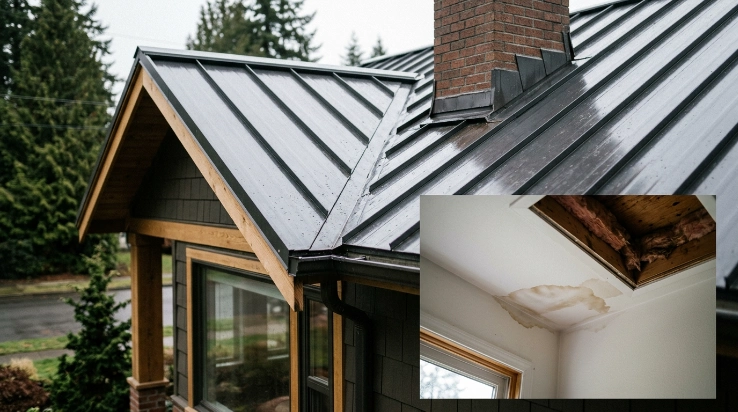
There is no single price for roof water damage because homeowners may actually be paying for several different jobs.
You might need to pay for:
- Finding and stopping the roof leak
- Removing wet insulation
- Drying the attic or wall cavities
- Replacing damaged drywall
- Repairing the ceiling
- Replacing rotten roof decking
- Treating mold
- Repainting affected rooms
- Repairing electrical components
- Repairing or replacing damaged roofing materials
Current HomeAdvisor cost data puts general residential water-damage restoration at approximately $1,383 to $6,371, with an average near $3,867. Its data also estimates roof-related repairs around $400–$1,700, ceiling repairs around $450–$1,600, and drywall repairs around $300–$850. These amounts should be treated as planning ranges rather than guaranteed quotes because local labor rates and damage severity vary significantly. HomeAdvisor water-damage cost data
Typical Roof Water Damage Cost Breakdown
| Repair or Service | Typical Planning Range | What May Be Included |
|---|---|---|
| General water-damage restoration | $1,383–$6,371 | Drying, cleanup, damaged-material restoration |
| Roof repair | $400–$1,700 | Minor leak source, flashing, roofing-material repairs |
| Ceiling repair | $450–$1,600 | Damaged drywall, sagging areas, finishing |
| Drywall repair | $300–$850 | Removal, replacement, taping, finishing |
| Mold remediation | $1,100–$3,400 | Professional mold removal where required |
| Major hidden damage | $5,000+ possible | Decking, framing, large affected areas, extensive restoration |
These costs are not necessarily separate or additive. A contractor’s restoration estimate may already include some drywall, drying, or cleanup work.
A $700 roof repair, for example, could become a $3,500 project if water has already soaked the attic insulation and damaged the ceiling below.
Why a Small Roof Leak Can Become Expensive
The visible leak is often only part of the problem.
Rainwater can enter through a small opening and travel along roof decking, rafters, pipes, insulation, or metal panels. By the time you see a ceiling stain downstairs, materials several feet away from the stain may already be wet.
That is especially important with a metal roof leak. Water commonly enters around:
- Loose or damaged fasteners
- Failed sealing washers
- Open panel seams
- Flashing
- Roof penetrations
- Vent pipes
- Chimneys
- Skylights
- Ridge caps
- Corroded areas
- Damaged sealant
The stain on your ceiling tells you where the water eventually appeared. It does not necessarily tell you where the roof is leaking.
A proper roof-leak investigation therefore matters more than simply applying sealant above the stain.
What Factors Affect the Cost of Roof Water Damage?
1. How Long the Roof Has Been Leaking
A leak discovered during the first storm may require only localized drying and repair.
A slow leak that has been occurring unnoticed for months can damage:
- Roof decking
- Rafters
- Insulation
- Drywall
- Ceiling finishes
- Interior paint
- Wall cavities
Long-term moisture can also contribute to wood deterioration and mold.
Fast action usually costs less than delayed action.
2. Size of the Wet Area
A small stain around one roof penetration is considerably different from water spreading across several ceiling joists.
Restoration contractors may use moisture meters or infrared equipment to determine how far water has traveled.
The larger the affected area, the more labor, drying equipment, demolition, and replacement materials may be required.
3. Roof Material
Roofing material affects both repair complexity and labor.
An asphalt shingle repair may involve replacing damaged shingles and correcting flashing.
A metal roof could require repairs to:
- Exposed fasteners
- Standing seams
- Panel overlaps
- Flashing
- Penetrations
- Corroded panels
Standing-seam metal systems can require specialized tools and manufacturer-compatible repair methods.
Tile and slate roofs may cost more to access because individual pieces can break during repair.
4. Damaged Roof Decking
Decking, also called roof sheathing, is the solid wood surface beneath the exterior roofing material.
If decking remains wet long enough, it can become:
- Soft
- Swollen
- Delaminated
- Moldy
- Rotten
- Structurally weakened
A roofing contractor may need to remove roofing material to reach and replace damaged sections.
Finding rotten decking after work begins is one reason an apparently simple leak repair can become more expensive.
5. Wet Insulation
Wet insulation loses much of its effectiveness and can hold moisture against wood, drywall, and other building materials.
Some saturated insulation can be difficult or impractical to dry completely and may require replacement.
The cost increases when insulation is located inside inaccessible wall or ceiling cavities.
6. Mold Growth
Mold can substantially increase restoration costs.
The EPA recommends drying wet or damp materials within approximately 24 to 48 hours whenever possible to reduce the chance of mold growth. It also emphasizes that mold control requires correcting the moisture source rather than merely cleaning visible growth. EPA guidance on mold and moisture
HomeAdvisor currently estimates professional mold removal at roughly $1,100 to $3,400, although extensive contamination can cost more.
If you notice a strong musty odor, widespread visible mold, or significant hidden moisture, professional evaluation may be appropriate.
What Should You Do Immediately After Finding Roof Water Damage?
Taking the right steps early may prevent a relatively manageable repair from becoming a major restoration project.
1. Protect People First
Keep children and pets away from the wet area.
Do not stand beneath a badly sagging ceiling. Saturated drywall or plaster may collapse.
If water is near:
- Light fixtures
- Electrical outlets
- Ceiling fans
- Wiring
- Electrical panels
avoid touching the area and contact an appropriate professional.
2. Limit Additional Interior Damage
If it is safe:
- Move furniture and electronics away.
- Place containers beneath active drips.
- Protect flooring.
- Photograph the affected area.
- Remove valuables from nearby shelves or walls.
Do not climb onto a wet roof to install an emergency patch.
The National Roofing Contractors Association recommends assessing storm-related roof damage from the ground and leaving closer inspection and repair to professional roofing contractors. NRCA roof repair and homeowner guidance
3. Stop the Source
Drying the ceiling while allowing the roof to continue leaking will not solve the problem.
A qualified roofer should identify why water is entering and determine the proper repair.
4. Begin Drying Promptly
Once the leak has been controlled and the area is electrically and structurally safe, wet materials should be addressed quickly.
Depending on the situation, professionals may use:
- Commercial air movers
- Dehumidifiers
- Moisture meters
- Water extraction equipment
- Controlled demolition
5. Document Everything
Take photographs and video before removing damaged materials when reasonably possible.
Keep:
- Contractor estimates
- Inspection reports
- Roof photos
- Interior-damage photos
- Emergency repair receipts
- Restoration invoices
Documentation can become important if you file an insurance claim.
Does Homeowners Insurance Cover Roof Water Damage?
Sometimes.
Coverage generally depends more on why the roof leaked than on the fact that water entered the house.
Homeowners policies may cover damage caused by certain sudden covered events, such as wind, hail, or a falling tree. However, policies commonly exclude damage caused by neglected maintenance or gradual deterioration.
The Insurance Information Institute explains that homeowners coverage commonly applies to roof damage resulting from covered perils such as wind or hail, while maintenance-related damage generally remains the homeowner’s responsibility. Your exact coverage, deductible, depreciation rules, and exclusions depend on your individual policy. Insurance Information Institute roof coverage guidance
For example:
More likely to involve coverage:
- Wind tears roofing material loose.
- Hail damages panels or shingles.
- A tree falls onto the roof.
- Storm damage suddenly opens the roof to rain.
Less likely to be covered:
- A roof has leaked for years.
- Corroded metal panels were never maintained.
- Failed sealant was ignored.
- Old flashing gradually deteriorated.
- Known roof problems were left unrepaired.
Never assume coverage. Contact your insurer and review your policy.
Metal Roof Water Damage: What Changes the Repair Cost?

A metal roof can last for decades, but it still depends on correct installation and maintenance.
A single leaking fastener on an exposed-fastener metal roof may be relatively inexpensive to correct.
A standing-seam roof with failed flashing, open seams, hidden corrosion, or damaged decking can be much more complicated.
Common Metal Roof Leak Sources
Fasteners and Washers
Exposed-fastener systems use screws with sealing washers.
Washers can deteriorate, screws can loosen, and holes can enlarge.
Simply tightening every screw is not always the answer. Overtightening may crush the washer and create another leak.
Seams
Metal expands and contracts as temperatures change.
Repeated movement can stress joints, sealants, clips, and fasteners.
Standing-seam systems should generally be repaired according to the roof manufacturer’s system rather than being randomly screwed or covered with generic caulk.
Flashing
Flashing directs water around roof transitions and penetrations.
Problems often develop around:
- Chimneys
- Sidewalls
- Vents
- Skylights
- HVAC penetrations
Replacing correctly installed flashing can cost more than applying sealant, but it may provide a much more reliable solution.
Corrosion
Surface rust may be repairable.
Deep pitting, holes, severely thinned metal, or widespread corrosion may require panel replacement.
Repair or Replace the Roof?
Water damage does not automatically mean you need a new roof.
Repair often makes sense when:
- The leak is isolated.
- Most roofing material remains healthy.
- Decking damage is limited.
- Flashing can be properly repaired.
- Only a few metal fasteners or seams have failed.
Replacement deserves consideration when:
- The roof has several recurring leaks.
- Large areas of decking are rotten.
- Metal panels have widespread corrosion.
- The roofing system was installed incorrectly.
- Storm damage is extensive.
- The roof is already near the end of its expected service life.
- Repair costs are becoming repetitive.
A good contractor should be able to explain why replacement is recommended rather than simply presenting it as the only option.
Roof Lifespan Matters When Making the Decision
The age of your roof changes the economics of water-damage repair.
An isolated leak on a relatively young roof may justify a targeted repair.
Spending thousands of dollars repairing interior damage caused by a roof that is already failing in several areas may result in repeated expenses.
Ask the contractor to assess:
- Overall roof condition
- Remaining service life
- Previous repairs
- Flashing condition
- Underlayment condition
- Decking condition
- Number of active leak locations
Do not judge the decision solely by the cost of today’s leak.
Warranty Considerations
Before authorizing metal-roof repairs, determine whether you have:
- A roofing manufacturer warranty
- A coating or finish warranty
- An installer workmanship warranty
Unauthorized repair materials or modifications may affect warranty coverage.
For example, drilling new screws into a concealed-fastener standing-seam panel may not be appropriate for the system.
Ask the contractor whether the proposed repair is compatible with your roofing manufacturer’s requirements.
Expert Tip
Expert Tip: Before accepting a roof water-damage estimate, ask the contractor to separate the price for stopping the roof leak from the price for repairing interior water damage. This makes competing estimates easier to compare and helps you see whether the underlying roof problem is actually being corrected.
DIY vs. Professional Roof Water Damage Repair
Homeowners can safely handle some interior tasks, such as moving furniture or documenting damage.
Roof repair is different.
Professional help is usually the safer choice when:
- The roof is steep.
- The roof is wet.
- You have a metal roof.
- The leak is near electrical equipment.
- Decking feels soft.
- The ceiling is sagging.
- Storm damage is involved.
- Mold covers a significant area.
- Several leaks are present.
A quick application of roofing cement or household caulk may temporarily change where water appears without correcting why it is entering.
That can make future diagnosis more difficult.
When to Consult a Licensed Roofing Contractor
Contact a licensed or appropriately qualified roofing contractor when:
- You cannot identify the leak source safely.
- The leak keeps returning.
- Metal panels are loose, buckled, or corroded.
- Flashing has separated.
- Decking appears rotten.
- Several rooms have water stains.
- The roof suffered wind, hail, or falling-tree damage.
- You are considering an insurance claim.
- The roof may need partial or full replacement.
Ask for a written estimate describing:
- Where water is believed to be entering.
- What roofing components are damaged.
- What materials will be removed.
- What materials will be installed.
- Whether decking must be replaced.
- Whether interior drying or restoration is included.
- What warranties apply.
Getting two or three comparable estimates can be useful when the repair is substantial.
Common Mistakes Homeowners Should Avoid
- Waiting for another storm. A small active leak can become a much larger interior repair.
- Repairing the ceiling before the roof. Fix the source of water first.
- Assuming the stain is directly below the leak. Water can travel significant distances.
- Applying random caulk to a metal roof. The wrong material may fail or interfere with normal panel movement.
- Ignoring wet insulation. Hidden moisture may remain after the visible ceiling dries.
- Painting over water stains immediately. Confirm that materials are completely dry and the leak has been corrected.
- Ignoring mold odors. Persistent musty smells can indicate hidden moisture.
- Walking on a wet metal roof. Metal roofing can become extremely slippery.
- Throwing away documentation. Photos, estimates, and receipts may matter for an insurance claim.
- Choosing the lowest bid without comparing scope. A cheap surface patch is poor value if the underlying leak remains.
FAQs
What is the average cost to fix roof water damage?
Many water-damage restoration projects fall between approximately $1,400 and $6,400. A minor leak caught quickly may cost considerably less, while widespread wet insulation, mold, rotten decking, or structural damage can cost much more.
How much does it cost to repair a water-damaged ceiling?
Current national cost data puts many ceiling water-damage repairs around $450 to $1,600. Your price depends on the size of the damaged section and whether insulation, framing, electrical fixtures, or mold are also involved.
Can a small roof leak cause thousands of dollars in damage?
Yes. A small roof opening can remain hidden while water repeatedly enters insulation, decking, ceilings, and walls. The cost depends more on how far the moisture spreads than on the physical size of the hole.
How quickly should roof water damage be repaired?
Address the roof leak immediately and begin drying wet materials as soon as conditions are safe. EPA guidance recommends drying wet building materials within about 24 to 48 hours when possible to reduce the likelihood of mold growth.
Does homeowners insurance pay for a leaking roof?
It depends on the cause. Damage from a covered sudden event such as wind or hail may qualify, while deterioration, poor maintenance, or a long-term leak may not. Review your policy and contact your insurer for a coverage decision.
Do I need to replace my metal roof because it leaks?
Usually not because of one isolated leak. Fastener, flashing, penetration, or seam problems can often be repaired. Replacement becomes more reasonable when there is widespread corrosion, repeated leaking, extensive installation defects, major decking damage, or an aging roof with several failing areas.
Should I repair roof water damage myself?
Minor interior cleanup may be manageable when conditions are safe, but climbing onto a leaking roof carries serious fall risks. Metal roofs are especially slippery when wet. Professional evaluation is recommended for structural damage, electrical hazards, storm damage, recurring leaks, and complicated metal-roof repairs.
Conclusion
So, what is the average cost to fix roof water damage? A realistic starting range for many homeowners is approximately $1,400 to $6,400, although minor damage may cost less and extensive damage can easily exceed that amount.
The biggest cost factor is often not the visible ceiling stain. It is how long the leak remained active and how much hidden material became wet.
If your metal roof or another roofing system is actively leaking, focus first on stopping the water source. Then determine whether insulation, decking, drywall, ceilings, framing, or other building materials need restoration.
Document the damage, review your warranty and insurance coverage, and get a detailed written assessment when the problem is more than a small isolated repair.
The sooner the cause of the leak is correctly identified and repaired, the better your chances of limiting both water damage and total repair cost.