
Roof Access Safety for Metal Roofs: A Homeowner’s Practical Guide
Getting onto a metal roof may look simple from the ground. In reality, roof access safety involves much more than setting up a ladder and climbing. Metal panels can become extremely slippery when wet, dusty, frosty, or covered with pollen. Steep slopes, damaged decking, skylights, high winds, and an unsafe ladder transition can make the risk much greater.
For homeowners, the safest approach is usually to inspect from the ground and leave roof-level work to trained professionals. If a contractor needs access for a leak investigation, storm inspection, maintenance, or replacement, you should still understand what safe access looks like.
This guide explains ladder access, fall protection, metal-roof hazards, weather conditions, inspections, labor and warranty concerns, and when professional help is the smarter choice.
Quick Answer
Roof access safety means using a stable access point, suitable ladder, proper fall protection, safe footing, and a plan for weather and roof hazards. Metal roofs require extra caution because smooth panels may become slippery and damaged decking may be hidden. Homeowners should avoid climbing whenever safe ground-level inspection or professional evaluation is available.
Why Roof Access Safety Matters on a Metal Roof
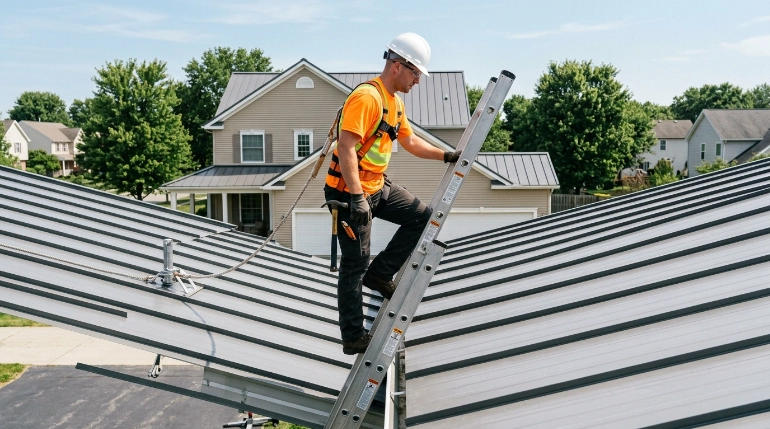
A fall from even a one-story roof can cause severe injury. Professional roofing crews also face changing conditions that can make a previously manageable roof dangerous within minutes.
OSHA notes that roofing workers installing standing-seam metal roofs can face unpredictable fall hazards from wind gusts, loose materials, and surfaces that become slippery when wet. OSHA’s guidance for standing-seam metal roofing emphasizes planning, suitable equipment, and fall protection.
Homeowners should think about access before anyone steps onto the roof.
Ask:
- Where will the ladder be positioned?
- Is the ground firm and level?
- How will the worker transition from the ladder to the roof?
- Is the roof wet, icy, dusty, or excessively hot?
- Are there skylights or weak roof sections?
- Is fall protection required for the work?
- Could the access method damage panels, seams, gutters, or coatings?
If a roofing company cannot clearly explain how its crew will access your roof safely, that is a reason to be cautious.
What Makes Metal Roof Access Different?
Metal roofing is durable, but durability does not mean the surface is automatically safe to walk on.
Smooth and Slippery Panels
Water, morning dew, frost, pollen, dust, leaves, and construction debris can reduce traction dramatically.
A roof that was dry when the crew arrived can become unsafe after a short rain shower. For that reason, responsible contractors may delay or stop work when weather changes.
Steep Roof Pitch
Roof pitch describes how steep the roof is. For example, a 6:12 roof rises 6 inches for every 12 inches of horizontal distance.
As pitch increases, maintaining footing becomes more difficult. OSHA treats roofs greater than 4:12 as steep roofs for its construction fall-protection provisions. Workers on qualifying steep roofs with unprotected edges 6 feet or more above lower levels must use specified fall-protection systems.
For a broader explanation of professional safety expectations, see our guide to OSHA roofing requirements for metal roof work.
Hidden Weak Decking
The metal panel is only the visible exterior surface. Below it is roof decking—the structural sheathing that supports the roofing system.
Long-term leaks may weaken decking around:
- Chimneys
- Skylights
- Valleys
- Plumbing vents
- Roof penetrations
- Eaves
- Previous repair areas
A surface may look normal while the decking below it has deteriorated.
If you suspect rot, sagging, or structural damage, do not test the area by walking on it.
Sharp Edges and Hot Metal
Cut metal panels and damaged flashing can have sharp edges.
Metal roofing can also become very hot in direct sunlight. Heat affects both worker comfort and the ability to maintain secure footing and concentration.
The Safest Approach to Accessing a Metal Roof
For most homeowners, safe access begins with deciding whether climbing is necessary at all.
A sensible sequence is:
- Inspect from the ground.
- Check the attic when it is safe to do so.
- Use binoculars or a zoom camera for visible roof problems.
- Document storm damage from safe locations.
- Call a roofing professional if roof-level inspection is necessary.
Our guide on how to work on a roof safely provides additional background on the risks involved.
Many common roofing problems do not require a homeowner to step onto the roof.
For example, you may be able to identify possible trouble by looking for:
- Lifted metal panels
- Missing ridge-cap sections
- Bent flashing
- Storm debris
- Visible dents
- Rust or coating deterioration
- Loose gutters
- Water stains in the attic
- Ceiling discoloration
- Interior dripping
Seeing one of these symptoms is usually enough to justify a professional inspection.
Ladder Safety for Metal Roof Access
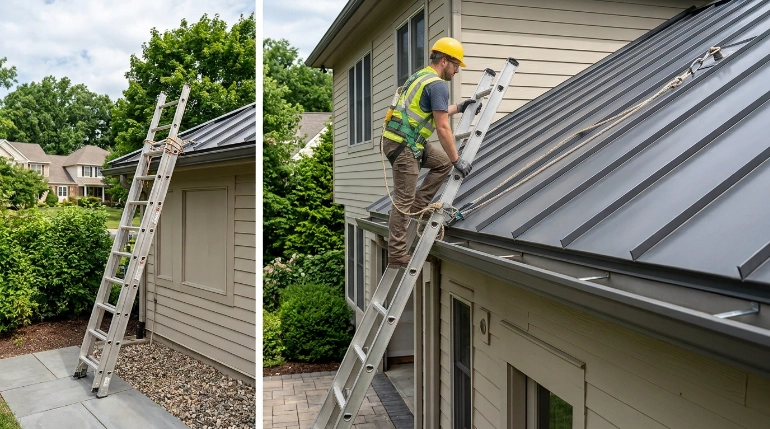
The ladder-to-roof transition is one of the most important parts of roof access.
OSHA’s construction ladder standard includes requirements for ladder stability and access. When a portable ladder is used to reach an upper landing surface, its side rails generally must extend at least 3 feet above that landing unless specified alternative measures are used. Ladders also need stable footing or protection against accidental movement. Review OSHA’s construction ladder requirements for the full rules applicable to covered workplaces.
Warning Signs of Unsafe Ladder Setup
Homeowners can recognize obvious problems without acting as jobsite safety inspectors.
Watch for:
- Ladder feet resting on loose gravel
- Muddy or uneven ground
- A visibly damaged ladder
- A ladder leaning against an unstable gutter
- Access near power lines
- A ladder placed in an active driveway
- Tools or debris blocking the ladder base
- Workers carrying large, awkward items while climbing
- An unstable step from the ladder onto the roof
Do not reposition a contractor’s ladder yourself. Speak with the foreman if something concerns you.
Fall Protection and Roof Access
Roof access and fall protection are closely connected.
For construction roofing activities covered by OSHA, employees working 6 feet or more above lower levels commonly require fall protection. The permitted system depends on factors such as roof slope and work type.
For low-slope roofing, OSHA allows systems such as guardrails, safety nets, personal fall arrest, and certain warning-line combinations. For steep roofs, workers exposed to qualifying edges generally require guardrails with toeboards, safety nets, or personal fall-arrest systems. OSHA’s construction fall-protection standard explains the detailed requirements.
A harness by itself is not a complete safety system.
A professional personal fall-arrest setup may include:
- Full-body harness
- Anchorage
- Connectors
- Lanyard or self-retracting lifeline
- Compatible components
- Proper clearance
- Rescue planning
Homeowners should not choose anchor locations or modify safety equipment.
If you want to understand this issue before hiring a roofer, our guide to OSHA roof tie-off requirements explains the basic concepts for metal-roof projects.
Expert Tip: Before work starts, ask your contractor, “How will your crew access the roof and attach fall protection without damaging the metal panels, seams, or warranty?” A qualified metal roofer should be able to answer clearly.
Roof Access Safety by Situation
| Situation | Main Concern | Safer Homeowner Decision |
|---|---|---|
| Dry, low-slope metal roof | Falls and panel damage still possible | Use a professional for roof-level work |
| Steep metal roof | Loss of footing and serious fall exposure | Avoid DIY access |
| Wet or frosty roof | Extremely poor traction | Postpone roof access |
| Two-story home | Greater fall consequences | Hire trained professionals |
| Roof with skylights | Fall-through hazard | Keep clear and use professional protection |
| Suspected rotten decking | Surface may fail unexpectedly | Obtain professional/structural evaluation |
| Storm-damaged roof | Loose panels, sharp metal, hidden damage | Inspect from ground and call a roofer |
| Roof near power lines | Electrical hazard | Do not attempt DIY access |
Weather Can Change a Safe Roof Into a Dangerous Roof
Weather is especially important with metal roofing.
Rain and Dew
Even a small amount of moisture can make smooth metal panels difficult to walk on.
Morning dew may be nearly invisible from the ground. Do not assume the roof is dry simply because it has not rained.
Wind
Long metal panels can catch wind like a sail. OSHA specifically identifies sudden wind gusts as a hazard during standing-seam metal roof installation.
Wind can also affect ladders, loose materials, tools, and worker balance.
Ice and Frost
Frost can create an exceptionally slick surface. Roof access should generally be postponed until conditions are safe.
Extreme Heat
Hot roofing surfaces can increase fatigue and heat stress. A contractor may adjust working hours, take additional breaks, or postpone parts of the project during dangerous heat.
A professional schedule should prioritize safety rather than forcing work to continue simply to meet a deadline.
Skylights and Roof Openings Need Special Attention
Skylights can be deceptive because they look like solid roof components.
For workplace fall protection, OSHA addresses skylights as roof holes/openings in relevant circumstances. Workers exposed to qualifying falls through roof openings need appropriate protection such as covers, guardrails, or personal fall-arrest systems.
Homeowners should never assume a skylight can support body weight.
Other dangerous openings may appear during:
- Vent replacement
- Chimney repair
- Decking removal
- Skylight replacement
- Roof tear-off
- HVAC work
Keep children, pets, and household members away from the work area during these projects.
How Roof Access Safety Affects Labor and Cost
Good safety practices require time.
A contractor may need to:
- Secure ladders
- Install anchorage
- Set up lifelines
- Establish controlled work areas
- Protect roof openings
- Inspect safety equipment
- Stage materials safely
- Remove temporary safety equipment afterward
That labor may be reflected in a professional estimate.
A suspiciously low roofing quote is not necessarily a better value.
When comparing proposals, look at the entire scope:
- Roofing materials
- Underlayment
- Flashing
- Decking repairs
- Labor
- Cleanup
- Fall-protection planning
- Insurance
- Workmanship warranty
- Manufacturer warranty requirements
Metal roofs are long-term systems. Saving money through shortcuts during access or installation can lead to damaged coatings, panel deformation, leaks, or warranty disputes.
Protecting the Roof While Protecting Workers
Fall protection must protect the worker without unnecessarily damaging the roof.
Metal systems may include exposed-fastener panels or standing-seam panels with concealed fasteners. The correct access and anchorage method can vary.
Improper work can potentially affect:
- Standing seams
- Protective finishes
- Panel shape
- Fasteners
- Flashing
- Underlayment
- Waterproofing
- Manufacturer warranty coverage
Before allowing repairs, ask whether the contractor’s attachment method is approved or appropriate for your specific roof system.
Our guide to OSHA rooftop fall protection explains how professional fall-control planning fits into metal-roof work.
DIY Inspection vs. Professional Roof Access
Some homeowner maintenance is reasonable from the ground. Walking a metal roof is different.
Reasonable DIY Tasks
You may safely:
- Look for visible damage from the yard
- Check ceilings for stains
- Inspect accessible attic areas
- Photograph visible storm damage
- Check gutters from ground level
- Note when and where leaks occur
- Review roofing paperwork and warranties
Tasks Better Left to Professionals
Professional help is safer for:
- Walking the roof
- Investigating an active leak
- Replacing metal panels
- Repairing flashing
- Working around skylights
- Opening roof assemblies
- Repairing rotten decking
- Installing anchors
- Storm-damage evaluation requiring roof access
- Working on steep or multi-story roofs
The cost of professional inspection is minor compared with the potential consequences of a serious fall.
Warning Signs That Require Professional Evaluation
Arrange a roof inspection when you notice:
- Active leaking
- Ceiling or attic stains
- Loose or lifted panels
- Storm or hail damage
- Bent standing seams
- Missing fasteners
- Significant rust
- Damaged flashing
- Loose ridge caps
- Sagging areas
- Persistent condensation
- Suspected rotten decking
Poor ventilation can also contribute to condensation and moisture problems that eventually affect roof decking.
Do not climb onto the roof simply to confirm what you already suspect.
A contractor can determine whether the problem requires maintenance, localized repair, panel replacement, structural assessment, or eventually a full roof replacement.
When to Consult a Licensed Roofing Contractor
Consult a qualified roofing contractor when safe diagnosis requires roof access or specialized roofing knowledge.
Professional help is especially important when:
- The roof is steep.
- The building has multiple stories.
- Panels are wet, icy, loose, or storm-damaged.
- Decking may be rotten.
- Skylights are involved.
- A large leak is active.
- Several panels need repair or replacement.
- Work could affect the roofing warranty.
- Solar panels or electrical equipment are nearby.
- An insurance claim may be involved.
Licensing rules differ by state and locality, so verify the requirements where you live.
If the roof is visibly sagging, framing appears damaged, or widespread deck deterioration is suspected, the roofer may recommend evaluation by a structural engineer or another qualified professional.
Questions to Ask Before Allowing Roof Access
You do not need to become an OSHA expert.
A few questions can help you identify a well-prepared contractor:
- How will your crew safely access my roof?
- What fall-protection method will you use?
- How will the ladder be secured?
- How will you protect the gutters and panels?
- Are your anchors compatible with this metal-roof system?
- How do you protect skylights and openings?
- What happens if rain or strong wind develops?
- Who supervises safety on the job?
- Are you insured for roofing work?
- Could your access or anchorage method affect my warranty?
Clear answers are a positive sign. Dismissive answers deserve more scrutiny.
Common Mistakes Homeowners Should Avoid
- Climbing up just to “take a quick look.” Many roof problems can be evaluated initially from the ground.
- Walking on a wet metal roof. Moisture can drastically reduce traction.
- Using a short or unstable ladder. The transition onto the roof is itself a fall hazard.
- Assuming a low-slope roof is safe. Lower pitch reduces some difficulty but does not remove fall risk.
- Moving a contractor’s ropes or anchors. They may be part of an active safety system.
- Walking near skylights. Never assume skylight glazing can support your weight.
- Ignoring suspected rotten decking. A weakened deck can fail unexpectedly.
- Hiring solely by price. Safety, insurance, workmanship, and warranty protection matter.
- Forcing work during bad weather. Delays are preferable to unsafe roof access.
- Allowing children or pets into the work zone. Falling tools, sharp metal, and debris can create hazards at ground level.
FAQs
Is it safe for a homeowner to walk on a metal roof?
Walking on a metal roof involves fall and surface-damage risks, especially when the roof is steep, wet, dusty, or damaged. Ground-level inspection and professional roof access are usually safer.
Are metal roofs more slippery than shingles?
Metal panels can become very slippery when wet, frosty, dusty, or covered with pollen or debris. Their smooth surface makes weather conditions especially important when planning access.
Does OSHA require roofers to wear a harness?
Not in every roofing situation. OSHA permits several fall-protection methods depending on the roof and work, including guardrails, safety nets, personal fall arrest, warning-line systems, and certain safety-monitoring arrangements.
How high should a ladder extend above the roof?
For covered construction workplaces, OSHA generally requires portable ladder side rails used for upper-level access to extend at least 3 feet above the landing surface, unless the specified alternative measures are provided.
Can roofers work on a metal roof when it is raining?
Responsible crews should evaluate conditions and stop or postpone work when rain makes safe footing or material handling impossible. Wet metal is a significant slip hazard.
Can walking on a metal roof damage it?
Yes. Incorrect foot placement, unsuitable footwear, damaged panels, or improper handling can dent panels or affect seams and coatings. The risk varies with the roofing system.
Should I climb onto my roof after a storm to check for damage?
Usually no. Storms can leave loose panels, damaged decking, sharp metal, and slick surfaces. Photograph what you can safely see from the ground and arrange professional inspection if roof-level evaluation is needed.
Conclusion
Good roof access safety begins before anyone climbs the ladder. The roof condition, slope, weather, access point, ladder setup, fall protection, decking strength, skylights, and type of metal roofing all affect how safely work can be performed.
For homeowners, the safest first step is usually ground-level observation and documentation. Avoid climbing merely to confirm a leak or storm problem that already deserves professional attention.
When roof access is necessary, choose a qualified roofing contractor who can explain how the crew will secure ladders, control fall hazards, protect your metal panels, account for changing weather, and preserve warranty coverage.
A metal roof can protect your home for many years, but no repair or inspection is worth risking a serious fall. Make safe access part of your contractor decision from the beginning.