
Industrial Roofing Safety: A Homeowner’s Guide to Metal Roof Work
Working on a metal roof can look straightforward from the ground. Once someone climbs onto it, the risks change quickly. Smooth panels can become extremely slippery, roof edges may be difficult to judge, tools can slide, and weather can turn a routine repair into a dangerous situation.
That is why industrial roofing safety principles matter even when the project is on a home rather than a large commercial building. Professional roofers plan access, fall protection, weather conditions, equipment, and emergency procedures before work begins.
For homeowners, understanding these precautions helps you recognize unsafe work, compare roofing contractors, and know when a repair should never become a DIY project.
Quick Answer
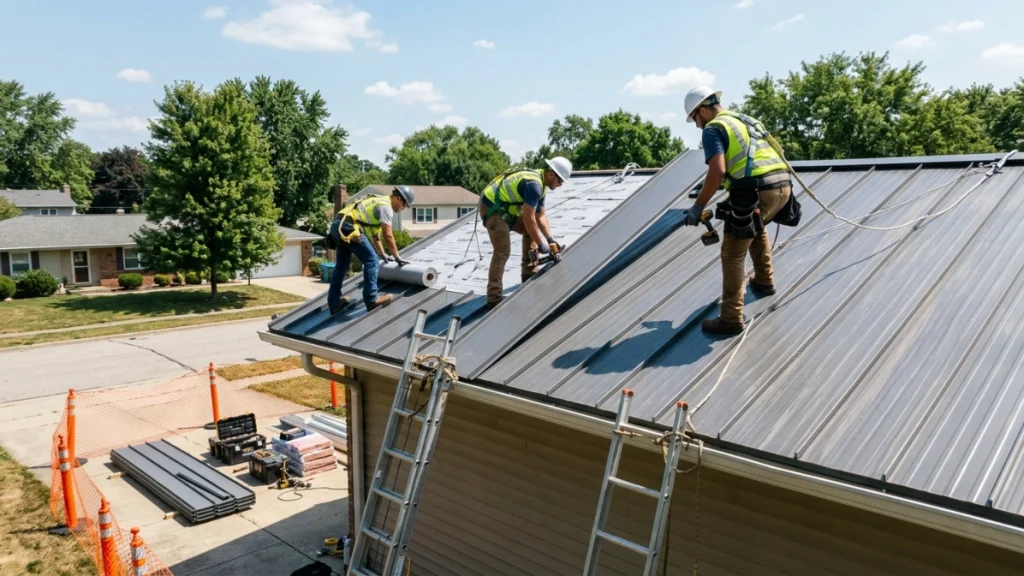
Industrial roofing safety for metal roofs centers on preventing falls, providing safe roof access, controlling tools and materials, monitoring weather, using appropriate personal protective equipment, and training workers for the job. Homeowners should avoid climbing onto metal roofing and hire a qualified contractor whenever inspection or repair requires working at height.
Why Metal Roof Safety Requires Extra Attention
Metal roofing has several qualities that make careful planning essential.
A clean, dry metal panel can already provide less dependable footing than many textured roofing surfaces. Add rain, morning dew, frost, dust, loose fasteners, sealant, oil, pollen, or a steep roof pitch, and traction may decrease further.
Workers may also encounter:
- Open roof edges
- Skylights and other openings
- Ladders and access points
- Loose panels during installation
- Sharp sheet-metal edges
- Hot roofing surfaces
- Power lines near the building
- Wind that can catch large panels
- Tools or fasteners that can fall to the ground
- Weak or damaged roof decking beneath the metal
Falls remain a major construction hazard. NIOSH reported in 2026 that falls from elevation remain the leading work-related cause of death in construction and specifically identified roofing and ladder work among high-risk activities. NIOSH’s construction fall-prevention guidance emphasizes planning, proper equipment, training, and hazard controls.
For a homeowner, the practical lesson is simple: a roof that looks walkable from the yard should never automatically be considered safe to walk on.
What OSHA Roofing Safety Rules Mean for Homeowners
OSHA requirements are primarily workplace rules for employers and employees. A typical homeowner who hires independent roofing contractors usually is not treated as the employer of the roofing crew, and truly self-employed individuals generally are outside OSH Act coverage.
However, OSHA standards provide a valuable benchmark for evaluating professional roofing practices.
Under OSHA’s construction fall-protection requirements, employees working on unprotected sides and edges 6 feet or more above a lower level generally require fall protection. Depending on the work, that may involve guardrails, safety nets, personal fall-arrest systems, or other methods permitted by the standard. OSHA’s residential construction fall-protection guidance explains these requirements in more detail.
The important distinction is that homeowners should not treat OSHA rules as a DIY instruction manual.
Professional fall protection requires proper equipment, compatible components, suitable anchor points, correct setup, training, inspection, and—in some situations—a rescue plan.
Major Industrial Roofing Safety Hazards on Metal Roofs
Falls From Roof Edges
The most obvious danger is falling from an unprotected roof edge.
Workers can lose their footing while carrying materials, bending over, changing direction, stepping around penetrations, or moving between roof sections.
Fall hazards also increase when a worker focuses on a repair and temporarily loses awareness of the roof edge.
Professional crews should identify fall exposures before starting work and select an appropriate protection system for the job.
Slippery Metal Surfaces
Metal becomes particularly hazardous when contaminated by moisture or debris.
Common causes include:
- Rain
- Dew
- Frost or ice
- Dust
- Leaves
- Roofing sealant
- Metal shavings
- Loose screws
- Oil or chemicals
A contractor should postpone work when conditions make safe footing uncertain rather than treating a schedule as more important than worker safety.
Steep Roof Pitch
Roof pitch describes how steeply a roof rises.
A low-slope metal roof and a steep residential standing-seam roof present very different movement and fall hazards. As pitch increases, walking becomes harder and a minor slip becomes more difficult to stop.
Homeowners should be especially skeptical of someone who plans to walk a steep metal roof without explaining the fall-protection method first.
Openings and Skylights
Skylights can create serious fall hazards because they may look solid even when they cannot safely support a person’s weight.
Other openings can appear during installation, ventilation work, chimney work, or roof replacement.
Professional crews should identify and control these hazards before workers begin moving around the roof.
Sharp Metal Edges
Cut metal panels, flashing, trim, and damaged roofing can produce sharp edges.
Gloves and appropriate handling practices help reduce cut injuries, but they do not replace careful material control.
Large metal panels can also be difficult to handle safely because wind can turn them into unstable loads.
Essential Safety Controls for Professional Metal Roof Work

A good roofing safety plan starts before anyone climbs a ladder.
| Hazard | Typical Professional Control | What a Homeowner Can Look For |
|---|---|---|
| Roof-edge fall | Guardrail, restraint, fall-arrest, or other approved system | Workers are not casually walking exposed edges |
| Unsafe ladder access | Correct ladder, secure placement, clear access | Ladder appears stable and properly positioned |
| Wet or icy metal | Delay or modify work | Crew does not rush onto a slick roof |
| Falling tools/materials | Controlled work zone and secure materials | People are kept away from areas below |
| Sharp panels | Gloves and planned material handling | Panels are handled carefully by enough workers |
| Heat | Water, breaks, scheduling, monitoring | Crew manages prolonged hot-weather exposure |
| Electrical hazard | Maintain safe separation and plan work | Panels/ladders are controlled around electrical lines |
| Wind | Stop or modify panel handling | Large sheets are not carried in unsafe gusts |
1. Plan the Work From the Ground
Before roof access, the crew should understand:
- Roof height
- Roof pitch
- Access points
- Surface condition
- Openings
- Nearby power lines
- Material delivery areas
- Fall hazards
- Weather
- Emergency procedures
Planning is especially important when removing an existing roof because damaged decking may remain hidden until panels or old materials are removed.
2. Choose the Right Fall Protection
There is no single fall-protection arrangement suitable for every metal roof.
Professional systems can include guardrails, personal fall-arrest equipment, fall-restraint equipment, safety nets, or other arrangements allowed for the specific job.
An anchor is not automatically safe merely because a worker can attach a rope to it. The supporting structure, anchor, connector, harness, and other system components must work together correctly.
OSHA requires employers to determine whether walking and working surfaces have enough strength and structural integrity to support employees safely.
That is one reason homeowners should not improvise a roof anchor using a vent, plumbing pipe, gutter, chimney component, or other convenient object.
3. Use Safe Ladder Access
Many roofing accidents begin before the worker reaches the roof.
Professional ladder setup includes choosing the correct ladder, placing it on stable ground, keeping access areas clear, and controlling slipping or movement.
OSHA’s construction ladder-safety guidance states that non-self-supporting ladders should generally be positioned so the horizontal distance from the upper support to the ladder’s foot is about one-quarter of the ladder’s working length. It also requires ladders to be kept free of slippery substances such as oil and grease.
Never use a ladder simply because it is the only one available. A ladder must fit the task.
4. Control Tools and Materials
Metal roofing projects can involve panels, drills, screws, snips, sealants, flashing, underlayment, and removal debris.
These items create hazards both on and below the roof.
A well-managed crew should:
- Keep pathways clear
- Avoid leaving loose fasteners underfoot
- Control cords and hoses
- Secure tools where appropriate
- Stage materials away from dangerous edges
- Restrict people from walking beneath active work areas
Homeowners should also keep children and pets away from the work zone.
Weather and Heat Safety on Metal Roofs
Weather is not just an inconvenience during roof work. It can determine whether the job should proceed.
Rain, Dew, Frost, and Ice
Moisture can dramatically change footing on metal roofing.
A responsible contractor may delay the start of work even when the sky is currently clear because overnight moisture remains on the panels.
Wind
Wind is especially important when workers handle long metal panels.
A large sheet can catch a gust and become difficult to control. This can endanger the person holding it and anyone nearby.
Extreme Heat
Metal roofing exposed to direct sun can become very hot, while roofing work itself requires significant physical effort.
NIOSH warns that occupational heat stress can contribute to illnesses such as heat exhaustion and heat stroke and may also increase injury risk. NIOSH workplace heat recommendations include engineering and work-practice controls to reduce exposure.
Professional crews may respond by adjusting work hours, increasing rest periods, providing hydration, monitoring workers, and allowing employees to acclimatize to hot conditions.
Personal Protective Equipment for Metal Roofing
PPE depends on the specific job, but a professional roofing crew may use:
- Proper footwear with appropriate traction
- Work gloves
- Eye protection
- Hard hats where overhead or falling-object hazards exist
- Hearing protection when required
- Full-body harnesses as part of a properly designed fall-arrest system
- Weather-appropriate clothing
PPE is important, but it should not be viewed as the entire safety program.
NIOSH’s approach to construction safety emphasizes eliminating hazards and using engineering controls where possible before relying solely on personal protective equipment.
Metal Roof Type, Lifespan, Labor, and Safety
Different metal roofing systems create different working conditions.
Standing-Seam Metal Roofs
Standing-seam roofs use raised seams between panels. They can provide a clean appearance and long service life when properly installed.
Installation requires careful panel alignment, flashing work, seam detailing, and safe movement across large metal surfaces.
Exposed-Fastener Metal Roofs
These systems use visible fasteners through the roofing panels.
Maintenance may involve checking fasteners, washers, sealants, flashing, corrosion, and panel condition.
Even a repair that sounds small—such as replacing several screws—can require unsafe roof access.
Existing or Aging Metal Roofs
A metal roof may remain serviceable for decades, but age alone does not determine whether it is safe to walk on.
The condition of the supporting decking, corrosion, previous repairs, moisture damage, fasteners, and structural components all matter.
Never assume that a long-lasting roofing material means the structure beneath it is equally sound.
How Safety Affects the Cost of Metal Roof Work
Homeowners sometimes wonder why two roofing quotes have very different labor costs.
Safety can be one reason.
A contractor may need additional time or equipment for:
- Fall-protection setup
- Scaffolding
- Roof anchors
- Material lifts
- Specialized access equipment
- Steep-slope procedures
- Ground-level exclusion zones
- Extra workers for panel handling
These measures can increase labor or equipment costs, but removing legitimate safety precautions merely to reduce a quote is a poor trade.
When comparing estimates, ask contractors what access and fall-protection methods are included.
A suspiciously low estimate may not necessarily be unsafe, but it deserves careful questions.
Warranty and Insurance Considerations
Roof safety decisions can also affect the financial side of a project.
Manufacturer warranties may contain installation requirements, approved-product requirements, maintenance conditions, or exclusions. Work that does not follow applicable installation instructions can create warranty disputes.
Insurance claims may also become complicated when storm damage, structural damage, or emergency repairs are involved.
If a roof has suffered major wind, hail, tree-impact, or structural damage, document visible conditions from the ground whenever possible and contact the appropriate roofing and insurance professionals before attempting repairs yourself.
DIY vs. Professional Metal Roof Work
| Task | DIY From Ground Level | Rooftop Professional Recommended |
|---|---|---|
| Look for missing/damaged panels | Yes, visually | For close inspection |
| Photograph visible storm damage | Yes | If roof access is required |
| Clean ground-level gutters | Sometimes | For elevated or difficult access |
| Replace metal panels | No | Yes |
| Repair flashing | No | Yes |
| Seal an active rooftop leak | No | Yes |
| Inspect suspected rotten decking | No | Yes |
| Install fall-protection anchors | No | Yes |
| Evaluate structural movement | No | Roofing/structural professional |
The safest homeowner inspection is often the one performed from the ground, attic, window, or another protected location.
Expert Tip: Before approving a metal-roof repair, ask the contractor, “How will your crew access the roof and protect themselves from falls?” A professional should be able to explain the plan clearly rather than dismissing the question.
When to Consult a Licensed Roofing Contractor
Call a qualified roofing contractor when you notice:
- Active roof leaks
- Loose or missing metal panels
- Significant corrosion
- Storm or hail damage
- Damaged flashing
- Open seams
- Persistent fastener problems
- Sagging roof areas
- Suspected rotten decking
- Water stains spreading through ceilings or walls
- Damage near chimneys, skylights, or roof penetrations
A structural assessment may be necessary when the roofline is visibly sagging, framing appears damaged, a large tree has struck the building, or there are signs that the underlying structure has shifted.
A professional is also the safer choice when the only way to diagnose the problem requires roof access.
Common Mistakes Homeowners Should Avoid
- Walking onto a wet metal roof. Moisture can make footing unpredictable.
- Using an unsecured ladder. A roof repair is not worth a ladder fall.
- Treating a rope as a complete fall-arrest system. Professional systems require appropriate anchors and compatible components.
- Walking on a damaged roof after a storm. Hidden decking or structural damage may be present.
- Working near overhead power lines without planning. Metal materials and ladders require careful control around electricity.
- Repairing only the visible symptom. A ceiling stain may come from flashing, fasteners, seams, underlayment, or another location.
- Ignoring weather changes. Wind, heat, rain, and lightning can quickly change jobsite risk.
- Choosing a contractor solely by price. Training, insurance, equipment, access, and safety planning all affect legitimate labor costs.
- Assuming a metal roof is always strong enough to walk on. Supporting components must also be considered.
FAQs
What is industrial roofing safety?
Industrial roofing safety is the organized process of identifying and controlling hazards during roofing work. It commonly includes fall prevention, safe access, worker training, PPE, material handling, weather planning, equipment inspection, and emergency procedures.
Are metal roofs more dangerous to walk on?
Metal roofing can be difficult to walk on, particularly when it is steep, wet, dusty, icy, damaged, or contaminated. Panel profile and installation details also affect footing. Homeowners should generally avoid rooftop inspection.
Does OSHA require roofers to wear harnesses?
Not in every possible roofing situation. OSHA requires employers to provide fall protection under specified conditions, but permitted methods vary with the type of work and roof. Personal fall-arrest systems are one option among several.
At what height does OSHA require fall protection for construction roofing?
For many construction situations, OSHA’s construction standard requires protection when workers are exposed to unprotected sides or edges 6 feet or more above lower levels. Specific provisions vary by work activity and roof type.
Can I inspect my metal roof myself?
You can perform a basic visual inspection from a safe ground-level position, window, or attic when conditions allow. Avoid climbing onto the roof simply to look for damage. Hire a professional when close rooftop inspection is necessary.
Should roofers work on metal roofing in the rain?
Roofing crews should evaluate conditions and stop or modify work when weather creates unsafe footing or other hazards. Wet metal can increase slipping risk, and storms can introduce wind and lightning hazards.
What should I ask a metal roofing contractor about safety?
Ask how the crew will access the roof, what fall protection will be used, how weather affects the schedule, how materials will be controlled, and whether the company carries appropriate licensing and insurance required in your area.
Conclusion
Good industrial roofing safety is not about adding unnecessary equipment or slowing a project down. It is about recognizing that a metal roof is an elevated work surface where one mistake can have serious consequences.
For homeowners, the safest role is usually to identify problems from a protected location, keep the ground-level work area clear, ask contractors about their safety procedures, and avoid turning rooftop repairs into DIY experiments.
If your metal roof is leaking, storm-damaged, aging, loose, corroded, or showing structural warning signs, arrange an evaluation with a qualified roofing contractor. A careful inspection and properly planned repair can protect both your home and the people working on it.